Showing posts with label reputation. Show all posts

Sunday, November 14, 2021

Zip Comics #3 - pt. 1

Yay, it's Charles Biro's Steel Sterling! Panel 2 is packed with detail. Steel looks so cool in that suit. The way Steel amuses himself when he's bored is a trait we seldom see from action heroes, and the third identity was super-original at the time (we can call this the "Mike Murdock" mistake now, in hindsight).


"Notorious" is an odd term to use here. Steel isn't wanted by the law that I recall from issues 1 and 2, so I think what she means here is "famous" or "most talked about."  

Brazonia is Brazil, that's an easy one. Orio is a little trickier, since Brasília is the capital of Brazil. It's certainly unusual, from a RPG campaign perspective, to send your Heroes to another continent already on their third adventure, but there's certainly strong precedent for it, going back to Superman's trip to South America in his second story. Biro's Steel Sterling is very much intended to be his answer to Superman, with the invention of the twin used to solve the question of how the maskless superhero goes without being discovered, and Steel conquering South America around the same time in his career. 
 

I can't figure out what city "Colosso" might represent; it doesn't match any of the big city names in Brazil I know. 

Winged tanks should not be a thing, but golden age comic book writers really seemed to love them.

That is a long range for that magnetism power. It's impossible to say how far exactly, but those planes could be anywhere from 100-1,000 feet away already.

Foreign nations always seem to be turning their defense over to Americans; at least Steel used some powers to impress them first. 


Okay, sometimes Biro is moving too fast for his own good. Steel has been given 12 hours to stop Dr. Yar, so instead of looking for Yar, or questioning that pilot he captured (unless the plane crashed and the pilot died...?), he decides to keep up his second secret identity on a long boat trip. So long that it takes him 12 hours to get back to Orio? Or did Yar break his word and attack early (that does seem very villainous)?  

Here's a surprisingly tough call -- if Steel is wrecking the hatch on a tank, is he wrecking a door or a tank? When it's too tough to make a call, go in the middle; Steel is wrecking the hatch as if it was a robot.

Taking over the winged tank instead of wrecking it seems sound strategy. And you get a trophy out of it afterwards!
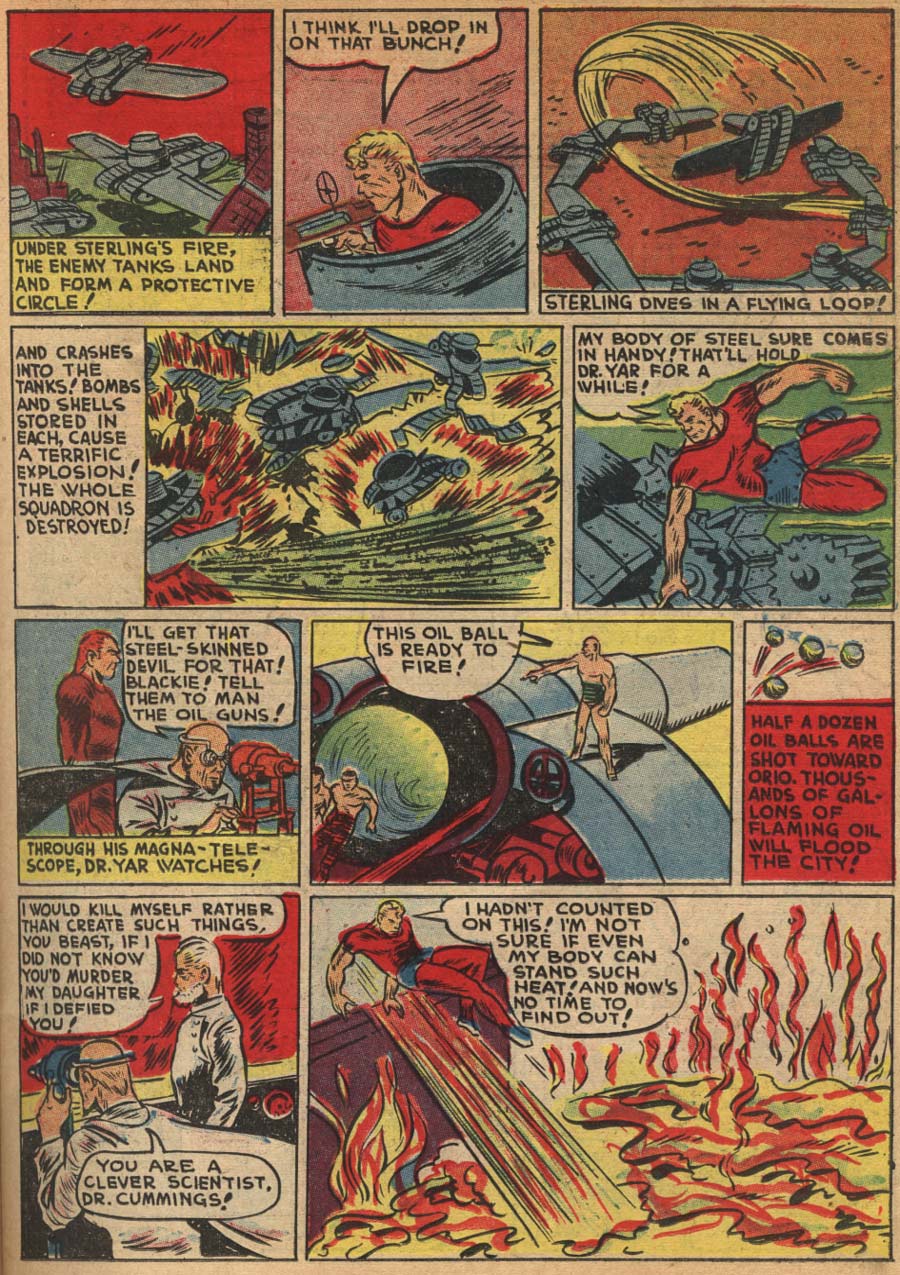
I'm not sure what tactical advantage the protective circle would have...but tank pilots can make mistakes and this was clearly a mistake, grouping up like that.

Steel survives the explosion thanks to the Invulnerability power. The fact that he's now worried about being hurt by fire proves that powers have limited durations, especially since Steel got his powers in the first place by diving into molten steel (we even saw a replay of it on page 1!).

Steel is going to regret wrapping himself in asbestos someday -- but nobody knew that in 1940. At the time, fashioning himself an asbestos suit out of the lining was quite ingenious. 

I'm a little apprehensive about allowing Heroes to catch missile weapons in mid-air, unless they are superheroes buffed with one of the Race the- powers, or perhaps some other related power -- I could see maybe Improvise Missile Weapon being rationalized, if Steel were catching it to then use as a missile weapon.

The range seems really impressive on those oil ball canons, but if Steel has seen the trajectory of enough of them, I could see letting him find the source with a successful Intelligence check.

Although the narration in the final panel says Steel is breaking into a building, it appears he is breaking through a fence outside the building. Steel walls wreck as tanks, but a steel fence, I might treat that as a truck instead.
Okay, I've had my fair share of quibbles with this story so far, but this page is gold. Henchmen with lightning guns! Steel showing a vulnerability to electricity (or at least thinking he is). Steel's smart tactics -- bringing down the roof to get at the villains out of range, and smashing through a wall to help surprise the main villain. Alligator men (anticipating the Monster Society of Evil?)! Although, between "Oogle gop!" and that suspicious looking seam between shirt and pants in panel 7, I have a sneaky suspicion these are just human hoodlums in costumes. 

Biro also anticipates something that at this time isn't yet true about Superman's stories: here the Black Knight is behind every plot, even in disguise, much like Luthor will later be in Superman stories.

Little details like how Steel recharges his powers from the static electric charge he gets from running his fingers through his hair help me really appreciate this feature. In H&H, you don't need to have a visual gimmick to activate your powers, but if you as a player decide to have one, it is up to you to play it consistent.

It looks like I was wrong about the alligator men being guys in costumes, unless those are amazingly good costumes. I would probably treat them as lizard men instead of statting alligator men separately. And yeah, I can definitely see 6 lizard men being able to take down one superhero with grappling attacks, particularly if the superhero has no good combat-related buffing powers left.

That the sound carrier looks like a giant megaphone is one of those comic touches that tells me Biro isn't taking this story too seriously, and neither should I.

The deathtrap is a good one, particularly for superheroes who can so easily wreck open doors...
 
But I'm skeptical about this solution. Does pushing a drill through a wall really not apply unusual pressure to the wall? In an instance like this, where I'm unsure if I should have a trap go off or not, I might allow the hero a save vs. science to answer the question for me.

Sterling's aim being perfect is worth noting because unbuffed superheroes don't get the bonuses to hit that fighters do. A lucky roll, or was he holding onto the Bulls-Eye power? 

I'm amused by how the colorist often doesn't know what to do with Biro's sometimes sketchy art style. When he doesn't draw lines on the sides of Steel's head in panel 1, suddenly he has no hair there anymore! And the colorist has no idea what to make of that guard. 

Things get really dark in panel 8 -- the Black Knight/Dr. Yar has apparently convinced Dora's father to concoct a chemical weapon, even after telling her father that he plans to use it on Dora. BK is either extremely convinced that he's broken the man's will, or isn't all that worried about whether whatever's in that cocktail will work or not. Perhaps it's just one last attempt to torture the old man before escaping.

(Scans courtesy of Comic Book Plus.)


Wednesday, October 13, 2021

Top-Notch Comics #4 - pt. 4

We're back and looking at the next page of Wings Johnson. Panel 4 looks very dramatic, but playing chicken that close with two airplanes seems like a terrible idea to me. It also gives the impression that facing really doesn't matter in aerial combat -- and in Hideouts & Hoodlums, maybe it shouldn't. In hand-to-hand combat, you don't get a bonus to hit for being right in front of someone; your odds are still about 50/50.

Finding a grenade in your plane seems like a dangerous idea, but in a campaign where trophy items are randomly dropped this makes more sense.


We're going to jump out of that story (nothing is every really resolved in a Wings Johnson story, he just hops from one dire situation straight into the next - as if anticipating how Marvel Comics will work someday!). 

...And we're going to jump ahead to yet another disastrously named comic book character, the laughable Bob Phantom. This particular story isn't too laughable, though, because you're going to be choking on the racism here instead. But if we look past that, we'll see an instance of game mechanics poking through here at the end, where the mobster gets a bonus to his morale save as soon as he knows his boss is listening.

This page gets really dark, as Bob completely fails to save an entire plane-full of people. Are there consequences? Only for the bad guy, as Bob now has an excuse to really cut loose on him.

And here we see something unusual; a superhero using an opponent as his instrument of wrecking things. The H&H rules are really set up to avoid this, mainly for game balance; the superhero is supposed to be good at breaking stuff and the fighter is supposed to be good at hurting people. Now, the superhero can knock a bad guy into a wall, essentially treating the wall as a club, and doing 1-6 points of damage (possibly modified by the superhero's Wisdom bonus). Wrecking things should be a separate action the player would have to wait a turn to do...but suppose the hero was buffed with a power, like Race the Train, that granted him an extra action per turn? Then he could legit wreck the wall at the same time as knocking the mobster into it, though it would confer no additional damage to the mobster. 

And check out the text around that newspaper article! It's the text from a story, but not from a made-up newspaper story. It seems to be cribbed from some piece of fiction. Maybe a text story from another MLJ comic book? I don't read the text stories, so I'm not sure.

I am really hoping that the writer of this story just didn't think it through. All the bad guys want to do is smuggle Chinese citizens into the U.S. Five times Bob has forced the planes to dump their human cargo into the ocean and kill them all. Never once has he teleported into the plane before it takes off, or waits for it to land and then catch the smugglers red-handed. It's really bizarre how Bob's player keeps making the situation worse every time he intervenes, and he just keeps right on doing the same thing each time.


You'd guess that pit was, what? Sixty feet deep based on the drawings? It seems unlikely that the boss could survive that fall, but Bob could just teleport down there and check. But this is a comic book story, so Bob would have to save vs. plot to interfere with a villain plunging to her death. 

Walt (it's hard to believe that his real name isn't Bob) goes to great pains here to hide Bob Phantom's involvement in the case, and this seems like it would be up to the personal preference of the player. Maybe it's just as well that there's no Popularity or Reputation mechanic in H&H, because it would hurt the players wanting their characters to act more anonymously.


I'm going to jump into the middle of Stacey Knight, M.D. If you do a good deed, but someone's forcing you to do it, even though you would have done it anyway - do you still get the 100 xp for doing a good deed? It's a question almost as tough as, why did these mobsters leave a kerosene can within reach of their prisoner? 

As dumb as the mobsters are, Stacey's plan is pretty bright. Not only does the fire distract his guards and puts their mobile hideout in jeopardy, but it draws the attention of much-needed help.


It's unclear if Stacey can boss the Coast Guard around because of his occupation or because of his level. 

Is that guy on the radio saying "Roosevelt" really slowly or spelling it out? 

The Roosevelt Field?  According to Wikipedia, "Roosevelt Field is a former airport, located 2.3 miles (3.7 km) east-southeast of Mineola, Long Island, New York. Originally called the Hempstead Plains Aerodrome, or sometimes Hempstead Plains field or the Garden City Aerodrome, it was a training field (Hazelhurst Field) for the Air Service, United States Army during World War I.

In 1919, it was renamed in honor of President Theodore Roosevelt's son, Quentin, who was killed in air combat during World War I.

Roosevelt Field was the takeoff point for many historic flights in the early history of aviation, including Charles Lindbergh's 1927 solo transatlantic flight."

Apparently, "auto-giro" is still a legitimate spelling, even though you never see it anymore. 

Good guys can pretty much go around punching bad guys with complete immunity, whereas in real life that cop could also arrest Stacey for assault, and Moriarty could still sue him for the assault even if Moriarty was found guilty of a crime.

And is this the biggest waste of the name Moriarty ever? You're going to use the name of Sherlock Holmes' nemesis on a guy who rigs boxing matches?


Before we wrap up this post we're going to take a sneak peek at Kardak, the Mystic Magician. Here we see an unusual type of mermen, for two reasons -- one, they have legs and fishtails, and two, despite obviously being mermen they are never once called mermen. They are referred to as underseas men, fishtails, and Anderrans (after the name of their city, Anderras). 

Oh, and Kardak casts Part Water, so, as commonly happens in comic book magic-user stories, we can expect the high-level spells to come fast and furious...

(Scans courtesy of Digital Comic Museum.)   


Friday, January 24, 2020

Flash Comics #3 - pt. 2

Continuing where I left off...

Hawkman's (or Hawk-Man's) friend is "killed" by Una Cathay, a female mad scientist/magic-user, a very unusual combination in the Golden Age, when most women aren't shown as being scientific-minded. The story is (get ready for spoilers later): she has come up with an interesting spin on raising the dead; her chemical potions can resurrect dead people, but to stay alive they have to remain mostly immersed in the chemical bath. She has a collection of revivified men floating in water tanks, a spin on the "brains in jars" trope. Oh, and she can work "Voodoo" spells. If she ties her hair to someone, she can make him take burning damage even at long range (not sure what to call this spell...Voodoo Fire?).

Hawk-Man does not yet have much of a reputation as a good guy; he is able to easily fool the scientist and a Russian spy working with her (actually identified as Russian and not given a fake country) into thinking he wants to throw in with them. But she decides to kill him anyway, with the aforementioned voodoo spell. Typical of the genre, the spy is an aristocrat (or at least calls himself a count).

Somehow, when Hawk-Man goes home to pick up some throwing daggers, Shiera is there, immediately spots a long woman's hair wrapped around his wrist from across the room, and instead of jumping to the conclusion that Carter is seeing another woman, she jumps to the weirder conclusion that someone cast Voodoo Fire on him. Could that be an expert skill check in arcane lore?

The twist to the story -- as too often happens -- is that there's less supernatural or super-sciency going on than it appeared; Una was poisoning people with something that put them into comas and pretended they were dead.

Hawk-Man confronts the villains after freeing the prisoners and pins the spy's hand to the wall with a dagger, but the dagger really just disarms the spy (it was his gun hand) and the pinning is quickly forgotten flavor text.

Una escapes from Hawk-Man by using a secret door that he appears to be unable to bust through. Does that suggest that secret doors should be harder to wreck than normal doors, or is Hawk-Man only concerned that wrecking the door will take too long and Una will get away?

When the spy falls out a window, Hawk-Man makes no effort to save him.

For the first time in any medium, I've now seen a thrown dagger puncture a tire and make a car crash. Also unusual for the car crash trope, the villain actually dies in the crash, Una suffering a broken neck (and Hawk-Man even checks the body to make sure she's really dead!).

Next up is Johnny Thunderbolt, or Johnny Thunder as we know him! Training to be a boxer, Johnny has gotten ripped since last issue.

"Pile of jack" is slang for "lot of money" in this story. Johnny also uses the term "slop up" to mean "go out for a drink" (though this is Johnny, so he means a chocolate malt, not booze). There is a topical reference to Glenn Cunningham. According to Wikipedia, Glenn Vernice Cunningham was an American middle-distance runner, who was considered as the greatest American miler of all time. He received the James E. Sullivan Award as the top amateur athlete in the United States in 1933.

When Johnny tells bullets to go back where they came from, he activates what appears to be the Turn Gun on Bad Guy power. Since Johnny is a magic-user, that means we need a Missile Reflection spell too.

Johnny is, at least briefly, heavyweight champion of the world. We still haven't seen a physical manifestation of his thunderbolt-genie yet.

Next we're treated to a reprint of Rod Rian of the Sky Police. The Mephisians use a giant raygun (one of those that looks a lot like the dome of a planetarium) to pull Rod out of the sky using a combination of magnetism and gravity, or what we now call in science fiction a tractor beam. In a convenient moment of charity, the Mephisian leader (who's name also happens to be Mephistos) not only spares Rod from being shot and decides to strand him and the other prisoners on The Island of the Living Dead, but also is sporting enough to arm them first. I guess Mephistos isn't such a bad guy after all! On the island we haven't seen the living dead yet, but we get to see the chasm beast! We haven't seen this guy since Dell's The Comics #10!

(Read at readcomiconline.to)


Sunday, September 1, 2019

Speed Comics #6 - pt. 1

We're back to Brookwood, predecessor of Harvey Comics, and home to Shock Gibson. Shock is, despite being human and having electrical-based powers, very Superman-like. This is great for Hideouts & Hoodlums, because these superheroes are all using the same powers and that makes them easy to catalog.

Here's Shock using the 1st-level power Feather Landing.
And here Shock is using the power Raise Elephant. Since he's not using the truck as a weapon, that is just flavor text assigned to the Raise Elephant power.

Shock would already be a 4th-level superhero at this point, but he still doesn't have enough of a reputation that ambulance drivers recognize him on sight.
Although he's outrunning a motorcycle and a truck, the power in use here is Race the Train.
There are Hold powers, like Hold Plane, that Shock could be using here against the truck, but since he doesn't seem likely concerned about whether the truck is damaged, it's more likely he is simply trying to wreck it.

It's also conceivable that little enough time has passed that the duration is still ongoing for his earlier application of Raise Elephant.
I love how Shock is interrogating the mobsters through the truck while he's holding it up.

Shock's forcefield is likely the power Imperviousness.
Unconcerned that the mobsters on the radio were listening in earlier, knew Shock had the truck, and were attempting to lure him off-track -- Shock just drives off to Kentucky because he was told to.  This is why it's a great idea for Editors to be flexible with their plans. If you weren't expecting them to go to Kentucky and your players go anyway, then it's time to relocate the adventure to Kentucky.

New York to Kentucky, incidentally, is about an 11-hour drive. I wonder if Shock drove straight through or stopped overnight. There's no indication in the story either way.
I love the idea of hiding hideouts in famous, real world cave complexes. I wonder if a map of Mammoth Caves is available online somewhere.

I've talked about Von Kampf zombies before and how they will be in the Mobster Manual (to be released eventually!). I really like how steady Von Kampf is; he's not a Lex Luthor who flits from world conquering plan to plan. Von Kampf is always focused on one plan, taking over with zombies!


I include this page because I very briefly wanted to mention that, in a modern setting, it is very easy to transport mobsters to wherever you need them for your scenario. Mobsters typically found in a different climate -- or even in a lost world setting -- can be flown or trucked into other areas to be encountered.
I'll have to add to the Von Kampf zombie entry that their creator can see what's going on through their eyes (I would assume, so long as he is within so-and-so range and has the appropriate equipment to do so).

(Scans courtesy of Digital Comic Museum.)

Monday, October 10, 2016

Smash Comics #2 - pt. 2

My first draft of Hideouts & Hoodlums' new grappling rules specified it was for one-on-one combat only, but I'll be adding a new paragraph on assigning modifiers if multiple grapplers all attempt against the same target, as they do on poor Abdul the Arab here.

The "Sultan" is not lucky with women. Interestingly, King Faisal II, the closest thing to a real world analog to this character, never married and had to call off two engagements.

Vernon Henkel had a good grasp on foreign politics. There was considerable unrest in Iraq over the king allowing British occupation.


First of all, that executioner's outfit would look great on a supervillain. Secondly -- unless Hassan is a superhero -- I seriously doubt he can chop through chains with a sword in one chop. "Hassan chop!" indeed!


Now, I'm about to back up and show you the first page of this story, because I had not shared it yesterday, and I want you to see what Abdul's mission was.


It was simple reconnaissance you were supposed to be doing, Abdul! But here you are, mowing down the king's men with a machine gun, until your tribal leader father shows up to take over. Now, in real life, the tribes were anti-British while the monarchy was pro-British, but Vernon has reversed allegiances in this story. So...this is a win, and all those deaths are justified, because the pro-British side won? This is from the same creator who had Gallant Knight hacking down saracens recently. Anything you want to tell us about your personal biases, Vernon...?

This is Hugh Hazzard and His Iron Man. Science, physics in particular, is only as important in a H&H story as you and your players need it to be for suspension of disbelief (and maybe to force some save vs. science rolls!). If you want a robot to be able to fly simply by having a beanie hat and propeller on its head -- then go for it!


I've written before about how there can be no hard and fast mechanic for reputation, but I've also written how it doesn't take much to qualify as a disguise in comic books/H&H. So, just saying you're someone else is a type of disguise, and a successful save vs. plot would see through that and mean that someone did recognize you -- I mean Hugh by reputation.

And as for shooting with two guns, I don't intend for that to give you any kind of game mechanic bonus. Hugh is getting the same number of attacks he would normally; carrying two guns is just flavor text.

How far Hugh has fallen, that he's already gone from fighting mad scientists with robots to hoodlums with an antique biplane.

We also get a sense here that Hugh's remote control over the robot has a pretty long range (a mile or more?).


Captain Cook of Scotland Yard reminds me about the penalty I had for hitting humans in dim light in 1st ed. It was a tough rule to enforce -- when was light dim enough?  So I ditched the rule. If you can see, you can attack at no penalty. If it's too dark to see, then you get -4 to hit. But this one panel makes me think the dim light rule had some merit. I mean -- the thief is clearly silhouetted by the light from the window, but Cook still misses because the room is dark.

It makes more sense to me -- and in fact would be a sign of a good player (and/or a Lawful Hero) in my book -- for Cook not to want a shoot out in a street with pedestrians around.

(Scans courtesy of Digital Comic Museum)


Monday, August 15, 2016

Mystery Men Comics #1 - pt. 2

We're still on Wing Turner today, and that's because of the "large Coast Guard auto-gyro" pictured here. Now, it's true we do have helicopters that big (and bigger!) today, but I wanted to look up if there really were transport auto-gyros in 1939. Now, I didn't make an exhaustive search, but the biggest auto-gyro I've found so far is this two-seater, which is clearly much smaller. But if this auto-gyro seems fanciful and futuristic, that makes it perfect for a Hideouts & Hoodlums trophy item!

This is George Tuska's Zanzibar, probably my second favorite Golden Age Magic-User after Yarko the Great. While Yarko deals with metaphysical threats, Zanzibar is a street level M-U, dealing with hoodlums. That doesn't mean he isn't crazy powerful (and way too powerful to be dealing with hoodlums!), as demonstrated by him casting a 5th level Telekinesis spell here.

But Zanzibar must not have too many hit points, because here he is getting clocked with one blow!


Now, this page is slightly problematic. Traditionally, a Magic-User can't cast spells with his hands tied, yet Zanzibar casts Knock by just looking at the door. There are two explanations here: one is that every M-U Hero should get to choose which factor he can't cast his spells without -- seeing, moving hands, or talking -- or the other possibility is that Zanzibar is actually a psionic. I'm thinking some pared-down version of psionics might have to go in the basic book as an appendix at this point.

It is not clear at all how Zanzibar snaps his bonds. Brute strength?

Zanzibar casts Knock again (he had it prepared twice), Disguise Self (very clever use of a spell), and ...Hypnotic Pattern? We don't see a pattern, but we can't see how often his eyes were flashing.


This is the Waco Kid, coming into a new town where a gang has killed the sheriff and taken over. Now, normally, most players would get that this is a situation they're meant to fix. But every once in awhile, your players might need a little more motivational kick to get them going. So have the gang approach the Heroes and threaten to take their stuff. That'll motivate them fast!

Also, "Brazos Teale" has got to be the lamest name for a Western bad guy I've ever seen.

This is Inspector Bancroft of Scotland Yard. Now you, as the Editor, might draw a map and think it's a great clue, but it may not be as easy for your players to draw the same inferences from it. Maybe your players infer that the bomber was riding the morning train, and you only meant to clue them in that the bomber is a train enthusiast. You can, at that point: a) change the plot to fit their idea, b) let them pursue a false lead that goes nowhere (frustrating, but it happens!), c) have someone else present suggest the inference you planned (not recommended -- your players will stop trying to solve puzzles and wait for you to tell them the answer), or d) let them learn a new clue while pursuing their inference.

Sometimes you just have to let a stupid plan work. There's no reason why the conductor should implicate himself by filling out the questionnaire, when he knows he's been hand-writing all his threatening letters. But it's the best plan your players have come up with, so you sigh a little inside and roll a save vs. plot for the conductor to see if he falls for it.


This is The Blue Beetle -- yes, just a Mysteryman with goggles on in his very first appearance. There's a couple of points to take away from this:

If you're playing a Hero with a job, and you want to get sent home from work so you can do some heroing, just get hurt. One or two hp of damage, and you're on sick leave!

I'm not sure if this chemical that reveals scratched out numbers is a real thing -- so it seems like a trophy item!

There does seem to be some psychological benefit to being announced by your calling card (in this case, a scarab). I haven't decided yet if there should be a game mechanic benefit, but I'm leaning towards no...

This is a pretty clever, but chancy, strategy, and only works for new Heroes without a reputation for being honest. Claim you want to work with the bad guys, offer them information, then have someone working with you offer the bad guys the same info in an anonymous call to corroborate your story.

There is no game mechanic for having a reputation, though how much XP the Hero has could serve as the Editor's guide. A good rule of thumb might be that you have a reputation within 1 mile for every 100 xp you have.

The first wireless phone wasn't invented until the 1970s, so this is a pretty advanced trophy item!

(Scans courtesy of Digital Comic Museum)