Showing posts with label Captain Cook. Show all posts

Friday, May 8, 2020

Smash Comics #8 - pt. 2

I don't care for any other features in Smash Comics as much as Espionage, but that doesn't mean we can't glean anything useful from them. Let's start with Abdul the Arab, our "hero"/traitor to his people, who helps the British steal his nation's oil...

We always pause to examine maps. Kuwait is not drawn by accident inside Iraq's borders; Kuwait had been annexed back into Iraq in 1938. Riyadh is the capital of Saudi Arabia.


This is an unusual scenario for a RPG, since it can't be solved by violence. Abdul has to prove Holden is stealing Rice's oil (in a Western setting, you could substitute cows for oil and run the same scenario) by getting a confession or finding the hidden pipeline, and by diving the work between himself and his sidekick, he gets both.


I can't verify that there is such a thing as a Cambridge Arsenal, let alone one holding 20,000 tons of high explosives. That seems like a really dangerous building to put that close to London.

Transatlantic flights did not fly every day in 1940, which can delay a scenario that takes place across the ocean. 


Here's an image of what appears to be a briefcase-sized short wave radio. 1940 Heroes can't easily carry these on them, but if they keep them in their cars they can split up and still communicate.


Heroes can often be notoriously hard to trap when they travel overly cautious, with all their gear and trophy items with them. The trick, then, is to get them to lower their guard and feel safe. Trap them while they don't yet know they've reached the hideout.


Yeah...that is one unconvincing ghost, what with his legs sticking out under the sheet. I know I've always said disguise needs to be really easy in comic books, but I might give the mobsters a +2 bonus to their saves vs. plot to see through this one.
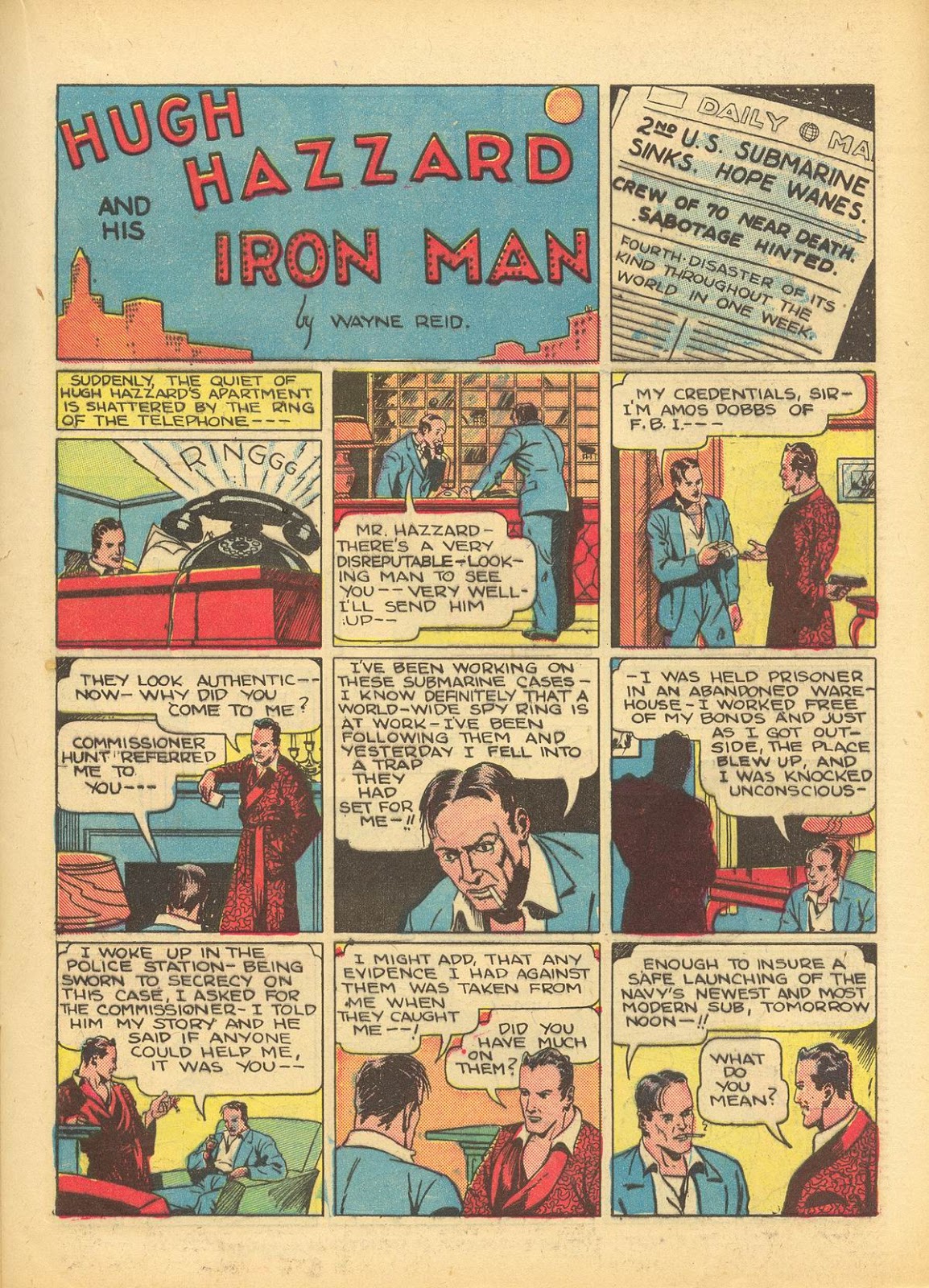
We're going to skip ahead into the Hugh Hazard and His Iron Man adventure that follows. All the backstory you need to know here is that the Batzis are Nazis, Hugh knows they are responsible for sabotage here in the U.S., and he figured out they are keeping in touch via radio. He lucks onto their short wave -- I can't see that being a skill check; perhaps he just has a random 1 in 6 chance of catching one of their messages per rest turn, like a wandering encounter on the radio.

Now, I don't exactly get how this works, but if you connect a super-seper iconoscope to a teleradio, you can get a visual image of the person speaking, even if that person was only recorded with sound. Who knew?

"Krautville" sounds like a racist name for any town with a large German population in it...
Bozo has the Dig power, so that means he functions as at least a 6th-level superhero. And yet...we are treated to Bozo using the "Look behind you!" trick like a grade school prankster. I would say it's amazing that the old guy doesn't hear the propeller right over his head and know that Bozo is still there, only...well, then we also have to overlook that this tiny propeller can make a large robot fly.  I guess you could give the guy a save vs. plot to see if he falls for it or not, but I think a +4 bonus seems reasonable too.
This page kind of undersells this tactic, but a time-tested method of keeping the Hero from capturing the villain until later in the scenario is to have something happen that the Hero has to leave right now to stop. A Lawful or Neutral Hero should then have to save vs. plot to stay and defeat the villain early (maybe Chaotic too, depending on how much is at stake).

(Scans courtesy of Digital Comic Museum.)

Monday, February 11, 2019

Smash Comics #7 - pt. 1

It's a pleasure revisiting the early Smash Comics for Will Eisner's Espionage, second only to The Spirit in the Eisner ouevre, in my opinion.

Black X has his original name back now and is no longer being called Black Ace. This page is interesting because it seems believable enough that it could be real history, only it's not. As far as I can tell, this "Caldwell Line" is a clever fabrication.
We've seen Batu's illusions before, but this is the first time it's been explained to us that his illusions last after he stops concentrating on them for a short while. None of the phantasmal spells, up to 3rd level anyway, explain this benefit.
This page explains that Black X can be overpowered by five-to-one odds (even though it looked like he was only fighting two guys on the previous page).

We get another example of a fighter (or a spy, if using that 1st edition class) wrecking bonds.
Black X looks like the tension is really getting to him, but the guys in the planes are doing most of the work here. Is Black X still guiding the adventure at this point? It's his positive encounter reaction check that gets the coast guard to believe him (unless he gave them some secret password we missed). One could also argue that it's Black X's expert navigational skills that save the day, meaning he must have succeeded at a skill check here. With the skill check, the pilots were only looking for  concealed torpedoes instead of secret torpedoes.
Morale dilemmas are so rare in these stories, but is Black X making this decision of his own volition? Could a femme fatale compel a Hero who fails a saving throw to act against his interests, like a Charm Person spell?
This is a huge detour from real world history that is ignored by next issue.

It will be interesting to see if the next installment really follows this and takes place in Chicago.
This is Abdul the Arab. This is a kind of clever way to tell when someone shows up for your super-secret meeting in disguise. Turned out to be important!
This story would be mundane if not for two details: 1) the villain is using ventriloquism and 2) in addition to money, the villain wants a specific gem. Why that gem? There's a story.

(The real story disappoints, though; the ventriloquism is unnecessarily explained away, and the reason for the gem is stolen right out of The Moonstone.)
"He's inside the house" is a horror movie cliche, but who knew it started with this story?

First villain lair in a swimming pool. There are not a lot of other situations where books on sea diving turn out to be valuable clues.

(Scans courtesy of Digital Comic Museum.)

Tuesday, September 11, 2018

Smash Comics #6 - pt. 2

Bozo, the name of the robot, doesn't even appear in this story.

It's interesting that the New York port is not named. The Daily Mail was a long-running newspaper in the Catskills, so it's possible that New York City is actually not where this takes place.
The entry for large iron robots has, since the Basic book, included more specific references to the Iron Man (indeed, they will be called Iron Men in the Mobster Manual), including having pilots able to ride around inside the robot. It does make me think that Hugh might be a midget, and that any time we see him side-by-side another person, he's standing on top of something.
The telescopic eye is an example of the telescopic vision power from both 1st and 2nd edition Hideouts & Hoodlums. Bozo also lets Hugh use the Fly I power. Lastly, he wrecks his way through an outer wall, which is something superheroes don't even have a chance to smash through until 3rd level. So Bozo is at least a 3rd level superhero here.
Bizarrely, Hugh leaves his robot standing on his roof, concealed only by an awning. I find this remarkable enough to share because a) it shows how Golden Age heroes are not all obsessed with protecting secret identities, and b) it's a good reminder for players not to be so careless with where they leave their valuable trophy items.

But maybe the real issue highlighted here is -- can Hugh be a superhero if the robot can be stolen from him? Does the robot exist except as flavor text? 
Note how, on this page, the mobsters don't even try to take Bozo with them, but put Hugh right back into it. It's a bizarre decision -- even if they can't figure out how to work it, surely they could try and sell it -- that only makes sense if they can't take it away from him.
Now we return to some real artwork, with Eisner's Archie O'Toole. The map is not particularly useful, but it sure is pretty! Unlike most fictional countries that have obvious real world analogues, there's still nothing concrete we can hook Pyromania and Spatoonia to.
The issue here is, during the car chase, does slamming on the brakes make the thrown bomb miss? It actually is not just flavor text here, as relative speed differences present an Armor Class adjustment. By braking first, Cook's driver changes his car's AC. But since this isn't ordinary combat, how to determine if the braking comes before the throw? We don't need to introduce initiative rolls into chase scenes if we remember the order of play of combat -- with movement coming before missile attacks.
Cook was knocked out on the previous page. Here is an somewhat rare example of the Hero not being able to recover from unconsciousness until the next day.

This is not our first story where helium is seen as a valuable commodity worth stealing, and I suspect it will not be the last.
This is a page from Abdul the Arab. Abdul was framed because some men were attacked and heard the name "Abdul" being yelled -- which is lousy evidence to frame someone with, since there can't possibly be just one Abdul in the region.

So, sentenced to die on the flimsiest circumstantial evidence possible, Abdul is only freed after everyone hears a forced confession. Amazingly, Abdul still wants to be friends with the British after this.

But most importantly, that remarkable shot, from behind the cover of a wall, that splits the rope, was either a 1 in 20 lucky break, or a Mysteryman stunt. Even though a weapon was used, because it was not being used for combat, a stunt can still be burned for something like that.

(Scans courtesy of Comic Book Plus.)

Friday, September 8, 2017

Smash Comics #5 - pt. 3

Whew! I've been getting so much Hideouts & Hoodlums stuff done, I haven't had time for this blog!

When I last left off, I was looking at the Invisible Justice story from this issue. I've already talked plenty about how easy disguise and hypnotism skills are in comics, so this whole first row should come as no surprise. No, what I'm interested in here is that Invisible Hood has to still sneak silently into the room -- invisibility does not itself guarantee surprise conditions -- and the fact that Invisible Hood was willing to shoot Hyde in the back as he was running away.

When I talk to people about H&H and golden age comic books, more than once I've been asked about how the game handles the perceived notion that all the Heroes of the Golden Age were goody two-shoes. Invisible Hood just tried to shoot the bad guy in the back.

This is from Abdul the Arab, and game mechanics-wise this is more complicated than it may at first appear. Abdul encounters a lone man wandering the desert and rides out of his way to aid him; the man turns out to be an ex-member of the mobsters Abdul didn't even know he was after. So what did Abdul just encounter -- a random good deed that rewarded him with a plot hook character, or a random plot hook character Abdul mistook for a random good deed? Only the Editor knows what he rolled for...

Sand pits are a good desert trap -- but not when they conveniently lead to the exact room in the mobsters' hideout you need to reach.

The bad guy is consistently referred to as a brigand here, a mobster type present since the beginning in H&H.  There is no game mechanic reason for the brigand's horse to stumble; it seems like a creative explanation of a missed attack roll.


This is Captain Cook of Scotland Yard, and one clue that this is meant to be a short, one-night scenario is that it starts at the entrance to the hideout (a freighter in this case) and he's already been given his mission.

The fact that this is a low-level scenario is evident by the single guard, armed only with a throwing knife. The guard misses, despite having bonuses for attacking from behind and above.

Linen is a good random thing to find in a hideout.

What the heck kind of map of England is that?

A clipped newspaper article is a cliched clue; making the clue an obituary of the guy who's office you're in gives the clue a creepy twist.


I can easily accept that Cook found the warehouse's address while in the company's main office. He could have even looked up the address in a phone book. But the warehouse address is on the company stationery's letterhead?  Instead of the corporate office address?


Though I've been riding this story pretty hard, this last wrinkle -- about the secret gas solidified into powder and sprayed onto the linens that have been out in plain sight all this time -- is a pretty good wrinkle. It could also make a pretty good trap. "This room's full of nothing but worthless linen; I'm burning it." BOOM!


Hugh Hazzard and His Iron Man would have me believe that large robots are worth $5 million. Nooo, I'm not putting something that valuable in my hideouts!


It's odd that Bozo is immune to the death ray, since it very easily wrecks the plane it strikes first. Bozo is clearly no ordinary robot, but one statted with levels in the superhero class. But no power of a superhero buffs you to be immune to rayguns (yet). Could this be as simple as a successful saving throw?

(Scans courtesy of Digital Comic Museum.)


Sunday, January 15, 2017

Smash Comics #4 - pt. 2

On this page of Invisible Justice (starring the Invisible Hood), we get a) a reminder about an easy way to counter invisibility, b) a decent trap for hideouts (dynamite-lined walls and a timing device), and c) a reminder that hideouts need secret exits and entrances besides the more obvious main entrance. Of course, this means that Heroes who search the area thoroughly enough may find the secret entrances first!

We haven't seen much of anarchists in comic books, but in this story we get a whole secret society of hooded anarchists.


Note how this "disreputable-looking man" is simply disheveled, has a hole in his pants, and is missing a tie and some buttons on his shirt. And this was what a disreputable person looked like in 1939.

Also note that Hugh hangs out at home in a smoking jacket, waiting for plot hook characters to come calling on him ala Sherlock Holmes.


Bozo is likely using the power Extend Missile Range II in that last panel.

We haven't talked about this yet, but...if Bozo is a superhero, then his race must be android. It's a little strange thinking of Bozo as a Hero since he isn't even autonomous -- but it would be possible to play a Hero completely dependent on another Hero to make the decisions, and a unique role-playing challenge too.

Players in Hideouts & Hoodlums always have control of their Heroes (unless magic or other extraordinary circumstances intervene), so torture won't work on a Hero unless the player chooses for it to work.

Hoodlums are meant to be played fairly stupid in H&H, but failing to spot a remote control hidden under a jacket lapel has got to be the biggest boner I've ever seen a hoodlum pull in a comic book.


Chic Carter, Ace Reporter, is on a high-stakes adventure in Singapore where a half-million dollars in gold bullion has been stolen. I don't know why that much gold would have been in Singapore in 1939, but I suppose it's possible.

The pirates here are unusual in that they're using tugboats and are heavily armed with sub-machine guns. Weirdly, these are the same pirates who are already rich with gold, but they seem to be just killing time on one last job before they can fence the gold.

Flash Fulton, Ace Newsreel Cameraman has an assignment to go to Germany and get action shots of Hitler -- or "Rudolph" in "Cerania," since some publishers were still wary about ...offending Germans, I guess.

Professionally employed Heroes could ask for a cash advance before going on missions. It seems that $500 is the most any middle class income-earner should expect to get.


Okay...maybe in 1939 it was still forgivable for Americans to think Hitler's war machine was actually fighting on horseback. This is actually such a departure from reality that I'm glad the story doesn't really use the names Hitler and Germany.

This is John Law, Scientective. The passing reference to Sing Sing Prison shows that John is based out of New York.

(Scans courtesy of Digital Comic Museum)

Thursday, November 17, 2016

Smash Comics #3 - pt. 1

This is Eisner's Black Ace again, but the real issue here is the poor bloke who gets his head dashed in when a torpedo rolls into him and knocks his head back against the wall. As drawn, it doesn't seem like the torpedo could have hit him for enough impact for doing damage, let alone lethal damage. Hideouts & Hoodlums already has built-in precedents for Heroes operating under different rules from non-Heroes (like the save vs. missiles). In keeping with this, the Editor has a lot of leeway for fudging rules against non-Heroes.


Here, Black Ace is called on by the scenario to face a difficult moral dilemma -- try to save everyone and probably fail, or leave some to die and ensure that he can save some of them? As Heroes grow more powerful through the course of the game and have more resources available to them, it becomes more difficult to lead them into a situation like that. Still, if you can set them up for it, a dilemma like this is the sort of challenge that never gets easier, no matter what level the Heroes are.


This page brings up a particular issue with morale. Black Ace feels he's identified one lynchpin person in the crowd who risks breaking the morale of all the other sailors and decides to take him out to stop that from happening. Is Black Ace just imagining this, or does morale really need to work differently than all-or-nothing on each side? An Editor could account for this by rolling individual morale saves for everyone involved.


And lastly, from this story, we're reminded that an important goal for many scenarios set pre-war can be to prevent the war from happening. U.S. involvement was not a given as of 1939 -- in fact, the majority of citizens were against getting involved.


This is Chic Carter. Here we get another example of flavor text wounds on a non-Hero, as there's no reason Valerie's bullet wound should need her to be rushed to the hospital, unless the Editor set up such a condition to add a time limit to the scenario.

I'm not sure how I would handle the overloading of the plane. On one hand, I kind of want that to be in the pilot's hands and make him roll a skill check. On the other hand, maybe everyone involved should just roll a save vs. plot to stay alive. A combination of the two would have the pilot rolling the skill check and the passengers on the wings making saves vs. plot (or maybe science, to avoid wind shear).


One might say that Wall-E borrowed a page from Abdul the Arab here, who borrows into the sand to avoid harm. Now, the tent itself essentially made Abdul invisible, giving his opponents a -4 modifier to hit. But this isn't just another penalty modify to stack on, this is removing Abdul from the direct line of fire. Editors will have to make their own calls for when the situation calls for eliminating the chance to hit altogether. For instance, without the tent obscuring Abdul's actions, all that sand would have amounted to little more than soft cover.


One could make a case that it wasn't Abdul who won the day here, but the British captain who sent in Abdul's back-up. It's also implied that the British have the stronger steel formula now, giving them the military advantage the Arabs had tried to get. Abdul certainly turns on his own people a lot.

Also worth noting is that formulas could be considered treasure -- something with monetary value, but little value as a trophy -- to a Hero.


We've already established that climbing is really easy in comic books, and apes are natural climbers -- two factors that make it really questionable that the ape happens to slip and fall in this page of Captain Cook of Scotland Yard.

Again, I question the use of madman as a mobster type, as Professor Dwyer really seems to just be a mad doctor here. Mad doctors get an entry separate from mad scientists in 2nd edition and will have a skill in brain transplants.

There's also passing reference to two trophy items here -- an electro magnet that can guide planes off-course, and an incandescent (as opposed to fluorescent?) death ray that seems to focus on killing vegetation.


Invisible Hood is dealing with mobsters with a submarine. The submarine is an advanced model with greater speed and able to attain greater depths -- a Submarine +2, if you will.

Realistically, the mobsters don't want to spend all their time on a cramped submarine, which is why their true hideout is the schooner. The schooner appears to be an ordinary trophy-transport item.

(Scans courtesy of Comic Book Plus)