Showing posts with label signature moves. Show all posts

Sunday, January 17, 2021

Detective Comics #37 - pt. 1

SPOILERS: This is the very last pre-Robin Batman story. 

One of the reasons I find the infallible Batman of today's comics so laughable is that he bears nothing but name and costume in common with this Batman, the Batman who gets lost and stops at a random house to ask for directions. 

In the house, a man is being tortured by three mobsters. Despite the fact that one of them gets the drop on the Batman with a pistol, the Batman is still able to go first and kicks him in the face hard enough to knock him into the mobster behind him. Two game mechanic things here: one is that there is no order of battle in Hideouts & Hoodlums, where missiles always go before melee. The Batman has won initiative, so the advantage of already pointing a gun at him disappears. The other point is the two attacks. This should only be possible if the Batman has levels in fighter and these mobsters have less than 1 Hit Die, or if he was a superhero using the Multi-Attack power. Neither should be the case here, since the Batman is obviously a mysteryman. There is one more area with some wiggle room, and if you recall the Batman's stats from Supplement IV you know I already used it; the Batman's signature move is hitting mobsters with other mobsters. This is actually borne out in the following panels; the Batman drops those first two with one kick, but it takes him two punches to drop the third one, possibly because that mobster had more hit points, but also possibly because the Batman no longer has as good an attack bonus against a single opponent. 

The first plot twist is that the tortured man, once freed, delivers a head blow that stuns the Batman (head blows are common enough that it is now a combat rule in 2nd edition). Because the Batman had already tied up the three mobsters, they are easy targets for the fourth man, Joey, when he uses a gun on them. If the tied-up men were Heroes, he would only get a +4 bonus to hit them (or at least the one who was only stunned and is awake already), but because these are just mobsters the Editor can handwave that and say they are each killed in one shot (as happens here).

The Batman's only clue as to where Joey went is that they all said they worked for a man named Turg. Later, Bruce Wayne remarks how uncommon that name is. No kidding, Bruce! Ancestry.com only lists six Turg families in Ontario, and none in the United States. But in this story, Bruce finds three in the New York City phone book and after visiting all three deduces the suspicious one is the one, Elias Turg, who opened a grocery store in a part of town without many houses in it. Most people would consider that a zoning issue, but to the Batman, it's a vital clue that turns out to be correct!

Later that night, the Batman barges into the upstairs office of the grocery store and finds Turg there with Joey and two more mobsters. He decides to intimidate them from the doorway first, spoiling any chance of a surprise attack. They are all 15-20' away, so the Batman can reach them easily for melee if he wants to, but this Batman doesn't feel infallible against four-to-one odds, so he turns off the lights and uses night-vision goggles. They aren't called night-vision goggles; the narrator calls it a "queer piece of glass," probably because the term "night-vision goggles" isn't in use yet. Night-vision devices are brand new on the battlefields of Europe, so new that I'm not sure the author (Comics.org credits Bill Finger) would even have heard of it yet and may have invented this idea independently.

After roughing them all up, the Batman does something I think is really clever; he pretends to leave and then hides before the lights come back on, so the mobsters will start to talk incriminatingly in front of him. It turns out, they aren't hoodlums but spies (or at least all of them but poor Joey, who they turn on and kill because the Batman called him out by name). 

En route to the piers to commit sabotage, Elias Turg splits off from the other spies and the Batman has to choose who to follow. He follows the other spies to the pier, where they are met by two more spies. Actually three more spies, because Carl (probably the lookout) is on the balcony of a building behind the Batman and gains a surprise attack (because he is standing separate from the others, he gets his own separate surprise roll). He drops a heavy sack full of ...something heavy on the Batman's head and it counts as a head blow attack, stunning the Batman again. Instead of just shooting him and killing him (which actually makes sense here, since they don't want to alert the ship they plan to attack), the spies put him in a sack and toss him in the water. Stunning has a very short duration and the Batman is able to cut his way out of the sack with a knife in his utility belt before drowning. 

When the Batman sneaks back up onto the pier, he switches to another favorite tactic of his, swinging on a rope to attack. It's very cinematic, but definitely would not improve his chance to hit. I think I talked about this before when he killed Jabbah this way and decided I might allow a +1 to damage for doing this, due to the additional momentum. 

Despite beating all five spies in melee combat, they still managed to start the moto launch rigged with TNT that will blow up the docked steamer that was their target. The Batman tells his feet to run like they've "never run before," perhaps burning his first stunt of the night to run faster so he can reach the end of the pier in time to jump on board. Once he's on board, the cutting of the ropes holding the steering wheel and turning the wheel in time takes four panels, but there are no game mechanics in play anymore to resolve this, only stated intentions.  

The story could have been over at this point, but there are two additional pages that seem rushed, as if tacked on. Joey had given the Batman the phone number for The Head (as in, the head of the operation) before dying, so the Batman finds out who's number that is and goes to his house. It's someone named Count Grutt and the Batman is either genuinely surprised or being sarcastic when he seems astonished that someone named Count Grutt is a foreign agent. Grutt is actually Turg without a disguise on (notice how the name is reversed; semi-clever, but if Grutt had gone by the name Smith, the Batman never would have found him). 

Grutt/Turg has super-strength, able to throw a sword across a room with enough force that it goes halfway through a door. Count Grutt must be a supervillain, buffed with ...Extend Missile Range? Then the Batman pummels Grutt until he's down to zero hit points. With his last punch, the Batman must have pulled his punch a little and transferred some points of damage into pushing Grutt back, because Grutt falls back into the sword, which kills him, since he just took more damage while at zero hp. The Batman doesn't seem concerned.

(Read in Batman Archives vol. 1.)


Saturday, December 7, 2019

Jumbo Comics #13 - pt. 3

This is Stuart Taylor's lab now? Interesting, because in the beginning, Stuart was just lab assistant to Dr. Hayward. Has Hayward died and left everything to Stuart?

Laura raises a good question about how sexist Stuart is, though Stuart could have countered with the more logical response, "I need you to work the controls that get me home!"

So, in the future, giant mosquitoes will be mankind's worst problem, just like in Minnesota today.

The numbers encountered in this story seem way off. Somehow, the city's defenders are just three guys with one cannon?

And then there's the convenience of Stuart being the only person in the room to think of picking up a hand weapon when the insect arrives. Yes, it makes sense to always give the Hero an opportunity to shine before any non-Hero characters in the room, but this would have made more sense if the soldiers were outnumbered.
So, in the 93rd century, there are very few people left, they have atomic-powered hand weapons, but don't wear pants.

We never learn how the atomo-gun is better than what Stuart last used; he appeared to disintegrate the giant insect in one hit before, so this gun is an improvement how...?

What kind of time machine is this that, that Stuart doesn't know what year he was sent to? Does it just randomly fling him to some year?

Are we to believe the City of the Insects was built by insects, or just taken over by them?


I had to laugh out loud when I read this page. What a terrible plan this was...

"I'm going to take on the insects in their lair! Stay behind men, I'll take this stranger with me!"

"Oops -- I forgot, their lair is outside my jurisdiction! I'm not a soldier, just an ordinary policeman. Here, why don't you take care of the insects for me? Bye!"

So...can only the leader talk, or are they all intelligent insects? We never learn!
This page is pretty comical too. The insect king keeps Stuart prisoner, but without any restraints, without any guards -- in fact, the insect king is now all alone! Where are his followers? Apparently either all killed by the invading army ("Just kidding -- it was actually in my jurisdiction after all!"), or like an ant queen the other insects lack direction without their leader.

Speaking of if things make sense...Stuart is the one who bumps into the generator, but is the only one in the room not hurt? I guess the electricity has an area of effect, with a saving throw for half-damage, and Stuart was the only one who made his save.


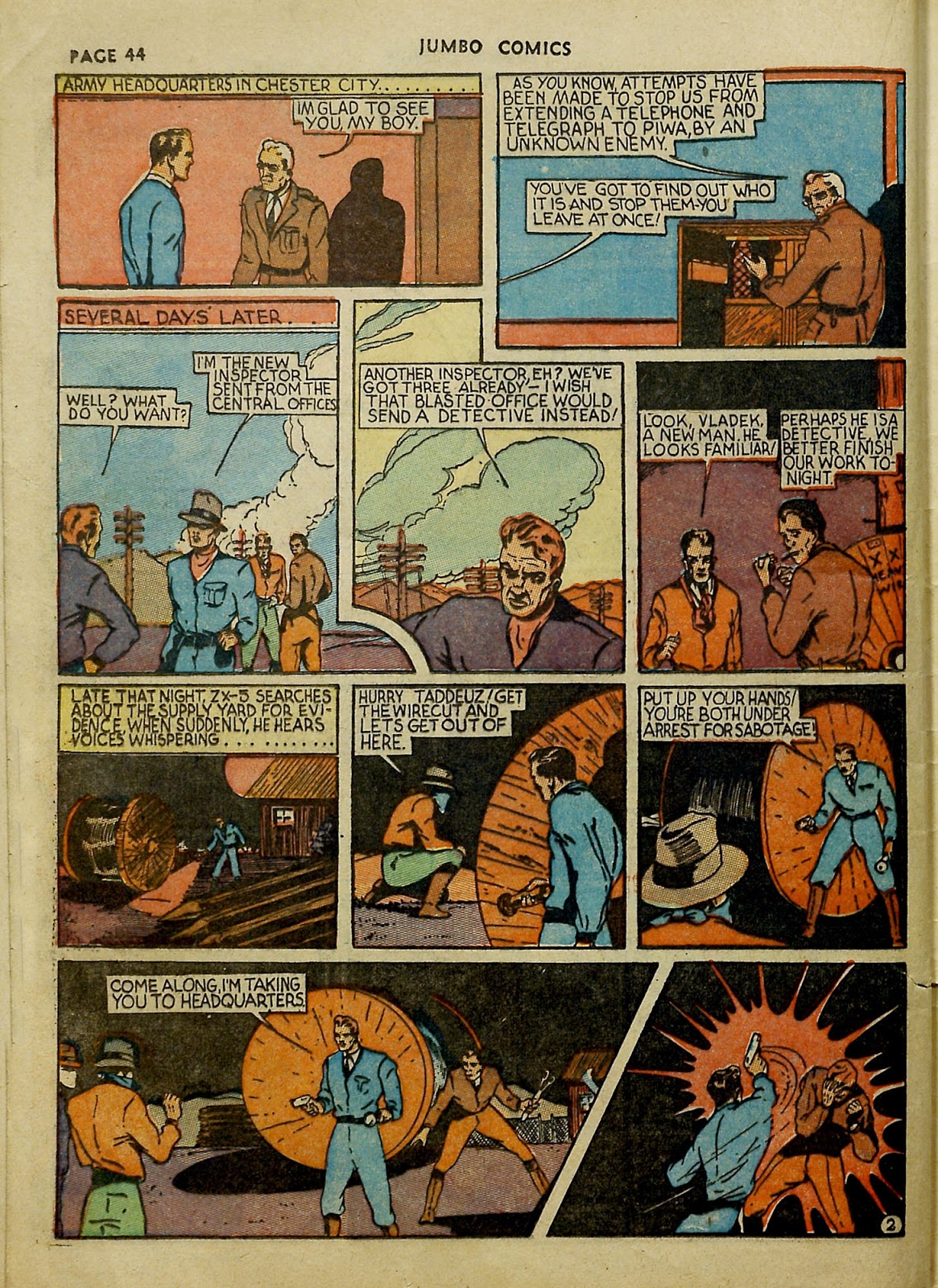
Moving on, this is ZX-5 Spies in Action. This story seems to take place in Ukraine or Russia, given the names, which makes it so weird when something like "Chester City" winds up in the mix. Is this supposed to be Chester, England?


I hadn't bothered including the first page of this story so you might not follow the twist here, but ZX-5's girlfriend was with him at the start of this story and, apparently didn't have the documents yet or this adventure would have been much, much shorter. This is a novel twist to pull on your players, having a supporting cast member turn out to be something other than she appeared to be, as long as you don't use this too often.

Completely ignored between panels 7 and 8 is how ZX-5 gets into enemy HQ and gets the general alone. That's probably not the sort of thing you would normally gloss over in a game scenario; in fact, that's likely more likely to be the main goal of the scenario, as there is exploration involved then.

ZX-5 has successfully grappled General Miaha, but does not need any kind of game mechanic to just point a gun at his head. Rather, the player stated the intention, the Editor adjudicated on the spot and determined that warranted a morale check, and the general failed. Or is that the general...?

...Because it seems really weird to capture the enemy's general, but then take Captain Vybral hostage instead. In fact, the whole scenario gets super-sidetracked at this point, with the mission becoming rescuing Manya from Vybral and nothing else really happening on the front. This is part of the charm of a roleplaying game that there is no winning or losing and goals can be highly flexible in a scenario...but as a story, it really doesn't make much sense.

In addition to guns, we see soldiers using knives and whips. These soldiers seem like they would need to be statted as something other than ordinary fighters, because they go into a berserk frenzy if their leader gets taken down first. I hesitate to stat Cossacks as a mobstertype because that's a little racist...maybe we should call them berserkers, or just add this special ability (+1 to hit if their leader is incapacitated) to bloodthirsty hoodlums.


Speaking of berserk, ZX-5 does the same, and I think we can safely say he would be statted as a Mysteryman now, because fighting after a woman has been struck seems like his signature move now.

Panel 6 sure makes it look like some passion is about to spark in the heat of the moment. And just how did his shirt get ripped off again...?

Lastly, why is ZX-5 being congratulated, when it seems like Manya did all the work? She delivered the papers herself and then summoned the English Army herself.

(Scans courtesy of Digital Comic Museum.)


Saturday, November 10, 2018

Blue Beetle #1

Here we go, with the first issue dedicated to one of my least favorite Golden Age characters. As few comic books were doing at the time, this issue really spreads out the panels, with a rare splash page opening. I won't bother sharing it, as the only thing I would point out from it is that it mentions Blue Beetle is wanted by the police. Now, realistically, it makes sense that all vigilantes would be wanted by the police, but this only ever gets stressed for mysterymen.

I have to say, I like this opening shot, and it makes sense that I would as comics.org tells me that the art chores here are the superior work of Will Eisner (layouts) and Charles Nicholas (finishing art). The city is not named, but from the look of it, it is almost surely New York City.

Note the very specific date of Dan's birth, as we don't often have birth dates for superheroes. Hopefully the doctor is entering with the baby from an interior door, as it otherwise appears that Dan was simply dropped off by the doctor. It does seem odd to me that Dan is a "sturdy boy" already by age 3. Did they not use the term "toddler" back in the 1940?
If the opening takes place in New York City, then this is State University of New York, up in Buffalo. From the first few pages (most of which we'll skip), it would seem this is a sports genre story, as we see Dan overcome the stigma of getting to college thanks to his intelligence (sigh) and excel at more manly diversions like football, boxing, and hockey.

Nick Collins never figures into Dan's story again after this moment.
Again, if Dan's university is in Buffalo, it explains why it took him so long to come home. Mike Mannigan figures prominently in all future Blue Beetle stories. We don't learn his specific age, but we learn here how long he had been a cop, so he must be at least 43.

I'm not sure police chiefs keep letters under lock and key like that...

In perhaps the earliest retcon in comic book history, Blue Beetle is shown here wearing the outfit he would not adopt until later on his very first outing. There is no explanation for why he chose to wear chainmail as a costume.


The panel layout is a bit confusing here at the top of the page, but the hoodlum gets BB in a hold, then BB reverses it into a flip. That doesn't do enough damage to take the hoodlum down, so BB is distracted with fisticuffs. Sure, it would make more sense to stop "Chick" (such a terrible name for a villain) from escaping, but BB needs to make a save vs. plot to deal with a villain before his henchmen have been dispatched.

A "powerful" touring car probably means this is a trophy item -- something along the lines of a Car +1, or a car with one of the bonus features listed for transport trophies in the Basic rulebook.


It is super-unclear how BB managed to get into the back seat of the car, or how he managed to throw a beetle onto the windshield from the backseat (maybe they are sticky and he tossed it onto the inside of the windshield?). The point is that BB has to have someone see his beetle symbol first before he gets his signature move bonus against them (see the Mysteryman character class).

This is the only original story in the comic; the rest are all reprints of Blue Beetle or Yarko the Great that I have covered before.

(Scans courtesy of Digital Comic Museum.)

Friday, November 9, 2018

Famous Funnies #66 - pt. 2


A bubble genies is... an unusual, modern spin on a classic. The Bubble Pipe of Genie Summoning is not something your players would be expecting, that's for sure!
Sifting through the racism, we get to the bottom and the image of a man swinging a bull around by its horns -- gruesome, if it wasn't so cartoony. At issue here is, did Wahoo have to activate the Raise Car power to do this, and would he have to? What is going on is clearly combat, so whether the bull is airborne or not seems irrelevant and is merely flavor text. Two exceptions I can think of would require Wahoo to activate the power for this: 1) he plans on throwing the bull next, which does require him to be able to lift it into the air, and 2) he is doing this to intimidate the bull and force a morale save, without hurting it any further. Flavor text cannot activate morale saves, so a power would have to be used for that.
Scorchy is doing everything right to find the kidnapper -- using aerial reconnaissance, checking maps, watching escape routes, and contacting the authorities.

Krag, on the other hand, doesn't seem to be as smart at setting up traps as Scorchy is. Why would he step on the starter if he thinks the motor is busted? And wouldn't his chief priority still be finding the girl?


The Lone Rider's true identity is revealed in this story -- and soon thereafter he is easily subdued in combat once the mystique of his mask was removed. 1st edition Hideouts & Hoodlums had a rule for superheroes that they could only use their powers in costume...but I'm wondering if that rule was not misplaced and a better fit for the mysteryman class all along. Perhaps the mysteryman should be denied his signature move when not wearing some kind of mask.
It seems a small point, but I thought I would explain that saving a dog from a burning building is still a good deed, and worth just as much XP as saving a person.

(Scans courtesy of Comic Book Plus.)

Tuesday, October 23, 2018

Detective Comics #35 - pt. 1

This installment of The Batman infamously opens on Batman standing in a doorway with a smoking gun in his hands -- it has nothing to do with the story, but must have impressed Kane as being a really cool opening panel.

This is, I think, the only story that makes out Bruce to be an amateur writer.

The story is a confusing jumble of racism, as the Batman tangles with Indian natives, working for a Chinese Fu Manchu-like character, who is actually a white man in disguise.

The Batman pauses to announce his presence before springing on two robbers, making me think his initial signature move was making sure bad guys got a good look at his costume before attacking them (and it makes me wonder if I should have rules on changing signature moves over time).

The "Batmobile" (not yet called that) is still only a high-powered roadster the Batman happens to drive.

Sin Fang's henchmen use khopeshes (swords; at least they aren't hatchets). Sin lures the Batman into a trapped room where the door slams shut and it slowly fills with mustard gas. Anticipating the 1960's Batman, the Batman just happens to have an anti-mustard gas pellet in his utility belt (marking the first time something weirdly random is drawn from the utility belt). Utility belts have been a trophy item since Book II: Mobsters & Trophies.

Despite the fact that Sin has lured the Batman into a mobster encounter and a trap already, the Batman still falls into another trap -- this time, a pit trap that is filled with water at the bottom, but there's a pipe in the wall partway down that he can grab at.

The Batman seems unconcerned when he knocks "Sin Fang" out a window to plunge to his death.

Fictional names for foreign countries often change from issue to issue, but this is the second issue in a series of Spy stories where Germany is "Luxor."  Being a spy is easy when you see the ambassador walking down the street and then just have to look through a door transom and you spot him colluding with a submarine commander in person.

Bart Regan uses a "sensitive microphone" to listen to a conversation through a brick wall. He wears a bulletproof vest in his installment.

Tangling with the commander, Bart is grappled, thrown prone, shot at, and knocked out with a blow to his head. The shot narrowly missed his ear -- though combat in Hideouts & Hoodlums is abstract enough that it could have been a "hit" and still caused hit point loss, without causing any physical wound.

Commanders are 7th-level fighters, so Bart is hard-pressed every time they fight. Bart is twice saved by convenient encounters -- the first time by a passing beat cop, and the second time by a rival spy who takes Bart out of the scenario and finishes it himself (poor refereeing!).

Buck Marshall, Range Detective starts off with an unusual premise, making it the best start to a Buck Marshall story yet -- Buck robs a stagecoach! It turns out, Buck is robbing it because he knows robbers are on their way that are too numerous for him to stop (6 to 1 odds), so he appears to rob the coach and tricks the robbers into chasing off after him. Finding their lair, Buck puts aniline powder in all the gloves he finds, so the dye will make their hands and they can be found later. Aniline powder is a real thing.

One of the robbers calls Buck a "gink" -- this is old slang that only means "guy." 

Next up is Steve Malone, District Attorney. This story establishes that Steve is based out of New York, and that his secretary's name is Nancy. Steve has three assistants who serve as supporting cast in this story, but none of them are named.

Ethnic restaurants are not treated with much respect circa 1940; an Italian restaurant is called a "spagetti house" (not my misspelling).

The hideout of the kidnappers Steve is after is only accessible by a bridge. The kidnappers watch the bridge and plan to shoot anyone crossing it, but Steve foils them by swinging hand-or-hand underneath the bridge (basic skill check?)

(Batman story read in The Batman Archives v. 1; the rest read at fullcomic.pro.)