Showing posts with label Ted Parrish. Show all posts

Saturday, July 24, 2021

Speed Comics #7 - pt. 3

 We're back with Ted Parrish, the Man of 1000 Faces as he crosses over into a wizard duel in a Ditko-esque magical landscape...oh, what's that? Scarlo is jumping and not flying in panel 3? Panel 6 is just horribly drawn, with a big, long perspective line inked as it vanishes into a solid chimney and the rest of the roof behind him just vanishes because the artist got lazy? Well, that's disappointing.


Speaking of disappointing...as the Editor in a Hideouts & Hoodlums scenario, it behooves you to ensure that the players feel like their presence in the scenario made a positive impact; that they wouldn't have been better off just standing back and letting the police do their job. You know, like how Ted totally bungles capturing Scarlo alive here, when the two officers might have stopped him had Ted not got in the way. 

But there will be times when the dice rolls go so badly for the players that terrible results will happen, and then you need to have in-game consequences. You know, like how Ted must surely be wanted for manslaughter now.

Now we're going to jump all the way to the last page of Biff Bannon. Dick Briefer is going full-on Mad Magazine (only 11 years earlier) here with the frantic pace, zany humor, and exaggerated violence. That got me thinking about the H&H rules for modifying campaign mood to fit the style of comic book story you want to tell. If you wanted to run combat in zany mode, maybe every attack should push at double distance in addition to damage (instead of replacing damage), and you could hit as many targets as you want with the same attack so long as the method or results would be funny and inventive. 

I don't think this would work for campaign play, as there would soon be no suspense about whether the good guys win (it wouldn't be funny if the bad guys could hit as many people as they wanted), but it would be fun to try in a one-shot scenario.

And now I'm jumping full steam ahead into Lt. Jim Cannon and the mystery of the needlessly elaborate plot device. I mean, you can sink a ship with icebergs, or you can sink a ship with mines, but does putting the mines on the icebergs really do any extra good? If anything, it makes the mines easier to spot, which is what happens here.

Maybe I'm just so incredulous because Devilfish is such a non-threatening name for a villain. Anything-fish doesn't sound villainous. "You may call me...the Goldfish!"


That does look like a really long submarine. The longest submarine in WWII was Japan's I-400-class sub; at 400' long it held the record for two decades.


This is from Landor Maker of Monsters, and this installment is a weird, soap opera-y one that our Hero (and his girlfriend) doesn't barge into until the second to last page. What's interesting here is that Creeta is clearly an android, with steel wires controlling her body inside, and her weakness is the screw in her neck that ...well, I'm not sure how it kills her exactly, but turning it seems to do a lot of damage to her.

Bob Powell seems to be really rushing the art here too. He could do much better.
This is from Munson Paddock's Mars Mason. Mars is an interplanetary mailman because, you know, we're never going to have some kind of electronic delivery system in the future. Comic book science is as goofy as ever here, with that heat radiation wave that is somehow different than radio waves, but that's nothing compared to a ship from Jupiter leaving after a ship from Earth and moves fast enough to intercept it before it reaches Mars. I think we're going to have to accept that the Jupiter Men have extremely long range teleport technology. 

What really works here is the creative alien design work and, even more interestingly, the villain name Killraye. That is great and suddenly I want to use it (though I'd probably drop the e).   

This, this is one of the reasons why the AH&H Mobster Manual is still not done after all these years. I'll be reading "new" comics and it's the same old human bad guys, blah blah blah, and I'll be thinking I've seen everything new I'm going to see -- and then Mars Mason fights Jupiter Men. Now the Mobster Manual has to include these! This is marvelously inventive, with the spiky heads and strange growths in their faces (are those fangs? Short tentacles? Something else? Who knows!). Their bodies seem to be separated into two halves sort of shaped like wings, which would seem to make sense for a lifeform evolving on a gas giant (if the gravity wasn't so crushing), each side ending in five appendages like giant fingers. Each appendage ends in a tool, either a club or a hook, that I'm guessing are not natural (but you never know in comic book space).  


This first panel makes it look like their heads can detach. Maybe the heads are the only real part and the rest of the body is just something they wear? Crazy.

Almost as exciting is the multi-ray torture machine. Which ray will it be? Sounds like this item needs a random table, although apparently the differences are just flavor text and all of them eat out your vital organs. 

If you're feeling cheated because Mars has to get rescued, keep in mind he's only a mailman. 

(Scans courtesy of Comic Book Plus.)


Saturday, July 17, 2021

Speed Comics #7 - pt. 2

We're back to Shock Gibson out West and the hoodlums he hid amongst last time, who have upped their game from hustling ranchers to attacking oil fields. This story has been a lot about escalation of threat level, whether it's targets or transportation (they've now also gone from riding horses to having planes). An Editor needs to up his game like this on the fly if he begins a scenario that turns out to be too much of a cakewalk for the Heroes. 

Though Shock is probably buffed here with the power Fire Resistance, I like how nothing else on this page requires his powers, and lifting and twisting that valve is probably something any Hero could have done. 

It is strange, though, that Shock let them start the fire and waited until the hoodlums were gone to put it out, rather than stop them here in the act. I'm hoping an explanation for that is forthcoming and it's not just a plot hole. 


Okay, I think it's clear at this point that Shock is just toying with the bad guys. There's really no reason to trick the leader after getting him alone in the plane instead of just taking him prisoner now. 

This is, though, the kind of playing I expected to see more in H&H and never have -- good guys vastly outclassing the bad guys, but then taking it easy and trying to make it fun. Players always seem to want to end things as quickly and efficiently as possible. I have wondered before if H&H needed a game mechanic that would encourage this better, like bad guys being worth more XP if you spend longer defeating them than you need to.

Given Shock's powers, you'd think he could have just wrecked the hangars on their own, but there's a poetic justice in using their own bombs against them. Speaking of which...I love that second panel and the fun sense of overkill. I suppose I would give those hoodlums a penalty to their morale saves in that situation. 

The next page is the last page that wraps things up. There's no big reveal of the head hoodlum ("Gasp -- you were Joe the Ranch Hand all along!" or something like that) and it's only implied that the hoodlums knew about the gold and that's why they wanted the land...though the oil would have been just as valuable, so...

Lastly, Shock stops by and gives the old prospector a strange admonishment (and I won't bother showing you the whole page just for it), to "remember the unemployed" when he's rich. The unemployment rate was at 17% and dropping by the end of 
1939, better than its peak in 1933, but still high enough that wealth distribution should be a serious issue for superheroes. 

Now we're in the middle of the next story, Crash, Cork, and the Baron, as they deliver explosives to Argentina. Why, and who hired them? Eh, these guys are Neutral and don't really care about that. Oddly, they flew west to get to Argentina, so...the scenario started in Uruguay? But what I wanted to discuss here was gauchos. Gaucho was a lifestyle, not an ethnicity, but since gauchos were cowboys and not bandits, it's not hard to read some racism into this. Were they ever extinct? No, but their numbers did severely dwindle by the end of the 19th century. 

But this page also gives us more questions. Is Cork not dead after the bolo wraps around his neck (yes, game mechanics-wise, he's likely only unconscious at best, but realistically...)? Is Crash really such a bad pilot that he can't outmanuever an inexperienced pilot (very bad dice rolls, I suppose)? Who is
saying "The blitherin' idiot!"? Did the gauchos change Cork's jacket from a brown one to a green one?

It seems like Crash is using the Out of the Sun stunt from the old aviator's class here, and even though the old version of stunts is gone from 2nd edition Hideouts & Hoodlums, there's no reason why we couldn't keep the concept as a combat modifier, -2 to be hit from below, just like how Crash should be at +1 to hit for attacking from above.


I'm pretty sure this is what only doing 1 point of damage with a bolo looks like. 

We also get one of those rare examples of a hero's gun running out of bullets. While seemingly unlimited bullets is a common trope in fiction, I love it when the heroes can't rely on guns and have to think up another solution instead.  I'm sure they'll put their heads together and come up with some nonviolent solution and...

...oh. A couple o' loads o' dynamite. Well, that escalated quickly.

I have serious reservations about this. I would need the Mythbusters team back together to resolve if you could detonate an explosion big enough to create a colossal wave. I suspect the waves would just make the water choppy, but not enough to capsize the boat. And I have to wonder if it wouldn't have just been better to let the bad guy get away than to destroy an entire coastline.

In-game, I suppose you have to look at these ideas in terms of what will make the story more exciting for the players. Maybe your players like blowing up cliffs. My players probably would have just thrown the dynamite at the boat...


We'll just glance ahead at the third story in the book, this feature being Ted Parrish, the Man of 1,000 Faces. Here, we learn that if you have a steel-lined cap, it protects you from head blows. We also see a clever trick, disguising yourself as one of the bad guys and escaping with them to see where their lair is -- but then Ted goes the easy route and leaves a note on the door for the police. Boo, Ted! What kind of action hero does that (you'd think his player doesn't want XP or something!)?

Also note one of my pet peeves about golden age comics -- colorists who just don't care and get wrong obvious things, like the constantly changing suit jackets. 

(Scans courtesy of Comic Book Plus.)


Friday, September 6, 2019

Speed Comics #6 pt. 3

We're still looking at this month's Crash, Cork, and the Baron adventure and, as always, talking about comic book stories and how to emulate them using the game Hideouts & Hoodlums.  If you don't play H&H, you're still welcome to stick around and look at the pretty pictures.

Under most circumstances, and as we've talked about many times on this blog, H&H makes no distinction between subdual damage and lethal damage; the only time injuries kill is when the character is already unconscious or in a deathtrap. So the question here is, is Crash in a deathtrap?

No, the natives' intentions are to torture Crash, not kill him, so this cannot be a deathtrap. Indeed, rather than full damage, it appears that the natives are being careful to do less than full damage.


I hesitate to allow either side, players or Editor, to have such control over their damage that they can specify an exact number of points of damage they want to inflict, but misusing or under-utilizing a weapon should make it work like an improvised weapon, which do half weapon damage.

I really hate how this story ends. They threaten the chief, feed him a baloney story about how oil pipes leaking into their drinking water isn't bad for them, and then apparently get him addicted to cigarettes to force compliance. I just...ugh.
So let's move along and look at Ted Parrish, Man of 1,000 Faces.

Right off the bat, I'm wondering about that fall. Is Ted -- disguised here as Pedro -- really knocked unconscious by that, or just pretending? Ted is a 2nd level mysteryman by now, so it seems awfully humiliating to have a 10' fall knock him out. On one hand, maybe he's feigning unconsciousness, so no one can ask him any probing questions about where Pedro had got off to, but on the other hand, maybe the Editor wanted him unconscious so he couldn't do anything that would derail the story before the sub reaches Central America.

So, the next question I have is -- where is this? What Central American country was producing oil circa 1940? With some effort, I was able to find that Mexico started drilling for oil back in 1916, but I can't verify any other countries were drilling that early.

Even this page, which talks about a jungle, does not invalidate Mexico as a likely suspect. Though one normally thinks of Brazil both in terms of jungle and oil, Mexico has the smaller Lacandon Jungle within it.

And look, the ol' stick in the mouth trick!
Moving on, this is Dick Briefer doing Biff Bannon. For humor, the superhero-soldier turns out to have a fear of public speaking. But what does that mean, in terms of game mechanics? Is this evidence that Biff has a low Charisma score? Perhaps Biff's player really wants Miss Lee for his supporting cast, and is afraid of messing up the recruitment roll?
This first tier is rather remarkable. Firstly, it's a stirring mini-speech about the value of integrated public education to combat racism. I think that was Dick's genuine intention, as the second remarkable thing about this tier is panel 2, and the black boy who is drawn completely normal (or as normal as Briefer's highly stylized art allows). Remember, this is a time when even artists as progressive as Will Eisner were drawing black people in minstrel show style.
I'll spare you from the strange subplot that gets Biff put in a dress and wig. The important thing here is the sheer mass of improvised weapons half-pints can use, including things I never thought of, like B-B guns, firecrackers, blowguns, and inkwells. The inkwells come with a little something extra, the chance of producing a blinding attack, but I would say that's pretty unlikely; maybe if the inkwell hits on a natural 20.
This page is noteworthy because the mobster in panel 2 acknowledges that they live in the same world with Shock Gibson. So many characters lived in their own isolated universes before this, even in the same anthology title.


This is Lt. Jim Cannon of the British Navy. By "15-inch guns" it probably means the BL 15-inch Mk I naval gun. "It was the first British 15-inch (381 mm) gun design and the most widely used and longest lasting of any British designs, and arguably the most efficient heavy gun ever developed by the Royal Navy. It was deployed on capital ships from 1915 until 1959, and was a key Royal Navy gun in both World Wars," according to Wikipedia.

Leaving your big, protective ship, and putting yourself in harm's way in a shot-range plane or a torpedo launch seems like a terribly unsound tactic, and yet what else can a Hero do? Share XP with everyone on board the Hood? Not likely!

(Scans courtesy of Digital Comic Museum.)


Saturday, November 24, 2018

Speed Comics #5 - pt. 3

And we're back with Crash, Cork, and the Baron in their Ceylon adventure. I was very pleased to look up arrack and find out that's a real thing, but it's only an Indian liquor. So, he wasn't actually "doped" so much as they just got him drunk.

Covering him with leeches was an unusual deathtrap.
I'm not sure how this would work, game mechanics-wise. Nooses are a simple entangling attack, but how to handle pulling them up into the trees? A second save vs. science to avoid (the first save would be vs. the ensnaring)? A skill check does not make much sense here; it's almost necessary to introduce ability score checks so the Heroes could make Strength checks for this.
This is Ted Parrish, the Man of 1,000 Faces. Thankfully, we don't have to discuss disguise again this time; I'm sharing this page because of the unusual entangling attack. It looks like he's attacking two people at once with the bed sheet, but in the next panel it is clear that the two men are tied up in separate bed sheets; Ted must have thrown one over one mobster's head and then a second sheet over the other on the following turn (since he has surprise for the first attack, the second could have occurred at the beginning of the first regular combat turn).

Since bed sheets are not made for ensnaring attacks, I might give the mobsters a +1 bonus to save vs. being ensnared.
Now we'll jump ahead into Biff Bannon of the U.S. Marines. Biff has an unique challenge to start this scenario, as I can't think of any comic book before or since where the Hero had to park a battleship. Looks like a failed expert skill check, but here the Editor allowed something good to come of the failed roll; Biff crashes into the underground lair of saboteurs (just feet away from hitting all their dynamite too -- lucky he only missed his roll by 1!).
All of Biff's mini-adventures in this installment are random/wandering events. Here, a subway driver has fallen unconscious behind the wheel and Biff has to jump onto a careening subway train. Jumping is a skill check when you have to jump higher or farther than normal, but to jump "on target" like that, you need to make an attack roll instead.

The following newspaper headlines make it clear these mini-adventures are taking place in New York City.


I'm just going to share this one page of Smoke Carter as we race through this issue, and for just two things. One, this long-winded confession is emulated by only one game mechanic, the unconditional surrender of mobsters who fail morale saves. And two, "Flames like the stamp that seals his doom" is so melodramatic that Stan Lee should have used it as the title in a Marvel Comics story.


Now we'll jump to Landor, Maker of Monsters, who creates a 20' giant mole in this story.

It makes no sense at all that a) Landor has his pet mole start digging from so far away instead of driving it closer, and b) that Landor left no guards behind to protect his castle, even though he knows Tony Terrence knows where the castle is. Further, I am skeptical of gunshots causing a cave-in so quickly, but maybe it could happen...plus it's a good way to make guns less of an option in an underground hideout.


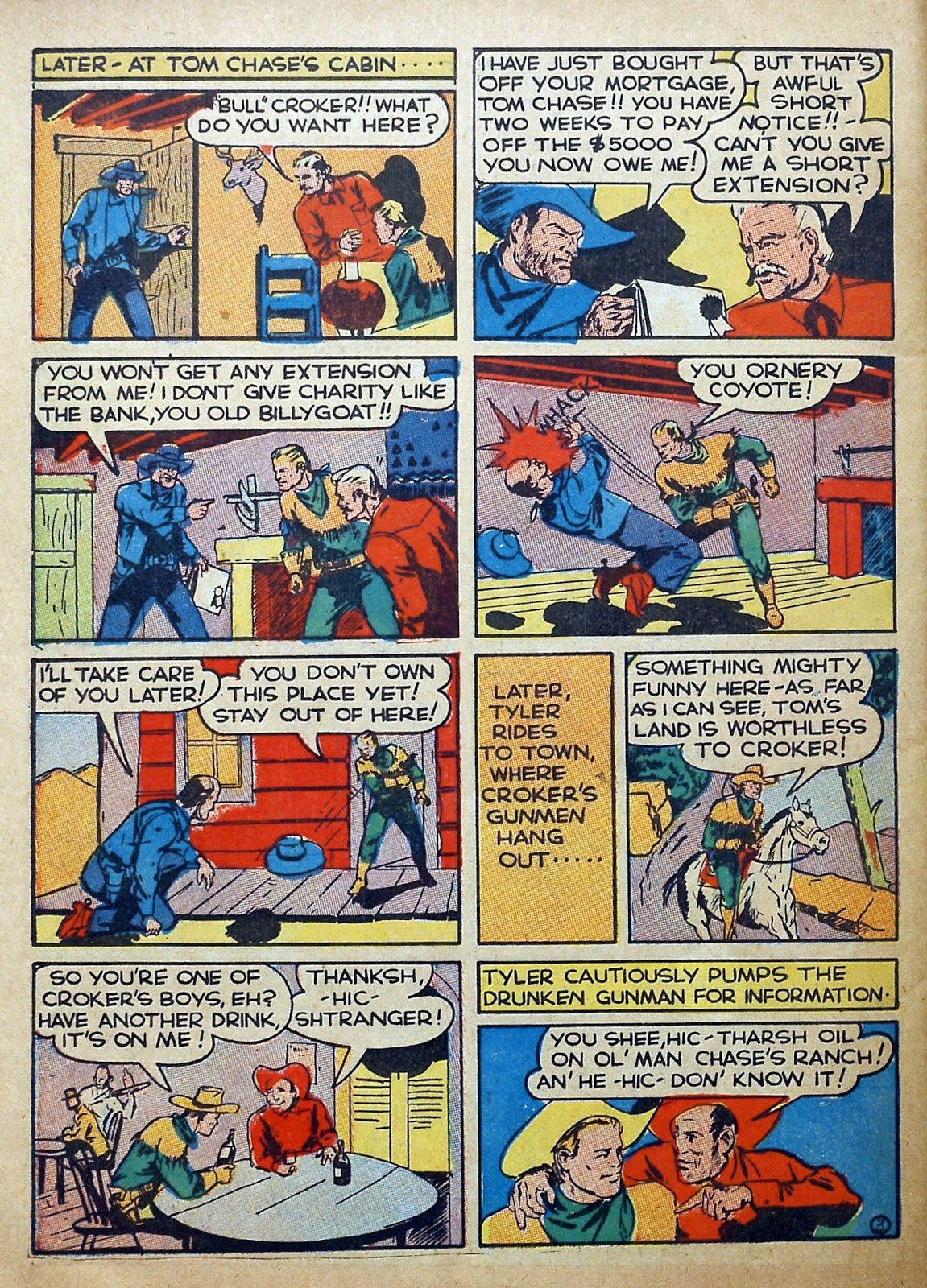
Now this is Texas Tyler, and this page demonstrates how easy it is to get information out of drunken hoodlums (I'll have to add a note to their stat entry).

(Scans courtesy of Digital Comic Museum.)

Thursday, May 10, 2018

Speed Comics #4 - pt. 3

Random design, that makes no internal sense, is a feature and not a bug of Old School dungeon design -- and the same seems to be true here of outdoor hideouts. Does it make sense for a band of slavers to have a stockade for keeping elephants? Not really. Does it lend the hideout a fun, zoo-like quality? Yes. A seemingly unrelated question: can elephants be forced to make morale saves simply by flying low over them in an aircraft? The answer to that is apparently yes too.

This is Ted Parrish, Man of a 1000 Faces, and he seems to really like different modes of getting around. First he's got an ordinary car, like any starting character can buy. Then he's got a plane that he only uses to do recon in for one panel, and we don't know if he owns it or he rented it. Lastly, he has a jalopy with a "powerful engine" hidden in it -- that sounds like trophy transportation to me, and I wonder where he picked that up.

That's a pretty good place to put a sentry with a machine gun (as long as you're okay with your Heroes getting their hands on a machine gun!).

I like how Ted's plan is to summon the state police, but then he gets impatient because they're taking too long and he decides to just do it himself. I've had players like that.

This could be our first time seeing a Hero launch himself from a catapult before. I don't care how good his save vs. science is; I'm pretty sure he's going to take damage from this.


Okay, maybe the Editor gave Ted a roll to hit the window (AC 4, maybe? It is a pretty small target and catapults are not accuracy weapons), and then only 1-6 points of damage for hitting the window. I'd give him at least twice that had he hit the wall.

We get some details of a two-story ranch house with attic here. Note the spacious rooms and spartan furnishings. Better for making room for big combats.

I was just talking about plane rentals too -- now we know how much they cost.


I don't think planes were so unreliable in 1940 that Heroes will have to worry about a random chance of the motor dying per flight. Rather, this looks a lot like the set-up to a scenario before play begins, with the flight and the engine failure being prearranged to get Biff in the right spot.

Of course, play could begin right at panel 3, requiring Biff to make a skill check for a safe improvised landing.

I'm confused by this page. If the entire canal is underwater, and Biff crashed into it, where are Biff and the soldiers he's fighting standing? It's like we're missing some panels where he climbed into the submarine.

Curiously, the secret canal was dug through Panama, west of the Panama Canal, where the country is thicker and there are no lakes to take shortcuts through. A cursory glance at a real map would suggest that east of the Panama Canal, short-cutting through Lake Bayano, would have been easier.

It interests me that the secret canal was dug "years ago." Often in these stories, Heroes stumble across something like this when they are new, or still being built, before they can affect history. It would be interesting to conjecture how a secret canal through Panama would have impacted world history.

I also have to say, I'm liking the distinctively cartoonish art on Biff Bannon.

Convincing a tugboat captain to put someone else's freighter and his own livelihood at risk like this would have required an encounter reaction check at a substantial penalty, maybe as high as -3. Biff's player is a lucky roller, or Biff has a high Charisma and a bonus to offset some of that penalty.


Spotting a periscope in the water, at distance, without binoculars or a telescope? I'm going to rule that Biff only had a 1 in 8 chance of spotting it under those conditions. Lucky roller indeed!

(Scans courtesy of Comic Book Plus.)

Saturday, February 25, 2017

Speed Comics #3 - pt. 3

We return to Crash, Cork, and the Baron in time to see the Baron snag his rope ladder on a sapling -- which is an odd occurrence in Hideouts & Hoodlums, since there are no fumble mechanics here.  There seems to be no reason for the ladder to get snagged other than Editor's fiat, especially given how empty the terrain seems to be around it. Yet, if the terrain was covered in more features, the Editor would be fair in declaring that the Baron's player would have to save vs. plot to avoid his ladder getting snagged on something as he flew past.

*ahem* African "white ants" are actually termites. I think the writer meant "red" ants here.

Crash thinks it's easy to escape those bonds, but it's up to the Editor (in 2nd ed.) to decide if this is a basic or expert skill, and then assigns the die roll to you to determine success (based on race and level).


This is from Ted Parrish, the Man of 1000 Faces.  The mobster he's punching folds after one punch. It's reasonable to roll for morale every turn of combat, unless the bad guys have an obvious advantage.

It's also interesting that the mobsters at the hideout have a special warning knock they can signal each other with.

This is Biff Bannon of the U.S. Marines, looking particularly cartoony today.  I've written before about how a convenience leading to a trap escape (termites here) could be either Editor's discretion or the player requesting it and winning it with a save vs. plot.

No, what strikes me here is that a sea plane is just sitting there in the water, right next to some type of naval ship, unmanned and seemingly abandoned there. It's odd -- but it's exactly like the "summon aircraft" ability of the Aviator class, from The Trophy Case #6.

A submarine of this size seems awfully ..well, overkill for what appears to be a mob of six hoodlums. And yet, this raises a good point that trophy tables are random and you never know who or what will wind up with something really good!


This is Smoke Carter.  I like the scenario I see here -- Smoke simply has to get from point A to point B (point B being a boat that's on fire) without being stopped, and mobsters along the way want to stop him. So there's a falling bridge to overcome (beat it in initiative to go under it in time), and mobsters in boats you pass taking potshots at you.

I don't understand how the mobsters are fooled by a thrown coat, though...


This has got to be a first -- Smoke throws a grenade at someone, to save them, and it works.  What this writer would have you believe is that you can choose between damaging opponents or wrecking things with explosive weapons. I'm not comfortable with that distinction for H&H, as it makes them too easy to use.

Also worth noting, all story long, they've been called "bombs", but this reference to one being a "pineapple" leads me to believe "bomb" was being used for "grenade".

Well, I'll be!  When I introduced giant mosquitoes in Supplement I, I thought I was just giving the game its own version of stirges. Imagine my surprise when it turned out there actually was a giant mosquito in a comic book -- and the same size too!


Giant mosquitoes are good enough fliers to carry away a full-grown woman. They're also smart enough to follow orders like a dog. Who knew?

(Scans courtesy of Comic Book Plus)