Showing posts with label unconsciousness. Show all posts

Thursday, July 2, 2020

Crackajack Funnies #21 - pt. 2

We're still looking at Wash Tubbs and, boy, there's an unsettling mix of realistic and cartoony violence in there -- which is actually pretty much my Editing style when running Hideouts & Hoodlums.

There are some interesting things going on here and on the previous page. From the previous page (I'll just summarize it for you), Frankie Slaughter beats up one of Wash's employees just to intimidate everyone present into not telling the police he was ever there.

Slaughter tries all the angles to get what he wants, as low as beating Wash half to death and threatening to do the same to his girlfriend. But he makes the mistake of trusting Wash is frightened enough to comply and doesn't send one of his boys with Wash to the bank.

Frankie Slaughter is a great villain name.

Wash, for his part, threatens Frankie with a gun (on the page I didn't share), but I was relieved to find out it wasn't loaded. Keeping the lease at the bank was very smart on his part.

Speaking of smart, Frankie again shows good tactics, trying to trick Wash into unloading the lease to a stranger, and then establishing an alibi (and having a secret exit from locations that aren't even his hideout!).
Red Ryder is knocked unconscious by the explosion. In D&D, when a PC wakes up, they can immediately get up and rejoin the battle with no ill effects (other than maybe still functioning at reduced hp). Here, Red is stunned for at least 1 turn after waking up; a more gradual transition to being fight-ready and something I'm considering adding as an optional rule now.
I'm normally far from a gun advocate, but if Red was looking to finish this fight most effectively, I think he would have gone with his gun rather than throwing sand in Carr's face. Apparently the sand gives him such an advantage that he easily wins the fight off-panel, so maybe I'm wrong? Let's review; how I would handle this is an attack roll, ignoring any armor but not DEX bonus or cover, then a saving throw vs science from the target. Failure means temporarily blinded and at a -4 to hit penalty for the next 1-4 turns. So, I guess that's a pretty good advantage, but not a sure win.
This has to be the most verbose feature I've reviewed yet for this blog, and I'm not even showing you the pages that are almost solid text. It's not really that complex a plot, but the author seems to think it is.

A monogrammed lace handkerchief and the smell of perfume are good clues, but the knife in the back is the best one of all and they don't even talk about it.
Noticing that someone else has the same initials is not a clue I would normally make someone roll for, expecting the players to catch it themselves. The smell of the perfume the players could not tell on their own, so for that I might allow an Intelligence check to recall it smelling the same; I don't see that being a skill, unless we treat perfume identification as a skill. There is generally a lower chance to make a skill check than an ability score check, so I guess it depends on how hard you think recognizing the perfume should be.


The Scarlet is an unusual name for a villain for two reasons: one, Scarlet isn't a noun, and two, you normally associate Scarlet with a female.

A fountain pen that shoots out stunning gas that can affect 1-2 people is a handy minor trophy item.

Smashing a window seems an unusual signal. What if The Scarlet had used bulletproof glass in his windows?

Complicating the story was the fact that Dorn's sister provided Ed with wrong information, and Dorn was purposely feeding people false stories to throw them off. Players need to be reminded sometimes that they can't trust all the information they receive in-character.

I'm not sure, but I suspect that "200 suspected cases of espionage a day" was just a guess and not a fact I could look
up and verify.

I never thought we'd be looking at Apple Mary again for adventure ideas, but a $5,000 reward to search for a missing item is a plot hook worthy of a fun treasure hunt.
From this page we learn that psychics charged $5, and a book can sell for as little as 50 cents (maybe from a used book store?).

(Scans courtesy of Digital Comic Museum.)

Saturday, April 25, 2020

Marvel Mystery Comics #5 - pt. 1

We're heading back to check on Timely Comics today, back in (cover date) March 1940. This month, the Human Torch leaves New York City for the Midwest. It's the old story of a remote Alaskan village that needs urgent medical supplies but is cut off by the weather, only transported to a fictional island in the middle of Lake Superior because...I guess Alaska was too far? This weird island is covered in a glacier...I suspect Carl Burgos never visited Lake Superior and maybe heard some tall tales from Minnesotans about how cold and snowy it is there.

So HT leaves for the Midwest, but using the Newark Airport, which is an interesting choice. That's a real airport in New Jersey, and one New Yorkers still use today. The LaGuardia Airport had just opened months before this comic book would have been written.

HT, or Jim as his friends know him, has a supporting cast member named Johnson, who Jim isn't apparently on a first name basis with, but is still willing to come along on this dangerous flight to Lake Superior.

HT badly fails a skill check to pilot during a storm (probably at a penalty) and crashes their plane. In a rare occurrence, a Hero is knocked unconscious in a crash. The wrinkle here is that two hoodlums just got free from jail on the island (not sure how this island is big enough to have a jail, but okay...), they discover the plane, rob the medical supplies, and then set the plane on fire to get rid of the pilots.

I've never been fond of the Human Torch and reading these old stories make me less fond. It really bothers me how unscientific his powers work, that fire somehow answers to him as if it were alive. Nowhere is it more evident than in this story, where the fire forms a protective circle around HT, even while he's unconscious. So either he can subconsciously control fire in his sleep, which I think is way overpowered, or fire has some sort of collective consciousness, which is really weird and wonky. Now, once he's conscious again, using his Control Fire power to make the fire part for him -- that makes sense to me.

More wonkiness comes a bit later when HT falls into water and, instead of his fire being extinguished, the narrator says he was "ordering his flame out." Now, maybe there is a sensible explanation for that too. Maybe he extinguishes his flame voluntarily before the water extinguishes it because, if he turns it off then he can turn it right back on, while if it's extinguished, then he can't use his powers for a random amount of time.

Still more wonkiness is when HT searches a wooden cabin, while still ablaze, and doesn't combust anything. That Control Fire power really gives you complete control. But what you can't explain away with that power is towards the end when he encircles a pack sled and its dogs completely with fire, and the dogs keep running. That all six of them make their morale saves, at their Hit Dice, is rather incredulous.

There's an interesting wrinkle where HT flames on (he doesn't call it that; that's a Johnny thing) and his heat helps keep Johnson from freezing. Now, an Editor could hand-wave that as a common sense side effect...but it could also be a new power, Resist Cold, that a superhero can confer on someone else. We also see HT do sky-writing with flame, which I think we've seen before and needs to become a power in the Heroes Handbook.

Lastly, the two hoodlums plummet into the icy lake waters and die after HT melts the ice under their feet with a circle of fire. Whether he intended for that to happen is unclear...but he shows no regret, and we already have seen he has total control of his fire, so...

Next up is The Angel. The Angel's strength level is really up in the air in these early stories. Except for one text story that had him at Superman levels, he usually was only a strong human in most of his stories. Here, he can tip over a car with extreme effort (or a little help), so he can maybe lift 1,000 lbs. In Hideouts & Hoodlums terms, this is the Raise Car power, as there is no Can't Raise, But Can Tip Cars power (H&H deals more with abstraction than specific measurements). This isn't just a prank; it's all part of a plan to foil bank robbers by tipping over their getaway vehicle and any other vehicle on the street they can use to escape.

Angel then uses a length of rope (he must carry rope sometimes) to get to the roof and watch for them to come out. Note that he does not simply leap to the roof, so he has great strength, but not great leaping powers, again confirming that H&H is on the right track by making players choose which powers they have for each scenario.

Speaking of Raise Car, later in the scenario he is on top of a speeding taxi and pulls the driver out through an open window (if the taxi had air conditioning, maybe the hoodlum who carjacked it wouldn't have carelessly left his window down). Now, this seems to defy science, because you would think that even with great strength, someone with no way to brace himself would just fall over the side before being able to pull a braced man out the car window. Superpowers, luckily, defy science by their very nature. I might also, on a generous day, allow a Mysteryman using a stunt to do that as well.

For some reason, The Angel isn't wearing pants today.

Soon, when The Angel is swinging on that rope, one of the robbers manages to shoot the rope, and it seems to be merely accidental. There is some precedent for this, with firing into melee giving a chance of hitting a random combatant. For this to apply here, we would have to consider the rope and The Angel in "melee," which is a bit of a stretch. For the Editor to just randomly through in this complication would seem unfair in game play. 

The Angel joins a long line of comic book Heroes willing to use mobsters as living shields, but this might be the first Superhero to do so.

In the end, Angel decides to pummel the last of the hoodlums unconscious and he rains "blow after blow" on him. Now, in most game systems, a superhero's strength remains constant and the damage he would have done after just one blow might have knocked out an ordinary hoodlum. But here, a superhero has to buff his strength first before doing additional damage, so if he wanted the satisfaction of punching out a bad guy slowly with normal blows, that's very easy to do.

Next up is The Sub-Mariner, called the "Ultra-Man of the Deep" on the first page of his feature here. Demonstrating the difference in pace of Golden Age stories, the Angel story took place all in 10 minutes, while Namor accompanies a cargo ship to protect it for 3 days before the scenario even gets started.

Remarkably, Namor is said to communicate telepathically with the crew of his flagship submarine in this story. If you've ever wondered how Namor talks underwater...this would be how.

(Read at readcomiconline.to)

Monday, December 30, 2019

Silver Streak Comics #3 - pt. 2


Not many days left in December to work on the ol' blog, but let's try to get through Silver Streak Comics #3, if nothing else.

This is the last page of Bill Wayne, the Texas Terror. Here he consistently shoots twice per turn, but I already discussed ways of accounting for that in the Hideouts & Hoodlums rules last time. This time, I want to point out the neck sheathe for a concealed knife -- and what an insanely dangerous place to store a knife that seems to be, to me.

Panel 5 is a clear example of simultaneous initiative.


Now we're going to look in on Lance Hale again, comics' only loincloth-clad interplanetary warrior.

That is one incredibly durable spaceship, since it is traveling faster than light when it crash lands. No one inside is even harmed!

Traveling faster than time transports you, not into the past or future, but into spirit-land here, which is a highly unusual twist. Spirit-land is inhabited by beast men (long ago presented as a playable race for 1st ed H&H in...one of the Trophy Case issues; I forget which one...).

How kind of the artist not to burden us with having to view that ferocious battle!
Here is some unusual evolutionary science: spiritmen have no bodies, but are somehow able to interact with Lance and grapple him. Having no souls puts them just below mankind "in the cycle of evolution." How did they evolve to have no souls or bodies?

As a reminder, Lance wears an armband that lets him operate as a superhero, wrecking things like chains (the door category) with ease.

That is a highly untraditional Crystal Ball, giving bodies to body-less beings instead of scrying.

Or is the Crystal Ball only an illusion generator? King Loti is revealed as a beastman...or a kenku...or a type I demon?
Can spiritmen/beastmen turn invsible, or is King Loti a beastman magic-user?

And what manner of invisibility is this, that Lance can see him but Dr. Grey can't. This is not like the Invisibility spell, so it must be a special ability of spiritmen, one that gives a saving throw vs. spells to resist.

Here we have the age-old question that has always plagued D&D -- how to adjudicate disbelieving in illusions? It seems that Lance here gets a saving throw just by stating the intention to disbelieve, or to "use his own will power."
Here's a special rule that will keep players from attempting to disbelieve in illusions all willy-nilly: disbelieving in one is so draining that you are too weak too move -- essentially paralyzed -- for 1-4 turns afterwards.


A chair is soft cover, improving Lance's AC by 1 (which he desperately needs, since he's almost naked).

Dr. Grey is taking quite a chance on a scheme that doesn't make much sense. Why does he need a silver bowl to disbelieve in illusions? And what if the spiritmen weren't illusions? Or are spiritmen always illusions?
This is from the next feature, Ace Powers. Here we have a very rare complication from combat -- arm paralysis caused by taking damage. Now, we could make up a new rule that any head blow that doesn't cause unconscious has a chance of a different result, and we could even design a random table for that...but the paralyzed arm doesn't here really change the combat any, so it passes the smell test for flavor text to me.

Tying the Hero to a steam radiator seems a low-key deathtrap that I'm surprised we've never seen before. Since the steam has to build slowly, it could start as 1 point of heat damage in turn 1, 1-2 points in turn 2, and so on.
This is one of those strange instances in comic books where taking damage causes consciousness instead of unconsciousness. It runs counter-intuitive to how damage works in both H&H and, frankly, every game system I can think of.

Duplicate keys must be like a skeleton key.

(Scans courtesy of Comic Book Plus.)

Thursday, April 11, 2019

Jungle Comics #2 - pt. 1

Jungle Comics is what happens when a publisher (Fiction House) has one successful title (Jumbo Comics, packaged by the famous Eisner-Iger studio) and decides to launch another, but on the cheap. When Fletcher Hanks is your best artist (and you'll be seeing his contribution in a day or two)...

I was recently in a Q&A with Don McGregor on Facebook and I asked him about pushing the envelope for violence in comics. His response was that he wasn't trying to push violence so much as show that violence has consequences. Which is relevant here because violence is on display on practically every page of Jungle Comics, but a strangely bloodless violence, even when characters are getting stabbed in the face. I found some of these images too unpleasant for sharing on my blog, so you'll just have to take my word on the face-stabbing incident.

Today we're just looking at the first two stories from this issue, Kaanga and Red Panther (called White Panther last issue).
Kaanga is drawn by Ken Jackson -- often free of the constraints of any backgrounds -- and so stiffly that he can sometimes be mistaken for Fletcher Hanks (in fact, I'm not entirely convinced that Jackson isn't just a pen name for Fletcher, with someone else inking over him).

Compared to Kaanga, Arthur Peddy's work on Red Panther is positively dynamic, though still gory. Later, Arthur will join DC Comics and get to work on the squeaky clean later appearances of the Justice Society of America.

Now, let's talk about the pages! In the first one above, we get possibly the first instance of a stick holding crocodile jaws open in comic books. At least he doesn't kill it!

Ape men often look -- or are blatantly -- racist in nature, but this story skirts that problem by depicting the ape-men as white as they can get. Dr. Wratt may be the first mad scientist in comics who won't wear pants. Or shoes. Or socks. I think we can safely assume he's naked under that long shirt. Dr. Wratt may be evil, but he's not too evil; he operates on Kaanga using an anesthetic gas.


=====

Game mechanic notes: Sticking a stick in a crocodile/aligator's mouth requires a successful attack roll, followed by a failed save vs. science for the animal. The ape man achieves a surprise attack and lands a head blow that stuns -- unless Kaanga was just low on hit points from the crocodile fight, in which case Kaanga has been rendered unconscious at zero hit points."Torn legs" do not require miraculous cures in Hideouts & Hoodlums, just normal rest.

Wratt needs to only establish eye contact with his victim to hypnotize him, but we've had plenty of evidence of how easy it is to hypnotize people in comic books. He does have one limitation, though, he can only hypnotize someone to make them do something they already want to do (like escape the island). To "dominate another's will" he needs that big, stationary machine.
It's unclear if the machine does all the work, or if it only makes his normal hypnotism more effective.

A choke hold is a result on the grappling table in 2nd edition H&H.

Here is a very rare example of tripping two opponents at the same time.

===

Wait a minute...if the shore was that far from his lab, how did they see the hypnotized guy get torn apart when he "neared" the shore?


The island is in the middle of a lake (I didn't share the page that established that); the long suspension bridge is the only way to the shore of the lake. But couldn't Kaanga swim the lake...?

We see ape men can be encountered in groups as large as eight.

Are the crocodiles in the lake, a lagoon, or both?

Meanwhile, Red Panther is trying to save missionaries from headhunters.

===

A stunt never seen before, or likely since, in comic books, is swinging from a vine held in one's teeth and scooping up two full-grown people, one in each arm. I have toyed with the notion of restoring the multiple levels to stunts that they had in 1st ed. But how to distinguish 2nd level stunts from 1st edition ones? A thought I've had here is that a stunt should only be able to accomplish one thing, but a 2nd level stunt can accomplish multiple things (2? 3?) at once.

A skill check can discover a hidden trap if the Hero is actively searching for them, though Red Panther seems to just happen to spot one here as if by accident. 
A long established practice in RPGs is to combine traps with something to fight, such as a tiger in a pit trap.

===

It seems odd that Red Panther chooses to jump into the pit and kill the tiger, rather than simply reach into the pit and pull the man out. He could have even helped the tiger out and sicced it on the headhunters.

====

Red Panther is able to use a stunt -- cutting his bonds against the sword -- even though combat has already started because he has not yet taken a combat action.

This is not the first time the term "giant" has been used to apply to a combatant who is actually just normal-sized. This is why I was thinking of creating a pseudo-giant mobstertype.

A push attack does not need to be away from you; here it shows a push attack being used to move an opponent behind you.

(Scans courtesy of Digital Comic Museum.)


Friday, July 27, 2018

All-American Comics #8 - pt. 1

On to #8...

Which starts out with new feature Gary Concord, the Ultra-Man. This is another one of those future adventure stories, this one taking place in 2239, but our first installment is largely flashback to Gary's father -- who was born in 1915!  Gary Concord Sr. (the son in 2239 is really Jr.) was considered a military tactics prodigy by 1936. But after WWII, he became a scientist and worked on an invention until 1950 -- when WWIII happened. The U.S. was invaded; it's not specified by whom.  The invention is confusing too; it creates a scrubbing bubbles-like foam that heals, clears the mind, increases size, strength, and intelligence, and makes you immune to fatigue, but also puts you to sleep ala Buck Rogers.

In Red, White, and Blue, Whitey is knocked unconscious with a vase over the back of the head, then kicked while he's down. According to the rules, if he took additional damage while unconscious, he would be dead. However, one way of interpreting the 2nd edition "zero hit points" rule is that if you are simply stunned while at 0 hp (you made your save vs. plot), then taking additional damage then makes you unconscious (as if you had failed your save).  But then, a third source of damage should then still be lethal.  All of this, by the way, is contradicted by the story, where Whitey is still only stunned, even after what seems to be multiple kicks.

Meanwhile, Red is able to make phone calls to the State Department, Naval Headquarters, and the State Police, and they all just do whatever he asks them to. Red should be a level 4 fighter by now, which makes him a lieutenant, which means his ability to boss people around automatically should be much more limited than this. Red is also able to wreck his way through the roof of a truck in this story.

In Hop Harrigan, we learn that he keeps his plane stocked with a pair of shotguns. When mobsters turn a plane loose on the tarmac to endanger other planes, Hop and his Supporting Cast manage to lasso the plane and pull it to a stop.That's interesting - and surprisingly difficult to moderate using Hideouts & Hoodlums, since it doesn't used opposed rolling. Ability score checks would work, if I had Hop and friends roll under their Strength or less, but I've been super-hesitant to bring that game mechanic into play. What I might do is assign a Hit Die to the plane so it can make a save vs. science each turn to see if it is stopped or not.

In an aerial duel, Hop and Gerry use the Stay in Blind Spot stunt  -- which can't be as hard as I always made stunts out to be, because Gerry, and not Hop, is the pilot here. In fact, maybe all piloting stunts should be basic skills, since non-aviators in comics are able to do them so easily.  Hop, meanwhile, gets a "lucky shot" against the wing-mounted fuel tank with his shotgun. The complication forces the smugglers' plane to land.


Monday, July 2, 2018

Pep Comics #1 - pt. 2

Jack Cole's first superhero, the Comet, shows little of the promise that would come to fruition later with his masterpiece, Plastic Man.  We're already off to some really shaky science here, plus a lot of brevet ranking on our brand new Hero.

Hydrogen is just about as light as matter can get. The closest thing that's "50 times lighter" than hydrogen is an electron.  So, Dickering is shooting electricity into his veins to get his powers -- which actually does sound at least a little more science-y than getting them from injecting gas.

Although we'll soon see the Comet flying, he's demonstrated leaping here because, well, that's what superheroes did this soon after Superman's debut. I'm estimating that yellow building in the background is at least 21 stories below him, which means he is using Leap II, which means he has two brevet ranks and is operating as an extraordinary man (level 3 Superhero) already.

His disintegrator eyebeams are flavor text for wrecking things, combined with the Wreck at Range power.

Hmm...glass is a poor conductor of electricity, so this seems to support my Comet theory further.

I told you that you'd see the Comet flying soon.

This outbreak of typhoid fever recalls the cholera epidemic of Chicago, 1885-1891.


Just like he created his eyebeams by combining the wrecking things mechanic with the Wreck at Range power, the Comet can manage this speed in flight by stacking two other powers together -- Fly (any version) with Race the Plane.  However, if it is unimportant to the scenario how the Hero gets from point A to point B, I usually hand-wave the requirement of burning off a power slot.

The guy at the door is a thug, perhaps the most common mobstertype in early comics!

I think we're getting some wacky science again with the smokescreen...but the game needs a new power for Smokescreen/Fog Cloud (a note for later and the Advanced Hideouts & Hoodlums Heroes Handbook).

I would treat a roof as the robot category for wrecking.

Since The Comet is in melee range, he does not need to use Wreck at Range to wreck the gangster's gun, even though he appears to still be using a missile attack.

The Comet finds the list of names immediately, suggesting he used the power Find Evidence.

Wrecking an entire house would be the same as wrecking a truck (the thought being that so much of the house is combustible, it will burn itself down even if your initial attack doesn't obliterate it).

It could be possible to wreck even more effectively by voluntarily choosing a more difficult wrecking rank.

"Will my eye blasts utterly destroy the whole house?"

"If you want to make it burn down, it wrecks as a truck."

"No, I want to really scare those gangsters; I want to obliterate the house."

"You can do that, but it leaves all the glass behind, if you can wreck at battleship level."

It seems like the Comet was just walking down the street in costume, hoping to run into wandering encounters.

There is no real Tri-State Building that I can tell.

It looks like The Comet is not opposed to murdering.

I'm not sure how you would go about lining the inside of the walls with glass. Wouldn't that require a massive and highly visible reconstruction process?

The Comet is only stunned instead of unconscious (a 2nd edition option). 

I'm not crazy about Heroes being able to wreck bullets in mid-flight...but that could be flavor text to go along with a successful save vs. missiles?

A Superhero can't kill this easily. A high-level Magic-User could with a Death spell. A Superhero could knock them all unconscious with a Blast II spell, then kill them with a second Blast II spell.

Falling damage also doesn't kill, except in a deathtrap. Lifting someone up in the air and dropping them doesn't seem like it's complex enough to count as a deathtrap, and I don't think Heroes should be able to set up deathtraps.


This is Sergeant Boyle. Here's an example of a mobster failing a morale save, really badly.

If Boyle's title here reflects his level title as a Fighter, then he is level 3.
I'm not immediately comfortable with the same bullet being able to shoot two people...but if a gun allows Sgt.  Boyle to have two or more attacks per turn, do bullets expended necessarily have to line up with that? I already have an optional rule where the Editor can secretly roll a die to determine when a gun runs out of ammo, so no 1:1 deal is necessary.

Boyle finds the TNT exactly like a trophy item.

So this page makes me think...the trench is no more than hard cover for the officers, and that's AC 7.  Boyle and the others are hiding out there for what seems like hours. How is it so hard to hit someone with an AC of 7?  I'm not sure if hard cover should be more effective, or if that could be combat imbalancing, or if something else is going on here. It requires more thought.

(Scans courtesy of Digital Comic Museum.)


Sunday, November 19, 2017

Wonderworld Comics #8 - pt. 3

Dr. Fung finds it extra hard to find the trickster Scorpio (the trickster class, designed for mediums and psychics, debuted in The Trophy Case v. 1 #4) in his weirdly-shaped mansion. The first room is concealed behind curtains, but behind the room is a secret door keeping the blackmail files safe. The Editor can double up on tricks and traps as well if it keeps the hideouts challenging.


Weapons concealed in canes are so cliche that they'll never fool your players, but a spring-loaded arrow-launcher concealed in a magician's wand? That's a trophy item that will surprise them (though I question the penetrating power of such a weapon -- maybe it would only do 1-4 points of damage?).


Tex Maxon is good in a fight, but not as good as Timmons!  Check out how he kicks a rock with the back of his foot and manages to get enough lift to strike Tex in the head. I'm not sure even professional soccer players could pull off that stunt. It certainly makes me question if Hideouts & Hoodlums needs any facing rules.


It is not unfeasible for someone to fall 150' and survive, as there have been lots of examples of people falling even further and living. The H&H rules are unforgiving , with a fall from that height doing 15-90 points of damage. Now, it's possible that Jon Pulski had 16 hit points and got really lucky, or the Editor set a lower minimum damage (which he could always do, at his discretion).

Fake skulls seems like it could be interesting hideout dressing.


This is K-51, though the influence of Will Eisner makes it seem an awful lot like a Black X story. This takes place in the Philippines, which was an U.S. territory at the time. The rabble-rouser Mussoni is obviously based on Mussolini, though what he'd be doing in the Philippines isn't clear.

Notice how, in fiction, no one ever gets stabbed during a grappling fight. This is borne out in the 2nd edition grappling rules, where if you grapple someone, that opponent can't make any attack back at you that turn except for grappling.

The typhoon is either a wandering event or something the Editor just tossed in, at his discretion, to shake up the plot (it had been a standoff before this). The typhoon is strong and wrecks as if a high-level superhero. X-51 and his fellow agent Claire (she does have a codename, but it's not used past the first page) both make their saving throws vs. science (or maybe plot, or whichever was worse?) to survive the storm, with the Editor rolling for the major antagonists on the ship, while likely hand-waving the rest of the rolls and just saying the crew all died.


The bad guy here is called both a bandit and a robber, but by the way he gets from the side door of the train to the ropes hanging above the train, he must be a mysteryman.


The "chief" is a master criminal; you can tell he is by the bald head. A thug (another mobster type) robs the train this time, using less acrobatics.


The car is full of a mixture of gangsters and thugs. One of the thugs recovers quickly, having made his save vs. plot to recover quickly from unconsciousness (a new 2nd ed. rule). This indicates that even small-fry mobsters are eligible for the recovery rule...though, if there was no such rule, this could perhaps be explained away as a special ability of the thug mobster-type.

(Scans courtesy of Digital Comic Museum.)


Friday, February 10, 2017

Amazing Man Comics #7 - pt. 2

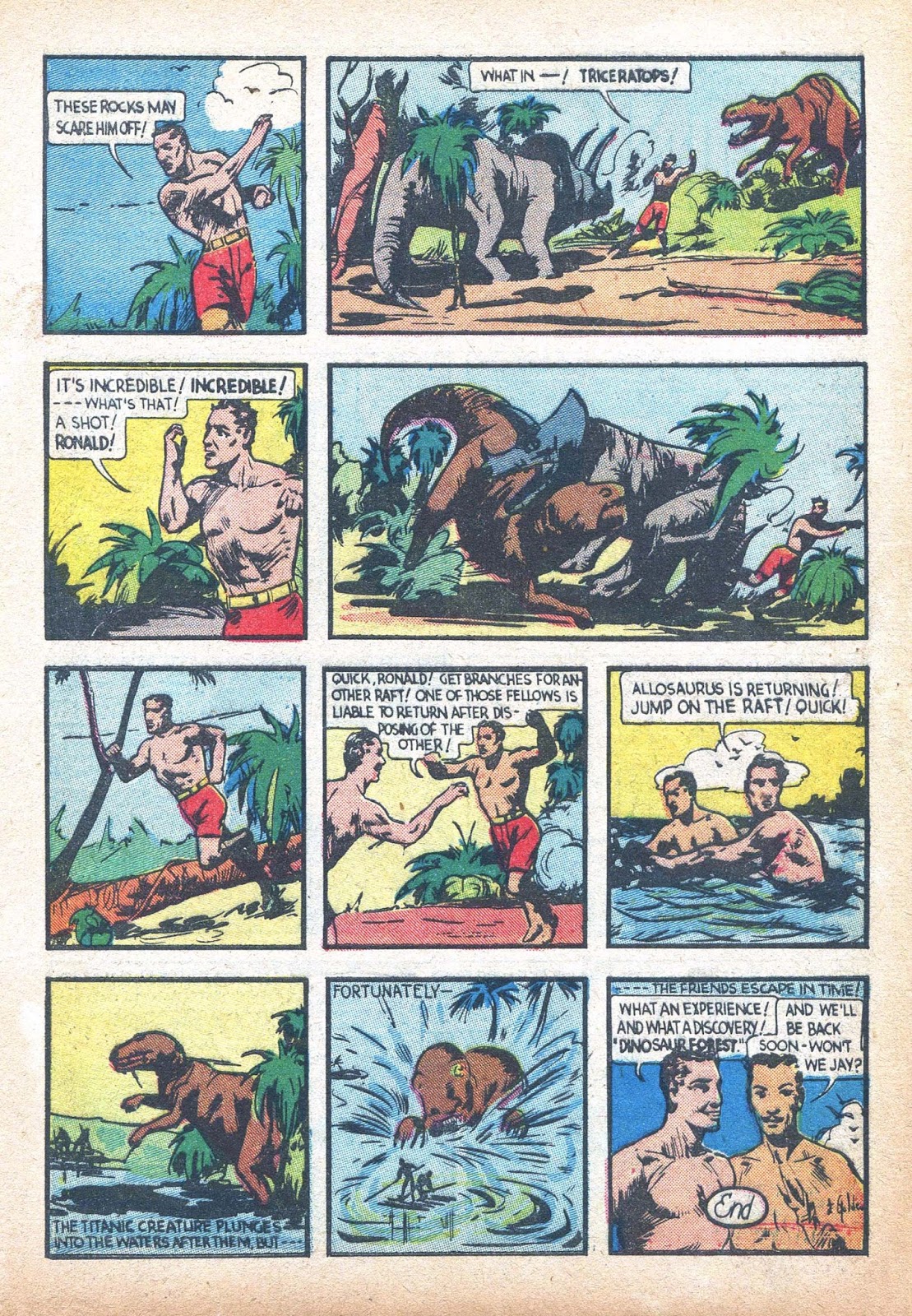
Dinosaur Forest puts forward an intriguing premise -- what if dinosaurs were common enough still that you didn't need to find a lost world setting to find dinosaurs? Here, Jay and Ronald are already following dinosaur tracks in South America as if that was the most natural thing in the world.

The cliche of the whirpool is to see them big enough to swallow a ship, but this is a small whirpool only large enough to unsettle a raft.

The crocodile is pretty unsettling too, but like all opponents in comic books it seems easily dispatched. And with just a knife, no less.

This page makes the knife fight even more extraordinary, as the crocodile is now a "great crocodile" -- which I'm guessing means larger than normal.

This is the second allosaurus in comics.


Or is it an allosaurus? Because that's clearly a triceratops, and the two species didn't live at the same time. But then, we're also imagining that it's normal for them to still be around in 1939, so...


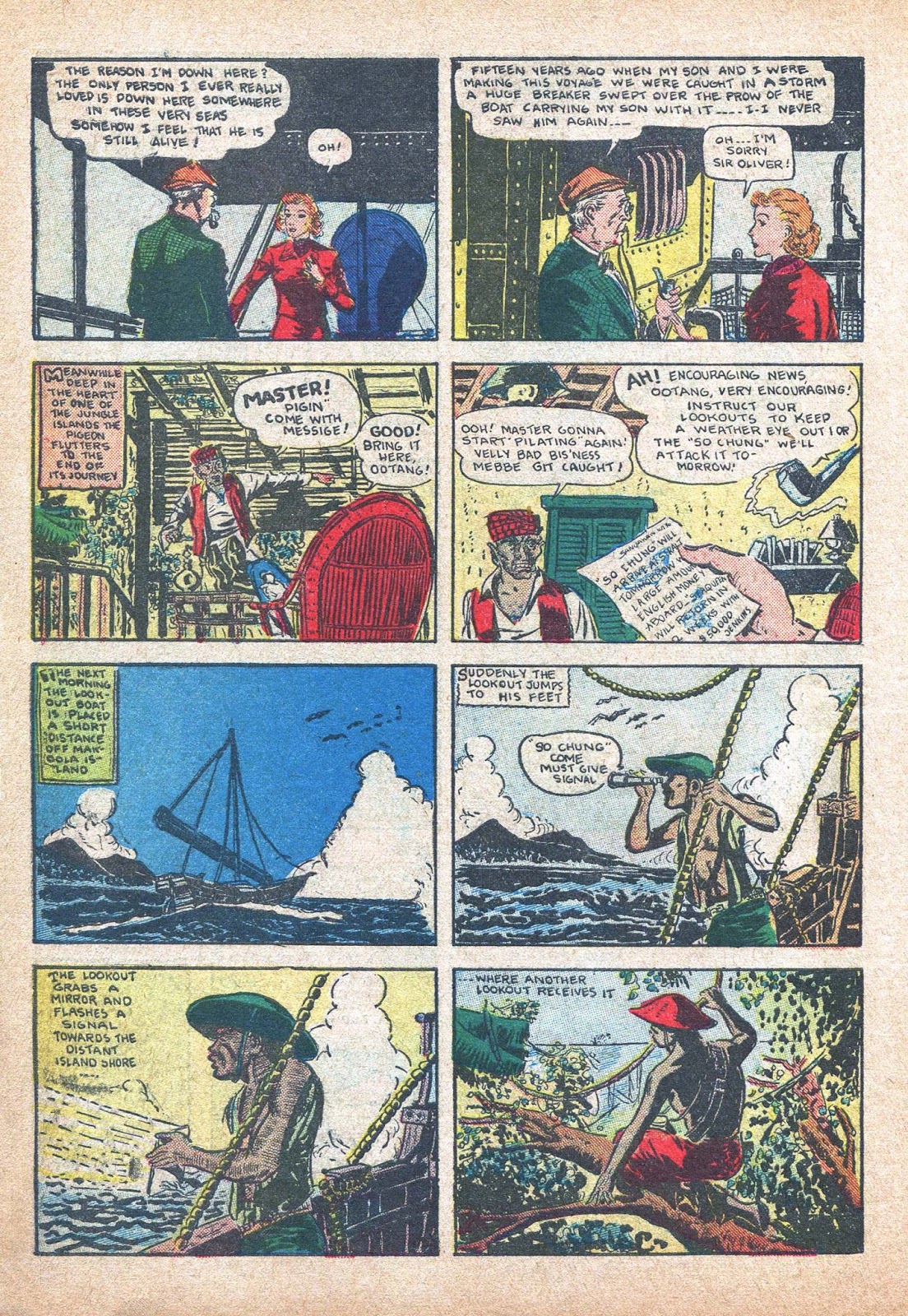
This is from a story called "The King of the South Seas." It posits that a pearl diving company could make $25,000 a month collecting pearls.


The manservant is a pretty awful stereotype, but the lookout is a strong ethnic character. Lookouts will turn up as a mobster-type in H&H later, though it's cut from the 2nd edition basic book for now.  Maybe it needs to have some skill or ability about signalling others over long distances.


That looks like an autocannon/anti-aircraft gun/heavy machine gun on the deck of the pirate ship -- and, by my research, there seems to have been little difference between those three circa 1939. I mention it because anti-aircraft gun is getting an entry in the H&H 2nd ed. basic book.


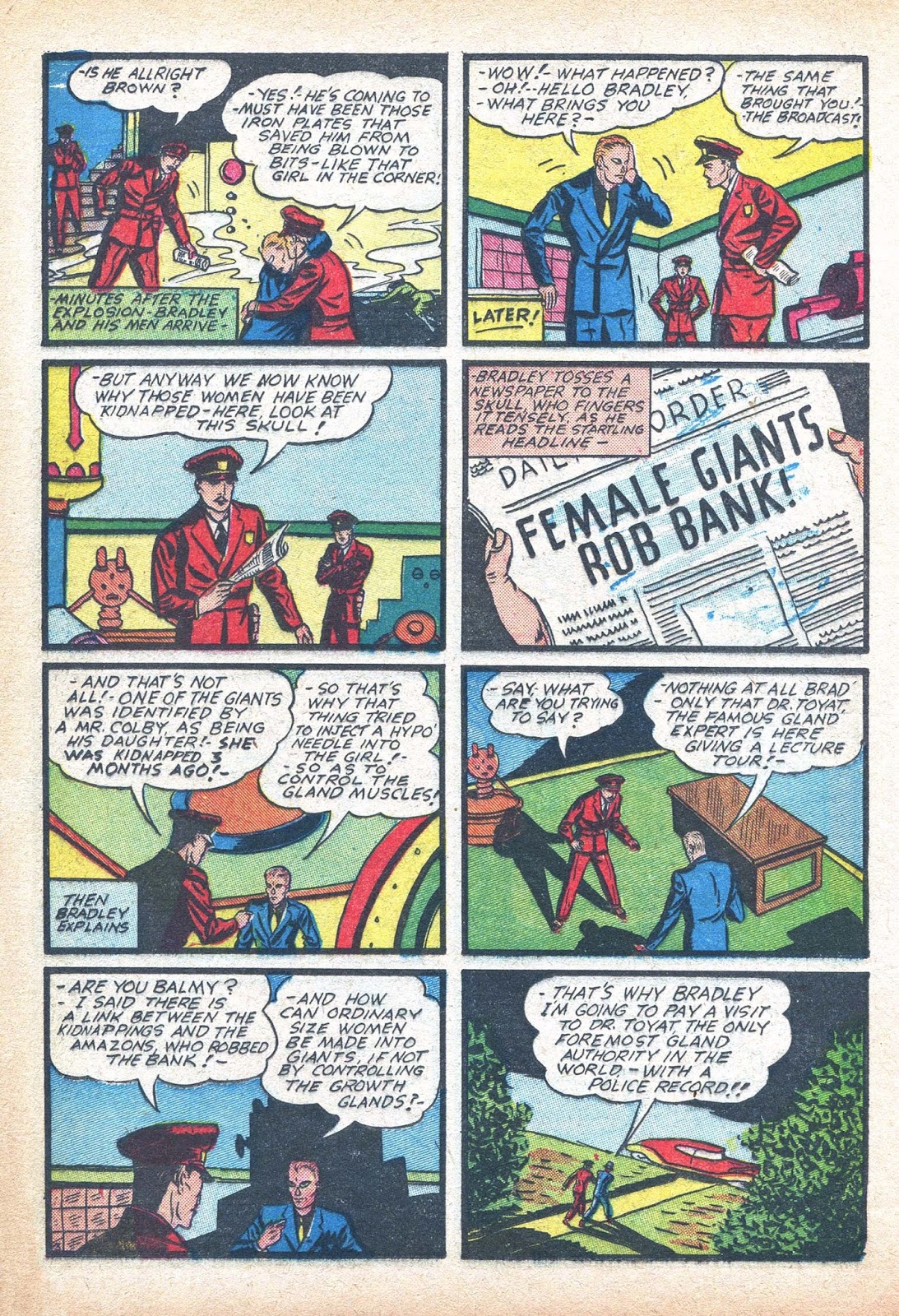
Three stories in, we not only get an origin story for Iron Skull, but we finally find out when his stories take place. This is a pretty bleak alternate future, where WWII dragged on at least until 1950, and it is now the "future" of 1960.

The Iron Skull sounds like a cyborg, but "android" works just as well and is the race he'd be in H&H. Other than him, color TV is the only other advanced technology so far...

In the future, you don't need to pick up a source from multiple directions to triangulate its source -- you just use a radio direction finder. They must be hard to come by, though, since Iron Skull has one but the police force doesn't.

Iron Skull is a superhero, but he doesn't wreck his way in, even though he easily could. Going for stealth, he uses a window like a mysteryman.

I need to give at least one of the robot types in H&H a self-destruct option.

It only takes Iron Skull minutes to recover, though it isn't clear if he was unconscious or just stunned somehow.

Giants being create-able through mad science needs to be reflected in their mobster stat entry.

(Scans courtesy of Digital Comic Museum)