Showing posts with label origin stories. Show all posts

Saturday, March 30, 2019

Miracle Comics #1 - pt. 2

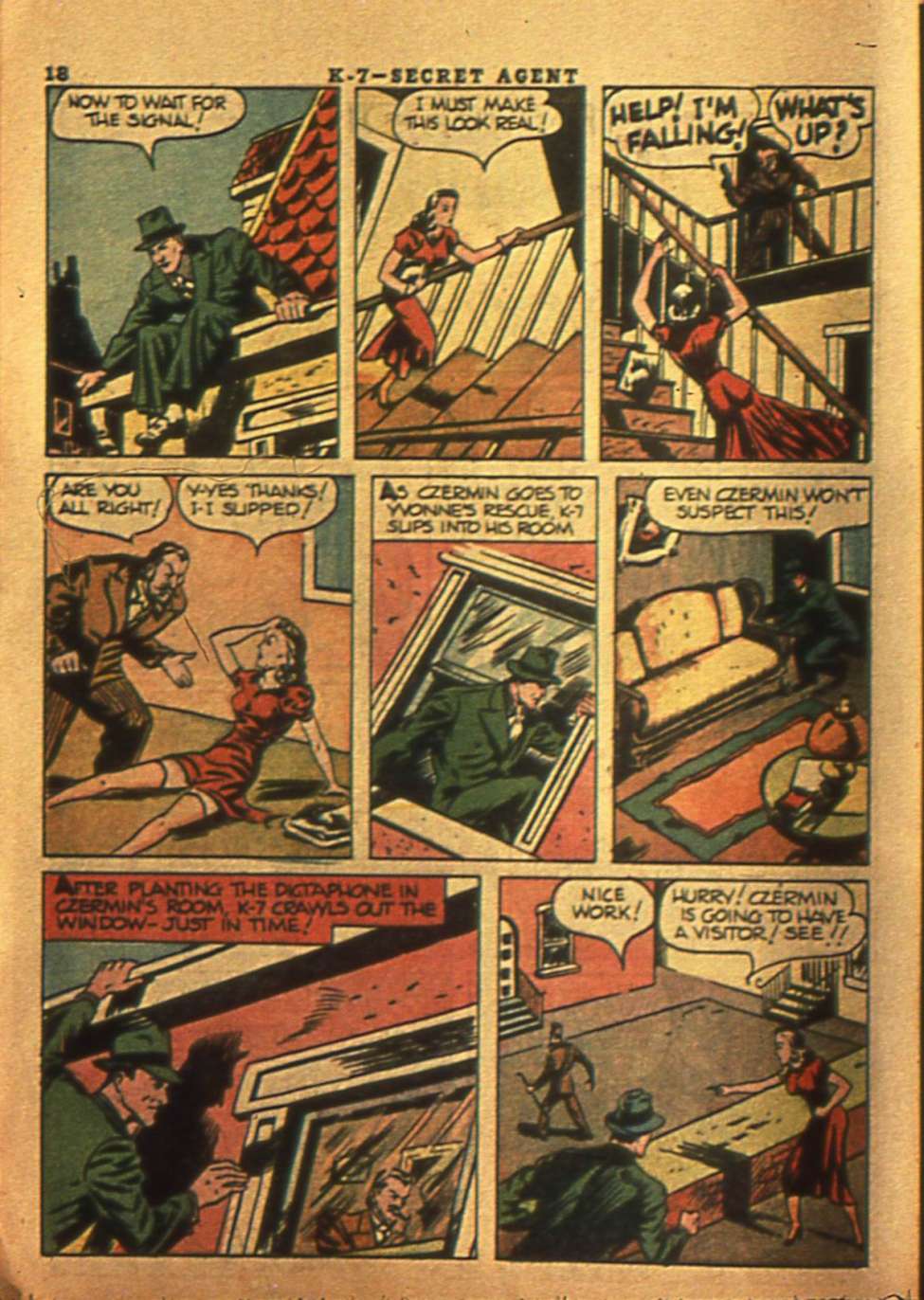
Your scream will be the signal? If I was K-7's supporting cast, that would not inspire confidence in me! (-1 penalty to loyalty checks?)
The question here is, is the villainous Czermin such a gentleman that he rushes to a lady's aid, or does he come rushing to see how high up Yvonne's hose goes? It's chancy, expecting your bad guy to do the right thing; I would ask for a save vs. plot to make sure that ruse worked.
Good thing Yvonne rolled to "hit" that hay cart, or her falling damage would have been 4-24 points and surely knocked her out cold.
This is a curious kind of scenario that you don't see often in comics, where the bad guys defeat themselves and it doesn't really matter if any good guys were there at all. I would not recommend using this often in a Hideouts & Hoodlums campaign.
This is Dash Dixon who, in return for helping a scientist, gets shot up full of drugs and then -- "Oh, I guess I forgot to tell you what I was doing to your body, Dash!" "Don't worry about it, Doc. As long as I don't get cancer from it, it's all good, right?"

Luckily, what happens is that Dash gets to become a superhero. And then he jumps up and hits the ceiling...which is weird because his strength has only tripled. Was he trying to leap 3' in the air for some reason, and then went 9?


A super man? That's a convenient choice of words. No, a super man is the level title for a high-level superhero; Dash is only a 1st level good man right now.

I also can't shake the feeling that Dash is dressed as a bellhop with a diaper over his uniform...
Panel 2 puzzles me, as I can't find any references online to air taxis before the 2000's. How common, then, was this term in 1940?

How high is that plane Dash jumps to? The lowest safe altitude for a plane is generally 500' (higher in heavily populated areas, or if the terrain is higher). Unless that plane is about to land -- and it does appear by its speed lines that it is descending -- then Dash jumps 62.5 times the current world high jump record, which is pretty high for someone who had their strength tripled. This is easily within the range of the Leap I power, though.
What game mechanic would a Hero use to keep from being crushed to death by the tremendous pressure of a plane wheel retracting? I would say hit points would be the main mechanic -- the wheel does crushing damage like being caught in a trap -- maybe 2-12 points of damage (or higher, for a larger plane). You can save vs. science to slip through and dodge the wheel, or activate a Raise power and negate the damage (because you can "lift" the wheel away from you automatically).

I'm having trouble even guessing which real life country the Republic of Scalene is based on. It kind of rhymes with Spain.

I like the secret exit from the basement, hidden inside a large cask -- though the steps in front of it might serve as a giveaway.

(Scans courtesy of Comic Book Plus.)

Wednesday, January 9, 2019

Daring Mystery Comics #2 - pt. 1

It's been some time since we last checked in on the fledgling company of Timely Comics.

It starts with Zephyr Jones and His Rocket Ship, firmly in the science fiction genre. Zephyr and his friend Corky are heading to Mars in a privately built rocket ship. Zephyr is right about how far it is to Mars, but either his calculations for travel time are off or mine are, because at the 300,000 MPH speed he claims he's going I think it would take five days to reach Mars instead of one. That speed is, incidentally, eight times faster than the fastest spacecraft ever launched from Earth up to the present day.

When the ship veers off course, it lands on a "lost planet" -- as if there could be an unnoticed planet between Earth and Mars. Actually, since the theory is floated later that this "planet" broke off of Earth ages ago, it's more factually a moon -- just one much smaller and in a far wider orbit. The moon is called Sunev (yes, Venus backwards, har har), and it not only has normal gravity and a breathable atmosphere, but it is inhabited by human-like aliens with feathery wings who call themselves the Birdmen and speak English. The birdmen live in a 19th century-like monarchy, but gunpowder was never discovered and the only science they are advanced in is chemistry. They have discovered an elixir that expands lifespan, so that the birdmen can live 300-400 years (there is no explanation given for how they have solved the overpopulation problem that would cause). There is a separate race/culture on the Sunev called (I'm not kidding either) the Parrotmen.  The Parrotmen are more muscular and brutish-looking, preferring to go shirtless in combat and fight with maces.

Zephyr and Corky, perhaps having not expected a safe journey into space, came armed with two automatic pistols and a Tommy gun, make short work of the parrotmen with their maces. After stopping the Parrotman uprising, Zephyr and Corky return to Earth before heading to Mars, which makes sense -- they would need all new calculations to change their trajectory from Senuv, and likely the Birdmen are not advanced enough mathematically to help them.

The Phantom Bullet, Scourge of the Underworld, is next.  Nearly washed-up and cynical newspaper reporter Allen Lewis works for the Daily Bulletin, a name just too generic to be able to trace to a particular real city.

Despite the fact that at least five people have examined a crime scene before him, Allen is the first person to find a bird feather clutched in the dead man's hand -- proof that it always pays to examine the scene of the crime for clues, no matter how much later. A police officer at the scene also gives him a freebie, telling him what might have been a randomly rolled rumor, that hand prints have been found at the scene of three crimes that seemed to belong to a seven-fingered person. 

Players often pay little or no attention to the private lives of their characters when not adventuring; seldom is that more on display than when Allen's player calls his boss an idiot and tells him to write the story himself, before running off to do hero work.

The first indication that Allen may be a mysteryman comes pages later, when Allen makes a spectacular -- though still far from superhuman -- leap between rooftops. But Allen is still 1st level -- indeed, still in his origin story -- and is handily beaten in his first turn of combat when ambushed by "birdmen" (see a theme developing between stories...?).

Amazingly, Allen still has his job the next day and gets assigned to talk to an inventor, who just randomly decides to hand off his "invention" to Allen -- a gun that shoots ice bullets. This is what Allen needs to complete his origin story; armed with the gun, wearing make-up on his face instead of a mask, and wearing a bright-colored shirt and red cape -- because, you know, he'll need to sneak around and stuff -- he sets out to stop more murders. Off-panel, the Phantom Bullet uses his skills to move silently and climb walls to get around the police cordoning off a threatened man's home.

This time Allen shoots and kills one of the bad guys when they show up again, but there is no sign that the man has feathers; he just seems to be an ordinary black man. We also learn the plot finally -- the bad guys are killing rich men who refuse to hand over $500,000 to help fund a new government. The other two make off with the money and Allen has to move on to the next would-be victim.

This time, the man doesn't refuse and the money is picked up by a bum Allen recognizes. Cornering the bum, Allen recovers the undelivered money and finds out where it was supposed to go, the address being a local cemetery. Now, it would be great if this was the bad guys' hideout -- a nice, atmospheric location. But the cemetery is empty. Allen goes back to the bum and re-examines the envelope with the address on it; the correct address is in invisible ink and the first address was a phony clue.

The real hideout is an African explorer's house, or more precisely the caverns under the house (the Phantom Bullet finds the caverns off-panel). *sigh* ... in a decidedly racist twist, the "bird men" turn out to be half-black men/half-ape mutants wearing feathered headdresses as if they were American Indians. This resembles the beast men race we talked about adding to Hideouts & Hoodlums a long time ago, but I think I would just stat them as ape men. There are not two more of them, but five more of them, and they're dumb enough that PB can trick them into following him back upstairs to a window and then all jumping out after him like lemmings. PB had swung himself up to the top of the window ledge, and then comes down to shoot the evil explorer, ending the story (and saving a kidnapped young woman who just happened to be in the caverns).
 
Next up is Trojak the Tiger Man, a Tarzan clone. Normally, Tarzan clones have to be raised by animals to speak to animals, but Trojak was raised by an African tribe of humans and just happens to know how to talk to animals anyway. He also gets a tiger for a starting companion. His tiger, Balu (showing this feature steals from The Jungle Book as well as Tarzan), is shot, but is only lightly injured by it.

Trojak himself is shown to be able to bend a gun barrel, which is either a really lucky roll for a non-superhero at wrecking things, or maybe Trojak is a multi-class fighter/superhero. Further, subtle evidence of Trojak being a superhero might be the strange case of the unnamed woman in the white hunting party Trojak encounters and follows. At first, the woman is fine with her companions and their quest for gold, but over the course of days of observing Trojak following them, she starts to show disgust with her fellow travelers and an admiration for Trojak that can only be explained as sexual attraction -- or maybe use of the power, Turn Good.

(read at fullcomic.pro)

Friday, August 31, 2018

Action Comics #20 - pt. 2

In Tex Thompson, racist caricature Gargantua T. Potts misses a morale save when he sees five zombies and faints. Text discovers that swallowing salt not only protects them from becoming zombies, but can reverse the zombification process (though this may be only true of "fresh" zombies; it is unclear if being a zombie longer makes it permanent).

After freeing the zombies, Tex forgoes fighting the whole tribe of natives by rushing straight to their chief and challenging him in single combat. Now, normally, the cliche is that this works and the Hero gets to win the scenario with just one fight -- but this time it doesn't work and Tex gets knocked out and put in a deathtrap (tied on a spit over a roaring fire) -- so maybe he tried to save vs. plot to make that happen and failed?

Likewise, the story makes use of the cliche of the chase over the rickety bridge spanning a deep chasm, and this time the natives do pursue across, like in the cliches, even when they see Tex cutting the ropes on the other side. Maybe they missed their saves vs. plot too.

The Three Aces are in the Koyukuk "Valley" in Alaska, which is a real place. Golden Age writers always seem more comfortable using real places if it's in Alaska. Gunner uses semaphore to communicate with the other two aces in their plane -- a rare instance of a language being used that not every Hero necessarily knows.

Gunner rescues a stranded father and daughter. The father is hurt, but Gunner gives him hot broth to "bring a stir of life to him." It is not the first time I have considered allowing healing after eating -- though I'm not there yet.

We learn that Gunner Bill is an orphan, possibly being the closest we ever get to an origin story for one of the Three Aces.

Gunner, the father, and daughter Tony are trapped in a blizzard for an entire week. Only after the week ends do they finally meet a wandering encounter, a pack of at least seven wolves. Very unusual for an adventure strip, the thugs who attacked Tony and her dad and left them stranded are caught and arrested behind the scenes, without the Heroes involved at all (which is what happens when you don't want to continue the scenario next time).

The Zatara story, curiously, takes place earlier in the summer of 1939. The "mist death" strikes in Africa, Asia, and Europe, killing hundreds every time the mist appears. It is not a choking hazard, but burns the skin like acid. The Prime Minister of England (if you squint really hard, it even looks like Neville Chamberlain a little) recruits Zatara to investigate.

Zatara is visited by a moon woman. Moon women are like full-sized Tinkerbells. This one is crazy; she thinks moon people came to Earth thousands of years ago and wiped out most human life. Zatara casts a "Fly" spell so he can accompany her from England to India in a matter of hours. The Fly spell does not allow transportation that fast, so they are more likely teleporting slowly -- unless some more powerful version of the Fly spell exists.

Instead of attacking from the Moon, the moon men are attacking from underwater caves off the coast of India. Unlike moon women, moon men look like 5' tall goblins, with green skin, big, orange, saucer eyes, and lower jaw tusks. It is unclear if the moon men have horns, if they just wear horns attached to the chainmail coifs they all appear to be wearing.

Zatara casts some kind of a spell that turns rays from the moon man's raygun into firecrackers. It seems overly-powerful that Zatara uses a spell powerful enough to transform energy into matter (that's a high-level polymorph spell -- at least 6th level!) to overcome a lone sentry, so perhaps it is a simpler weapon that makes weapons misfire (I could see that as a 4th level spell). Then -- because this is Zatara and he always burns his most powerful spells right away -- he also casts Wall of Stone (another 4th level spell) in front of the moon man as he's running away.  When he meets the moon men's dictator, he uses Telekinesis -- a third 4th level spell! -- to tip his throne over on him.

Zatara is attacked by nitons -- winged snakes (with sail-shaped wings) that have magic resistance and are immune to mind-affecting spells. Very unusual for Zatara, he has to flee from the nitons and uses Wizard Lock on their three remaining cages (maybe Wizard Lock should affect more than one portal?) so more nitons cannot be released. And then he casts Hold Person on the nitons' keeper (though the spell makes it appear that chains have wrapped around him).

The next two spells are confusing. To save Nala, the moon woman, when he finds she's been captured (the moon men view her as a different race, by the way), he casts a spell that makes a glass wall (Wall of Glass -- 2nd level spell?) appear around her. That keeps the moon men from harming her, but it does not explain how it gets her away from them by the next panel. Then Zatara casts a spell that teleports every net (nets are used for catching nitons) located in the moon men's sunken city into one big pile. This has got to be some advanced version of Teleport called Collect, and I would put it at 8th level (it can collect every example of one type of item found within a certain radius, so if you cast it to collect doors, every door in the hideout within a 1,000' radius, or something like that, would appear in a pile by you). Then he tosses a Fireball on the pile of nets, because the nets go up in a cloud of smoke. 

Next, Zatara casts Polymorph Any Object three times to turn the cages of nitons into pearls. He uses Polymorph Self to appear to be a moon man. He uses Charm Person -- a very rare 1st level spell! -- to make one of the moon men scientists his best friend and tell him their whole master plan.

Moon women can turn invisible. Nala claims moon women lived on Earth millions of years ago before migrating to the Moon. Although, bear in mind, she's a fruitcake. Zatara indulges her because he likes how she looks in a bikini.

Earlier, Zatara claimed the moon men were a thousand years more advanced than Earth men. Little bears that out, though the moon men do have a monorail, and they can turn radium into gaseous form (that accounts for the death mist). Zatara plans to kill all the moon men with a combination of the radium gas and the nitons -- though, to be fair, the moon men also plan to end all life on Earth, so it's kind of a kill or be-killed situation.

Zatara either owns a Cloak of Invisibility, or casts an Invisibility spell in the form of a cloak.

Zarara must have some spell cast on himself that protects him from radiation, as he withstands a lot of exposure to it while moving through the mist-filled city, more so than can be explained by his amount of hit points.

In a rare instance of Zatara claiming a trophy item, he takes a moon ray gun, which can wreck at short range.

Moon men and moon women were both statted in Supplement I: National.

(Read at fullcomic.pro.)


Friday, July 27, 2018

All-American Comics #8 - pt. 1

On to #8...

Which starts out with new feature Gary Concord, the Ultra-Man. This is another one of those future adventure stories, this one taking place in 2239, but our first installment is largely flashback to Gary's father -- who was born in 1915!  Gary Concord Sr. (the son in 2239 is really Jr.) was considered a military tactics prodigy by 1936. But after WWII, he became a scientist and worked on an invention until 1950 -- when WWIII happened. The U.S. was invaded; it's not specified by whom.  The invention is confusing too; it creates a scrubbing bubbles-like foam that heals, clears the mind, increases size, strength, and intelligence, and makes you immune to fatigue, but also puts you to sleep ala Buck Rogers.

In Red, White, and Blue, Whitey is knocked unconscious with a vase over the back of the head, then kicked while he's down. According to the rules, if he took additional damage while unconscious, he would be dead. However, one way of interpreting the 2nd edition "zero hit points" rule is that if you are simply stunned while at 0 hp (you made your save vs. plot), then taking additional damage then makes you unconscious (as if you had failed your save).  But then, a third source of damage should then still be lethal.  All of this, by the way, is contradicted by the story, where Whitey is still only stunned, even after what seems to be multiple kicks.

Meanwhile, Red is able to make phone calls to the State Department, Naval Headquarters, and the State Police, and they all just do whatever he asks them to. Red should be a level 4 fighter by now, which makes him a lieutenant, which means his ability to boss people around automatically should be much more limited than this. Red is also able to wreck his way through the roof of a truck in this story.

In Hop Harrigan, we learn that he keeps his plane stocked with a pair of shotguns. When mobsters turn a plane loose on the tarmac to endanger other planes, Hop and his Supporting Cast manage to lasso the plane and pull it to a stop.That's interesting - and surprisingly difficult to moderate using Hideouts & Hoodlums, since it doesn't used opposed rolling. Ability score checks would work, if I had Hop and friends roll under their Strength or less, but I've been super-hesitant to bring that game mechanic into play. What I might do is assign a Hit Die to the plane so it can make a save vs. science each turn to see if it is stopped or not.

In an aerial duel, Hop and Gerry use the Stay in Blind Spot stunt  -- which can't be as hard as I always made stunts out to be, because Gerry, and not Hop, is the pilot here. In fact, maybe all piloting stunts should be basic skills, since non-aviators in comics are able to do them so easily.  Hop, meanwhile, gets a "lucky shot" against the wing-mounted fuel tank with his shotgun. The complication forces the smugglers' plane to land.


Saturday, February 11, 2017

Amazing Man Comics #7 - pt. 3

We'll pick up where we left off with The Iron Skull. Here, he follows a hunch and checks in on this scientist (he handily just happens to know the address).

That Iron Skull is normally bulletproof, yet this hypodermic needle pierces his skin easily, is proof that I was on the right track with Armor Class for superheroes. Unless they are intentionally buffing themselves with defensive powers, they should always be vulnerable.

It's unclear what the needles contained, but the drug seems to have only rendered them unconscious.

It's interesting that the cage is located far underground -- suggesting a multi-level hideout -- yet there's a window in the room with the cage. Unless that's just a giant chart on the wall...


The giant women appear to be about 20' tall, making them around the size of cloud or storm giants in That Other Game. Cloud giants will be called moon giants in H&H 2nd edition, though they may not be included in the basic book. I'm tempted to stat these girls differently, as they are called Amazon giants in this story. These giants are so strong that they can accidentally wreck things.

Iron Skull is buffing himself offensively again.


Though 100 girls were kidnapped, only a few Amazon giants are encountered (by next page, we'll have seen 6 of them), suggesting a high rate of failure at transformation.

Here we have a precedent for grappling attacks being able to work despite size difference.

Iron Skull finally activates the one defensive power he's been saving, giving himself Super-Tough Skin. The breaking of the wrist is just flavor text; Iron Skull simply did x hit points' worth of damage while grappling.

Despite the fact that this is an underground secret passage, for some reason there is a hill covered in boulders inside it -- proving that hideout design can be totally random and make no sense.


The high-speed elevator here is essentially a trap -- stand underneath it and you'll take crushing damage, unless you can wreck it first. This is the only time this story Iron Skull using his wrecking things ability. Should there be a limit to how many times per day a superhero can wreck things?

You know, Dr. Toyat's jaw might have been healed better had he not taken the effort of saying out loud that it was out of place...

So that helmet machine is a ...giant shrinking machine? It seems pretty specific in its design to go over a giant's head. Note how dangerous it is to use if you don't know the right way to touch it when activated. Trophy items can have downsides like that.


Magician from Mars debuts this issue and it's got several firsts going for it here.  One, it's our first non-human magic-user hero. Two, it's our first half-alien (the half-alien race debuted in Supplement I: National).  Three, it's our first magic-user who gains powers through science, not through occult study. Four, it's the first and probably only instance of a cathode tube -- the same technology you would find in a TV set -- giving someone special abilities.

Our "1st level" magic-user demonstrates some sort of Mending spell, Minor Creation (the ice cream cone), and Telekinesis, all in the same afternoon. She must have at least two brevet ranks to raise her up in level high enough where she can cast three or more spells per day.


This page makes some rather bold assertions, that Jane can destroy time and space, run faster than anyone, think quicker than anyone, and she knows more than anyone in the universe -- but all we see her do is use a Levitate or a Fly spell, and use Telekinesis on a weight, admittedly, heavier looking than the spell would normally allow.

(Scans courtesy of Digital Comic Museum)


Saturday, February 4, 2017

Detective Comics #33 - pt. 1

This is the issue that gave us Batman's famous, two-page origin story. This story is also the origin of both the "cowardly" and "superstitious" hoodlums, from Bruce's famous speech about "criminals are a superstitious cowardly lot."

When the real adventure begins, Bruce Wayne observes scarlet rays. These rays have multiple effects -- they can blind people and wreck buildings (probably at least as well as a 6th level superhero). Since thousands are killed in a single attack, we can assume they have a large range and a wide area of effect.

Prof. Carl Kruger is at least our 2nd Napoleon mobster in comics -- though I'm still not seeing a lot of justification for statting it differently like I did before in 1st edition. Maybe Napoleons are just master criminals or master criminal/scientists.

Batman hurls his Baterang as a missile weapon for the first time here, but Kruger is protected by a glass wall he keeps in his office between his desk and the window (perhaps wary of snipers?). Batman is overcome with a surprise head blow from behind (already going in 2nd edition).

Kruger's death trap is to leave Batman tied up with rope on the floor with a bomb set to go off in five minutes. Why Kruger wants to blow up his own house isn't clear, other than that he's obviously crazy. Batman cuts his bonds with a blade concealed in his boot and escapes in time. Luckily, Kruger never checked his boots -- or even peeked under his mask! (Save vs. plot to make sure villains don't do anything that obvious to you when you're captured.)

Batman doesn't escape entirely, though. His bleeding lip seems to indicate he took some of the blast, just not enough to kill him. An explosion would normally require a save vs. science for half damage, but with a deathtrap maybe it should be a save vs. plot for half damage, with a failed save meaning death instead of twice the damage.

Batman's not a great fighter yet in these early stories, but he's smart. He doesn't know where Kruger fled to, but Kruger unwisely told him the names of his lieutenants and one, apparently, has a publicly known address. Batman confronts him, tells him to take a message to Kruger, and then follows him in his Batplane (still the auto-gyro).  Of course, Batman would have been sunk had the lieutenant simply called Kruger on the phone...

Batman has a glass vial that, when it breaks, surrounds the Batplane in a thick smokescreen that clings to the plane. How this doesn't blind Batman isn't clear.

Guards can be really stupid. They see a smokescreen hovering in the sky and mistake it for a raincloud. I think even Winnie-the-Pooh would have seen through this.

Smaller (I presume weaker) versions of the scarlet death-rayguns can be mounted on trucks. They're delicate though -- one shot and they all blow up. Kruger explains soon thereafter that the death ray is a combination of ozone and gamma rays.

This is the first story in which Batman's life is saved by a bulletproof vest. This time, the bullets still knock him out and make him bleed (superficially).  On later occasions, bullets will just bounce off him because of the vest (maybe he has a Vest +1 by then).

Then Bruce Wayne whips up -- and I'm not making this up -- an anti-death-ray chemical spray to coat his Batplane with. This was the story that made me decide Batman had to be dual-statted as a mysteryman/scientist for Supplement IV.

The first Batplane is destroyed when Batman crashes it into Kruger's blimp, from which the scarlet death-rays are being fired.

Kruger apparently had an army of 2,000 mercenaries, though we never saw more than him, his three lieutenants, and two guards. After Kruger dies, Batman seems to sit back and let the authorities round up the army.

The next installment of Spy has to do with the country of "Luxen" -- a very poorly disguised Luxembourg suffering a bloodless annexation from "Thoria" (Germany). The story is interestingly prophetic, as this was 1939 and Luxembourg wasn't invaded until the following year -- and it was largely bloodless! The government did flee the country, but to the UK, not the US.  Past that, details seem strangely altered; Luxen has a male president instead of a female duchess. Also, in real life, the duchess fled with her family, which makes more sense than what the president does -- leaving his family behind so they can be threatened as hostages.

Bart Regan seems more observant than normal; he spots a wire hanging down behind a painting and immediately recognizes that it's a dictaphone wire.

The Luxen president's speech is interrupted by what appear to be mountebanks -- or so I call them in a new stat block for 2nd edition. Mountebanks, or rabble rousers, are able to get a growing number of innocent bystanders to start fighting.

And I learned a vocabulary word in this story -- plebiscite. Though it is consistently misspelled "plebecite."

Buck Marshall, Range Detective plays for high stakes when he has a defend a played out mine suddenly valued at $500,000. I learned the term "salting a mine", a con where you add extra gold to the random samples to make the mine seem more valuable.

Buck slips into a shack through a window because the front door is padlocked. It's important to keep in mind that, in modern times, we have multiple ways of locking doors. A padlock is relatively easy for Heroes to foil -- they might be able to wreck it with bolt cutters (though at a -4 penalty, if a non-superhero), or it can be shot off with a bullet if the bullet hits AC 7. Buck didn't want to make that much noise...

Buck didn't bring his own light source, though, so the Editor was gracious and left a lamp sitting out in the dark interior.

(Batman stories read in Batman Archives vol. 1; the rest read at Readcomics.net


Friday, July 10, 2015

The Comics #5

Our tour of 1937's comic books continues with this Dell anthology and a page of Wash Tubbs.

A top hat for $18. A bottle of perfume for $10. They're intentionally high-end prices, but still an indication of what Heroes might have to pay.


A Hero can keep taking damage so long as he hasn't run out of hit points -- but can he keep taking it without flinching?  The Arizona Kid would have to save vs. plot to avoid flinching. The Editor could even assign a modifier, such as a penalty for every point of damage minus the Hero's level.


Sombrero Pete has fallen into some Aztec ruins, ruins guarded by a trapped statue rigged to slam its fists down on the first intruder to come within range (one-time attack roll, as if a high-HD mobster?).

The ruins conceal a lost world still populated by primitive and superstitious Aztecs.


The Magic Draught sounds like a magic item/trophy, one that can not only heal serious wounds, but transform the imbiber into a Superhero!  This story could also be re-used as the origin story for a modern-day superhero...


And we end with a goat joke #10 in my running tally!

(Scans courtesy of Digital Comic Museum)