We're back and still looking through Fiction House's Jungle Comics #3 and seeing what lessons we can apply to running or playing my RPG Hideouts & Hoodlums from it.
This is Captain Terry Thunder of the Congo Lancers. The geography seems way off here, since the Congo is in central Africa, he desert is in northern Africa, and then they somehow find swamps, followed by more desert, before coming back to the jungles. Did they just make a big circle?
Regardless, the lesson we can take away from this is that the details of travel can be glossed over to get us to the main story.
You might feel as uncomfortable as I do looking at how the Africans are colored on this page. Now, in 4-color coloring, blue highlights often accompany something that is supposed to be interpreted as all-black, but you usually don't see this applied to black people.
That said, the natives show some clever tactics in the last panel. While Terry can do nothing but try to resist the grappling attack, the other three are all free to try and beat him with their (spiked?) clubs. Now, there is an element of risk for them as well; I would rule that, if you were trying to attack an opponent being grappled, and you miss, you have to roll again to see if you hit the grappler on your side instead.
"Smitten from ambush?" Are the natives using Cupid's arrows on them? What strange wording.
I also checked; grass rope is a real thing.
This is Wambi the Jungle Boy. I don't think much of Wambi, but these two trappers have a super-inflated idea of his value. Worth a million, in 1940 dollars, for being able to talk to animals? I'm skeptical...
Especially since animals have no problem talking to each other, across species lines.
It's remarkable that, just from word getting through the animal grapevine that Wambi is in trouble, an elephant and at least 11 gorillas show up to rescue him. It seems unlikely that Wambi would have this many support cast member animals, but perhaps his SCMs joined up with a wandering encounter...?
I like to share unusual disarming attacks; this could be the first time we've ever seen a man disarmed with an orange.
This is from the next story, Roy Lance. "Nyama" is the word for spirit, used by the Dogon people of Africa. Did the author, know that, or was it a lucky guess?
More evidence of natives using poisoned weapons.
You don't often hear about cattle herding in Africa, but that's legit; they do keep cattle herds over there.
The last story we'll look at today is Simba, King of Beasts -- you know, Disney's other source material for The Lion King other than Hamlet. Simba, in turn, seems to have The Jungle Book as some of its source material, so that leaves me wondering if the boy isn't paralyzed with hypnosis instead of fear, ala Kaa. Regardless, not being able to do anything is one of the eight random results of a failed morale save now, in Hideouts & Hoodlums 2nd edition, so maybe it really is fear.
Of course, that reminds us that the boy is not a played Hero in this scenario, but a Supporting Cast Member under the control of the Editor. Simba is the Hero, obviously classed as a Fighter, with the Editor allowing Lion as a playable race. The Lions special abilities are being able to attack with bite and claw attacks, and hopefully a few extra Hit Dice too, or he's toast against this wandering encounter of an angry rhino.
(Scans courtesy of Comic Book Plus.)
An exploration of the Golden Age of Comics, through the lens of Hideouts & Hoodlums, the comic book roleplaying game.
Showing posts with label Captain Thunder and the Congo Lancers. Show all posts
Thursday, April 9, 2020
Jungle Comics #3 - pt. 3
Wednesday, April 17, 2019
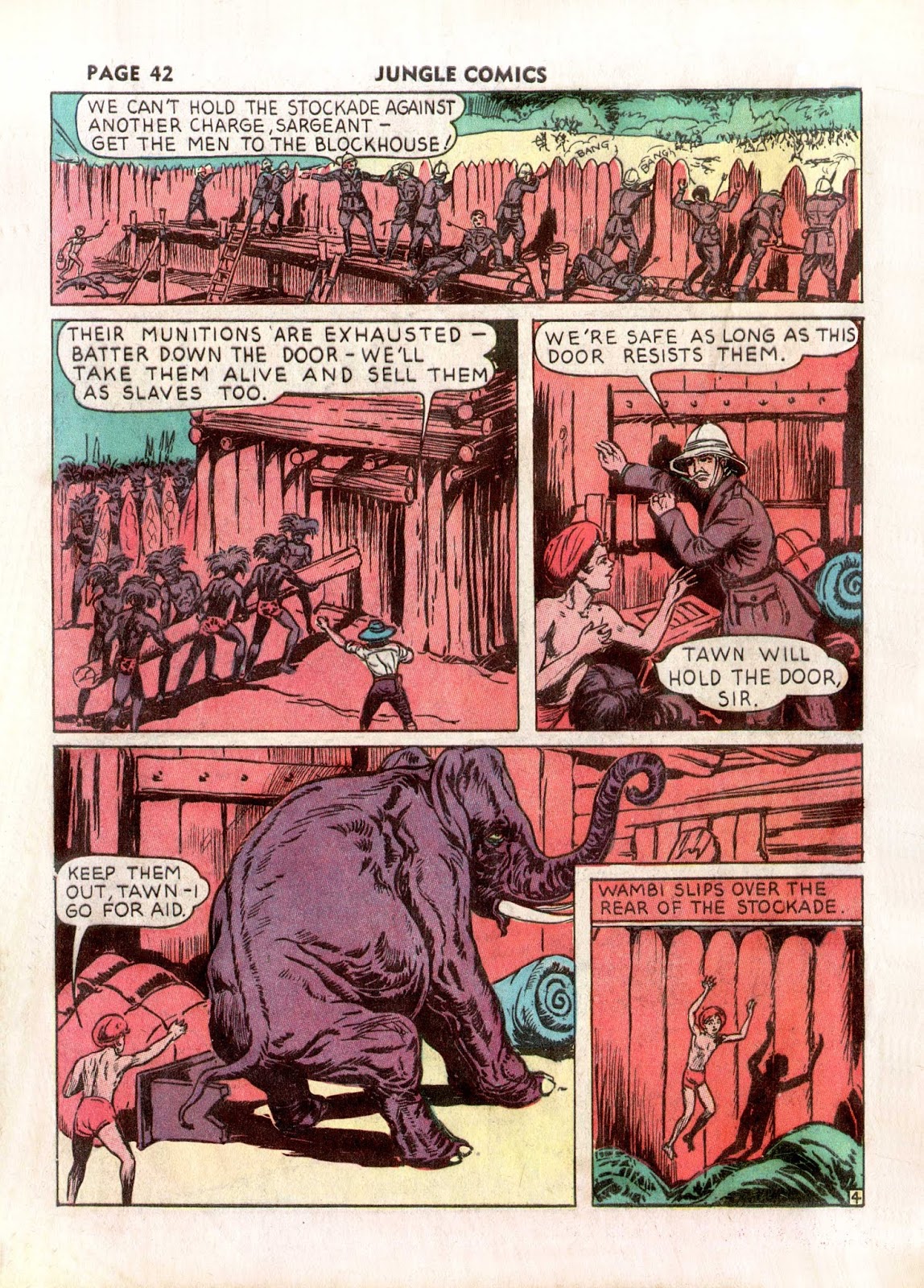
Jungle Comics #2 - pt. 3
We're still looking at Captain Terry Thunder of the Congo Lancers ("Terry" has been added to the title since last issue). I like that fifth panel; in a RPG scenario, each man's secret could be shared with the player only and, although the published scenario here was all combat, in game everyone could have the secondary goal of trying to figure out everyone else's secret past through roleplaying.
This is Wambi, the Jungle Boy. Wambi has the ability, like most jungle explorers seem to do, of summoning animals. Here, we see nine monkeys encountered at once.
Wambi, forced to choose between the people who raised him and some white guys he just met last issue, chooses to betray his own people. Okay, sure, they turn out to be slavers -- but those slavers wiped your bottom when you are a baby, kid!
Speaking of number appearing, here we see at least 40 natives, and is probably meant to represent much more than that.
"What the devil? How did the elephant get in my blockhouse? And how is there room for him in here? Is he sitting on all my men?"
Of course, in the early days of D&D, you could put 20 orcs in a 10' x 10' room and no one batted an eye, but nowadays you should put a little more sense into spaces than that...
This is from Roy Lance, a feature best remembered for its good sense of geography and ethnography. The Riffians are indeed a real people, also known as Riyafa or Rwafa, and a Berber-speaking people of Northwestern Africa. Everyone has heard of Ethiopia today, but that might have been an obscure country in 1940. The Zulu are a Bantu ethnic group of Southern Africa and the largest ethnic group in South Africa. Not surprisingly, the author cannot name a real cannibal or pygmy people from Africa.
This page is all kinds of wrong -- Joan is being spanked, with a native gleefully watching, for being a free thinker and feeling like she shouldn't have to obey a man. 1940 was a tough time to be a woman.
The map is serviceable, though, with a mix of real locales, like the Congo River and Stanley Falls, with names that I can't verify are real. Twice, upon seeing Wakuna in this story, I thought "Wakanda...?" Probably not intentionally similar.
Now, seeing all the "primitives" running in fear from a film projection might seem racist to you, but bear in mind this trick also works on Scooby Doo. It just seems to be a given of the comic genre that visual and audio trickery is much more compellingly realistic than it would be in real life. So, as the Editor, keep an open mind when your players try nonsense like this.
This is from Simba, King of Beasts. It takes a lot of imagination to picture a water buffalo being the deadly nemesis of a lion, but now I'm just going to have to make sure to stat water buffalo -- and make them nasty!
I included this page because I realized there were actually few examples I had found so far in comics of outdoor tracking. This was the primary ability of the 1st edition explorer class, but maybe that can't be justified by direct emulation after all...
(Scans courtesy of Digital Comic Museum.)
This is Wambi, the Jungle Boy. Wambi has the ability, like most jungle explorers seem to do, of summoning animals. Here, we see nine monkeys encountered at once.
Wambi, forced to choose between the people who raised him and some white guys he just met last issue, chooses to betray his own people. Okay, sure, they turn out to be slavers -- but those slavers wiped your bottom when you are a baby, kid!
Speaking of number appearing, here we see at least 40 natives, and is probably meant to represent much more than that.
"What the devil? How did the elephant get in my blockhouse? And how is there room for him in here? Is he sitting on all my men?"
Of course, in the early days of D&D, you could put 20 orcs in a 10' x 10' room and no one batted an eye, but nowadays you should put a little more sense into spaces than that...
This is from Roy Lance, a feature best remembered for its good sense of geography and ethnography. The Riffians are indeed a real people, also known as Riyafa or Rwafa, and a Berber-speaking people of Northwestern Africa. Everyone has heard of Ethiopia today, but that might have been an obscure country in 1940. The Zulu are a Bantu ethnic group of Southern Africa and the largest ethnic group in South Africa. Not surprisingly, the author cannot name a real cannibal or pygmy people from Africa.
This page is all kinds of wrong -- Joan is being spanked, with a native gleefully watching, for being a free thinker and feeling like she shouldn't have to obey a man. 1940 was a tough time to be a woman.
The map is serviceable, though, with a mix of real locales, like the Congo River and Stanley Falls, with names that I can't verify are real. Twice, upon seeing Wakuna in this story, I thought "Wakanda...?" Probably not intentionally similar.
Now, seeing all the "primitives" running in fear from a film projection might seem racist to you, but bear in mind this trick also works on Scooby Doo. It just seems to be a given of the comic genre that visual and audio trickery is much more compellingly realistic than it would be in real life. So, as the Editor, keep an open mind when your players try nonsense like this.
This is from Simba, King of Beasts. It takes a lot of imagination to picture a water buffalo being the deadly nemesis of a lion, but now I'm just going to have to make sure to stat water buffalo -- and make them nasty!
I included this page because I realized there were actually few examples I had found so far in comics of outdoor tracking. This was the primary ability of the 1st edition explorer class, but maybe that can't be justified by direct emulation after all...
(Scans courtesy of Digital Comic Museum.)
Labels:
Captain Thunder and the Congo Lancers,
Explorer,
locations,
map,
mobster placement,
mobsters,
new mobsters,
number appearing,
Roy Lance,
scenarios,
sexism,
Simba,
tactics,
tracking,
Wambi
Monday, April 15, 2019
Jungle Comics #2 - pt. 2
Tabu, not you too! Once-staunch defender of the wilderness, Tabu now slaughters animals willy-nilly to defend any man he sees. This has got to me my absolute least favorite part of the golden age -- this cheerful acceptance of animal death.
On the surface, Tabu drawn by R. L. Golden certainly looks better than by his creator, Fletcher Hanks, but it also looks more normal and mundane -- even when Tabu turns into a tree!
The elephant's graveyard is certainly supposed to be more impressive than it is, as it appears to only be the graveyard of three elephants.
One thing I do really like about this story is how Tabu discourages the youth from seeking revenge, but encourages him to let cosmic justice take its course (which happens, of course, because this is a comic book).
===
Some game notes: Tabu uses ordinary grappling attacks on the lions, perhaps buffed by some powers, if Tabu is a magic-user/superhero, as I suspect. For the Advanced Hideouts & Hoodlums Heroes Handbook, I have been working on a mystic class that combines them both.
Evidence of gorillas being encountered in groups as large as five. It's odd that gorillas are actually social animals, but in comic books they are almost always encountered individually. This is also an example of pacing an encounter so the Heroes do not face all the mobsters at once.
There is, interestingly enough, a Tree spell in the original game that inspires H&H. I'll have to see if there's an open license version of that spell, or if I'll have to create something of my own.
======
This is a really curious story because it is actually a retconned retelling of the story in the previous issue -- something that almost never happens in comic books (except maybe in flashback). The white man's name is altered and the ending is altered so that Camilla lives. Someone may have thought after last issue went to press "Oops -- if we're going to name our feature after Camilla, it might be a good idea if Camilla survives."
I can find no evidence that a city named Kaza ever existed in Africa, but interestingly there is a KAZA now -- the Kavango–Zambezi Transfrontier Conservation Area.
That is one curious little rocket ship. Or, at least, it would have seemed strange in 1940 -- today we would call that a drone.
...As you can see here.
There's a very curious thing about these "natives." They look an awful lot like robots, yet they're never referred to as robots (or automatons, or anything but natives), and the narrator even tells us John kills several of them. Now, it's possible that the narrator is speaking from John's perspective, and how he thinks he's killing real people.
It's interesting that flexodium is a ray -- so it's a type of energy -- but it discussed as if it was a metal. Very likely this stems from a lack of understanding about how radiation works, which may have been commonplace in 1940.
Other than wanting to destroy western civilization, Camila doesn't sound so bad. Robbing ivory caravans is something I would be quite comfortable with letting Heroes of any Alignment do in my campaigns, though that is from my modern perspective, of course.
By "torpedo" she must mean rocket, and if her rockets can really reach space, her's beat German's V-2 rockets there by four years.
Once again, the very robot-like people are called nothing but guards.
=====
Game notes: 4 to 1 odds is overwhelming for John -- but if the Editor took a mulligan on their first gaming session, should John get to keep the XP from it?
We've seen so many paralysis rays already in comic books by now, but this time it's called an electric radio beam (which sounds like it would help your radio get good reception rather than paralyze someone).
I'm not crazy about Congo Lancer stories -- but I'm crazy about that map! If I was super-ambitious (I mean, more than I am now), I would try drawing a Editor's map of my campaign area that shows pictures of all the animals in that region and where they can most often be encountered.
That is one weird middle panel, with the crocodile just laying there, minding his business, while the radio waves talk over him.
(Scans courtesy of Digital Comic Museum.)
On the surface, Tabu drawn by R. L. Golden certainly looks better than by his creator, Fletcher Hanks, but it also looks more normal and mundane -- even when Tabu turns into a tree!
The elephant's graveyard is certainly supposed to be more impressive than it is, as it appears to only be the graveyard of three elephants.
One thing I do really like about this story is how Tabu discourages the youth from seeking revenge, but encourages him to let cosmic justice take its course (which happens, of course, because this is a comic book).
===
Some game notes: Tabu uses ordinary grappling attacks on the lions, perhaps buffed by some powers, if Tabu is a magic-user/superhero, as I suspect. For the Advanced Hideouts & Hoodlums Heroes Handbook, I have been working on a mystic class that combines them both.Evidence of gorillas being encountered in groups as large as five. It's odd that gorillas are actually social animals, but in comic books they are almost always encountered individually. This is also an example of pacing an encounter so the Heroes do not face all the mobsters at once.
There is, interestingly enough, a Tree spell in the original game that inspires H&H. I'll have to see if there's an open license version of that spell, or if I'll have to create something of my own.
======
This is a really curious story because it is actually a retconned retelling of the story in the previous issue -- something that almost never happens in comic books (except maybe in flashback). The white man's name is altered and the ending is altered so that Camilla lives. Someone may have thought after last issue went to press "Oops -- if we're going to name our feature after Camilla, it might be a good idea if Camilla survives."
I can find no evidence that a city named Kaza ever existed in Africa, but interestingly there is a KAZA now -- the Kavango–Zambezi Transfrontier Conservation Area.
That is one curious little rocket ship. Or, at least, it would have seemed strange in 1940 -- today we would call that a drone.
...As you can see here.
There's a very curious thing about these "natives." They look an awful lot like robots, yet they're never referred to as robots (or automatons, or anything but natives), and the narrator even tells us John kills several of them. Now, it's possible that the narrator is speaking from John's perspective, and how he thinks he's killing real people.
It's interesting that flexodium is a ray -- so it's a type of energy -- but it discussed as if it was a metal. Very likely this stems from a lack of understanding about how radiation works, which may have been commonplace in 1940.
Other than wanting to destroy western civilization, Camila doesn't sound so bad. Robbing ivory caravans is something I would be quite comfortable with letting Heroes of any Alignment do in my campaigns, though that is from my modern perspective, of course.
By "torpedo" she must mean rocket, and if her rockets can really reach space, her's beat German's V-2 rockets there by four years.
Once again, the very robot-like people are called nothing but guards.
=====
Game notes: 4 to 1 odds is overwhelming for John -- but if the Editor took a mulligan on their first gaming session, should John get to keep the XP from it?
We've seen so many paralysis rays already in comic books by now, but this time it's called an electric radio beam (which sounds like it would help your radio get good reception rather than paralyze someone).
I'm not crazy about Congo Lancer stories -- but I'm crazy about that map! If I was super-ambitious (I mean, more than I am now), I would try drawing a Editor's map of my campaign area that shows pictures of all the animals in that region and where they can most often be encountered.
That is one weird middle panel, with the crocodile just laying there, minding his business, while the radio waves talk over him.
(Scans courtesy of Digital Comic Museum.)
Sunday, March 25, 2018
Jungle Comics #1 - pt. 3
This is what happens when you make your subjects wax their chests and go around shirtless all day instead of explaining to them how electrodes work.
After running Hideouts & Hoodlums for a long time now, I've noticed that using a d6 for mobster hit points, instead of the d8 I used to be accustomed to using when running AD&D, really makes a difference in finishing fights faster. And, while I sometimes regret when a fight ends faster when my sense of drama tells me it should have ran longer, pages like this with their "killed in one shot" fights remind me that stretched-out battles have little place in H&H.
I'm guessing the secret formula in the ring is for the longevity potions. But if they were such a bad idea, why is she sharing it...?
What? Okay, Dale, we get that you're not getting along with the locals, but maybe you can sit down and discuss your differences with them, look for common ground. Wait, what are you doing with that torch, Dale? Why are you -- FOR THE LOVE OF GOD, DALE, YOU DIDN'T HAVE TO KILL ALL OF THEM!!
I think Jon Dale's player just saw this whole scenario as a quick XP grab.
That fortress looks real tiny, but I like the 3-D layout, with its multiple levels. Make those skeletons undead and you've got a cool adventure locale from that one picture!
If H&H had more outdoor survival rules, there would probably be something about a 1 in 6 chance of mishap while fording rivers.
It would be highly unusual for that to happen in H&H, where the slavers get a surprise attack, but then are still unseen afterwards. For the sake of fairness, anyone who attacks is visible to retaliatory attacks in combat.
Slavers, incidentally, are going to be a mobster type in the AH&H Mobster Manual.
It's worth noting that Terry never actually finds the secret entrance. Instead he just stumbles on a pit trap that happens to lead into the secret underground tunnel.
The snake might be a set or a wandering encounter in the tunnel. Wrapping it in a shirt might be a bit of a stretch for the grappling rules and is more of an entangling attack, like dropping a net on someone. I think the real stretch, though, is that he held it in his shirt all that time until the slavers showed up, hours later?
Lots of things to cover on this page. First, the slavers are working with thugs, apparently.
It might make sense to give a morale bonus if the bad guys outnumber the good guys (say, +2 for 3 to 1 odds?). I don't like to include a lot of formulas for modifiers in the rules, leaving it to the Editor to decide on what the situation warrants.
Cover sure comes in handy.
We solved the mystery of how all those soldiers kept dying -- they died of boredom, having to play Solitaire with only five cards.
I guess the trap door was a secret door from the top side, since you can't find a secret door without looking for it. Even a concealed door you would figure a guard would have stumbled across eventually.
I call shenanigans on that rock attack, and not on a rock rolling down a slope being an effective weapon. I question why the three thugs would be running up the slope in such tight formation that the rock could hit all three of them. It would have made more sense to spread out and try to flank him, even before figuring out what he planned to do with that rock.
This is Sabu -- I mean, Wambi the Jungle Boy, who is an Indian boy, in Africa? It's a confusing mash-up (on the previous page we had gold miners panning for gold in a stream in Africa -- was that ever a thing in Africa?).
The clearest thing is that I'd never allow a low-level hero to have an elephant as supporting cast. Because they can trample all over an entire village.
(Scans courtesy of Digital Comic Museum.)
After running Hideouts & Hoodlums for a long time now, I've noticed that using a d6 for mobster hit points, instead of the d8 I used to be accustomed to using when running AD&D, really makes a difference in finishing fights faster. And, while I sometimes regret when a fight ends faster when my sense of drama tells me it should have ran longer, pages like this with their "killed in one shot" fights remind me that stretched-out battles have little place in H&H.
I'm guessing the secret formula in the ring is for the longevity potions. But if they were such a bad idea, why is she sharing it...?
What? Okay, Dale, we get that you're not getting along with the locals, but maybe you can sit down and discuss your differences with them, look for common ground. Wait, what are you doing with that torch, Dale? Why are you -- FOR THE LOVE OF GOD, DALE, YOU DIDN'T HAVE TO KILL ALL OF THEM!!
I think Jon Dale's player just saw this whole scenario as a quick XP grab.
That fortress looks real tiny, but I like the 3-D layout, with its multiple levels. Make those skeletons undead and you've got a cool adventure locale from that one picture!
If H&H had more outdoor survival rules, there would probably be something about a 1 in 6 chance of mishap while fording rivers.
It would be highly unusual for that to happen in H&H, where the slavers get a surprise attack, but then are still unseen afterwards. For the sake of fairness, anyone who attacks is visible to retaliatory attacks in combat.
Slavers, incidentally, are going to be a mobster type in the AH&H Mobster Manual.
It's worth noting that Terry never actually finds the secret entrance. Instead he just stumbles on a pit trap that happens to lead into the secret underground tunnel.
The snake might be a set or a wandering encounter in the tunnel. Wrapping it in a shirt might be a bit of a stretch for the grappling rules and is more of an entangling attack, like dropping a net on someone. I think the real stretch, though, is that he held it in his shirt all that time until the slavers showed up, hours later?
Lots of things to cover on this page. First, the slavers are working with thugs, apparently.
It might make sense to give a morale bonus if the bad guys outnumber the good guys (say, +2 for 3 to 1 odds?). I don't like to include a lot of formulas for modifiers in the rules, leaving it to the Editor to decide on what the situation warrants.
Cover sure comes in handy.
We solved the mystery of how all those soldiers kept dying -- they died of boredom, having to play Solitaire with only five cards.
I guess the trap door was a secret door from the top side, since you can't find a secret door without looking for it. Even a concealed door you would figure a guard would have stumbled across eventually.
I call shenanigans on that rock attack, and not on a rock rolling down a slope being an effective weapon. I question why the three thugs would be running up the slope in such tight formation that the rock could hit all three of them. It would have made more sense to spread out and try to flank him, even before figuring out what he planned to do with that rock.
This is Sabu -- I mean, Wambi the Jungle Boy, who is an Indian boy, in Africa? It's a confusing mash-up (on the previous page we had gold miners panning for gold in a stream in Africa -- was that ever a thing in Africa?).
The clearest thing is that I'd never allow a low-level hero to have an elephant as supporting cast. Because they can trample all over an entire village.
(Scans courtesy of Digital Comic Museum.)
Labels:
Alignment,
Camilla Queen of the Lost Empire,
Captain Thunder and the Congo Lancers,
cover,
Hit Dice,
maps,
mobsters,
morale,
new mobsters,
outdoor survival,
scenarios,
secret doors,
visibility
Subscribe to:
Posts (Atom)