Sunday, February 7, 2021

Comics on Parade #24

Happy February! We're back and revisiting Comics on Parade and, for the first time in a long time, Tailspin Tommy.  Boy, it feels like Tommy and company have been stuck in that valley forever! 

Here we have a remarkably rare occurrence of an animal not being dropped by a single bullet. Cougars need to be really tough in Hideouts & Hoodlums; I'll have to review the stats and see if I should raise them.

It appears our Hero plans to act as a living shield for the damsel in distress, but since he is the only threat present it makes sense that all attacks would go towards him anyway.


We have an unusual use of "cookie" as slang here, but the real reason I shared this page is the tip about following tracks back to the lair. I have mixed feelings about this. There have been times when I had a lair all prepared and was frustrated that the players didn't want to follow the tracks back to it, and other times when it was a completely random encounter, and I was frustrated when they did follow the tracks!

The concern about an animal having a mate nearby is a sound one too. When rolling for number encountered, bear in mind that the total number doesn't have to be encountered all at the same time.


Detailed plane information for your next transportation trophy.


Oops, don't have a lot to say about this page. Keep scrolling down...


Hi again! So Abbie an' Slats is obviously not an adventure strip, but there is a strong moral dilemma here that I think would be delicious to explore in a game session at some point. A rich girl will save the town for you if you're willing to get rid of your most important supporting cast member. Is that 100 XP for a good deed worth it to you?


There are three things that stand out from this page for me. One is the uncommon term "soup strainer" for mustache. Two is the amount of money would could expect to find on someone of, let's assume middle class. Three, and perhaps the most unusual thing here is the exact height of her husband. Cartoony men are often drawn short, but in this case it is not exaggeration for comic effect. Yeah, and there's some racist depictions here too.


Yes, I'm obsessed enough on little details that I checked to see if the Bowery Lifter Upper Society was a real thing. This is almost surely a reference to the Salvation Army. 

A $150 purse seems really good for a boxing match in the 1930s, or even the 1920s (this story was first published in 1936, and the scene within it is a flashback to some years earlier). 


I'm not sure what the crime was here. Prizefighting without a license? Or was it illegal to be a female boxer? I can't figure this one out. I know it was legal for women to box in the 1950s, but I can't find anything about the earlier half of the century.

I had to look up "demi-tasse;" it's a small coffee cup, so this is an insult about his short height.

Lochinvar is a very obscure reference today, and I can't help but wonder how often this went over the readers' heads in the 1930s. Lochinvar was the fictional, romantic hero of the ballad "Marmion" by Sir Walter Scott (1808).
 
Even Fish Cake Fannie maybe isn't a throwaway line - "Fish Cake Fanny" was a 1923 play. 

This feature continues to educate! "A Bird in a Gilded Cage" was one of the most popular songs of 1900, reportedly selling more than 2 million copies in sheet music at the time.

Drinking champagne from a lady's slipper became a symbol of decadence in the early 20th century, possibly before 1910. 

"Skiddoo" meant "go quickly," later shorted to "shoo!"


And I'm tossing this gag filler in because I thought it was funny!

(Scans courtesy of Comic Book Plus.)


Sunday, January 31, 2021

Adventure Comics #48 - pt. 3

When we left off with Socko Strong, he was confronting Monte on the wing of a flying plane about Monte's attempts to kill him. In a clever trick, even though both parachutes are actually fine, Socko pretends he switched parachutes on Monte to give him the "sabotaged" one. You would think Socko would use this trick to make Monte confess, but instead Socko pushes him off the wing to panic him, just to pay him back.

Moving on to Steve Conrad, Adventurer, we find Steve on a cruise where he spots and recognizes 'Singapore Sal,' a notorious jewel thief (perhaps after making an INT ability score check?). When she leaves the deck, Steve is surprised she didn't notice him, suggesting they've met before (and letting us know that Steve had surprise in that encounter?). Sal's partner is called Slick -- he's almost surely a slick hoodlum. Steve comes up with a pretty clever trick where he has his comic sidekick slip a handwritten, signed note by Steve under the door, then listen to the two of them talk about their plans through the door after they read it. 

The next wrinkle in the story is that Steve tries to stop the valuable jewels on the ship from being stolen. The would-be thief appears to be Slick, but he's wearing a mask and, surprisingly, he manages to get away from Steve easily after just hitting him once with a sap (and not even a head blow at that). When Steve confronts Slick he discovers it wasn't him -- Slick is not wearing the same jacket and hasn't had time to change it. Although the wrinkle requires a bit of railroading to let the thief escape, it winds up being a pretty interesting wrinkle. The clue turns out to be the cord Steve tore off the thief; he doesn't know where he's seen it before until he remembers it was holding another passenger's monocle in place (if the player had trouble thinking of this, maybe he was allowed to "remember" after an INT check). 

The only other thing I'm going to say about the Steve Conrad story is that it is extremely verbose with big word balloons in almost every panel.

Am I just going to have to accept that it's a lot easier to throw a missile weapon hard enough to pin it into a wall in comics than real life? In Rusty and His Pals, Rusty manages to throw a spear -- and it's not really a spear, it's just called a spear in the story but it's clearly a lance -- across a room, knocks a man's gun out of his hand, sails right past him, and still hits the wall hard enough to become embedded into it. Did I mention Rusty looks like he's 11 years old? You know...sure, why not. Embedding in the wall is just flavor text at the end of the combat turn that doesn't affect the disarming attack or anything in the following turn. 

Having cleared the bad guys out of the house, they consider the clue they have, that they're supposed to look "behind Stevenson," and then they figure out that there's something in the library behind a copy of Treasure Island -- a clever clue, so long as no one felt like reading it and took it back to their room, of course. Behind the book is a button that opens a secret door. The boys realize they need to consider illumination issues behind the secret door so they all fetch candles. They mysterious passage looks straight out of D&D, leading to a small room with a chair, desk, and a small chest on the desk. The desk contains both a clue, a journal, and a secret clue concealed in a false top -- a single sheet of paper, the contents of which we'll find out next issue.

In Anchors Aweigh, we hear about the trick of putting cotton in your nose to make it look broader, when disguising yourself as someone with a broader nose. There is an interesting wrinkle to the story where Kerry finds out the man he's impersonating has a wife who he has to push away without making her suspicious. The last page, though, is terribly confusing. When the Naval officers burst in on the smugglers' headquarters, they leave the driver tied up in the elevator. The driver, trying to escape, makes the elevator go down with his feet. Somehow, the elevator doors do not close on their own (did elevators not have automatic doors at this time?), so the boss smuggler backs up to the elevator and falls. But...somehow he falls onto the driver at the bottom of the shaft and not onto the roof of the elevator car. Were there ever roofless elevators?

Lastly, Cotton Carver and Deela crash-land in a petrified valley where the challenge of this scenario is finding food! On day 2, they find a tree with edible berries (skill check to identify they are not poisonous?). Hunting for meat, Cotton knows he will run out of bullets soon, so he builds a bow. The terrain gets progressively worse for them; they come across a chasm thousands of feet deep filled with hot geysers, and at their backs they encounter three ape men armed with warclubs weighted for throwing. The ape men seem unusually intelligent and manage to defeat Cotton, then carry them away down to the bottom of the chasm by leaping from branch to branch growing out of the rock wall. Cotton was only stunned and cowardly shoots the ape men in the back (I guess with his last bullets?). Too bad he didn't try to talk to the ape men, because it seems like they could talk. They probably also were responsible for making the stairs they find, and the tall ladders that lead to the top of a volcanic cone. The volcanic cone is dangerous because of poisonous fumes in the air. Both of them make saving throws vs. poison and Deela fails, faints, and falls off the ladder. Cotton grabs her with an attack roll, then makes a Strength check, probably with a significant penalty (-5? More?) to continue climbing the ladder one-handed, while holding Deela with the other.

(Read at readcomiconline.to)


Friday, January 29, 2021

Adventure Comics #48 - pt. 2

And we're back with what I promised, a look at this issue's installment of Federal Men. In it, the FBI gets a hot tip that counterfeiters are working in Northville, and in an unusual way -- a fake $1,000 bill is mailed to them anonymously, but came from Northville. Of course, we're given no indication as to where Northville is but, since so many comic book stories have a New York City orientation by now, it stands to reason that "Northville" means somewhere North of NYC, so...maybe it's actually Albany? Or even Poughkeepsie? Ah well, it's all speculation...

The plot is one we've seen before and will see again -- the hero stumbles across a crime school where a professor (or professors) teach classes on forgery, safe cracking, and killing in exchange for a cut of future profits. This one is pretty expensive -- a complete course costs $5,000, plus 25% of your take for the first year. I would be really leery of allowing a real game mechanic benefit to this.

Steve Carson (our hero) disguises himself as a "tough" by smoking a cigarette, going without shaving, and possibly darkening his eyebrows. He's caught -- not because he looks just like Steve Carson, but because he gets fingerprinted and the Professor somehow has all federal men's fingerprints on file.

Fitting in with the dark themes at DC Comics this month, the deathtrap is a suicide machine -- you're strapped in, with a gun in your hand, and the machine makes you squeeze the trigger and shoot yourself in the head. Without wrecking things, it's a pretty foolproof deathtrap -- so the only way out for Steve is to have one of the hoodlums turn on the Professor and free him. The twist is that the hoodlum did it -- and sent the fake $1,000 bill to tip off the feds -- not out of any altruism, but revenge because he was about to be expelled.

By now, the Sandman has been downgraded from billionaire Wesley Dodds to millionaire Wesley Dodds. Wesley is shown smoking a pipe, and the Sandman carries binoculars for the first, if not only time, in this issue.

Dian Belmont is in love with Wesley already, if her letter to him is written honestly. Her father, the D.A., learns Wesley is the Sandman in this story and seems cool with it, even though the Sandman was wanted by the police in the past.

The Sandman is shown jumping safely from a second floor window. Should stunts be able to lessen falling damage? Maybe. Maybe...half damage per 10', per stunt?

The Belmonts own a Chris-Craft -- Chris-Craft Boats was an American manufacturer of boats that was founded by Christopher Columbus Smith. This page is a good commercial for them -- it's fleet, and can easily catch up to a yacht. 

When Sandman searches Judge Quick he finds a letter in a secret pocket. I'm not sure how you conceal a "secret pocket" on your person. A pocket inside your jacket certainly wouldn't qualify as "secret." Maybe it's sewn to the inside of his pant leg...? The letter is a major clue without even reading it, because it smells of one of the suspects' perfume. 

Sandman climbs a wine-covered trellis (it's called a ladder, but it's pretty clearly a trellis) to an upstairs window, which should be a basic skill check, maybe even with a bonus if the trellis is sturdy. Dian, the Woman in Evening Clothes (and that's including high heels, no doubt) climbs it right after him, and that's got to be an expert skill check.

In one panel, the gas from his gas gun is referred to as "deadly."   

In Socko Strong, Socko is trapped in a deathtrap underwater, but he finds a trapdoor that serves as the drain for this pool. It feeds to an underground stream and Socko is swept into it. He emerges, "finally," on the bank of a river. But how long was he underwater? Were there pockets of air for him, or did he hold his breath the whole time? We're not told, but those details can mean life or death in a realistic campaign. 

The next day, while shooting a film, the guide wire snaps on a heavy arc lamp, and the lamp is about to fall on a small girl. "The entire group all stands motionless in frozen horror -- except for Socko..." Now, there's two possible explanations for that. One is that, as the only Hero present on the scene, the Editor is making sure none of the other characters on the scene can upstage him. Or, the Editor used surprise rolls to determine if anyone was surprised by the falling arc lamp, or perhaps Socko surprises the falling arc lamp, giving him even more time to act.

In an interesting twist, the father of the girl was paid to kill off Socko by sabotaging his parachute for the next scene to film. Doing the good deed pays off and saves Socko.  

(Read at readcomiconline.to)


Tuesday, January 26, 2021

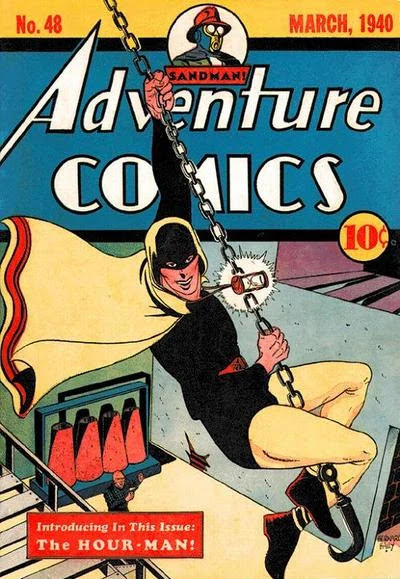
Adventure Comics #48 - pt. 1

In this issue debuts Tick-Tock Tyler the Hourman. The narrator is pretty unspecific about his powers. His Miraclo gives him the "power of chained lightning" (though his powers aren't electricity-based) and "speed almost as swift as thought" (though he's never nearly as fast as the Flash). Rex's schtick (his first of several) is that he has a P.O. Box and advertises in the newspaper and asks people to send him their problems. Surprisingly, lots of people start taking him up on it, despite how sketchy that set-up sounds. 

In addition to Miraclo, Rex has a ring that contains "tear gas concentrate," enough to "mark an army cry," which seems a lot like that narrator's talent for exaggeration. That narrator shows up again to tell us Miraclo is a fluid that makes him, not invulnerable, but "insensible to harm and injury." That means he's unaware of or indifferent to harm and injury, which may not necessarily be a good thing.

For the only time in Hourman's history, Miraclo gives him the power to see in the dark (Infravision). Miraclo gives Hourman the "speed of wind," which sounds right this time, as wind can gust at 40-50 MPH and Hourman can only keep the car in sight, not gain on it. Though maybe he's still using the Race the Train power and holding back to see where their hideout is?

Hourman is relatively unharmed by being hit by a speeding car; I'm guessing that's the Imperviousness power, which means Hourman has four brevet ranks. We also see him using a leaping power; it isn't clear how many stories tall the building is (it's at least two), but it still probably falls in the Leap I category no matter how tall the building is.    

That tear gas ring that can stop an army? It affects just two people. It also seems to be just a one-shot trophy item, since it never appears again. 

Barry O'Neill is back to facing his old enemy Fang Gow, who has somehow hypnotized Inspector Le Grand's daughter, made her hate them, and made her work for an unnamed enemy nation. Barry decides to bust Jean out of prison in a scene straight out of a Western -- the French jail is so small the prisoners' cells line the outside walls, and the only substitution here is that Barry uses a car to pull out the bars rather than a strong horse (though *ahem*, I suppose it's still horsepower either way). The thought is that she will head straight to Fang Gow if freed, which is a pretty iffy proposition -- if I was Fang Gow, I would have included the hypnotic instruction to forget everything she knew about my location if Barry ever freed her.  

Apparently there's a "sinister dock section" in Paris -- that might come as a shock to the people of Paris -- and if you take the stairs down to the lower docks, you'll find a secret door to Fang Gow's newest hideout there. And maybe a flashlight too, since Jean didn't have one in her jail cell, but has one by the time she reaches the secret door. Don't forget to stock your hideouts with dropped items from the starting equipment list!

Fang Gow's new plan is to incriminate Le Grand by having Jean slip stolen plans into his diplomatic pouch when he goes to "Rumania." This is an easy one; Rumania is obviously Romania. Why even bother with fake names if you're going to put that little effort into it? 

The real surprise here is how Barry frees Jean from Fang Gow's mental influence. It seems they are using the magic-user's contest of wills mechanic to see if Barry can free Jean. But when did Barry become a magic-user? The other explanation is that they are both making skill checks to hypnotize Jean, loser is the first to fail his skill check. Poor Jean!

Fang Gow only summons back-up, three thugs, after losing the hypnotism duel. Barry uses a pistol on them only while they were at missile range, drops the only one with a gun (they are very poorly armed thugs), then drops his own gun and fights with his fists once they are in melee range. One of the remaining thugs has a knife and the other one is unarmed as far as we can see.

The gag filler Butch the Pup suggests that it costs $5 to repair a broken and ripped tent, and a fine of $100 to set up a tent on private property.

Ugh...let me just pause a moment to gripe about how low the art had sunk on Adventure Comics at this time.  Fred Schwab's cartoony art, seen here on Butch the Pup, used to grace Comic Magazine's poorer titles. Barry O'Neill, that used to be graced with the elegant art of Leo O'Mealia, now suffers the bleah art of Ed Winiarski. For some reason that defies understanding, Chad Grothkopf is now the artist on Federal Men (as he is on Slam Bradley in Detective Comics), though his ugly art bears none of the vitality of Joe Shuster. Even Ogden Whitney, competent as he is, is no Bert Christman, the original creator of Sandman. You would think every good artist in New York had already been drafted from this issue...

Oops, griped too long. I'll get to Federal Men tomorrow! (Stories read at readcomiconline.to)


Saturday, January 23, 2021

Detective Comics #37 - pt. 3

Speed Saunders starts out in odd territory; Speed has been busted down to a beat cop in the suburbs since we last saw him, after being framed as a drunk. This is extra odd because Speed was never a police officer before! He also has a new friend, Patsy Ross. Speed has sunk so low that he doesn't see a way out of this without Patsy's encouragement, becoming his partner as he takes down enough mobsters to get his old job back. It's a really big departure for the feature, practically a reboot. 

You can do that with your Hideouts & Hoodlums heroes too, if everyone agrees. You also have to agree if you want to restart from zero experience points or from some point higher. 

Steve Malone, District Attorney gets involved when a woman is kidnapped for $50,000 ransom. The kidnappers aren't very experienced at this; they write out the random letter by hand. One of the kidnappers uses the phrase "No dope" to mean, "no kidding." 

There is a huge plot hole in the story where Steve plans to find the kidnappers by searching the woods he thinks they might be hiding by plane at night, and parachutes down by the first light he sees in that area. It turns out to be the kidnappers' hideout on the first try, but there is no reason why that should be the case; there could be any number of people with cabins in the woods, and they would naturally have their lights on if it's night.

This story turns really dark; not only do the kidnappers plan to kill the woman once they get the money, but it seems like one of them plans to rape her first before Steve shows up. I've never seen that in a golden age story before, and I don't like it.

Steve conveniently lost his gun when he landed (Oh, I haven't even brought up how low his chances of landing safely in the woods at night should have been!), but that's okay because these are low-hit die hoodlums and guns aren't that effective in their hands. Oops, Steve almost loses anyway, and the kidnapped young lady has to save him by setting the building on fire (it distracts the hoodlums, naturally!). 

Cliff Crosby is a reporter who gets a scoop over the phone - a moll/vamp wants to rat out her partner for the kidnapping of a judge (lots of these anthologies would have theme issues where the stories are all similar). The moll jabs paper into the phone to keep the connection open -- because phones used to work like that. Cliff, instead of being worried for her safety when he hears her partner confront her, brags about what a scoop this is going to be for him. Smooth, Cliff...

Cliff hears the mobsters threaten his moll on the phone, and he's still just threatening her when he shows up after...driving across town? Finding a parking space in the city? 

The mobsters are slavers! Cliff tricks them by saying he needs to call his friend at the office and tell him there was no story here (makes sense), but then they don't notice him tapping out Morse code (harder to believe). 

We know the slave ship is off the Florida coast, but never get a clue where the story started. On board the slave ship, a slaver tries to whip Cliff, and he grabs the whip. I would allow that with a successful attack roll, but the weapon automatically does damage to the grabber. After escaping Cliff throws a knife at a slaver hard enough that his hand is pinned to a metal wall. Had it been a wooden wall, I could see this happening after rolling to attack both the slaver and the wall, or rolling a certain number over what he needs to hit the slaver, but to pierce a metal wall is going to require a wrecking things roll as well.

Amongst the slavers are thugs. The thugs are better armed, with handguns and rifles. One man on the ship has a machine gun, but it's not clear if he's a slaver or a thug.

This issue continues to be really dark. When the Coast Guard shows up, most of the slaves on the ship are dumped overboard, while still chained, and apparently drown. The gangster heading the slavers captured the Coast Guard when he recovers the machine gun, Cliff is taken prisoner, and thrown overboard to a waiting "giant" octopus (maybe a large octopus?). Because Cliff still has a knife on him, he's able to kill the octopus. In a really weird moment, Cliff puts the dead octopus on his head as a disguise so he can sneak on board the ship (warning: this is a racist moment; he scares the "colored lad" with his disguise). 

In the Slam Bradley story, Slam inherits a racehorse, and every cliche about horse racing stories ensues. I'm not going to take the time to cataloging them. The Slam stories have been so lame since Joe Shuster left that I can barely stand to read them.

(Read at readcomiconline.to)


Monday, January 18, 2021

Detective Comics #37 - pt. 2

*sigh* "Spy" used to be so good when it was Jerry Siegel and Joe Shuster working on it. Ever since Maurice Kashuba started drawing it it's been so boring, I wonder if Siegel's name is only contractually on it and he's not actually writing it anymore.  

The plot here is that a bomb blows up a "conference of government officials," with no specifics as to the nature of the conference or the level of the officials present. Forensic evidence points to a suspect, which our hero Bart Regan collects from the scene, which seems odd because you would think a forensic specialist instead of a spy would be collecting evidence. 

An assassin tries to shoot Bart in the back, but facing doesn't matter in Hideouts & Hoodlums; if you win the initiative roll, you can turn around and deck someone behind you, just like Bart does. 

Undercover, Bart tries to join Ligoni's mob, what we would call a terrorist organization today. Ligoni is a skilled knife thrower and tests his new recruits by throwing knives at them until they flinch. Bart stands still for 16 knives before Ligoni gives up. I would use two mechanics for this: one is rolling to attack Bart with each throw. Since he's trying to miss, a successful "hit" becomes a miss. The other is requiring a save vs. plot from Bart to see if he flinches. If I was really mean, I'd make him make 16 different saves, but the odds would really be against him then. I would have him roll once and, if he missed, the number he rolled is the number of knives he can withstand without flinching. Then, to be fair, I would roll randomly (on a 20-sided die) to see how many knives Ligoni throws.

During the initiation, a mobster walks in who knows Bart and recognizes him immediately. Bart was "disguised" only with a change of clothes to look like a criminal, which is not enough to warrant a mobster having to make a saving throw to see through it.

Whimsically, the newspaper headline saying the bombers were captured is from The Daily Star, the newspaper Superman then worked for. This could be seen as the first cross-title continuity between Action Comics and Detective Comics.

In Cosmo, the Phantom of Disguise, Cosmo's friend is a ship captain tasked with delivering unspecified "chemicals" to England. I immediately thought this was suspicious and did some digging and saw that we did send chemicals to England -- illegal mustard gas -- in 1943. We never do learn if it's that type of chemical being delivered.

It normally took a steamship 15 days to reach England from New York then, but the captain seems to suggest it will take 1 whole month with the circuitous route they planned around the "war-infested areas," which actually does sound like quite a reasonable precaution.

Cosmo, in disguise, hears talk of mutiny on board the ship (after a skill check for listening?). In a clever bit, Cosmo pretends to shoot the captain with a blank cartridge, then dumps a dummy overboard, so the mutineers will trust him and the captain can still move about the ship. Less clear is how Cosmo further distracts the mutineers with an explosion timed to when he drops the dummy in the water. Are the explosives inside the dummy? And if so, wouldn't dumping them in the ocean stop them from detonating? The story should have ended with the captain rallying the loyal crew for a big fight, but the story is running out of pages, so the mutineers all flee to the life boats, but Cosmo punches out the ringleaders before they can board the boats (why the ring leaders wait so long, until all the other mutineers are at sea, before leaving the ship is not clear).

The Crimson Avenger returns! A rich man's daughter has been kidnapped, so the Crimson Avenger goes to work -- as reporter, Lee Travis. He apparently finds no useful clues, so he comes back that night as the Crimson Avenger and, at gunpoint, forces the dad to tell him where the drop point for the ransom money is. His only plan now is to follow the kidnappers' car from the drop point (are police not doing the same?). 

The twist is that the kidnappers' hideout is a mansion in the suburbs. The Avenger even gives us the address for the mansion, 704 West Highway, "Scarchester." That sounds like Dorchester, Massachusetts to me. When he gets there, though, all the Avenger does is point a gun at the five kidnappers and wait for the police to arrive. Boring, and the art is terrible. What a bad comeback!


Sunday, January 17, 2021

Detective Comics #37 - pt. 1

SPOILERS: This is the very last pre-Robin Batman story. 

One of the reasons I find the infallible Batman of today's comics so laughable is that he bears nothing but name and costume in common with this Batman, the Batman who gets lost and stops at a random house to ask for directions. 

In the house, a man is being tortured by three mobsters. Despite the fact that one of them gets the drop on the Batman with a pistol, the Batman is still able to go first and kicks him in the face hard enough to knock him into the mobster behind him. Two game mechanic things here: one is that there is no order of battle in Hideouts & Hoodlums, where missiles always go before melee. The Batman has won initiative, so the advantage of already pointing a gun at him disappears. The other point is the two attacks. This should only be possible if the Batman has levels in fighter and these mobsters have less than 1 Hit Die, or if he was a superhero using the Multi-Attack power. Neither should be the case here, since the Batman is obviously a mysteryman. There is one more area with some wiggle room, and if you recall the Batman's stats from Supplement IV you know I already used it; the Batman's signature move is hitting mobsters with other mobsters. This is actually borne out in the following panels; the Batman drops those first two with one kick, but it takes him two punches to drop the third one, possibly because that mobster had more hit points, but also possibly because the Batman no longer has as good an attack bonus against a single opponent. 

The first plot twist is that the tortured man, once freed, delivers a head blow that stuns the Batman (head blows are common enough that it is now a combat rule in 2nd edition). Because the Batman had already tied up the three mobsters, they are easy targets for the fourth man, Joey, when he uses a gun on them. If the tied-up men were Heroes, he would only get a +4 bonus to hit them (or at least the one who was only stunned and is awake already), but because these are just mobsters the Editor can handwave that and say they are each killed in one shot (as happens here).

The Batman's only clue as to where Joey went is that they all said they worked for a man named Turg. Later, Bruce Wayne remarks how uncommon that name is. No kidding, Bruce! Ancestry.com only lists six Turg families in Ontario, and none in the United States. But in this story, Bruce finds three in the New York City phone book and after visiting all three deduces the suspicious one is the one, Elias Turg, who opened a grocery store in a part of town without many houses in it. Most people would consider that a zoning issue, but to the Batman, it's a vital clue that turns out to be correct!

Later that night, the Batman barges into the upstairs office of the grocery store and finds Turg there with Joey and two more mobsters. He decides to intimidate them from the doorway first, spoiling any chance of a surprise attack. They are all 15-20' away, so the Batman can reach them easily for melee if he wants to, but this Batman doesn't feel infallible against four-to-one odds, so he turns off the lights and uses night-vision goggles. They aren't called night-vision goggles; the narrator calls it a "queer piece of glass," probably because the term "night-vision goggles" isn't in use yet. Night-vision devices are brand new on the battlefields of Europe, so new that I'm not sure the author (Comics.org credits Bill Finger) would even have heard of it yet and may have invented this idea independently.

After roughing them all up, the Batman does something I think is really clever; he pretends to leave and then hides before the lights come back on, so the mobsters will start to talk incriminatingly in front of him. It turns out, they aren't hoodlums but spies (or at least all of them but poor Joey, who they turn on and kill because the Batman called him out by name). 

En route to the piers to commit sabotage, Elias Turg splits off from the other spies and the Batman has to choose who to follow. He follows the other spies to the pier, where they are met by two more spies. Actually three more spies, because Carl (probably the lookout) is on the balcony of a building behind the Batman and gains a surprise attack (because he is standing separate from the others, he gets his own separate surprise roll). He drops a heavy sack full of ...something heavy on the Batman's head and it counts as a head blow attack, stunning the Batman again. Instead of just shooting him and killing him (which actually makes sense here, since they don't want to alert the ship they plan to attack), the spies put him in a sack and toss him in the water. Stunning has a very short duration and the Batman is able to cut his way out of the sack with a knife in his utility belt before drowning. 

When the Batman sneaks back up onto the pier, he switches to another favorite tactic of his, swinging on a rope to attack. It's very cinematic, but definitely would not improve his chance to hit. I think I talked about this before when he killed Jabbah this way and decided I might allow a +1 to damage for doing this, due to the additional momentum. 

Despite beating all five spies in melee combat, they still managed to start the moto launch rigged with TNT that will blow up the docked steamer that was their target. The Batman tells his feet to run like they've "never run before," perhaps burning his first stunt of the night to run faster so he can reach the end of the pier in time to jump on board. Once he's on board, the cutting of the ropes holding the steering wheel and turning the wheel in time takes four panels, but there are no game mechanics in play anymore to resolve this, only stated intentions.  

The story could have been over at this point, but there are two additional pages that seem rushed, as if tacked on. Joey had given the Batman the phone number for The Head (as in, the head of the operation) before dying, so the Batman finds out who's number that is and goes to his house. It's someone named Count Grutt and the Batman is either genuinely surprised or being sarcastic when he seems astonished that someone named Count Grutt is a foreign agent. Grutt is actually Turg without a disguise on (notice how the name is reversed; semi-clever, but if Grutt had gone by the name Smith, the Batman never would have found him). 

Grutt/Turg has super-strength, able to throw a sword across a room with enough force that it goes halfway through a door. Count Grutt must be a supervillain, buffed with ...Extend Missile Range? Then the Batman pummels Grutt until he's down to zero hit points. With his last punch, the Batman must have pulled his punch a little and transferred some points of damage into pushing Grutt back, because Grutt falls back into the sword, which kills him, since he just took more damage while at zero hp. The Batman doesn't seem concerned.

(Read in Batman Archives vol. 1.)