Anchors Aweigh! picks up where it left off last issue, with our Don Winslow-clone investigating El Diablo. El Diablo has somehow slipped poison slips of paper to Don Kerry's prisoners and the chief suspect is an old friend of Don's. This is a good position to put your players in -- do they stand by their Hero's supporting cast, or turn on them when things look bad?
Later, Don and Red are listening to clues from a nearby group of sailors in a joint, but one of the sailors notices them listening. Hideouts & Hoodlums definitely has a game mechanic for hearing noise, but not for the reverse -- and it does not make sense to simply reverse the mechanic (it should be easier to hear noise through a door, for example, than to hear someone listening through a door). The Editor may have to play this one by ear -- are circumstances right to be observed listening? -- and then resolve it with a save vs. plot for the Hero.
This story also gives us an explanation for why not to have hoodlums immediately use guns in a fight -- for fear that the sound will bring the police.
Don overhears the name of a ship captain who might be in league with El Diablo. But how to find the ship captain? Don asks around, claiming to have a message for the captain from El Diablo. It's a clever and daring plan -- exactly the kind that Editors should give a good chance to work.
Tom Brent's adventure has a crew mutiny, two jewel thieves, a diamond worth $50,000, and a suspect who turns out to be a police inspector doing his own secret investigation. I particularly like this last wrinkle. Could it be a cure for Heroes who shoot first and ask questions later?
The next adventure of Steve Carson of Federal Men is an unusual one in that it takes place just before a Presidential inauguration ceremony -- which means it took place two years earlier in 1936 or two years later in 1940! Time can be a fluid thing in a roleplaying campaign -- it can take place over days or it can take place over years, but generally campaigns follow sequential time. This does not always need to be the case, as I wrote about in Supplement V: Big Bang.
Nadir, Master of Magic, continues to show an aversion to actually using magic. He gets through a locked door, not with a spell, but with a skeleton key. He gets around by "powerful sedan" instead of by spell. Instead of turning invisible, he hides behind curtains. He does cast a Detect Thoughts spell.
Captain Desmo starts this new adventure by flying overhead when he sees travelers being attacked. Luckily he has two grenades for his sidekick to toss over the side of his plane. Then Desmo and Gabby use the oldest trick in the book, disguising themselves (in this case wearing Arabic robes, even though this is supposed to be India) so they can get in to see the big boss. The boss is guarded by a fighter who must be at least 9' tall (I would stat him as an ogre, then).
In Tod Hunter, Jungle Master, the primitives we met last time are called tribesmen here (a better name than natives or savages, maybe?). From the arena we observed last time, the prison cells are only reachable via an underground stream that requires Tod and crew to travel by raft. Past the stream is a maze of tunnels that seem to go on for miles. And yet, the trip back to the throne room seems to take no time at all -- perhaps they find a shortcut back. In the throne room are large urns, axes and spears mounted on the walls, hanging masks, and statues -- including a giant statue of the tribe's bald, fanged god that must be at least 30' tall. Tod is able to climb the statue and find a secret door leading through the statue's arm. The statue (I believe we learned it was wooden last time) is hollow and can be navigated inside by ladder. There is a secret room in the head where a crazy old man with a scimitar can speak through amplifiers and imitate the god.
Dale Daring's boyfriend Don is able to conceal a sub-machine gun under a cloak.
In The Golden Dragon, it's very unclear if the men are attacked by undead skeletons, or men dressed to look like skeletons, Scooby Doo-style. Regardless, a woman present is so frightened that she is paralyzed with fright. I'm thinking that everyone, even Heroes, will have to make morale saves when first encountering the undead, and non-Heoes will have to make morale saves when first encountering people pretending to be undead.
(This issue can be read at Comic Book Archives)
Wednesday, December 23, 2015

Tuesday, December 22, 2015
Detective Comics #18 - part 2

When Bruce's plane crashes, "his ankle was badly sprained and one arm wrenched painfully", but this is all just flavor text -- in reality, Bruce would only took x amount of hit points of damage from the crash.
Bruce utters the racist statement about his black companion, "There's plenty of white man in that big black." To be fair, Bruce is burning up with fever at the time and likely delirious. Disease is not flavor text. It can be resisted with a saving throw vs. poison, but if one succumbs, disease should have game mechanic penalties (in the case of jungle fever, Bruce is apparently incapacitated to the point where he can barely move (but is still able to attack on the next page).
A large python attacks Bruce and Ungi. Curiously, in addition to constricting, the python is able to headbutt anyone it is constricting for additional damage. I've never heard of a python doing that, though I suppose it's possible. Ungi is only stunned for one turn by the headbutt -- further proving to me that H&H needs a rule where any melee attack has a chance to stun for 1 turn.
We meet Steve Malone, District Attorney, in this issue. His adventures are clearly set in New York City (with his first scenario taking him specifically to Brooklyn). Steve's starting equipment includes a book of matches, a revolver, a flashlight, and a car with a short wave radio.
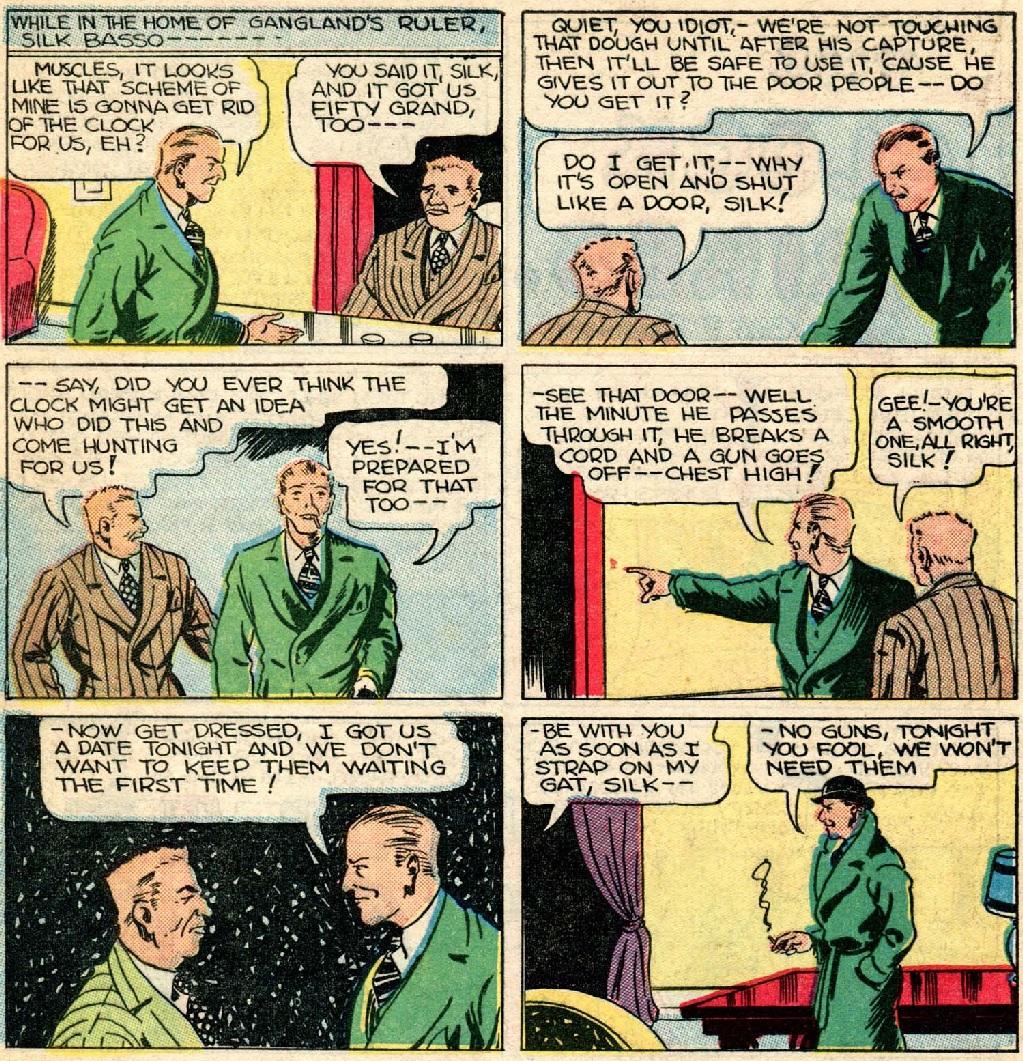
At his first hideout, Steve runs into seven hoodlums at once. Since Steve is probably a level 1 Fighter, his Editor clearly never meant for him to win that fight. Luckily, his Editor planned a deathtrap for him to be placed in, instead of killed outright. The deathtrap is: Steve is tied to a chair and a bomb with a lit fuse is sitting next to him. This isn't too hard to get out of. Steve could a) tip over the chair and see if it loosens his bonds, b) tip over his chair and headbutt the round bomb so it rolls away from him, c) try to snuff out the fuse between his shoes, d) try to tiptoe away from the bomb while balancing the chair on his butt. But Steve has a rookie player and his Editor, seeing that he's presented too much of a challenge, gives him a break and has two beat cops show up in time to save him.
Seeing that Steve's player is going to need more help, the Editor has those beat cops tag along and go into the killer's hideout first.
Really, the smartest person in this scenario is the dead diplomat's wife, who hid her husband's treaty by sewing it into her dress.
By now, stratosphere planes were becoming almost a common trophy item in the comic strips. Even though jet aircraft would not be reliably tested, for real, until 1940, two years from now, the idea or using rockets to make planes fly had been around since 1928. In this installment of Slam Bradly, Slam helps the inventor of a stratosphere plane. In this story at least, stratosphere planes look like futuristic jets and not ordinary planes. Furthermore, the stratosphere plane is said to be able to reach Europe in a "few hours", making it as fast as the supersonic jets of the 21st century.
Unlike the average comic book plot, this one has unexpected switch after unexpected switch, The person we believe to be the scientist's daughter turns out to be working for the crooks who want the plane, and the scientist, who believes Slam and Shorty are working with the crooks, becomes their adversary for part of the scenario. He captures them in his lab with trick chairs that extend straps around wrists and torsos, and then tries to torture them with a heat ray. When the crooks show up to steal the ship, the scientists frees Slam to fight them. But when the girl helps Slam, and the scientist escapes, we find out we'd been misinformed again -- this scientist was actually a thief who stole the ship previously. The girl really is a scientist's daughter, but of a previously unseen and captured scientist (in the story's one disappointing note, the missing scientist is found, uncreatively, locked in a closet).
At the end, Shorty asks for a reward by handing over a blank check and saying "figure it out". While not the most Lawful solution possible, this could be a helpful reminder for an Editor who doesn't always remember to offer a big reward at the end of his adventures.
(This issue can be read at Comic Book Archives)
Monday, December 21, 2015
Detective Comics #18 - part 1

If you only have time for a short scenario of Hideouts & Hoodlums, it might be best to jump into a story, in media res, like this -- cutting out the plot hooks and setting up the scene and just lay out what the challenge is in the scenario right at the start. And place any supporting cast your players will need nearby.
As evidence of how combat needs to stay abstract in a comic book RPG, Speed is shot at point blank range, but recovers when a doctor performs first aid on him, and doesn't even have blood on his clothes.
Later, "Speed learns the truth from the glint of fear in the fence's eyes." There's not a game mechanic tied directly to lie detection or eye reading, but if the Editor really wants to give the Hero a chance to pick up on a clue, then a "notice things" roll should be allowed, just as if the Hero were searching for secret doors.
Later still, Speed wants to go back to the murder scene "to make a more thorough search." What his player means is he wants more "notice things" rolls because he doesn't think he has enough clues yet.
This installment of Cosmo, The Phantom of Disguise, is suggestive that Cosmo might be based out of Chicago, since he leaves from Chicago to start a vacation. Cosmo's vacation takes place in the Mythic West, where everyone gets around on horseback, the only way to not draw suspicion to yourself is to dress like a cowpoke, and the town is remote enough that its only tavern is the only place to eat in 20 miles.
It is unclear how Cosmo solves his mystery. It seems he overhears the Mexican in the tavern say something incriminating, but all we're told is that Cosmo overhears the Mexican "babble" to himself. The implication seems to be that the Mexican's "babble" is him talking in Spanish, and indeed the only reason Cosmo seems to find the Mexican suspicious-looking is because he's a Mexican (or, to be fair, the only Mexican in the tavern). Further racism is found in the sheriff's "Negress" servant.
In the Larry Steele installment, Larry and his pal are in a deathtrap -- a dark pit that is being filled with a lethal gas. The way out is to search the floor and find the floor boards are loose enough to be pried up. Below the pit trap is an underground stream with a strong current, leading to a waterfall outside, near the house they were in. Although waterfalls are never lethal in comic books, there are still overhanging branches to grab in case the Heroes don't want to chance it.
Larry's big fight scene breaks down like this: Larry gets a surprise turn and, because everyone is unarmed, he gets two attacks. He uses them both to swing from the chandelier and kick the two hoodlums, doing enough damage to one of them to knock him unconscious. In the first turn of regular combat, the boss bad guy wins initiative, but the Editor rolls so poorly on his attack roll that he says the boss is still drawing his gun. Larry makes a disarming attack on the boss and wins possession of the gun. Because a weapon is now in play, we switch to one melee attack per turn. On turn 2, Larry wins initiative and clocks the bad guy, doing enough damage to only lightly injure him. The hoodlum who wasn't knocked out, though, fires into the melee. Because firing into a melee is dangerous, there is a chance to hit either combatant, and the Editor rolls that the bullet hits the boss instead of Larry. The remaining hoodlum gets shot on turn 3 by Larry. It's not clear if the second hoodlum and the boss are unconscious yet, or if they've failed morale saves and stopped fighting.
Bosses should maybe be a new mobster type, between hoodlums and master criminals.
If the Fu Manchu adaptation here was a H&H scenario, the Editor would be in for a tricky situation. There is a scene where one of the Heroes is approached by a mystery lady (a female practitioner of the Mysteryman class, no doubt). She gives him an important clue, and then needs to disappear (or she won't be mysterious). Now, the Editor could just make her high enough in level to give her a great roll at becoming effectively invisible through stealth, but that may later beg the question why she doesn't just tackle Fu Manchu herself if she's so high in level. Or, the Editor could fudge the die roll so she gets away, but fudging dice rolls just to railroad through a plot doesn't feel fair to most players.
Now, the trick used in the story to keep our Hero from following her is to have Wayland Smith show up with even more vital information our Hero needs. The problem with this is, Wayland is probably also a Hero in play in this scenario, so the two players will likely be confident they can share information at any other time. For a RPG scenario, Wayland would have to be swapped out for a character not under a player's control.
In Spy, Bart Regan is assigned to recover the Kahoon Ruby, not to keep, but to give back to the Maharaja who owned it. Still, because the ruby would clearly have a monetary value, it is easy to assign an XP award for finishing this scenario. Had the mission been to recover the Maharaja's missing child, the award would not be so clearly quantifiable. A further wrinkle is that the Maharaja will sign a peace treaty with whatever country recovers the ruby, so there will be lots of rival factions vying to compete this scenario first.
This is also the issue that Bart proposes to his partner Sally. If these were both played Heroes, this is role-playing above and beyond the call of duty.
(You can read this issue at Comic Book Archives)
Sunday, December 20, 2015
The Funnies #23


One way would be to compare to hit rolls, with the higher roll having the advantage. Another would be to compare saving throws, with the worst save vs. science winding up on bottom. Or, since both combatants hit their target numbers, and are normally not penalized for not going x number higher than the target number, simply roll a d6, with evens being Jack on top and odds being Rufe on top. You only have to go so far into using dice rolls for fairness; a lot of the time, dice rolls actually represent the chaotic randomness of combat that the Hero can't control.
(Scans courtesy of Digital Comic Museum)
Wednesday, December 16, 2015
Action Comics #3

When Superman resists the poison gas, that is the first level power Different Physical Structure.
When Superman is carrying three people all under the same arm, that's the second level power No Encumbrance.
When Superman is clearing the rubble in the mine, that could be the first level power, Raise Car -- but, since the panel specifically says demolishing the barrier, one could make an argument this is his wrecking things ability in play.
Superman exhibits some sort of super-climbing power when he climbs an elevator cable, hand over hand, while holding an unconscious man balanced over his shoulder. I neglected to give Hideouts & Hoodlums a super-climbing power, though I admitted in Supplement IV: Captains, Magicians, & Incredible Men that the game needed one.
Given the powers he has available to him, Superman is probably 4th level by this story.
Superman demonstrates his super-leaping alien ability when he vaults the wall around the mansion.
I wanted Superheroes to have to wear a costume, so I came up with the rule that they only gain XP as Superheroes and can only use their powers when in costume. In doing so I, conveniently, neglected to consider the prominent instance of Superman wrecking the wooden tunnel supports right here in this issue.
Though one could make an argument that the Superman story in Action Comics #2 was the prototype for this type of story, this issue marks the first of the Superman morality plays. This subset of Superman mythos consists of stories where there is no antagonist, but only a character who needs to learn a valuable lesson.
The Tex Thompson serial continues with Tex and Bob in the Sealed City, dealing with the Gorrah of the Sealed City. It's clear in this story that "Gorrah" is a title, but the Gorrah is starting to also look like a mad scientist-type. He has three servants who seem to be invulnerable, even to bullets to the chest, but maybe they just have really, really good Armor Class. Once Tex discovers their weak spot later (the tops of their heads), he knocks them out with a wooden club.
The central theme of the story is containment. The city is contained in a volcano. The main building in the city is a fortress within a fortress (with a dry moat and drawbridge separating the inner keep from the fortress surrounding it). The Gorrah tries to contain Tex and Bob in a pit trap (it dumps into an underground stream, but since the water is not deep, it's unclear how lethal this trap was supposed to be). They find the true Gorrah contained in his own deathtrap (buried in sand, surrounded by red ants).
The Tex feature doesn't take itself particularly seriously, with two of the Gorrah's servants named Scharem and Hawntem. The scenario is also...well, pretty impossible. As mentioned above, the previous issue seemed to indicate that the Sealed City was inside a giant volcano, but Tex and Bob fall into an underground stream and follow it for what "seems like days", only to still emerge in the Sealed City. Is the volcano, like a TARDIS, bigger on the inside? Or, more likely, this type of H&H adventure is an example of a stream-of-consciousness storytelling, only accidentally making any kind of sense.
"Chuck" Dawson's story includes a rare instance of the Hero tripping his opponent. Though one would think tripping would be the easiest grappling maneuver, it's neither very heroic-looking nor as visually impressive as others, so it's often ignored in the comics. Because of this, I would not give it a better chance at success than other grappling results.
In the Mythic West "Chuck" Dawson inhabits, $500 is a fair reward for a murderer.
Does this installment of Zatara, Master Magician include a clue as to where it takes place? Zatara is staying at the Hotel Hilaire. Could that be a hotel in Mont-St-Hilaire, Quebec? Of course, if Zatara is a globetrotting magic-user, why not?
Zatara uses a new spell, Spirit Form Projection, in this story. It is similar to clairvoyance, but he is seeing from the eyes of his own invisible presence. The range is very good (maybe a mile?), but anyone above 1 HD has a chance of sensing the caster observing them. This spell could be 3rd or 4th level.
The next spell is very difficult to explain, as Zatara creates a single-pilot fighter plane with just a glance, so Tong can learn how to fly it. I highly recommend that Magic-Users not be allowed to create extremely powerful/elaborate trophy items with spells (maybe minor ones, temporarily). My suggestion is that Zatara has just made a visual illusion of a plane for Tong to study before practicing with a real plane.
Interestingly, instead of conjuring a phantasmal date, Zatara visits a female escort company to hire a date to a party. Could escort services have been more innocent back in the '30s? We may never know, because Zatara hypnotizes (Charm Person?) his date and makes her go home with no memory of how she got there (should Charm Person be allowed to make people forget things?). He also might be using Charm Person to give Tong more confidence in his piloting skills. Zatara does cast Phantasmal Force to prevent a killing, and later to convince a hoodlum that he has a cannon pointed at the Tigress' hideout. He also casts Polymorph on Tong, to turn him into a bird, and Transmute Flesh to Stone on a hoodlum.
Zatara must be at least a 9th level Magic-User at this point. I'm okay with making Magic-Users advance through levels faster, but this seems a little too fast. Or Zatara has a LOT of untold tales.
(You can read this issue at Comic Book Archives)
Friday, December 11, 2015
Feature Funnies #11




I love how the Gallant Knight has a sword in his hand, but leads his attack by throwing a bottle in some guy's face. This actually illustrates two things for H&H - one, if all weapons do the same abstract amount of damage, then players can be more free to be creative with what they attack with. And, two, it demonstrates how important it is for the Editor to stock rooms with items the Heroes can use or interact with.

This blog has previously addressed similar issues related to falling damage, like falling into water. Perhaps a simpler ruling would be, if any circumstances exist that might prevent the falling damage -- something to cushion the impact, the Hero jumped so the fall may be controlled, the surface landed on is moving at a relative speed -- then the Hero may save vs. plot to take no damage.

From a second page of Off the Record.
(Scans courtesy of Digital Comic Museum)
Wednesday, December 9, 2015
Crackajack Funnies #3

If Heroes, or their Supporting Cast, should find themselves missing equipment, like rope, that they need to complete the scenario they are on, the Editor should feel free to introduce a mysterious stranger into the scene who shows up with just what they need. An explanation for the mysterious stranger can always be given later, when the Editor has had time to come up with one.


Our mystery ape -- which now is drawn more closely like a chimpanzee -- has more than one skill of a Mysteryman.

"Human gland secretions" might serve as a hi-tech potion for increasing Intelligence in animals.

Of course, this is seldom going to work past the first or even second levels, so enjoy it while you can.

Also note the salary of a boxer in a traveling carnival.

Oh, and Dr. Centaur has an "ultra short sound wave generator" (ultrasonic soundwave raygun?) that can broadcast over a wide range and potentially stun large numbers of people (save vs. science to resist).

(Scans courtesy of Comic Book Plus)
Subscribe to:
Posts (Atom)