Showing posts with label Gallant Knight. Show all posts

Monday, October 17, 2016

Feature Comics #24

Today, I lap myself, sort of. Back in the Winter of 2012, I did a lengthy review of this very issue in the sixth issue of my ezine, The Trophy Case -- and that article was in many ways the prototype for what I've been doing here on this blog for almost two years now. So, rather than re-read this issue and try to glean new insights from it, I'm going to share what I wrote then in my "Comic Book World" column.

Over 68 pages, Feature Comics #24 gave you a whopping 22 features between 1 and 9 pages long. And, reading it, it gives me a bunch of ideas about how I could use this stuff in an H&H game.

The first feature, the longest of the bunch, is a Charlie Chan, complete-in-9-pages mystery.  Charlie Chan is drawn to resemble Warner Oland, the original actor to portray Charlie Chan in the movies. It seems a little creepy, actually, since this issue came out 13 months after Oland died, but given  Quality’s reputation of reprinting never- or obscurely-published comic strips, it is likely that this strip was done before Oland’s death.

The page layout and story pacing suggests this might once have been intended as a three-panel comic strip – perhaps a blessing in disguise for the short story, as it forces a slight advancement in the plot to happen every three panels. It is also fortunate that the plot is fairly simple and straightforward, as Chan has to decide which of the passengers around him on a ship is actually a master jewel thief named Grissac (which is not also the name of a Captain Marvel villain, but so should be).

The plot is straightforward in that there are few complications (Number One Son is conveniently
indisposed with sea-sickness for the whole story so we are never treated to a comic sub-plot) and
simple in that Chan makes several assumptions that just luckily turn out to be true (like how the
friends that he last met two years ago are beyond suspicion). It’s still a true mystery story, though,
with a satisfying resolution. The main clue did escape my attention as it whizzed past at the
rapid pace of the story. And, better still, it charmingly evokes the feel of the Charlie Chan films.

If I was running this scenario as an H&H adventure (I’ve seldom, in 28 years of gaming,
been lucky enough to have players who enjoy a mystery scenario, but hypothetically), I would
make a list of assumptions the players could make that are true and roll for one assumption for
each Hero -- like a rumor table, but with all true ones. Nothing bogs down a mystery scenario
more than players who are afraid of spending too much time on a dead end and, I suspect, this
approach would help narrow their options without making the scenario feel railroaded. I would also
take from this story the effect of its pacing and be prepared to have a character around the Heroes
voice a clue or helpful suggestion – or just have something happen around the Heroes, like a
knife thrown from the dark – at frequent intervals.

For a longer scenario, I might also take an old time movie, like a Charlie Chan film that my
players are unlikely to have seen or recall accurately, and steal from it like crazy.

Following the longest story in the issue is a one-page feature called “Off Side” that consists of
four, one-panel jokes. The jokes aren’t funny, but I suspect they aren’t meant to be. Instead of an
abrupt transition between features, these one-pagers serve as a sort of pallet cleanser, getting
you ready for the next story. Perhaps one reason there are no successful anthology comic books
anymore is that this technique has been forgotten. The abrupt transition forces the reader
to either ‘switch gears’ quickly or put down the comic book for a while and come back to it later,
while a successful comic book is devoured in one sitting.

That said, the next feature was not worth the pallet cleansing, being instead another three pages
of pallet cleansers bearing the name and character of Lala Palooza. Lala is an upper class society girl plagued by her comic relief, good-for-nothing, Wimpy-like, live-in brother Vincent.  Indeed, if Lala was ever actually the star of these one-pagers, she has long-since been eclipsed by Vincent’s shenanigans. Vincent fights and gambles when he’s not being idle and avoiding work, making it impossible to understand why Lala would put up with him – but I suppose that’s more thought than you’re supposed to invest in this. The past page of the three is the last, with the semi-clever notion of contrasting Vincent’s classy-sounding diary entries with how he really spends his day.

Rance Keane is Feature Comics’ resident cowboy. The plot is nothing original – a conman is pretending to be the inheritor of a ranch so he can sell it, but Rance can tell he’s a phony because the conman is dumb enough to use the wrong hand. What makes this story worth studying is that every character -- the sheriff, the old Indian, the cowhand -- has a history with Rance and we even learn who long he has known them. Every H&H Editor needs to put at least this much effort into planning how Supporting Cast Members know each other and how they figure into the Heroes’ back stories.
Rance would enjoy some better than average artwork in future issues, but none of it is on display yet in issue #24.

The following two pages are more pallet-cleaning comic strip reprints. ‘Toddy’ is about a Dennis the Menace-like young scrapper who clearly makes his mother miserable. ‘Mortimer Mum’ is less clear. In one half-page installment, Mortimer becomes a ‘mum’ when he finds a baby in a basket on his doorstep, but the following installment is a short joke at Mortimer’s expense with no baby in sight.

Two pages of comic strip reprints of ‘Jane Arden’ follow, spread out over four pages. It’s hard to say what Jane is. Each page of her strip ends in a paper doll of Jane or one her friends with some outfits to dress them up in (go on, kids, cut up your comic books!) so it would seem she’s a model, but the police are asking her to go undercover for them at the beginning of this adventure. The plot is similar to the Charlie Chan story, but this time Jane needs to find a jewel thief by locating his fence, rather than picking him out from a crowd of suspects. There’s not much to recommend about Jane Arden for H&H, though perhaps one could make an argument for using paper dolls as miniatures. The artwork on Jane Arden is quite good and usually the best work in Feature Comics since Will Eisner’s Black X
moved to Smash Comics.

At the bottom of each page of Jane Arden is a shorter strip called Lena Pry, a very poor quality Li’l Abner clone. The less said about it the better.  The two-page ‘Big Top’ is a straightforward soap opera, but with all the visual appeal of the circus. It anticipates the movie The Greatest Show on Earth by 14 years, but is otherwise of little use to gamers.

Another page of ‘Off Side’ follows with one good visual joke out of five attempts. This time the pallet cleanser is there to get you ready for ‘The Clock Strikes’. This was Feature Comics’ big draw until Doll Man debuted. Bought from his previous publisher, Centaur, The Clock is not only widely credited for being the first original masked character in comic books and for being the “missing link” between the pulp heroes and the superhero genre, but also must hold a record for the sheer number of titles he jumped around between two companies. That said, it is also easy to see how The Clock would up languishing in obscurity, with the fault almost entirely being in the hands of his creator, George Brenner. A subpar artist, Brenner would seldom draw any kind of action scene, would trace old panels as often as he could, and one time committed the unpardonable sin of reusing the entire art from an earlier issue with only the word balloons changing.

In this installment, Brian O’Brian (usually spelled O’Brien) drops in on his friend, Police Captain Kane (hint for H&H players: police contacts are great for picking up plot hooks!), and learns of a swindler who is about to get away scott free because the witness against him has been murdered. The police have nothing other than circumstantial evidence linking the swindler to the crime, who has an alibi to boot. Still, that doesn’t keep Brian from suspecting him and he mails him one of The Clock’s business cards with the threat that he will show up at midnight. The swindler, frightened, summons all his accomplices to help protect him. This is all the proof The Clock was waiting for, as he needed to catch the swindler and the real killer in the same room to prove their collusion. He then paralyzes
all three mobsters present with nerve pinches so the police will find them together. How a good
lawyer wouldn’t manage to get them off on evidence like that is never explained, but in a five-page story you can’t expect an episode of Law & Order.

The best lesson the H&H Editor can take from this is not to get too hung-up on the reality of how the law works. Flimsy evidence and the admissibility of evidence gathered by vigilantes are staples of the genre. And in most cases, that’s all it takes. Except for a few popular supervillains, most bad guys who get arrested are never heard from again.

The following pallet cleanser is a half-page of ‘Rude Goldberg’s Side Show’, a quarter-page of
‘Candid Cartoons’ and a quarter-page of rhyming ‘Twisted Tales’. Rude Goldberg’s witty inventions
are rightfully famous and this issue’s mosquito killer is no exception (the mosquito, having dulled
the tip of its proboscis on a false leg, will surely head to the nearest emery wheel to re-sharpen it…).

The next four pages are dedicated to the ‘Joe Palooka’ syndicated comic strip. Joe is a boxer from Brooklyn(though we never see him boxing in this issue) who isn’t well-educated, but his innocence highlights the hypocrisy of everyone smarter around him. It’s a charming strip.

‘They’re Still Talking’ is a one-page pallet cleanser drawn in the ‘Ripley’s Believe It Or Not’
style, but with a sports theme.

The next four-page feature is ‘Gallant Knight’, a Prince Valiant-lite story of the paladins of
Charlemagne. Sir Raymond of Navaria has just won a duel with a Tartar spy, but is still lost in the
Enchanted Forest until he comes across a lone maiden at a bridge who offers him water. The maiden is an “enchantress”, but only in the magic-lite sense that the water is drugged. Easily subdued by soldiers who were hiding nearby, Raymond is dragged off to the court of the unimaginatively named Land of Shadows where he is made a slave.

Meanwhile, Sir Neville goes in search of Raymond only to encounter the same maiden, but luckily thinks he’s too busy to drink the water and has to be dragged down by greater numbers by the soldiers in hiding. Later, Raymond passes Neville’s cell and warns him that all the food and drink is drugged to keep the slaves weak. By not eating, Neville is able to stay strong enough to overcome the guards until he finds someone with a whole pot-full of “potion” that will serve as an antidote to the drug.

With the rest of the slaves freed, the King of the Land of Shadows is quickly overthrown. Raymond stays behind and Neville rides away as this serial draws to its not-too satisfying conclusion, with a note at the bottom that next month will feature the new adventures of Captain Fortune.   No explanation is given as to why these Frenchmen have such English names.


The following pallet cleanser is another page of ‘Rude Goldberg’s Side Show’, ‘Candid Cartoons’, and ‘Twisted Tales’, with the first of the three being the only reason to pause on this page.

The next three pages come from another syndicated comic strip called ‘Dixie Dugan’.  ‘Dixie Dugan’ seems to be a soap opera with a strong vein of comedy thanks to her Pa, a sort of domesticated Captain Haddock. The art is on par with ‘Jane Arden’. At the top of each page is a short strip staring “Good Deed” Dotty, done in an entirely different style. Sort of a homely Little Audrey, Dotty is about as whimsical as you can get in three panels.

‘Slim and Tubby’ is an unusual two-page feature. It’s set on a dude ranch and you’d think
it’s a Western, but it’s really a soap opera. Slim and Tubby are ranch hands, but they’re more like
spectators to the drama going on between the guests on the ranch. The theme of this issue’s installment is boxing, with two guests at the ranch being boxers; one is a bully and the other wants
to teach the first one a lesson by training one of the cowhands (not Slim or Tubby, but a tougher
hand named Benton) to box him.


“Wind screamed through the taut rigging like angry ghouls,” begins the two-page text story “Devil’s Head”. All comic books had a couple of pages of text story back then so they could be sold at cheaper magazine rates. This is a simple, but heartwarming tale about two brothers, one tough and one timid, and the inner strength the former learns of too late from the latter. However, what really makes this story stand out is the overblown prose which, if taken literally, would make for an exciting H&H adventure about a ship beset by ghouls and demons during a storm.

The next syndicated feature is four pages of ‘Ned Brant’ comic strips. Ned is a high school/college football coach who takes some of his players along with him adventures. Because the art is pretty sketchy, it is hard to say what exact age the players are supposed to be. One of them has a rich father who believes mobsters are looting one of his gold mines. He is right, but the coach and players find the secret tunnel to where the gold is being kept and ambush the mobsters.

What makes this H&H-relevant is the temporary Supporting Cast Members – for this adventure only, the regular cast is accompanied by two unnamed government agents. The author uses them exactly right, keeping them around to eliminate false leads while keeping them away from the action until the heroes have had a chance to shine. In this case, had the government agents not been there to check out the tire tracks, the heroes might have followed them and wound up being miles away when the
mobsters doubled back for their gold.

Two pages of ‘The Bungle Family’ follows, a syndicated comic strip about George Bungle and
his domestic adventures of getting so into a radio program that he literally sticks his head inside the
radio, or catching so many fish he sinks his boat and then no one will believe him. It’s light-weight
comedy done in a cartoony style, but the imaginary radio show, “Daggers of Doom” actually sounds more interesting. The artist has a gift for drawing clothing patterns. Each page of ‘The Bungle Family’ is accompanied by a cute two-panel strip called ‘Little Brother’ and a one-panel strip called ‘Another Day Shot’ that misses two chances to be funny.

The next feature is the four-page ‘Reynolds of the Mounted’. This installment is unusual for starting in medias res, jumping into the action without even an explanatory caption. A killer is out for revenge against a village of fur traders.  The effort to bring the killer to justice requires an ensemble cast, with Reynolds assisted by fellow Mounties Bob and Tom and pilot Bert. 

Reynolds is a low-level Fighter; the only time he goes solo, he is knocked out right away. The story has a randomness to it that makes it seem like it was a RPG transcript as well; you would expect Reynolds to deliver the final blow to the bad guy since it is his strip, but Bob is the one who hits the bad guy – with a crashing plane. It’s like Bob blew a saving throw, but the Editor took pity on him and turned his fail into a win. Also worth pointing out to H&H Editors is the role weather plays in the story. Reynolds wants to play it safe and wait for Tom and Bob to come back to him with dynamite, but no Editor would want the low-level Heroes having over-kill like that. So the weather just happens to turn dangerously cold, forcing Reynolds to act rashly or take cold damage.

A one-page pallet cleanser of six panels of mildly amusing ‘Off the Record’ follows.

The last feature is four pages of the syndicated humor strip ‘Mickey Finn’. Mickey is a cop, but this is as much a police procedural as Car 54, Where Are You? half the time, he is just watching his dim-witted Uncle Phil getting into trouble. At the top of each page is a three-panel strip called ‘Nippie’. Nippie is a boy who always does things wrong, but not in a particularly funny way.

One thing the old anthology books apparently did not always do was leave off with something
exciting. I can appreciate the difficulty of balancing humor and adventure, as well as the more important need of hooking the reader with a strong first story. Indeed, this too would be a lesson for the H&H Editor. Each scene in his scenario should be like a Golden Age anthology title, with a strong opening scene to hook them, a good balance of adventure and humor, and scenes that move through the scenario briskly.

(You can read the issue yourself here!)

Tuesday, September 13, 2016

Feature Comics #23 - pt. 1

My poor eyes! The Charlie Chan feature debuting in this issue has 20+ small panels per page.

Searching a small room normally takes 10 minutes for one search check, so Charlie is being quite thorough here.

Heroes can apparently try to force a lock however many times they need to.

A dark light camera -- able to take pictures in the dark, or through opaque objects -- would be a trophy item.

I thought the solution to the puzzle was clever, and not impossible to solve (though I'd probably have
to give my players a clue or two).

I was also unaware of that trivia about how the Bank of England is said as if plural in England. A curious people, the English.


This puzzle just isn't obvious enough -- players would need some clue that there's a message hidden in the letter, if not actually told to think of it as a word find puzzle.


Here's something you don't see every day -- an exciting stunt being performed entirely off-panel. The deadstick stunt is good for silent landings.


If you're playing a Detective -- or a non-combat-oriented character concept -- make sure you have a fighter among your loyal supporting cast.

If Heroes find a plane sitting out, they should probably have to save vs. plot to find the distributor head not removed (apparently this was the equivalent of leaving your car doors locked).

This is Gallant Knight, and this is a trick best used sparingly by the Editor, or players won't trust guides anymore.


The Gallant Knight is either an amazing tracker or supremely confident -- he can find one man's tracks among all those hoof prints, and knows exactly who they belong to?

I do like the idea that the forest is so maze-like that the Heroes need a guide to get them through it quickly.


$29 for a boy's bicycle (I assume a very nice one).


The Clock Strikes illustrates that, just because someone is in your supporting cast, doesn't mean they'll do everything you want them to. Here, Brian (The Clock) has to try to convince the police chief to let him come along to see a crime scene, but botches his reaction roll and gets told no.

This could be a deliberate reaction to the first Bat-Man story, and how easily Bruce Wayne got to go along with Commissioner Gordon to a crime scene. George Brunner did keep his eye on the emerging superhero genre and tended to be fairly critical of its authors (wait until we get to his Superman parody story).

(Scans courtesy of Comic Book Plus)


Saturday, June 18, 2016

Feature Comics #21

This is the first issue of Feature Funnies after a slight name change. These were good days for Feature Funnies/Comics, when Will Eisner's Espionage was right at the front of the book. This issue begins in New York City, which would soon be overrun with all kinds of heroes, but in 1939 was still not the default setting for comic book stories. I like not treating New York as the default setting for Hideouts & Hoodlums, but letting each Editor make that decision for his own campaign.

This is probably the first mention of the Holland Tunnel in comics. Using familiar landmarks is a good way to reinforce the idea that the Heroes are in a real place that exists.

The plot is an interesting one. Black X, as it turns out later, has already mailed the critical evidence to Washington, D.C., but still goes on a roundabout trip to D.C. himself in order to lure a whole bunch of agents out of hiding with himself as bait.

Although I was initially New York ignorant enough to think that Pennsylvania Station would be in Pennsylvania, I learned that this is still another NYC location. This "Washington Special", then, would have been the fastest way from New York  to Washington, D.C., short of taking a plane.


This is from Gallant Knight, a still-entertaining Prince Valiant rip-off. I'm still amused by the idea of someday running a medieval/fantasy campaign using H&H rather than D&D. I imagine it would be something like Gallant Knight. And it's good to know that princess ransom typically goes for 50,000 gp in the Gallant Knight's world.


Archie O'Toole, for a humor strip, has a lot of adventure elements and a Potion of Transformation is tempting to make an addition to H&H. It makes you so ugly that people of 1 HD or less have to make morale saves when they see you, and if you see your own reflection you have to save vs. spells or faint.


This will be neither the first nor the last story I'll be reading that takes place at the 1939 World's Fair. Like above, it serves as a location for adventures, but also a topical location.


Lala Palooza isn't normally a strip I would look at for inspiration. This might not change my mind...but half-pints, being able to stand on each other's shoulders, so they can all hit the same target...that's a little tempting.


Getting tired of using the same types of hoodlums in your campaign? Maybe shake up how the hoodlums try to get away, like you see here in Richard Manners, the Super Sleuth. This one has both a seaplane and a motorboat. Of course, your Heroes can always claim these transports when the battle's over, so don't be too generous right away.


The ol' loose tobacco in the face trick. Maybe save vs. missiles or be distracted for 1 turn?


Solo scenarios for 1st-level half-pint fighters -- like Toddy -- need to be not too challenging. So, a lone bat could be a distraction. Some falling plaster could be startling. A loose floorboard smacking you Chevy Chase-style might do 0-3 points of damage. A door falling on you might do 0-1 points of damage.

(Scans courtesy of Digital Comic Museum)


Monday, April 4, 2016

Feature Funnies #17

This is from The Clock Strikes, and that's not shoes in that shoebox -- that's radium!  This is 1939 and not too many people understand how radiation works, so it's not important that it work right in your 1939 campaign either.


That clever Clock figured out a good way to earn an extra 100 xp for a good deed in the middle of the scenario, extorting that charity check out of the good doctor!


This is Espionage -- always a favorite of mine, but I share this page to point out two things. One is the implied license to kill given to Black X. This is one of the good guys, but as of 1939, it was still okay for the good guys to kill. That would make some of my more bloodthirsty players very happy!

Also, using the torn pieces of paper as a passkey like that is a good idea worth stealing for an espionage-themed scenario.

Predating James Bond by 15 years, Black X has a wealth of super-spy weapons such that Q might have come up with, as inventoried in Supplement IV: Captains, Magicians, and Incredible Men.  Here we see the tear gas pen, good for temporarily incapacitating foes at point blank range.

We also see how volatile technology is when it makes a scene more dramatic.  The wrecking things rules has a note about wrecked generators setting hideouts on fire, but really it should apply to any machine, even when being wrecked by non-Superheroes.

This sword fight might be an example of a parry rule in play, or it might just be flavor text -- it's hard to say with parrying. The ability to go "full defense" and get an Armor Class adjustment is still asked for by my players, and Hideouts & Hoodlums will probably keep Parry as a game mechanic.

I'm not sure how jumping out of a high window into your car would negate taking any damage -- although it would, admittedly, look really cool and that's often reason enough for players to want to do something. Perhaps the Editor just rolled low falling damage.

This is from Gallant Knight. The panther's spring attack is more like tripping/overbearing -- a grappling attack that definitely needs to be accommodated in the rules and, apparently, usable by even non-intelligent foes.


This is a rather clever ploy from The Gallant Knight's player -- if he manages a positive or friendly result from an encounter reaction check, he could force some morale saves with this ploy. Since there is a large force of men involved here, the Editor could hand-wave individual morale saves and just say, oh, 30% of the men make their morale saves.


There's nothing particularly adventurous in this installment of Dixie Dugan, but I was struck by the similarity between this scenario and the video game franchise Animal Crossing, where you do favors for animals and retrieve loaned items in exchange for trophies -- and realized that one could play a Dixie Dugan H&H campaign based on this same premise!

(Scans courtesy of Comic Book Plus)


Thursday, March 17, 2016

Feature Funnies #16

Forgive the graininess and (this pun) quality, but I wanted to share at least a portion of this page of Joe Palooka so I could share this idea of a "sandbox" setting for Hideouts & Hoodlums.  For those not up on all their gaming terminology, a "sandbox" setting is an open setting prepared in advance for a campaign. The adventures are keyed to set locations or set events and are only encountered if the players choose to go that way. The whole sandbox is open to play.

Now, I am on record as hating the term "sandbox", but the idea itself still intrigues me. What would a sandbox setting for H&H be like?  Well, I imagine it could be a city-based campaign -- sort of a modern-day version of Citystate of the Invincible Overlord, with a high chance of certain types of encounters on certain streets.  So, if you want down this one street like Joe Palooka did, it would be a good place for running into wandering hoodlums.

The Gallant Knight fell in a pit trap with a slight twist, a secret door in the side that lets a "great" black panther into the pit. Great is a superlative that doesn't have any game mechanic value in H&H, but perhaps it could be considered a large panther (5 HD?).


Code breakers in real life require a lot of intelligence and skill. In comic books, as this installment of The Clock Strikes reminds us, the only ability you may need is being good at unscrambling words. Of course, this is a lot easier a code to spring on your players without making them hate you too much.


I haven't got to post a map in awhile. While Low Lake seems an intriguingly named local (why is it so low?), the real mystery seems to be why so many roads converge in such a lonely stretch of woods.


I would have to say, if I were the Editor running this game, that the Clock's player is being awfully reckless and doesn't care if his Hero lives or dies. While I should probably have a good long talk with him about why he's so unhappy with the campaign after this session, in this instance I would forget about trying to computate how many dice of damage to roll based on the speed of the cars, minus the amount of dice the cars would absorb, and just have all occupants save vs. science to jump out in time or die.

In this installment of Espionage is the debut of Black X's manservant, Batu. As I discussed in Supplement IV: Captains, Magicians, and Incredible Men, Batu is a good candidate for having psionics, and definitely the first non-Magic-User psionic in comic books.


I've shown pit traps before that combine with flooding traps, but they usually imply some complex plumbing going on behind the scenes to flood the pit. Here we see the au natural option of dumping your foes into a subterranean cavern that floods with tide water. Of course, then the time of day makes a big difference in how dangerous this trap is.


I'll spare you the whole story, as it's not very good, but the set-up here is the old chestnut of the voice in the statue talking to the gullible natives and making them give over their treasure. The wrinkle here is that there's actually a bit of a hideout here -- a concealed cave that connects to a cabin, with a tunnel that leads under the cabin and back to the big hollow totem, which has a secret door entrance in it.

(Scans courtesy of Digital Comic Museum)


Friday, December 11, 2015

Feature Funnies #11

"Off the Record" often makes me chuckle, more than other gag filler does.


A surprisingly progressive page of Hawks of the Seas from Will Eisner. Racism was optional in the Golden Age all along!


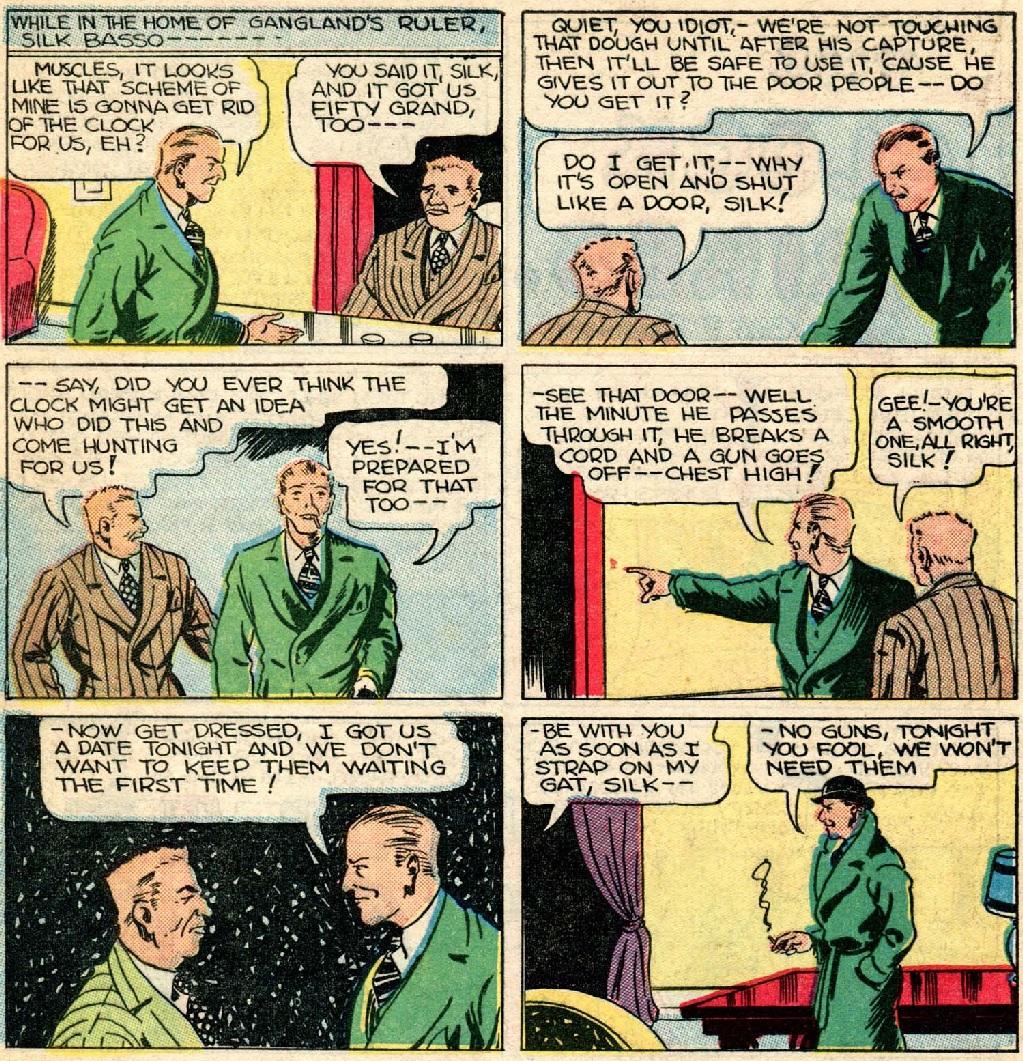
Now, where was I?  Oh yes -- stuff you can use in your Hideouts & Hoodlums games!  In this month's installment of The Clock, a trap is rigged so if the Hero crosses a tripwire set in a dark doorway, a gun goes off and blasts him.


Yes, that's so clever, Clock, hiding the wall safe behind a curtain. You only had a 2 in 6 chance of finding that concealed safe, or automatically if your player specifically mentions looking behind the curtain.


I love how the Gallant Knight has a sword in his hand, but leads his attack by throwing a bottle in some guy's face. This actually illustrates two things for H&H - one, if all weapons do the same abstract amount of damage, then players can be more free to be creative with what they attack with. And, two, it demonstrates how important it is for the Editor to stock rooms with items the Heroes can use or interact with.

This panel from a filler page called "Exciting Adventures" brings up an interesting point. By the H&H rules for falling damage, the man who fell out of the plane should have taken at least 10 points of damage on impact and -- unless he happened to have a larger than average number of hit points -- would surely have been unconscious on impact.

This blog has previously addressed similar issues related to falling damage, like falling into water. Perhaps a simpler ruling would be, if any circumstances exist that might prevent the falling damage -- something to cushion the impact, the Hero jumped so the fall may be controlled, the surface landed on is moving at a relative speed -- then the Hero may save vs. plot to take no damage.


From a second page of Off the Record.


(Scans courtesy of Digital Comic Museum)


Tuesday, November 17, 2015

Feature Funnies #10

Ah, a pleasant walk in the park with two big dogs...all well and good until you start getting dragged for points of damage!  Yesterday's post brought up the subject of being pulled off your feet in combat, but today's Joe Palooka makes me wonder if there is a lower threshold for what should be able to pull you off your feet? In other words, does it need to be two dogs dragging Knobby, or could one dog have done it?

I'm thinking someone should have a chance to pull a target with up to 3 times his hit points off his feet. A small dog would have no chance of pulling a grown man off his feet, but a giant rat might. That same giant rat would likely not be able to pull a 2nd-level Hero off his feet. 

This is from Off the Record. I thought it was really funny.


I never thought I would be featuring Lena Pry, and probably shouldn't here. I mean...if Hideouts & Hoodlums is to reach as broad an audience as possible, I shouldn't engage in the very negative stereotypes I point out on this very blog, right?  So if I was tempted to include a hillbilly mobster type that is permanently confused and shoots shotguns at random targets...I should just ignore that impulse, right?


I include these panels from Gallant Knight because I want to pose the question -- should fire have any additional effects than regular damage? Weapon damage does not take into account any residual effects, like bleeding, so it seems wrong to take residual effects like being set on fire into account.  Plus you just don't see many instances of people burning to death in comic books.

You do, at least here, see fire having a stunning effect, similar to how weapons sometimes just seem to stun people. So maybe H&H needs a game mechanic for any type of damage having a chance of additionally stunning the victim for 1 turn. Maybe there should always be a save vs. science?

Twelve days ago, I used a Dixie Dugan strip to support my supposition that people were accustomed to walking everywhere in the 1930s. I failed to remember how far back America's love affair with the automobile goes and, while this page of Dixie Dugan is probably exaggerated, it does go far in refuting my supposition. The urban streets were definitely still full of cars in the 1930s (or at least they were on weekends!).

I have no reason to post this page of Dixie Dugan, though, except that it's hot.

(Scans courtesy of Digital Comic Museum)


Tuesday, October 20, 2015

Feature Funnies #8 - pt. 2

Speaking of games (as I did in yesterday's post), an entire Hideouts & Hoodlums session could consist of working on a logic puzzle/investigation, like this one Jane Arden is solving.  I've only included the ending here to a story that's neatly resolved in three pages, but it's a "locked box" (as opposed to a locked room) mystery.


Verily, there are no rules for jousting in H&H, per se, but the sundering of shields could be handled by the non-superhero wrecking things rule, and unhorsing a rider would just be an extra save vs. science added to normal combat.


I was able to glean a surprising amount of nuances of characterization and backstory from the subtle workings of George Brenner on The Clock, when I wrote his entry for Supplement IV: Captains, Magicians, and Incredible Men, but even I forget if I ever noticed The Clock having a dad, who knows his secret.  This is really unusual, given how future generations of superheros will bend over backwards to fool their families and hide their secret pastimes.

It also raises an Experience Points issue, for Editors who are good at awarding XP for including Supporting Cast Members in scenarios -- do family members count as SCMs?   I would be inclined to say not. SCMs should have to be earned, by lucky dice rolls or good role-playing (though the official rules only recognize lucky dice rolls), not mothers and fathers and siblings that everyone could get to start with. I can just imagine someone trying to game the system by wanting to start with four siblings and a dozen cousins that they visit each game session...though, in truth, no one has really tried to do that yet.

At first, it seems pretty cool that The Clock has a secret lair with a bulletproof glass wall he can sit behind while he interviews guests, and the opaqueness of the glass kind of makes sense too, to conceal his identity...or would, if he wasn't still wearing his mask behind the glass. Aren't masks supposed to be all good guys need to conceal their identities? That's like the most basic trope of the genre. I'm starting to expect the opaqueness is a cheat to keep from drawing full figures. George Brenner uses lots of tricks like that, like close-ups of people just standing around talking, and shots of rooms where the lights have gone out.

Bulletproof glass walls have got to be pretty expensive, too. And he would only be able to use this place once, because the police captain would just come back and raid the place later otherwise.  So I don't recommend them unless your Heroes have a lot of money to throw around.

(Scans courtesy of Digital Comic Museum)