Showing posts with label game balance. Show all posts

Sunday, January 1, 2023

Thrilling Comics #3 - pt. 5

We're back, and so is The Lone Eagle! Here we see the Lone Eagle being overcome by four-to-one odds, which I find refreshing, even if it will not be the norm in this adventure from here. Perhaps he levels up quickly! 

Note that LE isn't placed in a deathtrap, but just left behind and they assume he's dead. Who has time to check for a pulse or watch for breathing? 

Now panel 6 is a big mystery, though you might not have realized that it was Where is this "no-man's-land"? You might assume, like I did, this is France - but this was published in February 1940 and Germany did not invade France until May! In February, the world knew Hitler had his eyes on Norway, but most of the fighting in Europe was taking place between Finland and Russia. This panel is like someone wasn't paying attention to current events and just, by coincidence, predicted the future!

I'm amused how Lone Eagle, clearly an Air Force guy, is able to commandeer a tank just by pointing at it. "This isn't Hertz, Lone Eagle!" that officer should be saying (fun fact: Hertz rent-a-car goes back to 1918!). 

I'm calling shenanigans on being inside an exploding tank and emerging unharmed, unless Lone Eagle is secretly a superhero buffed by the Invulnerability power. I think 8-80 points of damage, for being caught inside when a tank explodes, seems more than reasonable.

How did Lone Eagle catch up with Brent? If Brent was there some time ago, asking for the fastest route to German Intelligence, why is he still wandering around the battlefield? Or, if the soldiers didn't believe him and took him into custody - again, how is he now wandering around the battlefield? I feel like we missed at least three pages of Brent's daring escape from confinement.

Lastly, I'm again amused, this time by how Lone Eagle has a secret pocket in that jumpsuit. Come on, LE, the "secret" compartment is one of those huge, obvious cargo pants pockets above your knees, right?  

Great, thanks to this page we need to address the unpleasant subject of torture. Comic book heroes get tortured more often than I enjoy seeing. The goal is never to beat the hero unconscious, but to break his spirit and make him act unheroic. But how to handle that as a game mechanic? It might make sense to consider the whip damage subdual damage -- the hero can no longer resist if he reaches zero hp -- but LE just got over 100 lashes and I'm guessing he doesn't have over 100 hit points. I think how I would handle this is, every time the hero is reduced to zero hp, he has to make a save vs. plot or be broken by the torture. If the hero makes the save, hit points are effectively restored to full and the process can start again. 

But even if the hero is broken, what does that look like? Is the player forced to roleplay blubbering? A player could simply spare himself the headache of the game mechanics and chose this, as it's not really a consequence. But what if the hero lost something crucial - like experience points - if broken? There is precedent for energy draining in the game and, while it's purely supernatural, torture is a draining experience too...

One can't help but wonder what the warden was doing, taking a late night stroll without guards through the prison...but before that is the mystery of how LE got out of his cell. Did he use wrecking things to bust the door down?
Nope, nope, nope - unless that plane was planning to drop a person onto the roof of the train, there is no way LE should be able to leap up to the plane. I can no longer ignore that LE is clearly statted as a superhero, despite his lack of a proper costume and other genre tropes. 

That a superhero could have so much trouble with a single pilot is very much in keeping with how I pictured the superhero class balancing out in H&H; being a relatively weak fighter when not buffed with combat-related powers. 

But he's not just a superhero; it seems pretty clear that he's going to win this 6:1 dogfight (spoiler from next page: he defeats three and then escapes), which suggests to me that he's at least a 3rd level aviator, in addition to at least a 1st level superhero.

I do like the smart tactics of the Germans - trying to stop this unstoppable killing machine indirectly rather than continuing to approach the train with that field gun on it.

There were a lot of comic books published around this time that proved to be prophetic, not that it was hard - during WWII, if you imagined the worst scenario possible, that usually happened sooner or later. This comic predicts a German invasion of the Netherlands three months before it actually happened. Apparently the Dutch failed to believe Lone Eagle's warning. 

Again, this story predicts the bombing of London seven months before it happened. It predicts the bombing of Berlin by four months, though clearly the author is wrong that bombing Berlin first stops the bombing of London.

"Gee, good thing you told us not to miss, Lone Eagle! We were aiming low for a 50-50 success rate!"

A 50-50 success rate is, of course, the norm for 1st-level characters in H&H.

Yes, the British RAF did use some American planes, but most of them were British-made. The implications of this story are, of course, that the English can't save themselves withou the U.S.'s help (again, largely true), and that Americans would seem like superheroes on the battlefield with Europeans (this is just propaganda).

Moving on, we return to what I have long dubbed the Mythic West, a "demi-plane," if you will, that allows for "Wild West" action in the modern day. 

Nueces, Arizona, is not a real place, but is likely named after Nueces County, Texas. 

Panel 3 has some rather disturbing implications.

I had to look up the use of punchers here. From the Internet: "In those early days of cattle drives the cattle were not particularly eager to enter loading chutes or box cars, so the cowboys poked or punched the cattle with long poles to get them in to the cars. The term was first recorded in 1880 and soon became a synonym for all those who worked cattle."  I don't think "Fork-D punchers" has any special meaning, other than they work for the Fork-D ranch...

I had to look twice to verify this, but the guy in the fight at the bottom isn't the Rio Kid; he's just some guy who's about to become Supporting Cast, and is probably at least a 2nd-level cowboy, given how well he's doing in this fight.

Boy, this is one violent comic book! This page is a nice reminder, though, that not everyone in a given organization is going to be the same Alignment. Here we have a Lawful jailer having a disagreement with the Chaotic sheriff. Turn this around when you're stocking your hideouts - make sure there are the occasional Lawful hoodlums who may turn on their bosses and help the Heroes!

Shooting a rope, while riding on horseback, would normally require a natural 20 on an attack roll (at least while I'm running the game) - but this is why the cowboy class, when it resurfaces in 2nd edition someday, will still need to have stunts. 

Tombstone is, of course, a real place. It is likely a portal site that exists in both the real world and the Mythic West, so one could leave Tombstone heading into either.

(Scans courtesty of Digital Comic Museum.)


Sunday, December 13, 2020

Slam-Bang Comics #1 - pt. 5

I just can't seem to let Mark Swift go. There are only three pages left that I didn't get to in the last post that I want to get to today.  

Being thrown into a cage with an animal you have to kill is an okay trap. Being sporting enough to send you in with a sword is just offering you XP. 

Eagles is a really unusual choice; I can't say I've ever heard of eagles being called "vicious" before and think wild turkeys might have made a better choice. It's also unclear if these are meant to be huge eagles, or the narrator is saying eagles are huge birds. Huge eagles might be worth up to 1+1 HD...


If you didn't think this story was gonzo-crazy enough -- now the Indians have a pet dragon. It's big, it's fearsome-looking, and more importantly it should have some impressive Hit Dice given its size and mass -- but one of the most annoying tropes of golden age comics for me is the "dead in one hit" I keep seeing in so many stories. 

Hey Indians, if this guy can kill a dragon in one thrust, you really think you can take him with spears...?


The next time I run Hideouts & Hoodlums, if/when my players try something just off-the-wall crazy, before I say "that could never work," I need to recall this page and how a Viking rode a dragon like a bronco.

It's actually consistent with how dragons are pretty much uniformly treated in the early comics as unintelligent animals. Be cautious, Editors, about giving your players the opportunity to domesticate some of these and start a dragon breeding farm.

(Scans courtesy of Digital Comic Museum.)


Sunday, December 30, 2018

Fantastic Comics #3 - pt. 4

As 2018 winds down, we find ourselves still in February 1940 and this month's Captain Kidd story. Here we see the need for a voodoo doll spell in Hideouts & Hoodlums (though Supplement III had introduced the voodoo doll as a magic item, a perhaps equally satisfying solution).

Here we have our first hideout that is all in one tree, and I dare say I've never seen a rope ladder quite like that before (the rope makes up only the rungs, connected to the inside of the tree).

When has Kidd seen black magic before? It seems a stretch that he so quickly identifies the glass as Negus' wand (even I missed that, treating it as a new magic item just yesterday).
Negus' last spell is Smoke Image, one of the new 3rd level spells that debuted in the 2nd edition basic book. It's not clear what his intent with it is other than to try and scare off Kidd, but that's not easy to do when Kidd's plane is packing bombs -- bombs are one of the big equalizers for the fighter class.
Again I find myself sharing Professor Fiend, a joke feature with sometimes valuable lessons learned. Here, I was amused by the notion that Fiend might accidentally fall into a mirror, but floored by the idea that he could escape by scratching off the quicksilver backing, so that it would no longer be a mirror. And then bursting out the back, which was made of a separate material, was thinking outside the box, if you will, as well.


And now we get to Stardust, where Stardust is -- no, that's not a VR headset, but a crime-detecting ray view plate. At a range of millions of miles, it can detect when large scale crimes are about to take place on Earth.

Everyone always thought Thanos was a Darkseid rip-off, but it turns out that his "there are too many people" schtick came from The Demon here.

Space is big. Just the Moon is over 2 million miles away, so technically Stardust could be as close as the Moon.

"Undersea pressure-disturber" sounds like the kind of understated name a scientist would actually give a tidal wave generator. It's unclear if the undersea pressure-disturber also creates heat waves through vibration, or the Demon is describing two mad science inventions to his pal Max. 
If you can look away from Stardust callously crushing the Demon's chest with one hand, take note of the first two panels and Stardust's arrival. Is he the glowing energy star transformed into physical matter? Or is the glowing energy star a flavor text manifestation of his power, and what he's really done is Teleport through Focus, with his focus being the shadow on the wall? I'm asking because I seriously can't tell. Either way, it's a high-level power.
Anti-gravity will become a power, and reverse ray practically is already (Turn Gun on Bad Guy, but this would be a somewhat broader application than originally intended).


Sky Writing may need to become a power; it can't just be hand-waved as flavor text if the communication is important to the scenario. It would be 1st-level, though -- easily Stardust's simplest power to date.

And, lastly, we're going to jump into Sub Saunders. Sub's enemy, King Poseida, is using a hydro-vision like a television. A hydro-vision, I'm guessing, projects onto a wall of water?

Those are some crazy-looking mermen. Are those tentacles hanging from their chins?

That's one big giant octopus! Maybe 9 HD?

(Scans courtesy of Digital Comic Museum.)

Tuesday, November 7, 2017

Wonderworld Comics #8 - pt. 2

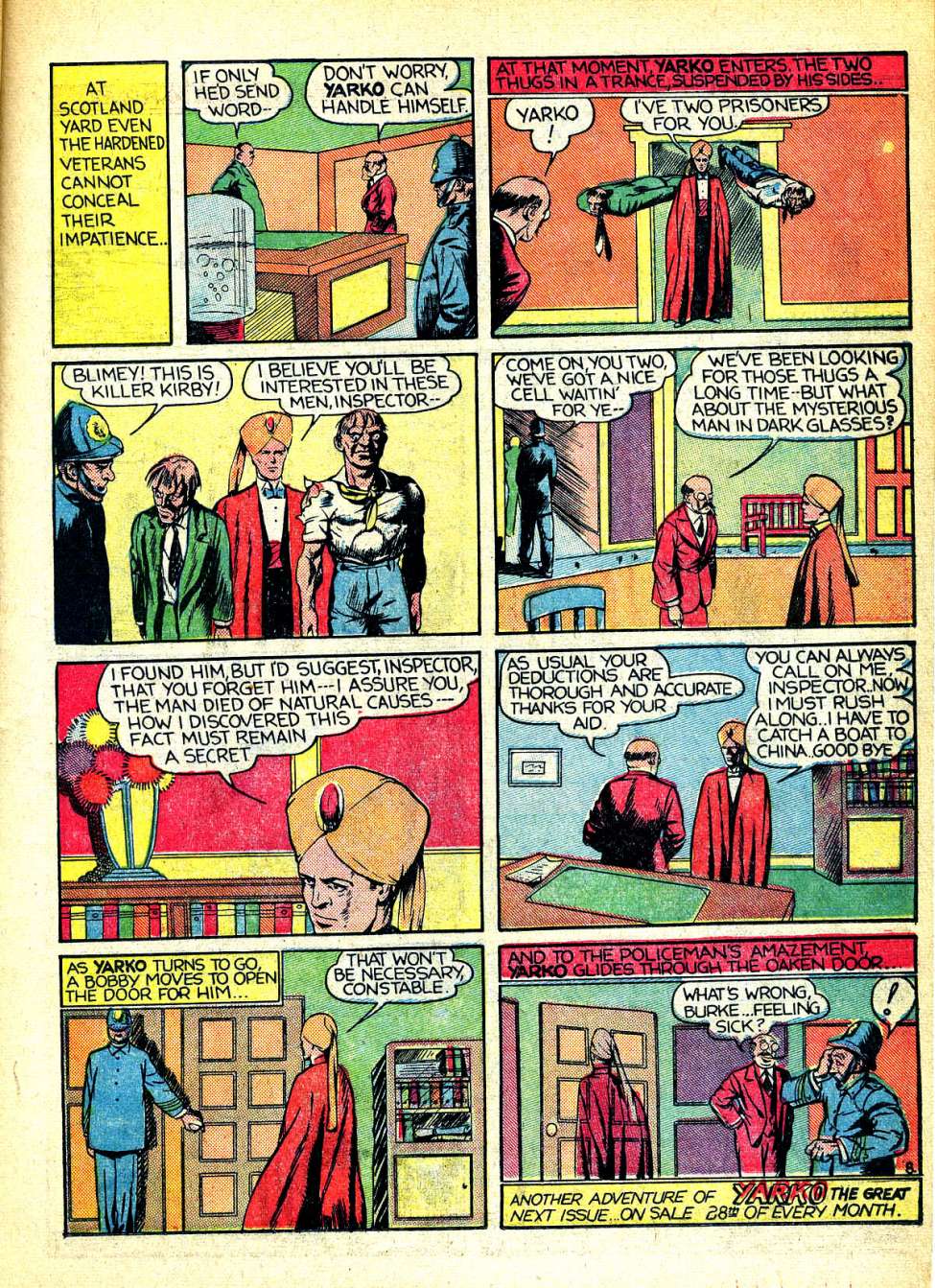
It seems that Yarko the Great has cast two spells here; the first seems to be a Telepathy spell, allowing two people to contact each other over distances, and the second seems like a Read Curse spell, that allows him to identity the curse on the dead woman.

I am going to do some limb-climbing, though, and suggest that we don't really need either new spell. We can assign "curse identifying" to Detect Magic. And the telepathy used here could have been as easily accomplished using two telephones, so I suggest that this instance of telepathy could be flavor text, created at the Editor's discretion, to get the plot rolling. Now, does this set a precedent for Yarko being able to use telepathy in the future? Not necessarily, particularly in a game system where powers and spells are chosen from day to day and not set in stone. And comic books themselves were always being inconsistent.

I ran a scenario in my JSA campaign based on this story (the Atom was killed by a cursed item, but the Spectre got them permission to go to the Valley of Death and retrieve his soul), so I'm particularly excited to get to it on the blog finally.

Here we see Yarko laying down some powerful spells, starting with Teleport and ending with Planar Shift. In the middle, he seems to rely on Enlargement for the intimidation factor. It's unclear if Yarko is commanding her with just the force of his words, or with a Charm Person spell.

For the boatman, I planned to use the stats of a Charonadaemon from the old Monster Manual II (luckily the JSA didn't choose to fight him). The little flying creatures over the river I statted as spined devils and vargouilles from the same book. I had to do this appropriation because I had not created anything too close to these yet in Hideouts & Hoodlums and, since they don't actually do anything in the story, I would have had to make stuff up from scratch anyway.

Burning Pain is actually covered by the yaksha demon in Supplement III: Better Quality. Lucky coincidence?

The JSA managed to avoid Fear by slaying Burning Pain with missile weapons and not exploring the ledge where Pain was. Fear I had planned to stat at the time as an apparition from the Fiend Folio, but in 2nd ed. H&H, I plan to have a new undead mobster type called the spectral killer.


Horror was evaded the same way. Because of the wailing shriek, I planned to stat Horror as a banshee/groaning spirit.


I skipped this scene, replacing it with The Atom and some other souls being found on a beach, guarded by an angel/deva that had to be persuaded to let him go. I was fearful of the players choosing to run down the hall of time and all de-aging themselves into babies, or encountering Death, choosing to fight him, and wind up getting all killed.

Why isn't Yarko de-aged? I guess he made his saving throw.

Will Eisner's moral lesson about vanity makes this heavy stuff for a 1939 comic book.

And then, on the opposite side of heavy, we have Shorty Shortcake. The poisonous snake in the bed was already an old enough cliche by 1939 to poke fun at it here.

Shorty is right on the border, with Seaweed Sam and Archie O'Toole, between being too ridiculous to consider running a H&H game based on it, but having just enough interesting ideas in it to make it impossible to ignore. Should snakes have to make morale saves if they see two reflections? Nope. Should people be able to tie snakes into lassos? Probably not. Should sailors be able to make blinding spit attacks with chewing tobacco? That's just interesting and plausible enough to consider -- and would be a special attack that makes a sailor mobster type more interesting.

But Mr. Mizzen is no ordinary sailor-mobster; he must be of the superhero class. Here he demonstrates nigh-invulnerable skin and, if the fourth panel can be taken seriously, the high-level power Super Punch. Mizzen must be high enough in level that the 20 to 1 odds by the end of page must not be too great (and I would probably have a superhero be at least 4th level, a remarkable man, before taking on odds like that alone).


Okay, if you ignore the overpowered notion of being able to punch people forward through time, and the subtle racism suggesting all Latinos are lazy, panel 3 suggests that the superhero class should have some disadvantage to it (like powers only being able to work in the morning). Right now, in second edition, disadvantages are only tied to race -- the thinking being that classes already have a balancing mechanism tied to experience point progression, and the only real unbalancing danger is when you combine the alien race and the superhero class together.

(Scans courtesy of Digital Comic Museum.)


Sunday, May 14, 2017

Marvel Mystery Comics #2 - pt. 2

So, we left off with The Human Torch chasing racketeers who have been trying to fix auto races. Though this story probably started in New York City, he follows the racketeers to "Auson City", which I can only guess stands for Austin. The Torch seems to run all the way there, perhaps using an Outrun Train power.

When The Torch reaches the race track, he uses a power faster than Outrun Train to pass the race cars. In 2nd edition, there is a 2nd level power for outrunning called Outrun Plane.

Somehow, The Torch throws the villain's race car out of control just by grabbing onto the back of it. I'm not sure how that works, physics-wise. Yes, in a set of chase mechanics, there should be a way to try and force a complication on your opponent, and I'll work on that. But in this scene, it would have made more sense if the villain was instead plowing through the fence in an effort to shake the Human Torch off.

While pursuing the villain's henchmen, the Torch accidentally sets a building on fire. It's a plot convenience, allowing the bad guys to get away while the Torch saves people he himself put in danger. But how to deal with that in terms of game mechanics? I do not want powers to come with built-in disadvantages where they can get out of control. If I ever took away the limited resource aspect of powers, then this might make a good game balance mechanic, but I would rather keep H&H a limited resource management game.

What's even harder to explain is the Human Torch's new ability to talk to flame and tell it what to do. Except to say that this is -- as goofy as it is -- simply flavor text for the 3rd level power Control Fire (debuted in Supplement I: National, retained in 2nd edition).

What should be the final battle with Blackie comes in a steel mill, where Blackie and his men don asbestos suits (in H&H since Book II) and train fire hoses on him. The high pressure of the hoses is able to push the Torch into their next trap. Second edition has rules for pushing an opponent, but those rules are for melee. However, I could see making exceptions for that, based on circumstances. 

When The Torch escapes the trap, he flings a ball of flame that lands in front of the fleeing men and it forces them back, the heat being too much for their suits to protect them. This looks a lot like Wall of Fire, which would be a 5th level power (it's currently a 5th level spell, though).  This means The Human Torch is a superhero of at least 8th level. That's a lot of brevet ranks!

We see Wreck at Range in use again, and this time we have a precedent for wrecking being able to wreck something very small and specific -- in this case, the visor of Blackie's suit. 

And, again, we see the Torch's wrecking things power being out of his control, as he starts to bring down another building around him. Maybe this can be explained away, though, as the Torch being only one month old and not in full control of his powers yet. Presumedly, an android Hero under a player's control is going to be "older" and have more control over his powers.

Blackie's car has a smokescreen ejector (also found in the game since Book II).

The patrol car the Torch hitches a ride on has a top speed of 110 MPH.  The Torch runs faster than that, meaning he's using at least the 2nd level power Race the Plane. The duration seems to end when he reaches the airport, though, as he can't keep up with the airplane taking off at that point.

Again, the Torch uses the Wall of Fire power to surround the bad guys for what, this time, finally turns out to be the final showdown with Blackie. Blackie uses his car as a weapon, trying to ram the Torch with it. The transportation trophy section of 2nd edition will say a lot more about ramming damage for cars. The Torch uses the Dig power to dig a deep trench to stop the car. He certainly doesn't need to, since he can just wreck/melt the car, but I guess he still had one 4th-level power slot left unused and decided to burn it before the scenario ended.

Whew! That's enough about the Human Torch. The next story features The Angel. While the first Angel story seemed to take place in New York City, this one is definitely in Hong Kong. The main character is the plot hook character, Jane Framan of the Smithsonian Institute, sent to report on the Lost Temple of Alano (a very un-Asian-sounding name). 

We also encounter the word "gruely" to describe a scruffy, disheveled man -- the only time I've ever seen this word.


Saturday, July 30, 2016

Wonderworld Comics #3 - pt. 2

While most heroes are running around stopping hoodlums, Yarko the Great is double-teamed by Death and the Devil. Well...at least something claiming to be The Devil. So far, its only power seems to be summoning Beppo.

Death is an imposing character, one of my favorite villains from the Golden Age. By the 1970s, Marvel Comics will be full of metaphysical characters like this, but for 1939 this is really different. When Death manifests in mortal form, he is killable (though I'd still be pretty charitable with the Hit Dice), but also kills at will with a gaze attack.

So let's look at what Yarko has to counter that with. He casts something that seems to be a more powerful version of Mirror Images (it can conjure up to a dozen illusory images of the caster). Maybe Mirror Images should be bumped up to a 3rd level spell for this. Yarko can cast a Wall of Force -- 5th level spell!

Stopping a Magic-User by blindfolding him seems consistent for how the class normally works -- it's usually the hands and mouth that have to be stopped, but this seems a reasonably close limitation.

I'm not entirely sure what to make out of Yarko's first spell. Create Water seems a little weak for what it's being used to do here. Maybe this is what Dispel Magic looks like, when used on magic fire? The Devil goes bye-bye -- without having done anything other than tell his hoodlums what to do -- thanks to Yarko's Dispel Evil spell. I still don't put much stock in that being the actual Devil -- more likely an incubus or yaksha (the two weakest demon types I statted in Book III: Better Quality).

But what is that? Did Yarko just use wrecking things to pull himself free from the wall? No Magic-User spell duplicates that (yet). Either I need to consider a new spell, or I need to give Yarko a level in Superhero!

Death is tough enough that even Yarko doesn't want to take him on!

I've used that panel before of Yarko walking on water to illustrate the Ring of Water Walking. There is still no spell for Hideouts & Hoodlums for water walking -- just the ring. I guess I have time to think about that again now.

The next spell Yarko casts is either some Mass Levitate or Mass Telekinesis spell - neither existing in H&H as of yet.

Looks like Yarko's Mass Telekinesis spell has a long duration, and has been coupled with a Hold Person spell to keep their traps shut. Then, just to show off, Yarko casts Passwall -- his third 5th level spell? That would make Yarko at least 11th level -- or, he has a new spell called Passdoor (a weaker version of Passwall), or he never actually entered the room and sent in an illusion of himself instead (we've seen him do that once already in this adventure), or this is flavor text for the Knock spell.

This is Shorty Shortcake, a surprisingly useful source to mine for ideas. This installment reminds us that, if the Heroes over-rely on calling in the cavalry and trying to always overpower/outnumber the bad guys, then the Editor has to do the same for the bad guys. This escalation of forces might convince the players that they're better off taking their chances with a small, stealthy force.


This is from Dr. Fung (and his sidekick Dan). Dan is pretty unlucky with his dice rolls there, shooting six shots at a fleeing mystery assailant and missing every time, even though he has a bonus for attacking from behind, and is only penalized for cover at the last shot.

It may seem too cliche to have the bad guy drop a note that explains everything the Heroes need to know, but that doesn't mean it isn't appropriate to use it!

Just like the ol' "constrictor snake coming through the window" trick is fair game!


There seems to be a good amount of precedent for the Snake Charm spell in comic books, but since it has such limited utility, I'm planning to just replace it with a more generic Charm Animal spell.


This is K-51: Spies at War. Mad science devices are seldom portable, but take up a whole lab or much of a lab. This mad science device is a variant on the death ray, in that it kills at a distance with projected sound. This page doesn't give us a good idea of the device's maximum range, but it seems to be in miles.


When you're not a superhero, your wrecking things options are somewhat more limited. Sure, you can bust open a locked door as a skill check, or count on your limited chance of non-superhero wrecking (most things have good saves), or you can just choose an action -- like throwing a rifle into a transformer -- and leave it up to the Editor to decide what happens.

It's a tricky call for the Editor to make. It could end the scenario prematurely to blow up the lab. It could be a total party kill if the explosion does too much damage to the Heroes!  Or it could be anti-climactic if nothing happens at all. With so many options to consider, it might be best to leave it to a 50/50 chance...or, put the ball back in the player's court by saying "Save vs. plot -- if you succeed, the transformer blows!"

(Scans courtesy of Comic Book Plus)


Wednesday, June 15, 2016

Jumbo Comics #8

We rejoin Hawks facing 20 to 1 odds on board an enemy vessel -- and those are not good odds for a 3rd-level Fighter with no armor and armed with a sword, even if he does get to combat machine these guys. Luckily, a quick-thinking supporting cast member creates a trap for the opposition by turning a sail into a net. Nets seem to be particularly effective in comic books. Whatever the size of the net, half that space below it will be covered in net and all in that area must save vs. science or be trapped underneath for 1-3 turns (you can see the two who made their saves here).

I'm less charitable to the use of the cloak during the fight; I really don't see what game mechanic advantage to give to someone fighting with a sword in one hand and a blinding cloak in the other. Hawks' player is going to have to choose between the two each turn. On turns Hawks uses the blinding cloak, his opponent will, if he's hit, have to save vs. science or lose his attack that turn. It's not an effective attack, but more of a delaying move, really.

This is not the first, nor will it be the last, time I see a half-pint kicking a mobster in the shin and disabling a grown man. Half-pints might need a special power of getting a +1 to hit mobsters in the shin, requiring a save vs. science if they hit or the mobster is stunned for 1 turn.


This is a special feature related to the World's Fair. Frank Buck reminds me that cobras and pythons need to be statted for Hideouts & Hoodlums 2nd ed. Pythons were not singled out by name in 1st ed., but there were stats for regular constrictor snakes. 2nd ed. will have stats for both regular and giant constrictor and poisonous snakes. I might include a note about how cobras can be caught in a sack, if you beat them in initiative and successfully hit them with the sack.


Is Wilton taking a risk, bringing Snorty back to town to see a doctor, or is he close to leveling and looking for that 100 XP good deed award for fixing up Snorty? Plus another bonus for including a supporting cast member in the story?


Ignoring the fact that Doogah looks more like a Muppet than a real person, this page is worth pointing out for the new trophy item -- the language chair. Anyone putting on the attached helmet and sitting in the chair will immediately learn the language of the next person to speak to him.


Here is an Editor at work trying to balance the challenge level of this scenario. Knowing that he plans to put Sheena and Bob up against a machine gun, he makes sure they have access to grenades to even the odds.

In this instance, Bob is not rescuing Sheena for a good deed XP award, since it does not count towards saving fellow Heroes. Instead, Bob is just playing smart and working to keep his comrade-in-arms alive.

That Bob is able to rush into the line of fire of the machine gun, pick up Sheena, and run out either means the Editor has rolled horribly for that machine gunner, or he's being too merciful to his players and deliberately unbalancing his game.

(Scans courtesy of Comic Book Plus)

Friday, March 25, 2016

Crackajack Funnies #8

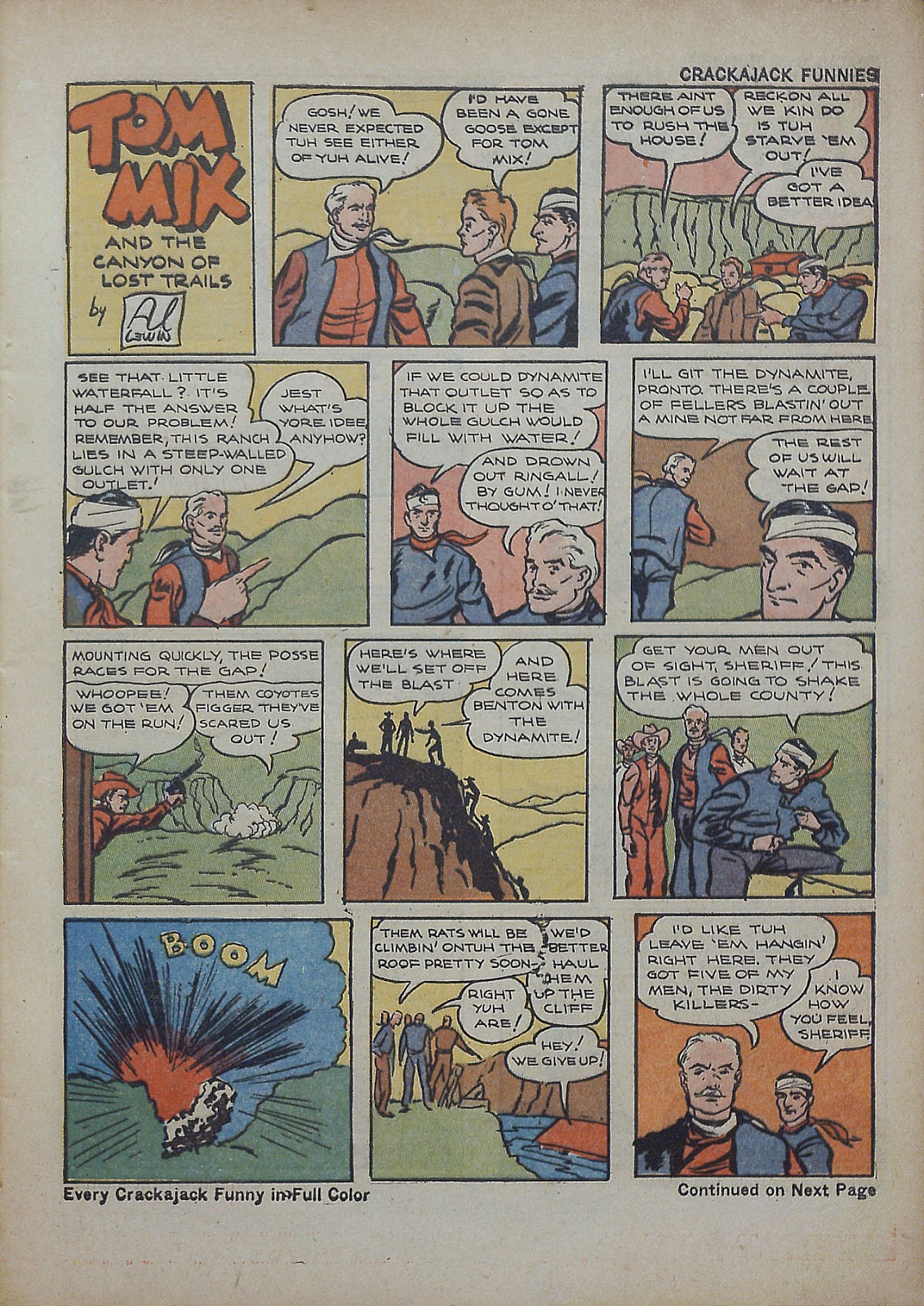
Sure, it's fun to play an alien superhero who can leap tall buildings in a single bound, but the challenge of getting into an upper story window without any super-leaping ability can be fun too. This is one of the reasons the Fighter class is still relevant in a campaign with Magic-Users and Superheroes.

If a Fighter like Dan Dunn wants to cross over to that window, he's going to have to find a ladder long enough to bridge the street, push it over to the window sill, and then balance across the ladder until he reaches the window.

Dan is quite confident that he's hidden the dictaphone well. There's no game mechanic for hiding it well, though -- it all depends on the luck of the searchers.

One of the many balancing acts of the Editor is to make hideouts challenging, but not so challenging that the players just decide to flood the place and be done with it. It's also a good idea not to tempt them by placing large bodies of water so that they would drain into the hideout.


This will not be the last portable time machine in comics. I don't recommend time machines be this portable or easy to use -- time travel could be a campaign wrecker in all but the most capable Editors' hands.

That said, the idea of going back in time and finding talking, intelligent dinosaurs, is intriguing...

(Scans courtesy of Digital Comic Museum)


Wednesday, January 6, 2016

Amazing Mystery Funnies #2

About a year before the publication of the Sub-Mariner, we have this first work by Bill Everett -- Skyrocket Steele. Steele is Everett's answer to Buck Rogers, a character well-represented in comic books up to this point in 1938, though we haven't been able to look at those adventures because of copyright issues.

Anyone wanting to use Hideouts & Hoodlums to run a Buck Rogers-like, or Skyrocket Steele-like, campaign could certainly do so. In many ways, the technology found in these future stories only mimics the technology of the times, but with some "flavor text" changes -- phones have built-in television screens, but still are not mobile, cars still transport you around, but they float above the ground and are called "skysters".  Even trips to other worlds is really just travel between locations with a bit more flavor text than usual to it.

Other equipment is just mundane things with new names -- a range-scope instead of a telescope, or G-2 camera instead of just a camera. Only the Kodacon seems different, with its crystal ball-like appearance, but what it shows is nothing more than a series of networked cameras could have broadcast.

We haven't seen Brailey of the Tropics in awhile (actually, this is a reprinted story from Funny Picture Stories #1), but here he demonstrates that just about anything should trigger a morale save, even a flaming broom...


...but, eventually, even a generous Editor must put his foot down. You want to ride an elephant into combat? Okay, maybe if you roll a successful save vs. plot, the elephant lets you ride it. What, you want it to attack for you now too? Come on, who's the Hero in this story, you or the elephant?


This is another reprint, an adventure of Speed Rush, Ace of the Private Sleuths, from Detective Picture Stories #2. He's a busy man on this page,

a) using his keen senses to spot the Morse code the window washer is using (2 in 6 chance to notice?),

b) dodging kerosene splashed at his eyes (I wouldn't let this do damage, but require a save vs. missiles to avoid being temporarily blinded -- plus the chance of being set on fire the following turn!),

c) performing a disarming attack, followed by a grappling attack (the later intended to do damage rather than establish a hold), and

d) an Editor might be justified in asking for an encounter reaction roll to convince the jeweler to take a $300,000 jewel out of his safe and run off with a private detective's that it's safe to do so.


Now, I don't know how Speed manages to snap his bonds here. A player with a Fighter is going to need some excuse to justify this, like a sharp object he could use to weaken his bonds with, or some such. I also would not allow, as a H&H character, for a thrown sack of cement to do damage to one opponent, and blind a second opponent in the same throw. There will just be times when we must choose not to emulate the comic books because it does not pass this fairness test: would the players be okay with this being used against them?

There's another one of those disarming shots.

And, incidentally, this J.M. Wilcox is really impressing me here with his dynamic panels and page layouts!


Well, it turns out that Speed's player came up with a rationale for being able to break his bonds after all!


Sometimes you might be tempted to offer a new type of lure to your players than financial reward. A possible cure for cancer -- who wouldn't go after that? Now, if your Heroes successfully retrieve it...you can play in an alternate timeline where cancer was cured in the 1930s, but other possibilities are that the possible cure winds up not working, or yields some results that will help create a cure decades from your campaign.

This is a reprinted story from Funny Picture Stories #4, and was one of Will Eisner's earliest stories in print. How exciting a comic book anthology featuring original stories by Will Everett, J.M. Wilcox, and Will Eisner would have been had Centaur only been able to afford it!

It's interesting, looking at reprints now, to find what stuff I missed the first time around that I read these for this blog.  For instance, how is Fatts shooting that machine gun without help?  Doesn't a machine gun need a second man to feed the ammo? I would actually rule that a 1st-level Fighter cannot run a machine gun alone, but a Superhero or a higher level Fighter can (this at least keeps machine guns out of the hands of most of your 1st level Heroes!).


When I last discussed this story in Western Picture Stories #1, I was convinced that H&H did not need parrying rules. Now I'm not so sure and would be open to more evidence from both sides.

(Scans courtesy of Digital Comic Museum)