Showing posts with label Professor Fiend. Show all posts

Tuesday, February 22, 2022

Fantastic Comics #5 - pt. 4

Oh boy - more Fletcher Hanks! Let's see how the science holds up here, he says knowingly...

Space Smith's record-setting moon run is 12,600 MPH, considerably slower than the Space Shuttle in the 1990s, that could orbit the Earth at 17,500 MPH. 

Is that supposed to be a nebula...?


I'm already not sure what's going on. Is it a living nebula, and a monster, or does it just seem to be alive and something else is going on? It seems more like a trap than a monster attack. Perhaps -- and I'm just spitballing with comic book science here -- but the nebula has been ...chemically treated to be drawn magnetically to what powers ship engines?


Uh-oh, it looks like I found another mobster that goes in Volume 1 of the Mobster Manual. So I'm still not done! Hoppers have superhero-like leaping ability, and their speed and agility lower their AC to at least 4 and maybe gives them a +2 bonus to saves vs. dodgeable attacks?

Hoppers are encountered in groups of 5-10.


Space seems to be punching out four hoppers at once. Does this mean hoppers are just 1 Hit Die? It's so difficult to accurately stat Hit Dice from how long they last in combat, because of the "done-in-one-punch" approach of golden age stories. I think, because Fletcher's heroes are always super-powerful, we can assume the hoppers are powerful too. I'm thinking 4 HD for them.
That looks more like a cloud than a net before it comes down. 

Meteor gas rayguns are curious trophy weapons. The gas seems to be able to pass through walls, unless the cockpit of the ship is open the hold? That seems...a bit too overpowered to me. I may keep the meteor gas raygun, but limit the range to 150', blanket a 15' radius (affecting up to 5 targets), with a -2 penalty to save.

This is the next story, Captain Kidd. There's a nice set-up here of Kidd coming to the jungle because of the rumors of a man-eating tree. It's not; the "tree" is the trapped entrance to a hideout. The tree's bark is studded with gems (cheap, ornamental stones, most likely), but if you try to pry one loose, a trap door opens in the side of the "tree" and drops you down a pit, which is the entrance to the hideout. It looks like maybe a 20' drop? 


Should guards come in large, huge, and giant guards?

At first it appears the food is drugged with sleeping poison, but if the melon contains acid, does that mean Freddy has actually passed out from taking damage? Ingesting acid should do at least 2-8 points of damage, depending on how strong the acid was.


The large guard is called here both a giant and a brute. A brute is going to be a variant of thug, while "giant" here means pseudo-giant. Since he goes down pretty quickly, I'm inclined to go with the brute for statting purposes.


We surely aren't meant to take Professor Fiend too seriously, but how off is the history lesson here? The Earth is 4.5 billion years old. 2.5 billion years ago was the start of the Proterozoic Era. It really was mostly water back then, as shown here, but it was scalding hot water, about 150 degrees. That might be hot enough to do 0-1 points of damage per minute of immersion.

(Scans courtesy of Digital Comic Museum.) 


Monday, November 4, 2019

Fantastic Comics #4 - pt. 5

This is the last page from Captain Kidd, and the gorilla turning out to be hot babe in a bathing suit in a gorilla costume is a twist worthy of Shyamalan. Use it to keep your players on their toes!
Professor Fiend is surprisingly relevant again, with an explanation for how "undead" skeletons might come about through chemistry instead of magic (using comic book logic, of course!).
Although -- spoiler -- this story doesn't end well for the skeleton, it does make a curiously effective origin story for an undead superhero.
And now we get to the second Fletcher Hanks feature in this issue, Stardust. The unnamed mad scientist, called only "A mad giant experimenter" here, is one of the first physically imposing supervillains, even if he has neither a name nor long pants.

No one has ever come close to reaching the center of the Earth; 7.5 miles down is the deepest anyone has ever drilled.
This is likely the first reference to Lake Michigan in all of comic books. There is no way a volcano could form under Lake Michigan; the geologic prerequisites just are not there. A tiny volcano, Hicks Dome, does exist at the southern end of Illinois, but it is a volcanic pipe powered by gas. Volcanoes do throw up lava bombs, like pictured here, but while lava bombs are dangerous if they land on someone, the real danger from volcanoes is the ash plume they send out. If this really happened, Chicago would be buried in it, lots of people and animals would suffocate, and the city would need evacuating. 
Hideouts & Hoodlums has a wrecking things game mechanic, a Wreck at Range power, and a Mass Wrecking power at higher levels. What Stardust seems to be using in panel 2 is an as-yet unwritten Mass Wrecking at Range power.

At high-levels, a superhero needs to be able to not just wreck things into fragments, but to destroy them utterly, like Stardust does in panel 3.

How does Stardust know where the chemicals that made the volcano came from? Not for the first time, Stardust seems to be using some advanced version of the Detect Evil power that functions more like divination magic.
I find it comical that Stardust would be known as a "crime-buster" instead of the most dangerously powerful being in the universe.

I'm intrigued by how anti-ray rockets would work. Do they somehow home in on energy, like a heat-seeking missile? And how do the rockets make him lose control of his raybelt? We've never seen Stardust rely on buttons or knobs on his belt before. Maybe it requires concentration.

Wall of Dust is an unusual spell with what I would consider a limited degree of usefulness. One, it might throw off missiles that are tracking you, like chaff. Two, it might trick your enemies into thinking you've been turned to dust. I would treat this as a 2nd level spell.

Lastly, Stardust uses Teleport through Focus to step out of the dust in the room.
The "boomerang ray" works exactly like the power Turn Gun on Bad Guy.

Wrecking a chemical plant, in this context, is just wrecking a generator, since they are inside the castle and not talking about wrecking an entire building.

Who are the interplanetary police? If only we'd learn more!
Here we see a hi-tech trophy item (mad science category) give Sub the Water Breathing ability, as per the spell.

(Scans courtesy of Digital Comic Museum.)

Sunday, December 30, 2018

Fantastic Comics #3 - pt. 4

As 2018 winds down, we find ourselves still in February 1940 and this month's Captain Kidd story. Here we see the need for a voodoo doll spell in Hideouts & Hoodlums (though Supplement III had introduced the voodoo doll as a magic item, a perhaps equally satisfying solution).

Here we have our first hideout that is all in one tree, and I dare say I've never seen a rope ladder quite like that before (the rope makes up only the rungs, connected to the inside of the tree).

When has Kidd seen black magic before? It seems a stretch that he so quickly identifies the glass as Negus' wand (even I missed that, treating it as a new magic item just yesterday).
Negus' last spell is Smoke Image, one of the new 3rd level spells that debuted in the 2nd edition basic book. It's not clear what his intent with it is other than to try and scare off Kidd, but that's not easy to do when Kidd's plane is packing bombs -- bombs are one of the big equalizers for the fighter class.
Again I find myself sharing Professor Fiend, a joke feature with sometimes valuable lessons learned. Here, I was amused by the notion that Fiend might accidentally fall into a mirror, but floored by the idea that he could escape by scratching off the quicksilver backing, so that it would no longer be a mirror. And then bursting out the back, which was made of a separate material, was thinking outside the box, if you will, as well.


And now we get to Stardust, where Stardust is -- no, that's not a VR headset, but a crime-detecting ray view plate. At a range of millions of miles, it can detect when large scale crimes are about to take place on Earth.

Everyone always thought Thanos was a Darkseid rip-off, but it turns out that his "there are too many people" schtick came from The Demon here.

Space is big. Just the Moon is over 2 million miles away, so technically Stardust could be as close as the Moon.

"Undersea pressure-disturber" sounds like the kind of understated name a scientist would actually give a tidal wave generator. It's unclear if the undersea pressure-disturber also creates heat waves through vibration, or the Demon is describing two mad science inventions to his pal Max. 
If you can look away from Stardust callously crushing the Demon's chest with one hand, take note of the first two panels and Stardust's arrival. Is he the glowing energy star transformed into physical matter? Or is the glowing energy star a flavor text manifestation of his power, and what he's really done is Teleport through Focus, with his focus being the shadow on the wall? I'm asking because I seriously can't tell. Either way, it's a high-level power.
Anti-gravity will become a power, and reverse ray practically is already (Turn Gun on Bad Guy, but this would be a somewhat broader application than originally intended).


Sky Writing may need to become a power; it can't just be hand-waved as flavor text if the communication is important to the scenario. It would be 1st-level, though -- easily Stardust's simplest power to date.

And, lastly, we're going to jump into Sub Saunders. Sub's enemy, King Poseida, is using a hydro-vision like a television. A hydro-vision, I'm guessing, projects onto a wall of water?

Those are some crazy-looking mermen. Are those tentacles hanging from their chins?

That's one big giant octopus! Maybe 9 HD?

(Scans courtesy of Digital Comic Museum.)

Thursday, May 31, 2018

Fantastic Comics #2 - pt. 4

Welcome back! We're still on January 1940 and this is still Space Smith. Unlike many features, "Space" doesn't seem to be his nickname -- it's his actual first name!

The science is wacky here -- especially weird, being a Fletcher Hanks story. The effect of "long range power lights" is not altogether clear, but they seem to be holding Space's ship in place.

The same applies to "radio-phonic detectors." It's not just a radio, but some sort of eavesdropping device for listening across the vacuum of space. And how did the ogres hear Space's radio call? Do they have some sort of "radio-phonic detector" too?

And then there's "anti-Earth demolishing rays." How exactly are they anti-Earth? Would they not work against other planets?

Ray-resistant shielding is new. If your campaign has too many rayguns floating around in it, your players will want ray-resistors too.

Ramming with spaceships seems fraught with peril, but ogre's must be very confident in their own shielding. Vehicular ramming damage is something that can be found in the 2nd edition basic book's trophy-transportation section, and even for airborne flying objects the ramming damage can be extremely high. I can't imagine how much damage to assign to ramming with a spaceship.

Are the ogres flying without any aid? The demolisher guns can be fired by ogre-sized opponents as if handguns, and superheroes should be able to do the same regardless of size.


Quick-shrinker bombs can take a 10' tall ogre and reduce them to...not sure, but probably under 3' tall, or at least 70% shrinkage, with a corresponding loss in strength (and, I would presume, carrying capacity, and damage). Of course, I'm assuming Martian ogres are 10' tall; given how stocky they look, perhaps they are shorter.


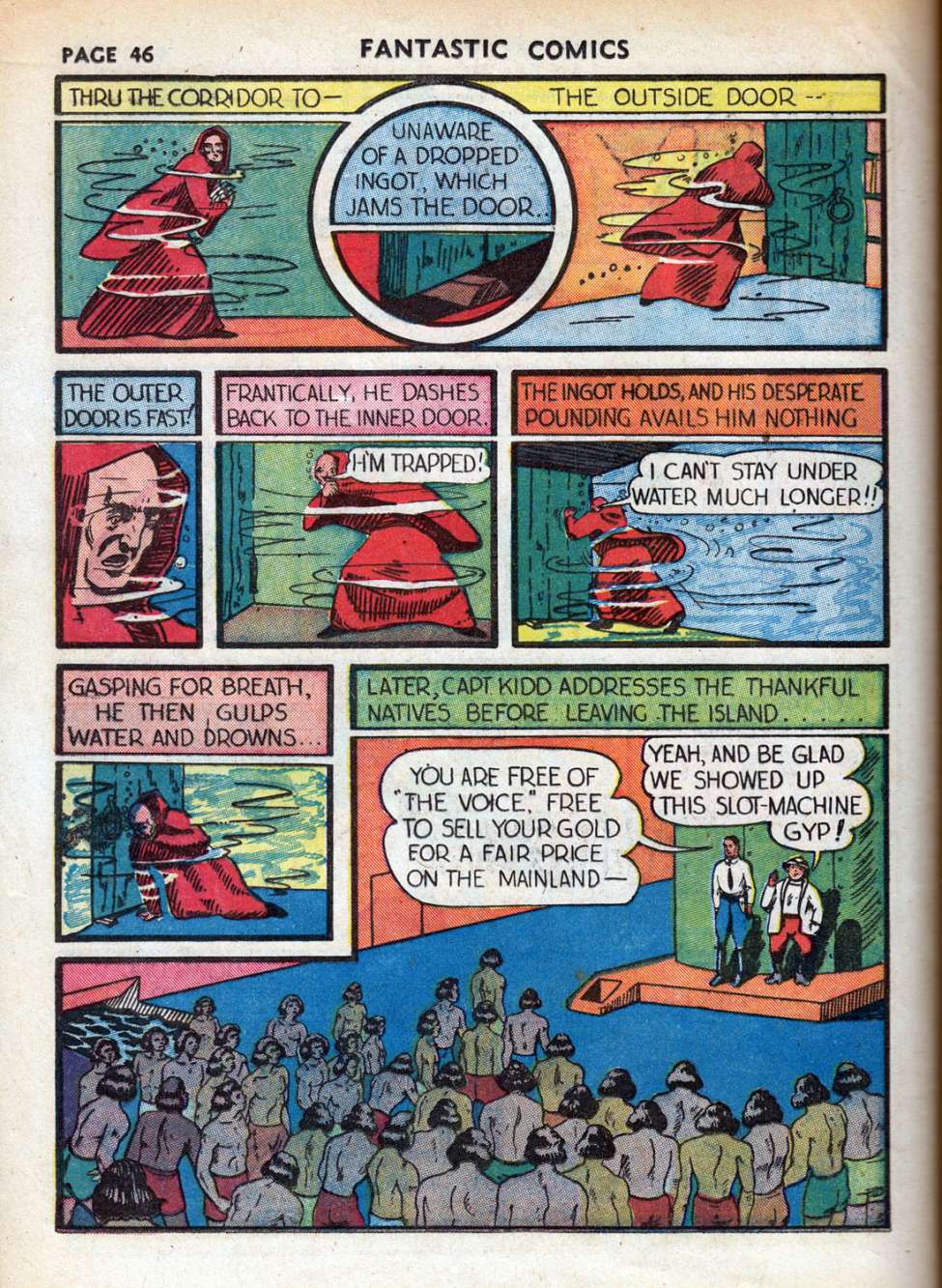
This is the next story, Captain Kidd, and the real mystery here is, where is Morgia Island? This page says it is in the tropics, and the legend of bamboo torture comes from Asia. But where would you find an island in that area? The South China Sea? Well, maybe; there are over 250 islands there, but none of them are known for having gold...

What interests me far more is the design of that temple. Windowless, accessible only by a front door that is only accessible by going underwater, and vaguely shaped like a cubist elephant -- brilliant stuff!

I'm not sure how the hat keeps the gun dry, but maybe we do need a mechanic to see if guns still work once they're wet. 2 in 6 chance of not firing? Anything to discourage players from overly relying on firearms!

I like the idea of a large statue that works like a slot machine; tug the arm and out pops a whiskey bottle from where his kidney should be!


I like the detail of the grenades mounted on the wall -- thank goodness the natives never mistook them for torches!  It would also be a nice encounter for Heroes to walk into an occupied room, see grenades on the wall, and then whoever wins initiative has a chance to grab the grenades first.

Those gold ingots look pretty heavy, and gold was worth $34.50 an ounce back then.

Oh...so that's why you don't want your front door underwater. Actually, I think the real lesson here is to always have a secret escape route from your temple.

Not sure how Kidd knows the bad guy was called "The Voice," since only the narrator called him that up to this point. Maybe one of the natives told him.


This is from a short humor strip called Professor Fiend. People are out to get the Professor for inventing a raygun that fires (*ahem*) permanent waves and curls people's hair.

Shrinking in order to hide is actually a good tactic, if you have the magic or the science for it. A "normal" potion of shrinking (as found in the H&H basic book's trophy section) stops at shrinking you down to about 6" tall. Here, the Professor shrinks to one-quarter of an inch tall, pauses, and keeps shrinking to the size of an atom (not unlike some future superheroes!).

(Scans courtesy of Comic Book Plus.)