We're still looking at Wash Tubbs and, boy, there's an unsettling mix of realistic and cartoony violence in there -- which is actually pretty much my Editing style when running Hideouts & Hoodlums.
There are some interesting things going on here and on the previous page. From the previous page (I'll just summarize it for you), Frankie Slaughter beats up one of Wash's employees just to intimidate everyone present into not telling the police he was ever there.
Slaughter tries all the angles to get what he wants, as low as beating Wash half to death and threatening to do the same to his girlfriend. But he makes the mistake of trusting Wash is frightened enough to comply and doesn't send one of his boys with Wash to the bank.
Frankie Slaughter is a great villain name.
Wash, for his part, threatens Frankie with a gun (on the page I didn't share), but I was relieved to find out it wasn't loaded. Keeping the lease at the bank was very smart on his part.
Speaking of smart, Frankie again shows good tactics, trying to trick Wash into unloading the lease to a stranger, and then establishing an alibi (and having a secret exit from locations that aren't even his hideout!).
Red Ryder is knocked unconscious by the explosion. In D&D, when a PC wakes up, they can immediately get up and rejoin the battle with no ill effects (other than maybe still functioning at reduced hp). Here, Red is stunned for at least 1 turn after waking up; a more gradual transition to being fight-ready and something I'm considering adding as an optional rule now.
I'm normally far from a gun advocate, but if Red was looking to finish this fight most effectively, I think he would have gone with his gun rather than throwing sand in Carr's face. Apparently the sand gives him such an advantage that he easily wins the fight off-panel, so maybe I'm wrong? Let's review; how I would handle this is an attack roll, ignoring any armor but not DEX bonus or cover, then a saving throw vs science from the target. Failure means temporarily blinded and at a -4 to hit penalty for the next 1-4 turns. So, I guess that's a pretty good advantage, but not a sure win.
This has to be the most verbose feature I've reviewed yet for this blog, and I'm not even showing you the pages that are almost solid text. It's not really that complex a plot, but the author seems to think it is.
A monogrammed lace handkerchief and the smell of perfume are good clues, but the knife in the back is the best one of all and they don't even talk about it.
Noticing that someone else has the same initials is not a clue I would normally make someone roll for, expecting the players to catch it themselves. The smell of the perfume the players could not tell on their own, so for that I might allow an Intelligence check to recall it smelling the same; I don't see that being a skill, unless we treat perfume identification as a skill. There is generally a lower chance to make a skill check than an ability score check, so I guess it depends on how hard you think recognizing the perfume should be.
The Scarlet is an unusual name for a villain for two reasons: one, Scarlet isn't a noun, and two, you normally associate Scarlet with a female.
A fountain pen that shoots out stunning gas that can affect 1-2 people is a handy minor trophy item.
Smashing a window seems an unusual signal. What if The Scarlet had used bulletproof glass in his windows?
Complicating the story was the fact that Dorn's sister provided Ed with wrong information, and Dorn was purposely feeding people false stories to throw them off. Players need to be reminded sometimes that they can't trust all the information they receive in-character.
I'm not sure, but I suspect that "200 suspected cases of espionage a day" was just a guess and not a fact I could look
up and verify.
I never thought we'd be looking at Apple Mary again for adventure ideas, but a $5,000 reward to search for a missing item is a plot hook worthy of a fun treasure hunt.
From this page we learn that psychics charged $5, and a book can sell for as little as 50 cents (maybe from a used book store?).
(Scans courtesy of Digital Comic Museum.)
An exploration of the Golden Age of Comics, through the lens of Hideouts & Hoodlums, the comic book roleplaying game.
Showing posts with label Ed Tracer. Show all posts
Thursday, July 2, 2020
Friday, February 22, 2019
Crackajack Funnies #20 - pt. 1
It's been a while since we visited the comic strip reprints Dell was running with. This post is mostly about tactics.
Here, Don and company show us the best way to get through a minefield.
I didn't really need to share this page; I just think "Doctor Thor" is such a cool name. Don Winslow had a good rogues gallery.
In this age of automatics, we forget how easy it once was to stall your motor. There should maybe be a small chance (1 in 10?) per turn of a car chase of stalling your motor, or it could be just added to the list of halting obstacles listed in the chase rules in 2nd edition.
The scale seems to be off on the Dwarf in that last panel -- he looks huge in that front seat.
"Espionage, eh? Sounds like a good name for a feature!"
Trying to pass yourself off as an inspector is one of the great RPG ruses and works perfectly here. You might have to forge some credentials, as not everyone will take you at your word like Mr. Rello seems to.
Note that Ed Tracer did not have to actively feel around on that wall to spot it was fake; secret door checks can be done on sight only.
Hideouts on piers with motorboats docked underneath them is practically a cliche by now on this blog.
This is the same year Dell will begin publishing squeaky-clean Disney comics, so I'm amused that they're still publishing stories about dope smugglers in February.
I like how, in 1940, the U.S. government is never a suspect. Conspiracy-based scenarios need not apply in the golden age!
Clipping the spark plugs is one of those complications I'll have to add to my vehicular combat rules.
The fighter aircraft pictured here is most likely a P-35. It's an interesting choice to compare the stratosphere plane to, as Wikipedia claims the "P-35's performance was poor even by contemporary standard" and "it was already obsolete by the time deliveries were finished..."
Wash gives us some more pricing information, with $830 being the cost of all new windows for a building and $300 being the cost of repainting a building.
Extortionists can be statted as bandits, at least according to Wash.
Rather than stat bodyguards, I think we need to recognize that Easy's pals are probably mid-level fighters, like he is.
Another example of non-Heroes needing longer to heal, in this case the hoodlums need three weeks to recover from being reduced to zero hit points.
Wire-tapping your own phone seems a sound strategy, especially if you suspect you have a spy in your midst.
(Scans courtesy of Comic Book Plus.)
Here, Don and company show us the best way to get through a minefield.
I didn't really need to share this page; I just think "Doctor Thor" is such a cool name. Don Winslow had a good rogues gallery.
In this age of automatics, we forget how easy it once was to stall your motor. There should maybe be a small chance (1 in 10?) per turn of a car chase of stalling your motor, or it could be just added to the list of halting obstacles listed in the chase rules in 2nd edition.
The scale seems to be off on the Dwarf in that last panel -- he looks huge in that front seat.
"Espionage, eh? Sounds like a good name for a feature!"
Trying to pass yourself off as an inspector is one of the great RPG ruses and works perfectly here. You might have to forge some credentials, as not everyone will take you at your word like Mr. Rello seems to.
Note that Ed Tracer did not have to actively feel around on that wall to spot it was fake; secret door checks can be done on sight only.
Hideouts on piers with motorboats docked underneath them is practically a cliche by now on this blog.
This is the same year Dell will begin publishing squeaky-clean Disney comics, so I'm amused that they're still publishing stories about dope smugglers in February.
I like how, in 1940, the U.S. government is never a suspect. Conspiracy-based scenarios need not apply in the golden age!
Clipping the spark plugs is one of those complications I'll have to add to my vehicular combat rules.
The fighter aircraft pictured here is most likely a P-35. It's an interesting choice to compare the stratosphere plane to, as Wikipedia claims the "P-35's performance was poor even by contemporary standard" and "it was already obsolete by the time deliveries were finished..."
Wash gives us some more pricing information, with $830 being the cost of all new windows for a building and $300 being the cost of repainting a building.
Extortionists can be statted as bandits, at least according to Wash.
Rather than stat bodyguards, I think we need to recognize that Easy's pals are probably mid-level fighters, like he is.
Another example of non-Heroes needing longer to heal, in this case the hoodlums need three weeks to recover from being reduced to zero hit points.
Wire-tapping your own phone seems a sound strategy, especially if you suspect you have a spy in your midst.
(Scans courtesy of Comic Book Plus.)
Sunday, August 5, 2018
Crackajack Funnies #19 - pt. 1
Back to public domain stories I can show!
Here we rejoin Don Winslow of the Navy, explaining a bit of problem solving he did. We also are reminded of a definition of "dope" that we might often forget these days.
Someone's been pranking this poor ship captain, replacing his maps with fakes. The Balkans do not border the Mediterranean Sea; they border the Adriatic.
What a "paravane" is is explained here.
The idea that Indians were secretly hoarding gold has enticed white men since arriving in North America.
If I ever succeed in making the Cowboy class (debuted in Supplement III: Better Quality) viable in 2nd edition, it will surely keep the ability to summon mount.
This is Ed Tracer, G-Man X32.
Dapper Danz is very excited about narcotics.
The secret hideout is an old moonshiner's cave with a secret front door.
This page is a nice twist. When we met "Deacon" Slade a few pages earlier, he just seemed like a harmless wandering encounter, maybe a red herring. But it turns out he's a rival with a different agenda vs. Dapper Danz.
Man, that sure is a nice looking Donald Duck pocket watch. It's going to cost a lot more than $1 today!
Stratosphere Jim has an interesting alternative explanation for how VTOL planes would work. A pressurized cabin was also a rare novelty circa 1940.
It would be 1953 before any plane officially matched this airspeed record. A simple system for keeping track of trophy items would be to say that a plane 13 years ahead of its time is a Plane +1, 26 years ahead of its time would be a Plane +2, 39 years ahead of its time would be a Plane +3, and so on.
The notion that secrets need to be kept, even from your own government, were a comic book staple before WWII, but would quickly seem unpatriotic. Yet, I wonder how many superheroes quietly shared their weapons' secrets with the War Department...
(Scans courtesy of Digital Comic Museum.)
Here we rejoin Don Winslow of the Navy, explaining a bit of problem solving he did. We also are reminded of a definition of "dope" that we might often forget these days.
Someone's been pranking this poor ship captain, replacing his maps with fakes. The Balkans do not border the Mediterranean Sea; they border the Adriatic.
What a "paravane" is is explained here.
The idea that Indians were secretly hoarding gold has enticed white men since arriving in North America.
If I ever succeed in making the Cowboy class (debuted in Supplement III: Better Quality) viable in 2nd edition, it will surely keep the ability to summon mount.
This is Ed Tracer, G-Man X32.
Dapper Danz is very excited about narcotics.
The secret hideout is an old moonshiner's cave with a secret front door.
This page is a nice twist. When we met "Deacon" Slade a few pages earlier, he just seemed like a harmless wandering encounter, maybe a red herring. But it turns out he's a rival with a different agenda vs. Dapper Danz.
Man, that sure is a nice looking Donald Duck pocket watch. It's going to cost a lot more than $1 today!
Stratosphere Jim has an interesting alternative explanation for how VTOL planes would work. A pressurized cabin was also a rare novelty circa 1940.
It would be 1953 before any plane officially matched this airspeed record. A simple system for keeping track of trophy items would be to say that a plane 13 years ahead of its time is a Plane +1, 26 years ahead of its time would be a Plane +2, 39 years ahead of its time would be a Plane +3, and so on.
The notion that secrets need to be kept, even from your own government, were a comic book staple before WWII, but would quickly seem unpatriotic. Yet, I wonder how many superheroes quietly shared their weapons' secrets with the War Department...
(Scans courtesy of Digital Comic Museum.)
Friday, November 25, 2016
Crackajack Funnies #16 - pt. 1
(The following post makes more sense if you think of this as having been posted on Thanksgiving, when I started writing it.)
Happy Thanksgiving!
What is Dan Dunn thankful for? That Hideouts & Hoodlums doesn't have "bleeding out" rules. Despite the fact that he's apparently been unconscious from a gunshot wound for hours, he wakes up just fine. And it really is the amount of time passing that made the difference, not the water that Irwin brought him -- unless Irwin happened to slip a dissolving healing pill into the water!
The mobsters are thankful for the new 2nd edition rule on cover fire, making the police afraid to move into the path of the bullets for they would be automatically hit. But Wolf is fine. Is that because cover fire doesn't work against smaller than man-sized targets, or is the grass really so tall that the mobsters don't have line of sight?
Here, the fact that Wolf hops over a wall and still isn't nailed by the cover fire seems to prove that it doesn't work against smaller than man-sized opponents. Or they switched off of the cover fire tactic for some reason (running out of bullets?).
Dan is awfully optimistic for a man who should be only back up to 1 hit point right now.
We've seen more elaborate trap triggers, like electric eyes, pressure plates, and even motion sensors (before that was even a thing you could buy), but here we get the simple trigger of a black thread setting off an alarm.
This page also suggests that carrying a lit flashlight could make it easier to target someone -- or at least would cancel out the dim light bonus in 1st edition.
Red Ryder is grateful for those hot coals, and being able to kick them in the air as high as a person's face. Now, I do plan on having a rule in 2nd edition for blinding attacks, but should hot material also do damage? I would be inclined to say no, since it gives a double advantage to the blinding attack. Of course, this might make sense for hot coals, but what if the hero was invulnerable and could kick up molten lava? An Editor will still have to play situations like that by ear.
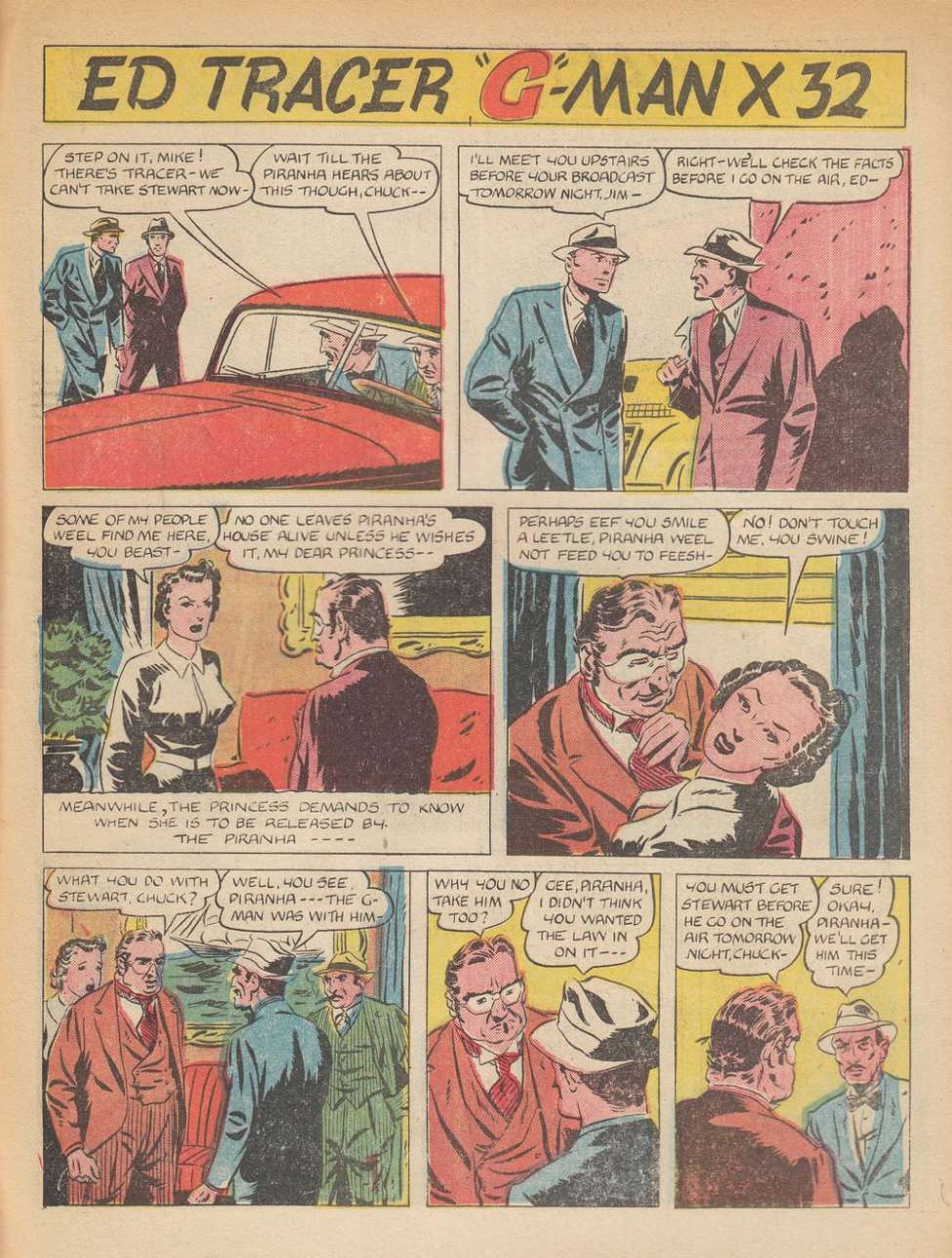
Ed Tracer has less reason to be thankful; first he's tricked by The Piranha, who pretends to have stuck Ed with a poison dart (bluffing is much easier than actually carrying poisoned weapons!), then a mobster gets surprise on him and puts him in a double-arm lock. I have grappling rules for 2nd edition that will cover multiple holds, like this one.
1st ed. H&H had the giant piranha. 2nd ed. is going to stat normal schools of piranha. But this appears to be a tank of only four piranha? That's a pretty easy deathtrap. They're going to be able to do maybe 1 point of damage to him per turn?
This is Buck Jones, and I don't share this page because of the simple "I'll roll a boulder down the hill" trap -- because we've seen that already. No, it's for the peculiar incident of the horse stumbling. Over what? When do cowboy's horses ever trip? There's no need for a game mechanic for this -- this is clearly a freebie from the Editor.
I'm equally skeptical of this. Should Heroes be able to outrun attacks? How slowly are those boulders rolling? In this case, I'm inclined to say Buck made a save vs. missiles to avoid the boulder trap, which was explained by the flavor text of him climbing a nearby tree to escape them.
Wash Tubbs is abused by his ex-girlfriend's bratty kids in this sequence that harkens back to the strip's pre-Captain Easy days. On the previous page was the ol' bucket of water balanced on the door trap -- avoided by a save vs. missiles and -- since it was only water -- doing no damage.
Itching powder also does no damage but could be a good distraction, maybe making someone save vs. science each turn or lose initiative until the powder is washed off.
Spitballs do no damage, but they sure are annoying (no game mechanic for annoying though).
Trip attacks will be covered under the grappling rules.
(Scans courtesy of Comic Book Plus.)
Happy Thanksgiving!
What is Dan Dunn thankful for? That Hideouts & Hoodlums doesn't have "bleeding out" rules. Despite the fact that he's apparently been unconscious from a gunshot wound for hours, he wakes up just fine. And it really is the amount of time passing that made the difference, not the water that Irwin brought him -- unless Irwin happened to slip a dissolving healing pill into the water!
The mobsters are thankful for the new 2nd edition rule on cover fire, making the police afraid to move into the path of the bullets for they would be automatically hit. But Wolf is fine. Is that because cover fire doesn't work against smaller than man-sized targets, or is the grass really so tall that the mobsters don't have line of sight?
Here, the fact that Wolf hops over a wall and still isn't nailed by the cover fire seems to prove that it doesn't work against smaller than man-sized opponents. Or they switched off of the cover fire tactic for some reason (running out of bullets?).
Dan is awfully optimistic for a man who should be only back up to 1 hit point right now.
We've seen more elaborate trap triggers, like electric eyes, pressure plates, and even motion sensors (before that was even a thing you could buy), but here we get the simple trigger of a black thread setting off an alarm.
This page also suggests that carrying a lit flashlight could make it easier to target someone -- or at least would cancel out the dim light bonus in 1st edition.
Red Ryder is grateful for those hot coals, and being able to kick them in the air as high as a person's face. Now, I do plan on having a rule in 2nd edition for blinding attacks, but should hot material also do damage? I would be inclined to say no, since it gives a double advantage to the blinding attack. Of course, this might make sense for hot coals, but what if the hero was invulnerable and could kick up molten lava? An Editor will still have to play situations like that by ear.
Ed Tracer has less reason to be thankful; first he's tricked by The Piranha, who pretends to have stuck Ed with a poison dart (bluffing is much easier than actually carrying poisoned weapons!), then a mobster gets surprise on him and puts him in a double-arm lock. I have grappling rules for 2nd edition that will cover multiple holds, like this one.
1st ed. H&H had the giant piranha. 2nd ed. is going to stat normal schools of piranha. But this appears to be a tank of only four piranha? That's a pretty easy deathtrap. They're going to be able to do maybe 1 point of damage to him per turn?
This is Buck Jones, and I don't share this page because of the simple "I'll roll a boulder down the hill" trap -- because we've seen that already. No, it's for the peculiar incident of the horse stumbling. Over what? When do cowboy's horses ever trip? There's no need for a game mechanic for this -- this is clearly a freebie from the Editor.
I'm equally skeptical of this. Should Heroes be able to outrun attacks? How slowly are those boulders rolling? In this case, I'm inclined to say Buck made a save vs. missiles to avoid the boulder trap, which was explained by the flavor text of him climbing a nearby tree to escape them.
Wash Tubbs is abused by his ex-girlfriend's bratty kids in this sequence that harkens back to the strip's pre-Captain Easy days. On the previous page was the ol' bucket of water balanced on the door trap -- avoided by a save vs. missiles and -- since it was only water -- doing no damage.
Itching powder also does no damage but could be a good distraction, maybe making someone save vs. science each turn or lose initiative until the powder is washed off.
Spitballs do no damage, but they sure are annoying (no game mechanic for annoying though).
Trip attacks will be covered under the grappling rules.
(Scans courtesy of Comic Book Plus.)
Thursday, June 16, 2016
Crackajack Funnies #12
The theme for today's post is stunts, a game mechanic from the Hideouts & Hoodlums supplements that is being radically overhauled for 2nd edition. In 1st edition, stunts had one-shot activations, like powers and spells, and then automatically worked so long as you made it into the duration before it expired. What will replace this are skills, that you always have a random chance of succeeding at. Mysterymen will still get a chance to use stunts -- a limited number of times per day they can auto-succeed at a skill, with extra panache.
So, despite how heavily the new rules will talk about Mysterymen, they apply equally to Cowboys. Cowboys are from Supplement III: Better Quality, will not make it into the 2nd edition Basic Rules book, but might make it into a later book expanding Hero creation options for different settings/genres.
Here, we see Tom Mix and another cowboy performing a stunt together. Leaping from one moving horse to another seems like a skill anyone might have a chance to accomplish -- though I would make it an expert skill with a lower chance. But leaping while your hands are tied behind your back? That's something extra, and has to be a stunt.
This is something that I had not considered a skill at first, probably because Heroes don't resort to it too often, but hiding is definitely a skill.
Captain Easy is often a good source of inspiration. Here, he teaches H&H players a thing about perseverance! Without any clues to go on where the pirates who kidnapped the girl he was responsible for are hiding, Easy and Tubbs start visiting every island where they could be hiding and checking every one. They have searched 17 islands so far at this point, and are about to finally strike pay dirt on the 18th...
This is a situation where a stunt, Increase Speed, that originally debuted for the Cowboy class, made so much sense that it was also given to the Aviator class (in The Trophy Case v. 1 #6-7), and then to Paladins in Supplement V: Big Bang. Now it makes sense to just let everyone have a chance at it, which is why it will now be a skill.
I don't have a lot to say about this, and any wargamer worth their minis already knows this, but tactics are important even when your Hero is in a Naval battleship, or a bomb-dropping blimp.
The tropes of the genre work both ways. There's no way that mask should be able to conceal anyone's identity. But if it works for the heroes, it works for the villains (and everyone still has to save vs. plot to recognize him through the mask).
(Scans courtesy of Comic Book Plus)
So, despite how heavily the new rules will talk about Mysterymen, they apply equally to Cowboys. Cowboys are from Supplement III: Better Quality, will not make it into the 2nd edition Basic Rules book, but might make it into a later book expanding Hero creation options for different settings/genres.
Here, we see Tom Mix and another cowboy performing a stunt together. Leaping from one moving horse to another seems like a skill anyone might have a chance to accomplish -- though I would make it an expert skill with a lower chance. But leaping while your hands are tied behind your back? That's something extra, and has to be a stunt.
This is something that I had not considered a skill at first, probably because Heroes don't resort to it too often, but hiding is definitely a skill.
Captain Easy is often a good source of inspiration. Here, he teaches H&H players a thing about perseverance! Without any clues to go on where the pirates who kidnapped the girl he was responsible for are hiding, Easy and Tubbs start visiting every island where they could be hiding and checking every one. They have searched 17 islands so far at this point, and are about to finally strike pay dirt on the 18th...
This is a situation where a stunt, Increase Speed, that originally debuted for the Cowboy class, made so much sense that it was also given to the Aviator class (in The Trophy Case v. 1 #6-7), and then to Paladins in Supplement V: Big Bang. Now it makes sense to just let everyone have a chance at it, which is why it will now be a skill.
I don't have a lot to say about this, and any wargamer worth their minis already knows this, but tactics are important even when your Hero is in a Naval battleship, or a bomb-dropping blimp.
The tropes of the genre work both ways. There's no way that mask should be able to conceal anyone's identity. But if it works for the heroes, it works for the villains (and everyone still has to save vs. plot to recognize him through the mask).
(Scans courtesy of Comic Book Plus)
Friday, June 3, 2016
Crackajack Funnies #11
Take a look at this guy in the yellow suit. Would you guess he was a hoodlum? No, but Irwin somehow makes him right away? I'm more convinced than ever that Hideouts & Hoodlums needs a skill for identifying mobsters.
Car bombs are deadly in H&H -- maybe 5-30 points of damage, if there's a full tank of gas. It's deadly enough that I wouldn't even think of putting a 1st-level Hero in a scenario where he could encounter one.
Now this is a mistake I never make anymore, when running any RPG. No players act like Red Ryder here, and stay away from a rendezvous point until the time of the rendezvous. They always want to show up hours early to stake the place out. So this scenario would never work out in a real game.
The law always seems to crack down hardest on the Heroes in stories like this -- note the $1,000 reward for Red Ryder, an exorbitant amount for a Western setting.
This is Buck Jones, and this is clearly the 1st level Cowboy stunt, Summon Horse, on display here. There's really no other explanation I can think of for why his horse just happens to walk into the cabin.
This is also the only instance I can think of where I've ever read about keeping matchsticks in your hat band being a good thing.
I'm going to have to call shenanigans on this one, Buck. Okay, maybe you coaxed your horse into leaping off the cliff with a lot of spurring, but you'll have an even harder time convincing me you both just took a 90' plunge into the lake and took no damage. Minimal damage, I can believe, but here they just ride off as if they took a light rinse.
This is Don Winslow doing the rowing. The plot here is an especially intriguing one, looking back, as the Spanish Civil War is really the forgotten war that didn't figure into World War II. But that does beg the question -- is Red's theory really half-baked, or is the intervention of men like Don Winslow that ended the Spanish Civil War early before it could spill out into the larger War in Europe?
Giant piranha are statted for H&H right away in Book II, though, to be honest, I've yet to see a giant one in the comics. Maybe I should apply those stats to a piranha swarm instead.
I don't plan on using a precise encumbrance system anymore in 2nd ed., so I guess it won't really matter how much an automatic pistol weights. But I was still surprised that an automatic could fit in a handbag that small.
(Scans courtesy of Digital Comic Museum)
Car bombs are deadly in H&H -- maybe 5-30 points of damage, if there's a full tank of gas. It's deadly enough that I wouldn't even think of putting a 1st-level Hero in a scenario where he could encounter one.
Now this is a mistake I never make anymore, when running any RPG. No players act like Red Ryder here, and stay away from a rendezvous point until the time of the rendezvous. They always want to show up hours early to stake the place out. So this scenario would never work out in a real game.
The law always seems to crack down hardest on the Heroes in stories like this -- note the $1,000 reward for Red Ryder, an exorbitant amount for a Western setting.
This is Buck Jones, and this is clearly the 1st level Cowboy stunt, Summon Horse, on display here. There's really no other explanation I can think of for why his horse just happens to walk into the cabin.
This is also the only instance I can think of where I've ever read about keeping matchsticks in your hat band being a good thing.
I'm going to have to call shenanigans on this one, Buck. Okay, maybe you coaxed your horse into leaping off the cliff with a lot of spurring, but you'll have an even harder time convincing me you both just took a 90' plunge into the lake and took no damage. Minimal damage, I can believe, but here they just ride off as if they took a light rinse.
This is Don Winslow doing the rowing. The plot here is an especially intriguing one, looking back, as the Spanish Civil War is really the forgotten war that didn't figure into World War II. But that does beg the question -- is Red's theory really half-baked, or is the intervention of men like Don Winslow that ended the Spanish Civil War early before it could spill out into the larger War in Europe?
Giant piranha are statted for H&H right away in Book II, though, to be honest, I've yet to see a giant one in the comics. Maybe I should apply those stats to a piranha swarm instead.
I don't plan on using a precise encumbrance system anymore in 2nd ed., so I guess it won't really matter how much an automatic pistol weights. But I was still surprised that an automatic could fit in a handbag that small.
(Scans courtesy of Digital Comic Museum)
Labels:
Buck Jones,
Cowboy,
damage,
Dan Dunn,
Don Winslow,
Ed Tracer,
Editor's tips,
encumbrance,
falling damage,
history lesson,
low-level play,
new mobsters,
prices,
Red Ryder,
skills,
stunts,
traps,
Wash Tubbs,
weapons
Subscribe to:
Posts (Atom)