Showing posts with label Invisible Justice. Show all posts

Saturday, May 9, 2020

Smash Comics #8 - pt. 3

Panels like this first one are so useful for figuring out how fast Heroes move. He's flying from New York City to Washington, D.C. -- about 220 miles as the crow flies -- and makes it in 22 minutes. That makes it really easy to figure out Bozo can fly at a staggering 600 MPH -- that's the 3rd-level Race the Bullet power.

Lifting the car is the 1st-level Raise Car power. Coupling that with a flying power makes it even more deadly. Since Bozo seems to have reached cloud altitiude, that puts him at approximately 16,000'.  Now, the Fly powers, as written, have no maximum altitude, so the only distinction is how long it takes to reach cloud level. Even at Fly I, this would only take about 4 1/2 minutes. At Fly II, this would take just over 2 minutes.

Taking no damage from a car exploding probably requires the 4th-level Invulnerability power.
If Bozo has returned to New York City, there is no Bird Airport there, nor even a name close to that.

Traps are usually ineffective if the Heroes have to touch something they have no reason to touch. I can't imagine what Hugh is hoping to accomplish by having Bozo lift the cable. Adolph is clearly inside the shack, not behind the cable!
20,000 volts is not going to melt Bozo, guys. That's a fairly standard amount of volts; your car's spark plug can take it. Now, interestingly, in a more hi-tech setting, Bozo would be full of electronics and 20,000 volts might mess with his systems. But in 1940, robots are chiefly mechanical contrivances, like clockwork automatons. So this trap isn't really doing anything but giving him electrified lariats to kill people with.
Let's jump ahead into Chic Carter. Chic's adventures in Moldavia are finally over and he's back in New York City trying to catch murderers.  Now, by all rights, this scenario should be over before it begins. Chic decides to beat up someone acting like a security guard of the professor he needs to talk to. Now, had Brenda screamed first, Chic could be trying to get in faster to save her, but since she screams after, Chic is just punching anyone who touches his arm.

More seriously, Hideouts & Hoodlums currently has no mechanic for making an attack roll miss against someone else. It doesn't seem like we can ascribe this to flavor text, since saving Lansing's life is vital to the story and why Lansing trusts Chic to take over the investigation. It's possible we could use the parry rules to slightly modify someone else's Armor Class from missile attacks.
Now, this is not a tactic I recommend most players using. Chic has a hunch thieves will come for the valuables in the safe room that night, so he remains locked in the safe room to ambush them. Is that safe room air tight? That's something Chic's player should ask first, in case he's wrong and the thieves wait another night. 
Redundancies are a good way to slow Heroes down, if not discourage them from getting to where they want to get into (players tend to be stubborn like that). Here, we have a wall safe, inside a safe room, each with its own combination.

Dousing the lights gives everyone a penalty to hit, but the open window means positioning is very important in this combat.
That is one amazing hunch Kent gets. Based only on Jenkins' testimony that he didn't know why he pulled the lever, Kent decides he must have been controlled by a VOODOO MASTER!! Instead of a garden-variety hypnotism. Or, you know, lying and being bribed to pull the lever. Somehow, looking at blueprints helped Kent reach this conclusion too, though I suspect the Editor fed this hint to Kent's player during setting up the scenario.
The Invisible Hood remembers to bring a rope and grappling hook on jobs where he thinks he'll need them...though if he's invisible, and the gate is open, I don't know why he takes the time to scale the wall...
I like the trap of the crystal ball next to the throne that casts blinding light at the flip of a switch. But, how does this make him visible? If bright light foils his invisibility, then he's not really invisible so much as camouflaged.

How stupid does a villain have to be to, in the middle of monologing, point out the very switch that can blow up his hideout?

The battle axe is a good choice to help with wrecking things. I might be inclined to give him a +1 bonus with the axe. Though, maybe that should come with a 2 in 6 chance of taking 1-4 points of damage when smashing something electrical...

(Scans courtesy of Digital Comic Museum.)

Saturday, February 16, 2019

Smash Comics #7 - pt. 3

And we're back with Invisible Justice, starring the Invisible Hood.

I get the creepy factor IH is going for, but being invisible inside a visible suit seems to take away any advantage that he has in combat.

Steele seems more than capable of mowing down the bad guys without IH's help. This is why it's important to have your supporting cast lower in level than the Heroes, so the Heroes are less likely to be upstaged (though bad dice rolls can still make it happen).

It's too bad that Steele is one of the good guys, because it would be a much more interesting tactic if IH had tricked one of the bad guys into thinking the two fire-eaters (stat as arsonists) who show up are more ghosts, and then get him to shoot them.

Lastly, it must have been super-awkward when Steele was feeling around in the air for IH's shoulders...
Wandering encounters are the potatoes that go with the meat of role-playing games, but sometimes an Editor may doubt himself and feel he's being too subtle with them. That's when you start having bad guys literally crash into the good guys out on the streets.
Tripping is a surprisingly rare fighting technique in comic books, but rarer still are examples like this that show how a trip attack can set up an opponent for a follow-up attack. So I'm wondering, should I add a game mechanic where you forego your own ability to do damage in the turn, in order to give the next attacker a bonus?
The enemy planes use a stunt (Fly out of the Sun).

Chic's readiness to use guns tells me he belongs to the fighter class.

I'm not sure how often pilots in dog fights would crash into each other, but if I ever write formalized dog fight rules for Hideouts & Hoodlums, it will likely include something about a low chance of crashing per turn.
I've posted plenty of times with examples like this, showing how you should not try too hard to hide clues from your players in your games. In fact, judging by this page, you shouldn't even hide them at all -- just leave them sitting out on a desk for anyone to see.
The 2nd edition rules for transportation includes ramming damage for just this type of scene!

The ramming damage for vehicles can be really high; perhaps it would be fair to split those dice between multiple opponents, like how Chic hits three guards at once here.
This is John Law, Scientective. The brightly-colored cellar is the result of the four-color process and the difficulty of printing gray tones back then.

A skill check to hear noise should also include a general sense of where it is coming from, even if only a basic skill check was successful.
A delightfully scientific trap! The strobing neon light keeps you from being able to see that the bar is actually moving back and forth very fast, when it appears to be still, and anyone walking through that door would take at least 1-6 points of damage. It's a good trap for hurting someone, but I'm not sure about it killing them...

In this rare instance, the villain loses a foot race to a woman in high heels. June can really move! Competing skill checks -- some combination of successful ones on her part and failed rolls on his part -- determined her close call.
The ol' pit trap filling with water trap! Making it a little easier, the Avenger left the hose accessible in the pit, giving John an improvised rope and grappling hook.

(Scans courtesy of Digital Comic Museum.)

Wednesday, February 13, 2019

Smash Comics #7 - pt. 2


Moving on, this is Archie O'Toole. Reducing machines that make you shrink is a very old joke, and one that should be in the trophy section of Hideouts & Hoodlums.

Also worth pointing out is the joke concept in this story that all kings belong to a union to which they have to pay dues. There's an unusual concept for a campaign in that, I think.


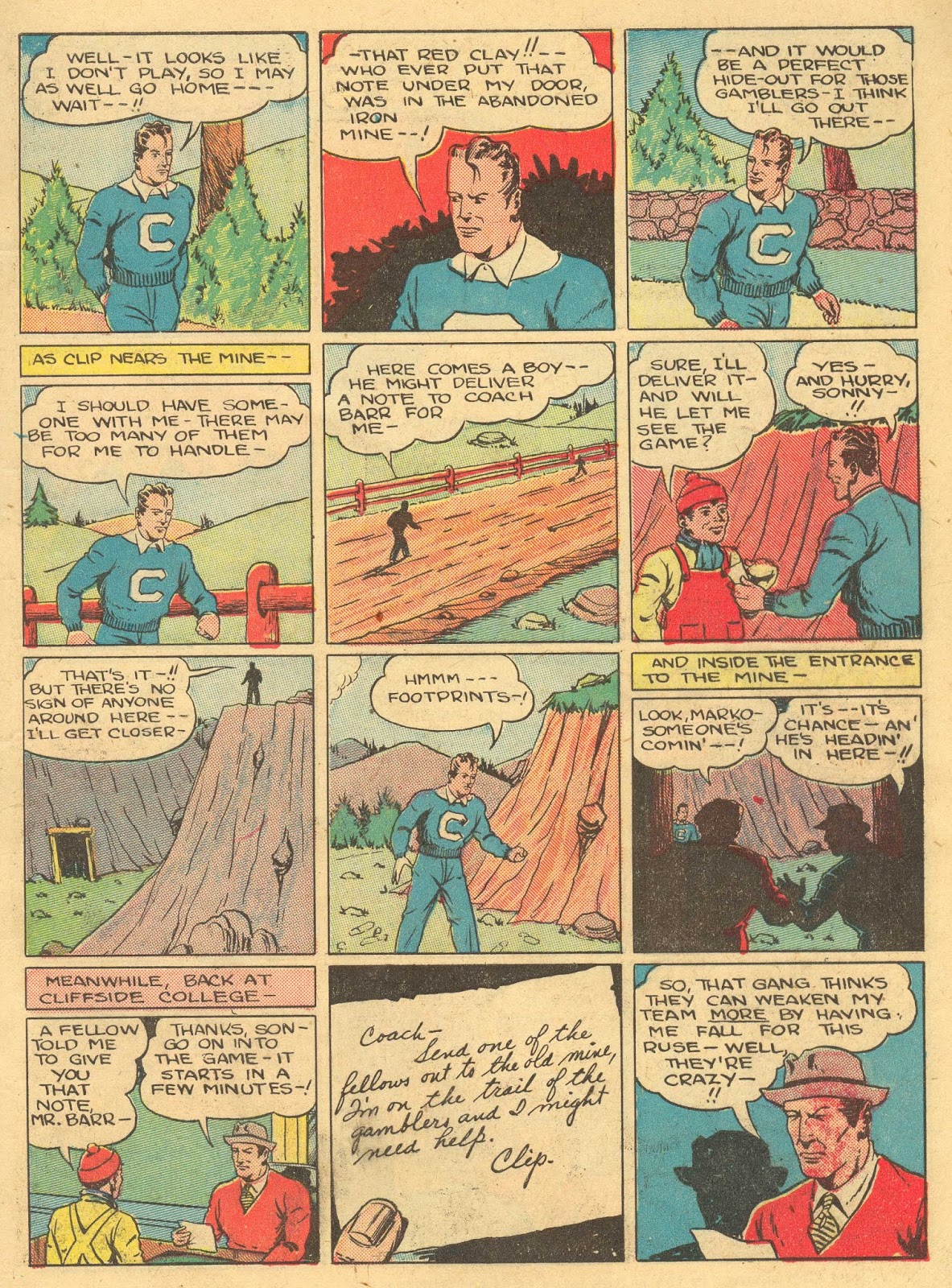
This is Clip Chance at Cliffside, a very boring member of the sports genre that I almost never cite here, but today I share this page to point out three things. 1) If you ever see red clay, it's a clue as to where it came from. 2) Abandoned mines are perfect hideouts for gamblers. 3) Clip suspects the gamblers are in that dark mine, so he heads straight there without so much as a flashlight...

Don't play like Clip.
If Smash Comics didn't already have Will Eisner work in it, Vernon Henkel's Wings Wendall would look much more impressive. Here, as with Eisner's Espionage, Vernon did not shy away from making very clear anti-Nazi messages.

But what I'm more interested in is that the bad guys have the "more powerful car," and what the best way is to have a game mechanic reflect that. Honestly, I've been struggling with this since the very beginning. Is a Car +1 going to move faster? Provide a better AC to the driver/passengers? If I ever decide to assign hit points to cars (a notion I've toyed with in the past), does it get more hp? There are just too many variables to a car, or should a "+1" reflect a slight increase to all of them...?


This sort of thing happens in my H&H campaigns all the time. Okay, maybe not an Army Air Forces bomber, but my players will show up with crazy-heavy armament to face bad guys I just gave a pistol to defend themselves with.
This is Philpot Veep, another feature we don't visit often. This is a goofy feature with some goofy perspective problems going on here, but I share it because fake babies may be a mobstertype we need to consider adding. Or would this just be a half-pint? He's even shorter than most children, but he seems unusually tough for his size, but would that still make him 1/2 HD...?
Unless I've forgotten something, I don't think we ever had a home town for Invisible Hood before, but now we have Glenport. I wish I could find a real Glenport so we could pin down what state this takes place in. Is Glenport our first fictional city for a superhero?

There wasn't much suspense to this mystery about the disappearing safes, but we do get to see a group of bad guys all wearing asbestos suits.

"One week later"? That's a long time for a stakeout, particularly in a superhero story.
What kind of drug is IH giving to that driver??

Also, instead of acetylene torches, the bad guys have "fire-pistols." Which I'd stat the same anyway.

(Scans courtesy of Digital Comic Museum.)


Friday, September 8, 2017

Smash Comics #5 - pt. 3

Whew! I've been getting so much Hideouts & Hoodlums stuff done, I haven't had time for this blog!

When I last left off, I was looking at the Invisible Justice story from this issue. I've already talked plenty about how easy disguise and hypnotism skills are in comics, so this whole first row should come as no surprise. No, what I'm interested in here is that Invisible Hood has to still sneak silently into the room -- invisibility does not itself guarantee surprise conditions -- and the fact that Invisible Hood was willing to shoot Hyde in the back as he was running away.

When I talk to people about H&H and golden age comic books, more than once I've been asked about how the game handles the perceived notion that all the Heroes of the Golden Age were goody two-shoes. Invisible Hood just tried to shoot the bad guy in the back.

This is from Abdul the Arab, and game mechanics-wise this is more complicated than it may at first appear. Abdul encounters a lone man wandering the desert and rides out of his way to aid him; the man turns out to be an ex-member of the mobsters Abdul didn't even know he was after. So what did Abdul just encounter -- a random good deed that rewarded him with a plot hook character, or a random plot hook character Abdul mistook for a random good deed? Only the Editor knows what he rolled for...

Sand pits are a good desert trap -- but not when they conveniently lead to the exact room in the mobsters' hideout you need to reach.

The bad guy is consistently referred to as a brigand here, a mobster type present since the beginning in H&H.  There is no game mechanic reason for the brigand's horse to stumble; it seems like a creative explanation of a missed attack roll.


This is Captain Cook of Scotland Yard, and one clue that this is meant to be a short, one-night scenario is that it starts at the entrance to the hideout (a freighter in this case) and he's already been given his mission.

The fact that this is a low-level scenario is evident by the single guard, armed only with a throwing knife. The guard misses, despite having bonuses for attacking from behind and above.

Linen is a good random thing to find in a hideout.

What the heck kind of map of England is that?

A clipped newspaper article is a cliched clue; making the clue an obituary of the guy who's office you're in gives the clue a creepy twist.


I can easily accept that Cook found the warehouse's address while in the company's main office. He could have even looked up the address in a phone book. But the warehouse address is on the company stationery's letterhead?  Instead of the corporate office address?


Though I've been riding this story pretty hard, this last wrinkle -- about the secret gas solidified into powder and sprayed onto the linens that have been out in plain sight all this time -- is a pretty good wrinkle. It could also make a pretty good trap. "This room's full of nothing but worthless linen; I'm burning it." BOOM!


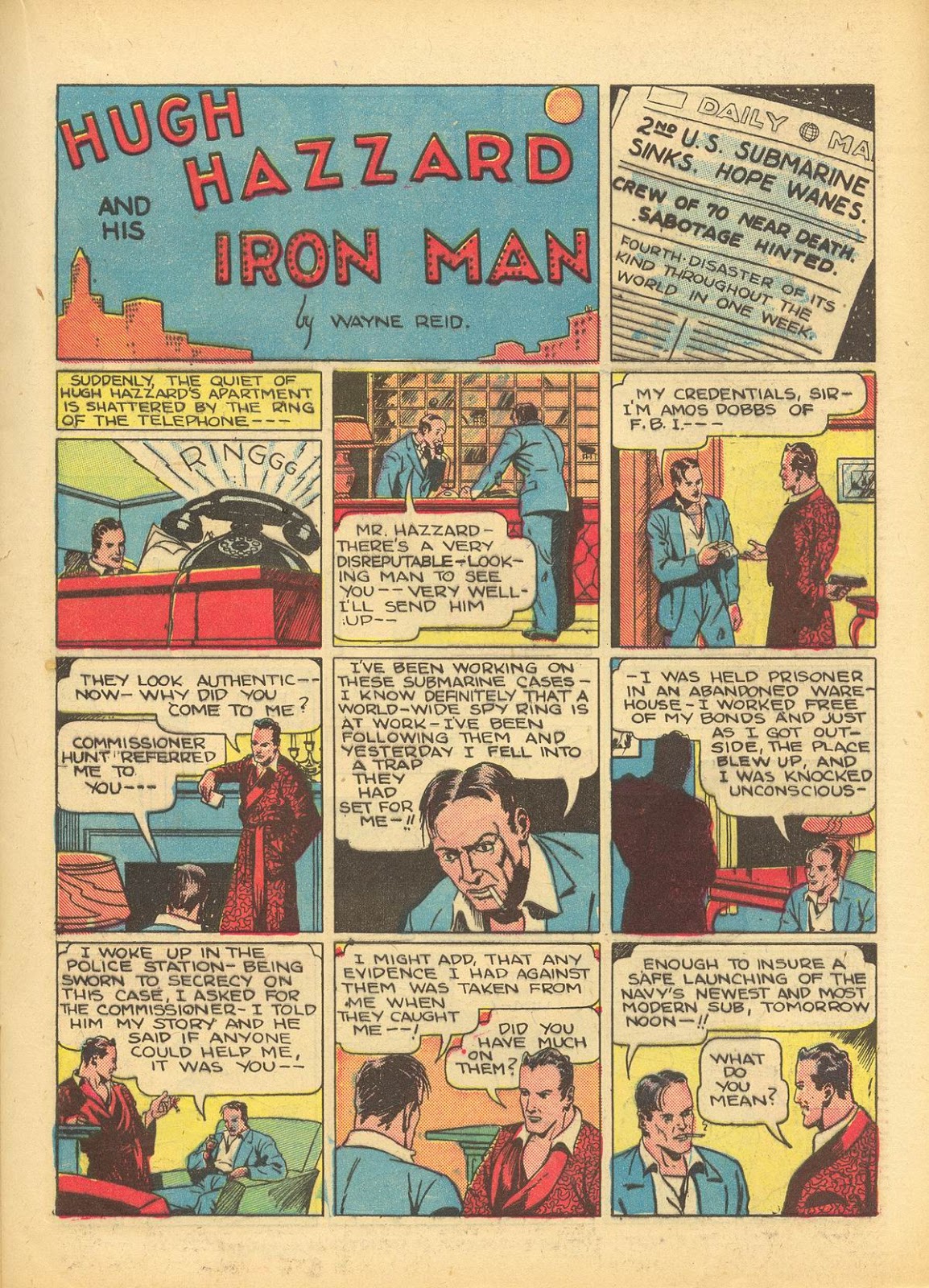
Hugh Hazzard and His Iron Man would have me believe that large robots are worth $5 million. Nooo, I'm not putting something that valuable in my hideouts!


It's odd that Bozo is immune to the death ray, since it very easily wrecks the plane it strikes first. Bozo is clearly no ordinary robot, but one statted with levels in the superhero class. But no power of a superhero buffs you to be immune to rayguns (yet). Could this be as simple as a successful saving throw?

(Scans courtesy of Digital Comic Museum.)


Tuesday, August 22, 2017

Smash Comics #5 - pt. 2

Wow, it's been so long, I finished and published the HIDEOUTS & HOODLUMS Basic Book 2nd Edition between posts!

I love how the Scientective uses science for problem-solving. Here, he realizes that something in the room with him can dissolve the material binding his wrists. Of course, a smart Editor anticipates things like this and stocks his hideouts accordingly.

"Rheostat" is a word that's fallen out of common usage. It means an adjustable resistor so constructed that its resistance may be changed without opening the circuit in which it is connected, thereby controlling the current in the circuit.  Of course, John could have just said "This switch ought to shut off the power," but that wouldn't sound very Science-y!

With little time to spare, John Law has to start playing hunches. His first hunch is that the brand new power plant right by the tracks can't be a coincidence, just like every reader was probably thinking on the first page.

John is able to smash the generator easily despite not being a superhero (and wouldn't he be in trouble if his hunch had been wrong!). I did include a note in the scientist entry in the mobsters section of the H&H 2nd ed. basic rulebook that scientists can all wreck labs -- but John is a Hero, not a mobster. For now, this will just have to fall outside the game mechanics...until the scientist class comes back in the Advanced Hideouts & Hoodlums Heroes Handbook someday...

There's a very curious editor's note about a giant induction field displayed at the New York World's Fair. I have not been able to find evidence of this, unless the editor is referring to the automated highway system demonstrated in the Futurama exhibit. I can find no evidence that Russian scientists were ever working on a "floating railroad." Could the author have read something about the electrification of the Russian railway system and misunderstood...?

This is from Wings Wendall and what makes me stop and pause is...what did that officer look up commercial airplane listings in?  Trade journals? Records of the Civil Aeronautics Authority? If Wings is flying with the U.S. Army Air Corps, how do they have these civilian records close at hand?

I like to think these hoodlums are just sitting there in warehouse drinking and planning because they're drunken hoodlums.

I've waffled for a long time now on how vehicular combat should go in Hideouts & Hoodlums. Do weapons trigger a chance of complications, like crashing? Or should it, like man-to-man combat, be a incremental process of hit point loss? The wording of "guns take their toll" suggests to me the latter, as the abstract, cumulative damage -- not any one hit on any one part -- is what causes the crash. But I've so far seen evidence in the comics that support both ways.

The idea that the Boss left such a simple note for Agent M-29 on a scrap of paper, rather than expecting him to commit a single sentence to memory, is an obviously planted clue. But planted for a trap, or by an Editor who really wants his player to get to that warehouse?

It's also worth noting that Wings doesn't head straight to the warehouse, but reports his intention to his superior officer first. That's a very Lawful way to play.

Why is one window locked and another window left open? It could be saves vs. plot, or it could be a simple 1-3 yes/4-6 no roll. The first option makes Heroes luckier as they advance in level, while the second option keeps circumstances at an even random chance.

We also see Wings being surprised. Fresh arrivals to an ongoing combat still get a chance at surprise.


Wings is attacked here by gangsters, a new mobster type with a special ability of getting victims into cars.

Although players should have some control over their supporting cast, they cannot just arbitrarily declare that their SCMs show up when the Hero is in trouble. The players can suggest that SCMs show up, and the Editor can decide if he should say yes or no, or give them a save vs. plot to see if it happens.

This sequence reminded me, while preparing the chase rules for 2nd edition, that I needed to include a missile combat phase during the chase turn!

I think I missed this, though -- when I compiled a list of abstract complications that could happen during a chase, I may have missed the slowing complication, like a flat tire. I'll have to double check...


Wings recovers quickly because of the new rule in 2nd ed. that allows unconscious Heroes a save vs. plot to recover in 1-6 turns. Because he's still in danger, turns are still being counted in half minutes.

The "boss" is either a master criminal or, if the spy class was in use, a higher level spy.

This is Invisible Justice. Thurston is driven off the road during a car chase (the complication is crash, but because there's water nearby to crash into, Thurston only loses the car and takes no damage).

Here's a precedent for invisibility, at least granted by trophy items, not turning items touched invisible.


Old mansions, on the only estates for miles around, make great hideouts (plus, its fairly easy to find a map of a generic mansion you can use for your game on short notice).

Large patio doors without closed drapes make a great way to spy on the hideouts' occupants before going in.

(Scans courtesy of Digital Comic Museum.)


Sunday, January 15, 2017

Smash Comics #4 - pt. 2

On this page of Invisible Justice (starring the Invisible Hood), we get a) a reminder about an easy way to counter invisibility, b) a decent trap for hideouts (dynamite-lined walls and a timing device), and c) a reminder that hideouts need secret exits and entrances besides the more obvious main entrance. Of course, this means that Heroes who search the area thoroughly enough may find the secret entrances first!

We haven't seen much of anarchists in comic books, but in this story we get a whole secret society of hooded anarchists.


Note how this "disreputable-looking man" is simply disheveled, has a hole in his pants, and is missing a tie and some buttons on his shirt. And this was what a disreputable person looked like in 1939.

Also note that Hugh hangs out at home in a smoking jacket, waiting for plot hook characters to come calling on him ala Sherlock Holmes.


Bozo is likely using the power Extend Missile Range II in that last panel.

We haven't talked about this yet, but...if Bozo is a superhero, then his race must be android. It's a little strange thinking of Bozo as a Hero since he isn't even autonomous -- but it would be possible to play a Hero completely dependent on another Hero to make the decisions, and a unique role-playing challenge too.

Players in Hideouts & Hoodlums always have control of their Heroes (unless magic or other extraordinary circumstances intervene), so torture won't work on a Hero unless the player chooses for it to work.

Hoodlums are meant to be played fairly stupid in H&H, but failing to spot a remote control hidden under a jacket lapel has got to be the biggest boner I've ever seen a hoodlum pull in a comic book.


Chic Carter, Ace Reporter, is on a high-stakes adventure in Singapore where a half-million dollars in gold bullion has been stolen. I don't know why that much gold would have been in Singapore in 1939, but I suppose it's possible.

The pirates here are unusual in that they're using tugboats and are heavily armed with sub-machine guns. Weirdly, these are the same pirates who are already rich with gold, but they seem to be just killing time on one last job before they can fence the gold.

Flash Fulton, Ace Newsreel Cameraman has an assignment to go to Germany and get action shots of Hitler -- or "Rudolph" in "Cerania," since some publishers were still wary about ...offending Germans, I guess.

Professionally employed Heroes could ask for a cash advance before going on missions. It seems that $500 is the most any middle class income-earner should expect to get.


Okay...maybe in 1939 it was still forgivable for Americans to think Hitler's war machine was actually fighting on horseback. This is actually such a departure from reality that I'm glad the story doesn't really use the names Hitler and Germany.

This is John Law, Scientective. The passing reference to Sing Sing Prison shows that John is based out of New York.

(Scans courtesy of Digital Comic Museum)