Showing posts with label Wilton of the West. Show all posts

Tuesday, December 10, 2019

Jumbo Comics #13 - pt. 4

I've got time for one more rant session -- I mean review! -- of this issue of Jumbo Comics.

Wilton of the West is in Skull Valley, which is an actual place out in Utah. It should also sound familiar because of the White Boy in Skull Valley strip we already reviewed a few years back on this blog.

Drinking water does not restore hit points in Hideouts & Hoodlums, but giving water to a dehydrated person can count as first aid, and that does heal back 1 hp.


I'll skip most of the story; this page reminds us that the cowboy genre is often set in modern day times, so you can include modern cars in your stories.

I don't know how you jump off a horse into a speeding car, but I wouldn't make that easy. It should require an attack roll vs. a low AC, like maybe 2, or even 0.


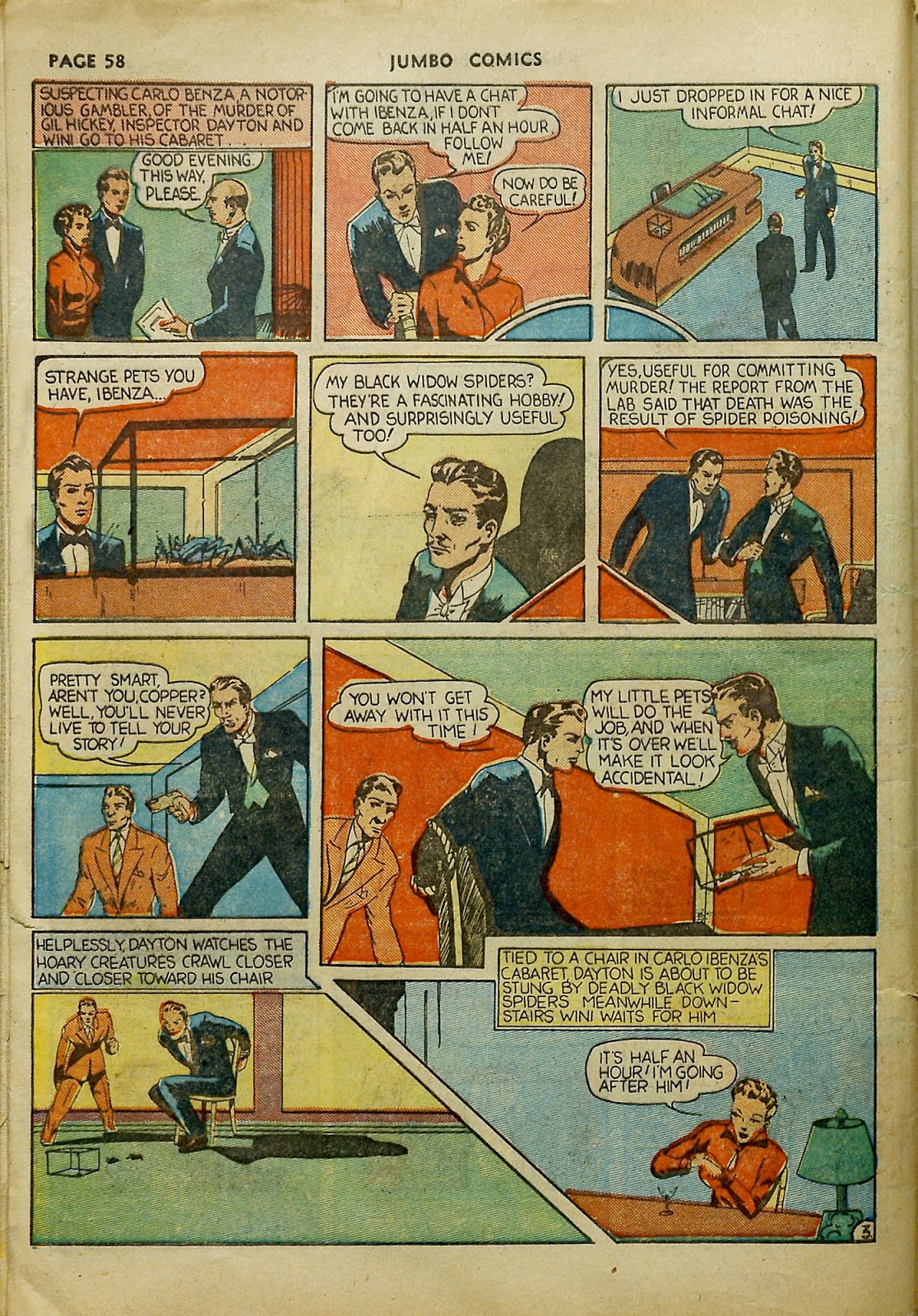
Jumping ahead, this is our final story, Inspector Bancroft. Bancroft has been given a lot more supporting cast this story, including a fiancee and...well, I don't know what relationship those two kids are supposed to be to Bancroft or Wini, but they don't figure into the plot anyway.

Lumps of jelly used for containers in medicine that melt in heat are good clues to find in a poisoning murder.

"Swanky!" That's a word you don't see often enough in comic books. 
Bancroft gets incredibly lucky here; his accusation comes way out of left field, and all Benza has to do is deny it and Bancroft has no evidence. Things like this always seem to go incredibly easy for the Heroes in Golden Age comic books, so in a H&H campaign, if you accuse a mobster of a crime, that mobster has to save vs. plot or confess.

The author, "George Thatcher" (likely a pen name), likes unusual words, so he gives us "hoary creatures." I'm not sure if he's referring to the color of the spiders or how old they are...

But speaking of spiders, why place them so far from Bancroft, instead of, you know, throwing them in his lap? It seems like a particularly poor deathtrap, if the spiders choose to go in a different direction. 
Keep in mind, as you're reading this, how badly Bancroft has failed at this scenario. He gets captured. He fails to get himself out of his deathtrap. He fails to capture the killer. He doesn't even phone for the police himself; Wini does all of this for him. The moral is, it's okay to fail when you're playing H&H. You're still a Hero as long as you tried.
If I was Wini, I would be hesitant to untie him too. If Dayton had just stood by and let the cops take him, Benza would have gone to jail. Well, maybe. I mean, Dayton still has nothing on him for the murder other than a confession that Dayton has no corroboration for.

But punching him gives Benza the opportunity he needs to try and run, and the cops are so enraged by this that they don't even shout "Stop or we'll shoot" first. This lack of due process and vigilante justice, though, is entirely appropriate for Golden Age campaigns.

(Scans courtesy of Digital Comic Museum.)

Saturday, January 26, 2019

Jumbo Comics #12 - pt. 2

We'll pick up soon after where we left off in Hawks of the Seas. To recap, Hawk and his small group of castle defenders are in a stand-off, holding onto only the armory/powder room, besieged by pirates who have taken the rest of the castle. Here we get a reverse exploration scenario -- instead of finding their way into the castle, they have to sneak around the castle from one room, gathering the food and supplies they'll need to hold out.

There's also a great example here of outside-the-box thinking when it comes to multi-level hideout exploration; you can always go outside and move from window to window (though you may leave yourself vulnerable to missile attacks!).

I would say that taking a gunshot wound, while swinging on a rope one-handed, would require a save vs. science to keep your hand on the rope. 

Normally, you don't have to worry in Hideouts & Hoodlums about bleeding out and losing more hit points over time, but the Editor can assign this to non-Heroes, as happens here to Tito.
Throwing a curtain on your opponent is certainly cinematic, but how effective is it as a combat tactic? It won't blind or ensnare your opponent for long, as it certainly can't take more than 1 30-second game turn to get a curtain off your head.

However, if you consider the opponent prone, because the opponent cannot see to defend himself, that could mean a +2 attack bonus for the curtain-thrower, on the following turn. If running away, like Hawk is, then the opponent would be getting a -4 penalty to hit for not being able to see (but +1 for attacking from behind), and that is assuming a successful skill check first to hear that Hawk is running and where.

Kudos to Hawk's player for not using player knowledge about what happened to Tito when he tried that same move.
You just don't see hatchets getting used much, exception by Asians and American Indians. How refreshing to see one in pirate hands (even if the scene is unusually violent for the refined Will Eisner).
The pirates have become drunken hoodlums in time for the big brawl, making them slightly tougher foes.

Move silently is an expert skill check, though as a half-pint Jeremy may have a "racial" bonus.

Shoulder paralysis is a complication not normally given to Heroes who have been stunned.

How typically random, like any game session -- the main bad guy goes down right away, and then it's his flunkies who wind up TPK'ing the party.

Hawks appears to be dead at the end of this installment. It will be interesting to see what happens next issue!


Wilton of the West finds a treasure map, purporting to show the way to an unlikely lost Aztec City as far north as Texas.
We have seen before hideouts that can only be entered via water, but not one that requires swimming such a long route underwater to get to, where the chance of drowning before you reach the Aztec city is a dangerous possibility.


As cool as it may be to have your Heroes encounter a step pyramid made entirely out of gold, it's really not a good idea to put that much wealth in front of them and make them greedy. Your entire scenario could become derailed by them trying to steal as many bricks from the pyramid as they can carry.
Getting kings to fail morale saves is highly profitable.

Natives act an awful lot like superstitious hoodlums sometimes. I'm starting to wonder again if I can even distinguish superstitious hoodlums as a separate mobstertype.
This is Stuart Taylor's feature, though he's nowhere to be seen here. Instead, we have Scarpo, an alchemist, Mephisto (the actual demon Mephisto), some unnamed 14th century queen (Queen Philippa?), and a lot of hideout dressing (for torture rooms).

(Scans courtesy of Digital Comic Museum.)


Friday, April 14, 2017

Jumbo Comics #11 - pt. 3

This is ZX-5 again, but I don't have anything Hideouts & Hoodlums-related to share from this page, I just like that it features the word "balustrade." You don't see that every day.


This is Wilton of the West, another feature that takes place in the "Mythic West" that still looks like the cowboy genre, but exists in the modern day world. And here we see a grim example of lariats being used as lethal weapons. Since the constriction damage would be continuous, then anyone dropped to zero hit points by the lasso/noose would die the following turn.


Inspector Dayton is out on the town when someone is murdered in a nightclub. Again, like in a previous story in this issue, the Hero takes a backseat to the supporting cast female accompanying him. I complained then about the Editor lazily allowing the SCM to find clues for the Hero, but maybe I have that backward -- maybe this is an example of a player taking advantage of a SCM's better chance at skills, like picking pockets. We have seen before, ever since Jane Arden debuted on this blog, that women seem to have a natural gift for being mysterymen in comic books. The slightly exotic name of "Miss Damien" might even suggest his companion is a vamp.

(Scans courtesy of Comic Book Plus.)


Tuesday, August 30, 2016

Jumbo Comics #9

I don't always have perfect digital copies of old comic books to look at, and Jumbo Comics is a perfect example of that. So far, I've had to settle for looking at the entire series in black and white. Normally, that doesn't trouble me greatly, but I do wish I could see "The Golden City" here in color, and determine how much of that "golden" is literal description and how much of it is hyperbole.

We get treated to some great visuals of this hidden land, most especially the courtyard of a palace. We see a dais, two trees growing up behind a throne carved to look like a many-armed demon. A man on the throne, flanked by trained apes. Looks to be quite an encounter!


A rare instance of a gun jam in comics.

The ape is using its "rend" special attack on Bob. Bob doesn't seem to be appreciating it.


The ape takes lethal damage from a fall. Bob was knocked out after two turns of fighting an ape (really, the ape just wailing on him mercilessly), but here is already recovered just a turn or two later.

The text doesn't match up with the pictures when Sheena and Bob fall into the trap. The caption says they are entering the courtyard, but they just fought the apes in the courtyard. It must mean "As they enter the palace".

The ol' trap door leading to an underground river trap. Note that Bob tries and falls to save them by holding onto the trap door, suggesting that the Editor gave them a saving throw to try and save themselves.

Peter Pupp runs into a 20' tall moon giant. They look and act like hill giants, but they're as big as cloud giants.


The Hawk fights Gor, a black "giant". Gor is able to pay "no attention to the rain of punches", probably because he's statted as a thug, and has a thug's Armor Class, despite wearing no actual armor. The Hawk keeps swinging, but isn't actually hitting well enough to do damage yet.


I think that's pretty funny.


Wilton of the West is teamed up with the Crimson Rider with this issue, the Crimson Rider being a cowboy, but of the Mysteryman class. My evidence of this? Mysterymen trigger morale saves as soon as they show up, while other classes have to do something first.


The Crimson Rider isn't concerned about making a 20' leap on horseback, and probably for good reason. The world record for a jumping horse leap is 28', so I'd probably give the Crimson Rider a ...4 in 6 chance of making the jump successfully?

(Scans courtesy of Comic Book Plus)


Wednesday, June 15, 2016

Jumbo Comics #8

We rejoin Hawks facing 20 to 1 odds on board an enemy vessel -- and those are not good odds for a 3rd-level Fighter with no armor and armed with a sword, even if he does get to combat machine these guys. Luckily, a quick-thinking supporting cast member creates a trap for the opposition by turning a sail into a net. Nets seem to be particularly effective in comic books. Whatever the size of the net, half that space below it will be covered in net and all in that area must save vs. science or be trapped underneath for 1-3 turns (you can see the two who made their saves here).

I'm less charitable to the use of the cloak during the fight; I really don't see what game mechanic advantage to give to someone fighting with a sword in one hand and a blinding cloak in the other. Hawks' player is going to have to choose between the two each turn. On turns Hawks uses the blinding cloak, his opponent will, if he's hit, have to save vs. science or lose his attack that turn. It's not an effective attack, but more of a delaying move, really.

This is not the first, nor will it be the last, time I see a half-pint kicking a mobster in the shin and disabling a grown man. Half-pints might need a special power of getting a +1 to hit mobsters in the shin, requiring a save vs. science if they hit or the mobster is stunned for 1 turn.


This is a special feature related to the World's Fair. Frank Buck reminds me that cobras and pythons need to be statted for Hideouts & Hoodlums 2nd ed. Pythons were not singled out by name in 1st ed., but there were stats for regular constrictor snakes. 2nd ed. will have stats for both regular and giant constrictor and poisonous snakes. I might include a note about how cobras can be caught in a sack, if you beat them in initiative and successfully hit them with the sack.


Is Wilton taking a risk, bringing Snorty back to town to see a doctor, or is he close to leveling and looking for that 100 XP good deed award for fixing up Snorty? Plus another bonus for including a supporting cast member in the story?


Ignoring the fact that Doogah looks more like a Muppet than a real person, this page is worth pointing out for the new trophy item -- the language chair. Anyone putting on the attached helmet and sitting in the chair will immediately learn the language of the next person to speak to him.


Here is an Editor at work trying to balance the challenge level of this scenario. Knowing that he plans to put Sheena and Bob up against a machine gun, he makes sure they have access to grenades to even the odds.

In this instance, Bob is not rescuing Sheena for a good deed XP award, since it does not count towards saving fellow Heroes. Instead, Bob is just playing smart and working to keep his comrade-in-arms alive.

That Bob is able to rush into the line of fire of the machine gun, pick up Sheena, and run out either means the Editor has rolled horribly for that machine gunner, or he's being too merciful to his players and deliberately unbalancing his game.

(Scans courtesy of Comic Book Plus)

Friday, May 13, 2016

Jumbo Comics #7

With this issue we reach cover date April 1939 in comic book history.  To say that Peter Pupp begins it with a bang might be a forgivable pun since we are dealing with resistance to firearms here.

The giant robot seems to be immune to bullets, a special defense that doesn't exist yet in Hideouts & Hoodlums, but could. Quite a few mobster-types are immune to all non-magical and/or non-silver weapons. Of course, it is equally possible that the robot just has so many hit points that Peter Pupp can't observe any obvious damage yet.

As hesitant as I am to allow vehicles to crash into opponents for large amounts of damage, it does seem to happen with a fair amount of regularity in comic books. Perhaps a counter-balance would be to insist the driver/pilot/passengers will always run the risk of taking damage too.


One of the earliest Carpets of Flying in comics. Note the Bat-Man-like silhouette in the second to last panel, in a comic done by Bob Kane, pre-Bat-Man...


This is from Sheena Queen of the Jungle, and I would never encourage an Editor to do this -- let the heroes stumble across an unguarded seaplane loaded with machine guns and TNT -- unless they desperately needed more firepower to finish a scenario.


Evidence that Golden Age comic book characters start out weak and get stronger over time -- Sheena is here knocked out by a mobster so weak he isn't even a named villain, in just three combat turns.


This is from Spenser Steel.  They say the Internet has made the younger generations today less concerned with privacy, but apparently there was a time when you could walk up to a train conductor, ask him where a passenger purchased his ticket, and not be told it's none of your business...


Even Wilton of the West learns that cave-ins can be a random occurrence in caves, and events like cave-ins can be treated as wandering encounters.

(Scans courtesy of Comic Book Plus)


Tuesday, March 15, 2016

Jumbo Comics #5

Welcome to 1939!  We start the year off returning to Fiction House already and their premier title, Jumbo Comics. What can we learn from this issue that we can apply to Hideouts & Hoodlums?

In Hawks of the Seas, Will Eisner was reinventing the pacing of comic book stories. Here we see one of, if not the, first use of a cutaway scene within a page to something else going on that the reader needs to see, but the main character has no knowledge of.

These intermissions are a useful narrative tool, but a H&H Editor will have to think hard about whether to use them in a campaign. Will the players benefit from understanding the Editor's story better, without using their player knowledge to their advantage? It takes a mature group of players to be able to play that way.

Further, this issue marks the first time we've really had a good sense of where Hawks of the Seas takes place. It always seemed to be the West Indies, but now we can narrow it down to the Bahamas.

Dr. Snyde here kills one of his own henchmen with a single blow, which should be impossible in H&H -- he would be unconscious and need a second blow to kill him. Of course, perhaps a second blow occurs between panels. Or maybe the "not yet dead at zero hp" rule needs to be amended so it does not apply to non-Heroes. Or, maybe this needs to be a special rule where master criminals can kill their own henchmen automatically.


It seems clear that Budah is meant to be a djinn, which means that djinn cannot be hit by normal weapons (or at least Budah can't).

It's interesting that the trap can be deactivated and escaped just by touching sections of the wall.  It seems particularly odd since people trapped in a flooding room would naturally be touching the walls, either trying to find a way out or try to climb out. I would allow two search rolls in this case, one for each spot (opening the door without turning off the water first could make for a very wet hideout!).

I've previously discussed what to call the type of thing that Zula is. He was called a bogeyman previously by another character, but in this issue the narrator specifically calls him a monsterman.

There is a lot of visual detail here for describing the dressing in a mad scientist's laboratory.

The robot here is said to be 30' tall, but it seems even the narrator is exaggerating, because it only appears to be twice as tall as Zula. Since the robot can shoot lightning, I would suggest it is a huge version of a copper robot, as detailed in Book II: Mobsters and Trophies).

Though scientists suspected the moon was barren and lifeless in 1939, it couldn't prove this was true yet. That left a lot of leeway for making the moon anything you wanted it to be. If you want there to be valleys filled with cream cheese and giant lettuce plants, or just wind, water, and trees like on Earth, then you can do that in a Golden Age campaign.


This is clearly not Will Eisner, but I wonder if it inspired his strip, Espionage, for Quality?  ZX-5 acts a lot like Black X here, and his exchange with the unnamed highness reminds me of the chemistry between Black X and Madam Doom.

For H&H purposes, I want to point out the battle of bluffs going on here. In certain editions of certain games, one would resolve this with rolling dice, higher bluff roll wins. I am glad H&H isn't like that. I am much more interested in seeing how a player responds to a bluff, and how well he or she can bluff back. I would probably still roll an encounter reaction roll, but try to factor that in to a reasonable response to the bluff in that situation.

Here we seem to have examples -- albeit racist ones -- of bloodthirsty hoodlums (which first appeared in The Trophy Case, but also snuck into one earlier printing of Book II).  Ali Pasha also seems to be demonstrating psionics; it looks a lot like Mass Domination.  Am I going to have to include psionics in 2nd edition?


 Lastly, this is from Wilton of the West, and we get to see that old chestnut -- the "shoot your own arrow" trick. Lucky dice rolling, or flavor text? This would be up to the Editor. Is it important to the story that Wilton split his arrow to impress the other guests? Then his player could be asked to roll to attack the target (with the same AC to hit the bulls-eye as it was the first time).  If not, then this is just something to do while waiting for the encounter at the end of the page and can be hand-waved as successful.

(Scans courtesy of Digital Comic Museum)

Wednesday, March 9, 2016

Jumbo Comics #4

Ouch!  Take that, Bob Kane -- Peter Pupp is bumped off the lead feature this month in favor of Inspector Dayton.


This page reminds me that not all traps need to be intentionally left in a hideout. Rotting floorboards giving way (maybe a 2 in 6 chance if normal weight steps on them) could lead to a serious fall.


And if any one ever says to you in Hideouts & Hoodlums that there is only a 1 in a million chance of something working, you know that's got to be only character-driven hyperbole!  In H&H, there should always be at least a 1% chance of anything happening.


I have no game mechanics to discuss from this page of Will Eisner's Hawks of the Seas.  Just enjoy this page layout, as Eisner slowly develops into the powerful storyteller he will become.


This is quite a horrible death trap -- not only is the old man about to be impaled and crushed by a spiked platform descending towards him, but his daughter is chained up nearby and being forced to watch! Extrapolating from this, an evilly-inclined Editor can see how a Superhero could be forced to remain in a deathtrap, without wrecking his way out, by threatening innocents (especially supporting cast!) within sight if the Superhero foils the trap.

Didn't I just see a one-eyed oriental in Tex Thompson? Is this a pulp novel archetype I'm just seeing now?


I think it's interesting that the little girl calls this guy a bogeyman. H&H doesn't currently have any mobster type called a bogeyman. And I like how he can hypnotize and levitate others. Maybe this needs to be a thing? Maybe they could even all have a weakness for tea...


Maybe a pepper jar should be on the starting equipment list? It does seem to be particularly good at blinding bad guys, besides the more obvious use of making people sneeze.


Bob seems to be changing classes (something that was detailed in Supplement I: National). He's going from a Fighter to an Explorer (a class introduced in The Trophy Case v. 1 no. 2) and picking up the tracking skill, plus he seems to be improving with his chance to hit with thrown missile weapons (a bonus not currently available to the Explorer class).


In H&H 2nd ed., though, the Explorer class will likely no longer exist. In that case, Bob's training is all flavor text describing his leveling.


This seems like it would be an interesting jungle-based hideout. The natives here have a lair in a petrified forest so dense that it's just like tunnels underground.


This page shows that even a thrown rock should be allowed to do real damage. But how much? The full 1d6 in the original, more abstract weapon damage system, but probably 1-3 in the expanded weapon damage system.


(Scans courtesy of Comic Book Plus)