Saturday, November 23, 2019

Thrilling Comics #2 - pt. 4

We're still looking at The Woman in Red as she investigates at a hospital, and talking Hideouts & Hoodlums game mechanics.

The one benefit I've seen so far to WiR dressing as a vigilante is, when she comes out of the costume, she's unrecognizable and doesn't have to make a disguise skill check.

Grabbing the canopy is a normal attack roll. The Editor has to wing the Armor Class based on how fast WiR was falling past it. Since it looks like she fell no more than 30', I'd say AC 7. Of course, the Editor does not have to put a canopy there, but a player can request one and, if the Editor is feeling half-generous, allow a save vs. plot for there to be a canopy between the window and the ground.
It's hard to make out that figure in panel 3, but it looks like the killer is wrapped up like a mummy. So...stat as fake undead?

Note the wisps of smoke around the police officers in panel 5, suggesting that they have been shooting at her, in the hallway of a hospital! This is so typical of the mysteryman genre, that police are ineffectual against crooks, but super-dangerous when they turn on the Hero.
The basement of the hospital is now more like a traditional hideout, with long, dark corridors and cell-like doors. A morgue contains lots of good, atmospheric dressing for a hideout.

A maniac might be a workable mobstertype. He seems at least as tough as a thug, but also has the ability to rip costumes off.
It's rare for radiation to be treated realistically in a comic book at any decade, so it's nice to see radium having an effect on someone. It must have also affected the morgue attendant's brain, since he doesn't apparently recognize a Geiger counter.

Geiger counters should be a mundane trophy item Heroes can collect.


Here's a question to ponder: is the rattlesnake a wandering encounter, the woman in trouble, or both together? Setting up wandering encounters as a rescue situation is a good way to let your players net additional XP!

"You spoke your piece" is just the kind of phrase you'd expect in a western.
There's some interesting slang on this page. A "waddy" was a cowboy, in this context, and not an Aboriginal war club.
This page makes me nuts. The top tier is all about confronting the killer, and then the store veers off into this sub-plot about capturing wild horses. The timing of it is terrible, but the idea of having sub-plots ready that your players can go do during less busy times in the game is a great idea.

Speaking of great ideas...setting off dynamite in the vicinity of the wild horses you want to capture alive? Probably not one of those great ideas...
This is from Tommy Dolan, Ace Detective. It's a confusing story that seems to be about an undercover detective pretending to have shot a cop in order to get in with a vamp who knows where treasure is buried, but not all of that is very clear up to this point; confusing things is that even the captions keep referring to Tommy as his alias, Terry.

Under dashboards is a good place to look for hidden weapons.

The "Lambeth Walk" is "an exaggerated rhythmic swagger, with plenty of arm swinging, copious hat-play, and elements of slapstick," according to the Londonist.com. 

There's some interesting chemistry between detective and vamp here, and lots of good pulpish dialogue, like "You hold all the cards," "I'm nothing but a stooge for a blonde," and "grab yourself a chunk of ceiling!" Perfect for an urban campaign with lots of noir to it.

(Scans courtesy of Comic Book Plus.)

Sunday, November 17, 2019

Thrilling Comics #2 - pt. 3

Saving the Wayne Girl is worth 100 XP for the good deed. Capturing the Mask is worth $25,000 and almost guarantees a level up.

And yet...letting the villain slip away once he's underwater is a staple of the genre, so he would have had to make a save vs. plot to dive for the Mask.
Now we'll jump into Tom Niles, Undersea Raider. This strip is even harder to read, with smaller font and gray captions. I could read enough for this part to jump out at me, about Berlin being a seaport. That can't be right, can it? I thought. Apparently, Berlin is linked to the Baltic Sea, the North Sea, and the Rhine River by a network of rivers, lakes, and canals.

There are a lot of ways this encounter at the bottom could have gone without violence. I mean, don't be so jumpy, Tom! They probably just wanted to check your papers. But in fairness, the soldiers seem to jump the gun too for no reason. It's a good idea to always come up with an idea for your encounter and a motive for the mobsters to work for.
The ol' impersonate-an-officer trick backfires because the commanding officer makes his save vs. plot. The guards at the door fail their saves and fall for such an obvious bluff.


I'm not sure how you would use a bayonet to bend iron bars, but apparently it was easy enough for Tom that it happened off-panel.

I honestly don't know how difficult a zip line is to ride, and if it should be treated as a skill or not.


I wonder if there is really a single lever on a submarine that would let water in. That doesn't seem like good design to me.

I really wanted to share this page because the U-boat is the U-46, and that was the name of my school district!

Tom's strategy seems sound, but I'm not sure how those tactics would play out mechanically in Hideouts & Hoodlums. I'm not liking the idea of fast-moving opponents being able to move into range, attack, and move out without counter-attack, as it seems grossly unfair the way the combat system is set up now. I may have to come back to thinking about that, particularly later when we start looking at more speedster superheroes.
Mobsters can punch women without a save vs. plot!

Despite only being halfway ready for second level, Tom is already given a captaincy at the end, as a special reward for his mission. Special rewards and titles can be worth XP as well.


There's trouble at the hospital and the police are called in. Naturally, a policewoman is put on the case and...immediately dresses up like a vigilante? Does she not think being a policewoman would give her enough pull with the hospital to let her talk to the staff? Or is this some subtle social commentary, that as a woman she feels unsupported by the establishment and has to go outside the boundaries to do what needs doing?

She lucks onto that mobster way too easily in the hospital, like a really lucky wandering encounter roll, or maybe a set encounter.


The assassin is a good one, offing the mobster before he can get out any clue.

The Woman in Red also loses the fight quickly, as a 1st-level Hero most likely would.

Typical of the mysteryman convention, everyone who sees her thinks she's one of the bad guys. You'd think she would just give up and show them her badge...
There's no such thing as an automatic hit in H&H, even when you're firing with a gun and your target is standing less than 10' away from you.

Implied in panel 3 is that the Woman in Red killed those mobsters, or else she could have questioned them when they woke up.

The caption in panel 5 tells us that the assassin we saw earlier is also classed as a mysteryman. Probably at least 2nd level, since he worked over WiR so quickly.

(Scans courtesy of Comic Book Plus.)


Wednesday, November 13, 2019

Thrilling Comics #2 - pt. 2

We're picking up where we left off with the Golden Age Dr. Strange -- though I apologize in advance for the poor quality of the microfiche scans. These are the best copies I know of out on the Internet.

The turning letter that unlocks a secret door is worth remembering. Though, if a superhero suspected there was a door there and wanted to get through badly enough, there is always a Raise power or wrecking things to get through the statue. I would treat this particular secret door as the machines category, one better than door, since the statue adds a non-door element to it.
The ol' "sarcophagus that's full of real diamonds but opens pit traps around the sarcophagus if you disturb it" trap. It looks like the pit has five crocodiles in it, but it's really hard to tell with the quality of this scan.
Dr. Strange's ability to punch boulders away strikes me as flavor text; all we really need for this is his save vs. missiles mechanic to make sure he's not taking damage.

There's no game mechanic that would account for how the boulders break the ledges apart; that seems like Editor fiat.
It doesn't need to be said that superheroes have leaping powers; the distance pictured here looks like one that even non-superheroes might be able to bridge.

Strange beats Crewe in initiative, letting him act before the drugs can be thrown away.

Speaking of thrown away...we know Strange could likely have leapt after Crewe and saved him, but he chose not to. Strange has already demonstrated that he's comfortable with letting villains fall to their deaths.

Interesting how we never hear about this miraculous wonder drug again. Maybe it didn't work as well as advertised.
We're going to jump into the next adventure, this being the debut of The Three Comrades. It's the first story I've seen drawn by Howard Sherman, who will later co-create Dr. Fate!

Newspapers are handy for dropping plot hooks!

Reading shorthand, like decoding a code, is a basic skill and not something automatic, like speaking to Germans or aliens.

A rare instance of a smell-based clue!
I like the little detail of, not just seeing a light, but a reflection of light in the plant tipping them off. I also like how every entrance has a guard on it, even on the roof.
That looks more like a necktie than a carat to me. Regardless, I have to pause now and consider what game mechanic in Hideouts & Hoodlums would emulate this scene? Grappling, with the result of throw? The actual tie grabbing is an irrelevant detail, as H&H focuses on the results, not how you get there.
The same here; it doesn't really matter how much the bullet touches the head or just "parts the hair," as the damage is just an abstraction.

The beat cop is a wandering encounter.

The kicked barrel is an improvised weapon...but a barrel can pick up a lot of speed rolling down a stairwell. I'd be inclined to assign it normal damage.

Did The Mask change his mask since we last saw him...?


This is the first time I've ever seen someone take damage from jumping into a car before! I guess the best way to handle this is to give the jumper a save vs. science, with no damage if successful, and regular damage if it fails.

(Scans courtesy of Comic Book Plus.)
This

Saturday, November 9, 2019

Thrilling Comics #2 - pt. 1

Mike's Amazing World of Comics tells me that the next comic book I should be reviewing, in order, is War Comics #1. But I accidentally reviewed that early, a year ago. Oops! So let's skip another ahead to Better's Thrilling Comics and the original Dr. Strange.

Our adventure begins with a mysterious death and the easy plot hook of Strange being asked to investigate it by the police. Strange looks for clues and, in an unusual move that I want to call your attention to, appears to be using scissors to cut into the dead man's clothing (unless, of course, he's also planning on performing an autopsy...). This is how he finds a secretive pin sewn into the seam of the clothing.
Note how Strange now has dark hair. Does he, instead of wearing a costume or uniform, just darken his hair before going into action?

Really, Fleming? The only place in the world you would find a three-headed serpent is an ancient lost city? I decided to do a quick Internet search on three-headed serpents to see if he was right. Besides an awful lot of hits for the video game Hitman 2, there was an article about a pillar depicting a three-headed serpent that came from Delphi. Good thing Strange didn't go there instead!

I wouldn't put much stock in what that assistant's telling you either, Strange. And you, Richard Hughes, writer of this story, if you knew you were going to base this story in Tibet, how hard would it have been in 1940 to do a little research and learn the real name of the desert there (which is the Gobi)?
One of the nice things about that last page is the fallibility of the assassin, who allows the assistant to get one vital word out before offing him. This makes it pretty easy to follow from one plot character right to the next -- and then risk killing him by punching him through a wall.

The game mechanics of Hideouts & Hoodlums (remember, this blog is also about a game!) don't currently support punching villains through walls, and would either need a modification to the pushing rules, or a new power that combines damage with wrecking things. I would definitely need to consider this as we move ahead, as I can think of quite a few later comic books that combine violence with such a flagrant disregard for property.

This third page, to the right, makes no sense to me...

Strange seems to have Crewe dead to rights already, yet after beating up his henchmen and showing off his Nigh-Invulnerable Skin, he just leaves so he can tail Crewe instead. You would think Crewe would be extra-cautious now about Strange and not act so brazenly criminal.

As stupid as Crewe is, his henchmen must be even stupider to nab a girl and bring her to their boss, just for loitering around a giant skyscraper. Strange isn't happy with them either, as he's perfectly willing to toss one of them out the window, knowing it's a lethal fall from that height.


Now this page has some tricky geometry to it. I'm not sure how Strange twists his body to land on the roof across the street, but it definitely appears that he is still leaping instead of flying. And, the fact that he needs to land on the roof instead suggests there is an upper limit to how far he feels he can fall safely.

In game mechanics-terms, maybe an upper limit needs to be put on the Feather Landing power. 

A herb that cures diseases like the spell would be a very valuable item in any campaign, and probably one best to keep out of the Heroes' grasp so it doesn't change the campaign world too dramatically.

Mongols are just wandering around Tibet? Mongolia is about 1,400 miles from Tibet. Seems like more writing done without research to me. Though the artist, Alexander Kostuk, at least looked at some old references for how Mongolians once dressed.
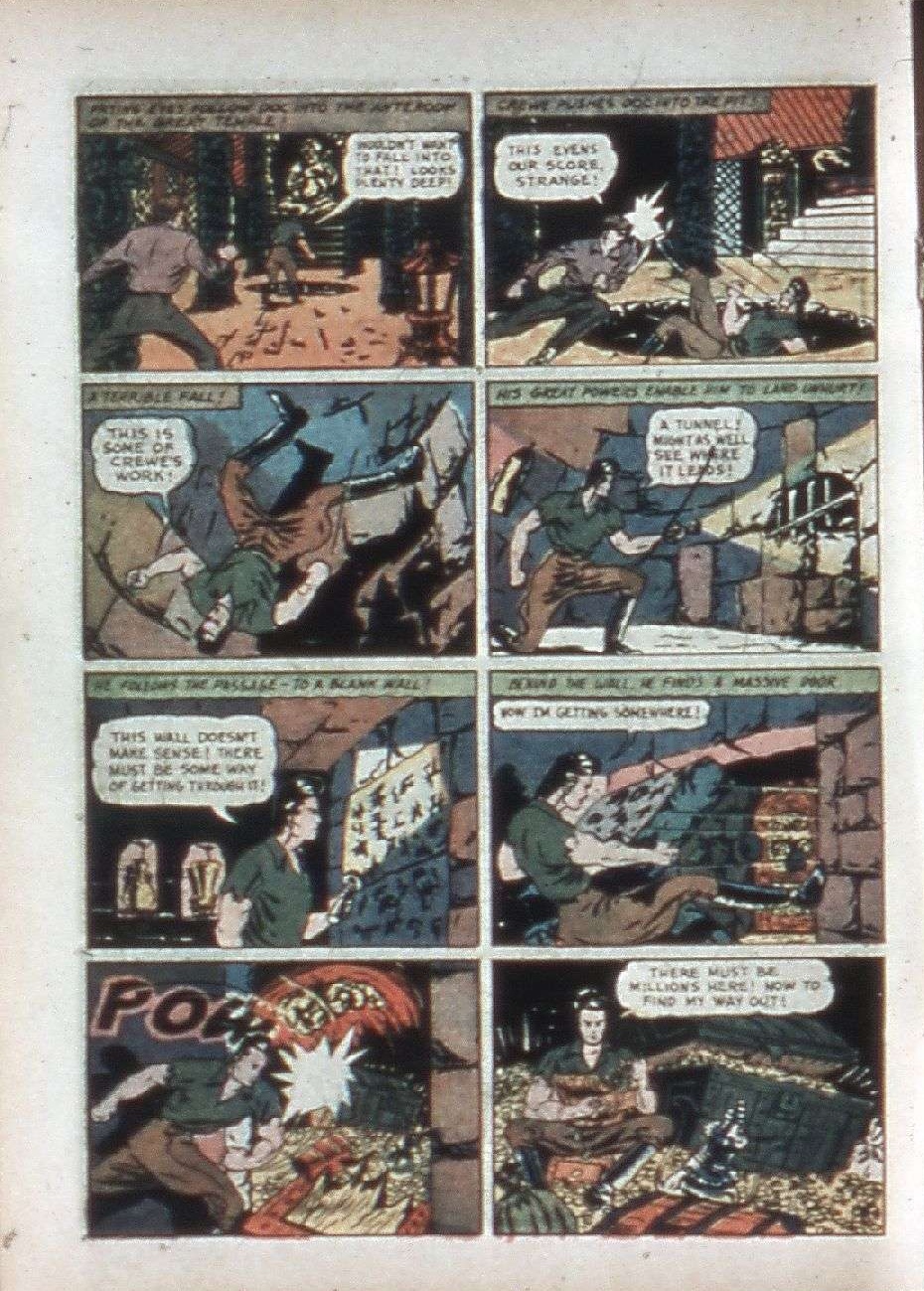
Strange uses his wrecking things ability on a stone wall, a door, and a cage here, demonstrating that a superhero needs the ability to use that game mechanic in quick succession.

What's going on with the guards being drawn like primitive African natives, hurling spears? How does that make sense in Tibet?

Rescuing prisoners is always a good idea, for the "good deed" XP award, the useful information they may have about the hideout, and their Supporting Cast recruitment potential.

Animals never fare well against Golden Age comic book Heroes and the fights are usually over in a single panel. This one, with Strange fighting two lions, occurs largely off-panel!

Once again, Hughes gets his geography wrong. The "Mountains of the Moon" are a legendary mountain range in east Africa, once thought to be the source of the Nile River.
More evidence that ordinary people can make push attacks on superheroes.

Strange wisely carries a flashlight.

Finding a secret door usually includes finding the means of opening it. But, if you just suspect a secret door is there, but you're getting impatient waiting for that successful "find secret doors" check, you can always wreck the wall. If you're right, you will only be wrecking against the door category, even if you can't actually see the door.

Millions of dollars' worth of treasure is usually a campaign-busting find and should be avoided doling out in actual play.

(Scans courtesy of Comic Book Plus.)

Thursday, November 7, 2019

Fantastic Comics #4 - pt. 6

Phew! It took a long time to finish analyzing this issue, but I just have a few pages left of Sub Saunders to go. I didn't want to ignore these pages, as I have thinks to say and some venting to do about them...

Pizga must be a wizard, since there is no scientific way to extract gold out of hydrogen and oxygen.

Similarly, there's really no reason why land-based clothing customs would extend underwater. Long dresses? Hats?

I've talked before about how giant clams, game mechanics-wise, are more like traps than mobstertypes.
The evaporation plant is a pretty elaborate piece of machinery. good for borrowing if you need a description for a mad science invention.

Tons of water, per coin? Has he ever thought about digging in the ground? Still, it's an unusual to find an environmental-themed morality tale in early comic books.

And kudos to Sub for being this ballsy!

"Sheer force of numbers," against Sub, is about seven guards.

Checking Sub's blood samples is the soundest science here.

Women always rescue Heroes, in these stories, even when it puts them in mortal danger.

How does Sub know they have a radio room?
So, on a page you missed, a bunch of submarines showed up with American soldiers. I wonder how they got in...did their hatches somehow dock with the front entrance to the hidden city?

I know we're supposed to be rooting for Sub at this point, but after seeing Pizga's people getting slaughtered, and Pizga thrown around like a bully's victim, I can't help but wonder if Sub doesn't just want the mermen's secrets for America...

(Scans courtesy of Digital Comic Museum.)

Monday, November 4, 2019

Fantastic Comics #4 - pt. 5

This is the last page from Captain Kidd, and the gorilla turning out to be hot babe in a bathing suit in a gorilla costume is a twist worthy of Shyamalan. Use it to keep your players on their toes!
Professor Fiend is surprisingly relevant again, with an explanation for how "undead" skeletons might come about through chemistry instead of magic (using comic book logic, of course!).
Although -- spoiler -- this story doesn't end well for the skeleton, it does make a curiously effective origin story for an undead superhero.
And now we get to the second Fletcher Hanks feature in this issue, Stardust. The unnamed mad scientist, called only "A mad giant experimenter" here, is one of the first physically imposing supervillains, even if he has neither a name nor long pants.

No one has ever come close to reaching the center of the Earth; 7.5 miles down is the deepest anyone has ever drilled.
This is likely the first reference to Lake Michigan in all of comic books. There is no way a volcano could form under Lake Michigan; the geologic prerequisites just are not there. A tiny volcano, Hicks Dome, does exist at the southern end of Illinois, but it is a volcanic pipe powered by gas. Volcanoes do throw up lava bombs, like pictured here, but while lava bombs are dangerous if they land on someone, the real danger from volcanoes is the ash plume they send out. If this really happened, Chicago would be buried in it, lots of people and animals would suffocate, and the city would need evacuating. 
Hideouts & Hoodlums has a wrecking things game mechanic, a Wreck at Range power, and a Mass Wrecking power at higher levels. What Stardust seems to be using in panel 2 is an as-yet unwritten Mass Wrecking at Range power.

At high-levels, a superhero needs to be able to not just wreck things into fragments, but to destroy them utterly, like Stardust does in panel 3.

How does Stardust know where the chemicals that made the volcano came from? Not for the first time, Stardust seems to be using some advanced version of the Detect Evil power that functions more like divination magic.
I find it comical that Stardust would be known as a "crime-buster" instead of the most dangerously powerful being in the universe.

I'm intrigued by how anti-ray rockets would work. Do they somehow home in on energy, like a heat-seeking missile? And how do the rockets make him lose control of his raybelt? We've never seen Stardust rely on buttons or knobs on his belt before. Maybe it requires concentration.

Wall of Dust is an unusual spell with what I would consider a limited degree of usefulness. One, it might throw off missiles that are tracking you, like chaff. Two, it might trick your enemies into thinking you've been turned to dust. I would treat this as a 2nd level spell.

Lastly, Stardust uses Teleport through Focus to step out of the dust in the room.
The "boomerang ray" works exactly like the power Turn Gun on Bad Guy.

Wrecking a chemical plant, in this context, is just wrecking a generator, since they are inside the castle and not talking about wrecking an entire building.

Who are the interplanetary police? If only we'd learn more!
Here we see a hi-tech trophy item (mad science category) give Sub the Water Breathing ability, as per the spell.

(Scans courtesy of Digital Comic Museum.)

Friday, November 1, 2019

Fantastic Comics #4 - pt. 4

Oh boy. Today, we're going to start with a look at Fletcher Hanks' Space Smith. Now, as goofy as it all looks, it doesn't actually read any goofier than most science fiction comic book stories of the time, and by that I mean that he gets the facts about as wrong as anyone.

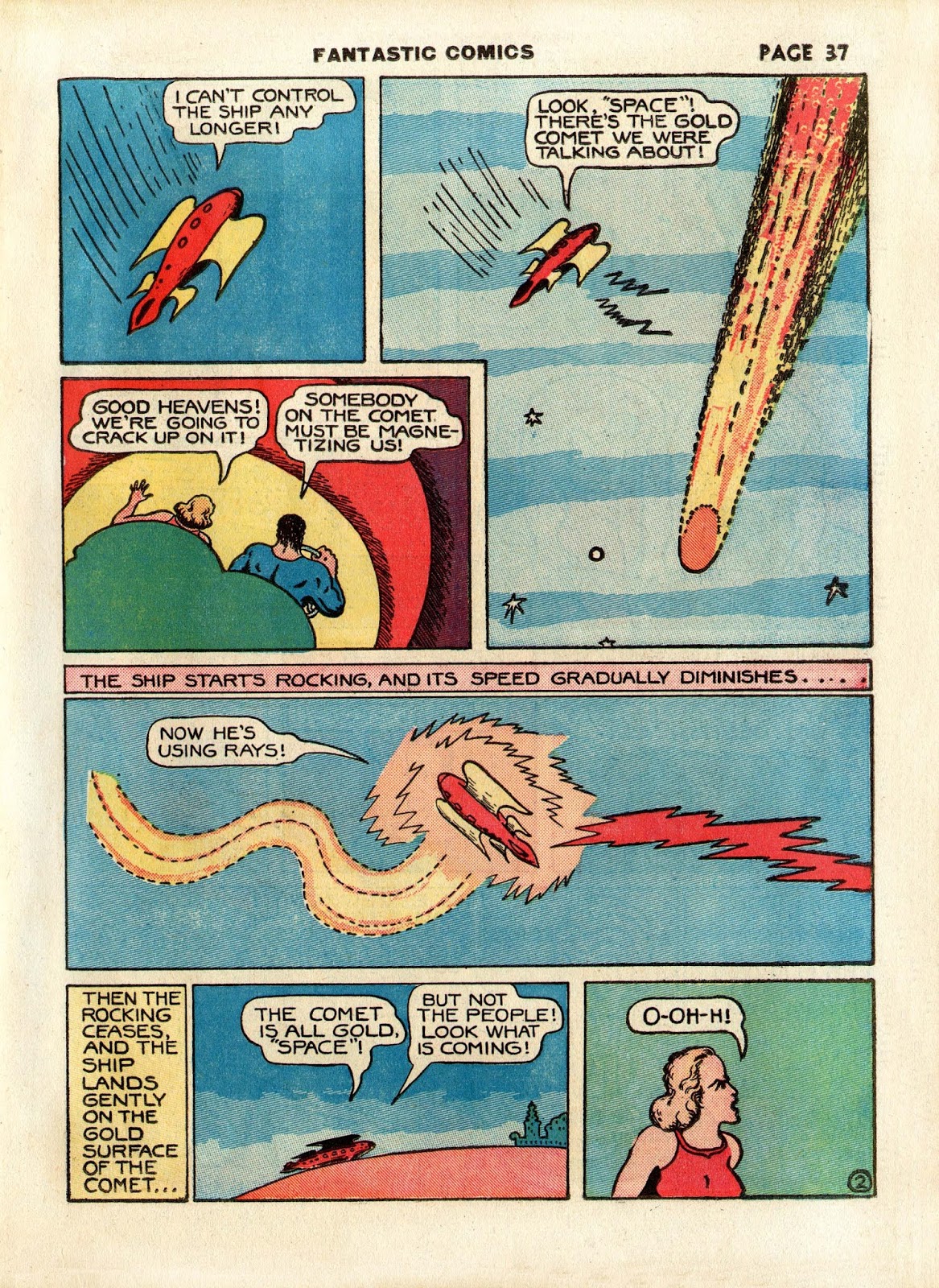
Obviously, there's no such thing as a solid gold comet. But, comets can be big enough to land spaceships on. The largest known comet, Hale Bopp, is 60 miles in diameter. But, a comet would also be frozen, atmosphere-less, and shedding ice in a constant ice storm.
If I thought Flip Falcon was inspired by Thuvia, Maid of Mars, Fletcher here outright borrows the Kaldanes from it, with the only difference being the eye on their chests and the fact that no alien heads are around to ride on top of them. The narrator refers to these only as "headless soldiers," which is just as well since Kaldanes is still copyright protected.

There are 14 headless soldiers in panel 3, the most we see of them at one time.

Where was Space hiding that telescope before he used it...?
This is an unusual use of wrecking things, vibrating the windows so that they all open? And yet, it's the only mechanic that makes sense for this.

The headless ones aren't all that tough, as Space is decking them with ease. Maybe 2 Hit Dice?
The descending pincer trap is okay as long as it hits on the first try, and must be pretty easy to dodge after that. A cage surrounded by fire seems like a much deadlier trap. Probably too deadly; judging from the height of those flames, I think it would do 1-6 points of damage to Dianna per minute!
I can imagine a random result table for the controls with results like "blinding flashes" and "energy crackles around you," and with the top of the chart being "everything blows up."

The headless ones not only can't fight very well, but they aren't as fast as Space and Dianna, and when not controlled, they beat each other up.
This is Captain Kidd, and is it a doozy of a wacky adventure this time. You wouldn't expect an aviator Hero to be exploring D&D-like caves and encountering what appear to be a cross between gnolls and troglodytes, along with a gorilla. How weird that, when confronted with such bizarre monsters, it's the gorilla Kidd is worried about.

"Sulphur" fumes could be a trap in a hideout, as a failed save vs. poison could suffocate you, as it makes it harder for you to breath.
And it gets weirder! The ape can talk. And the ape is advised by four drugged oracles. Oracles, if I treated them as a mobstertype, can apparently whip people into a fighting frenzy with their weird chanting, maybe giving their allies +1 to hit and damage?
Gnollglodytes (I totally made that up just now) are not very fast despite their deer-like legs, as Kidd easily outpaces them here.
This is what worries me, when running modern campaigns -- "hero" hops in his plane and mows down all his opponents from high above. I'd be tempted to lay down a new house rule that, if you don't put yourself in any danger, you get no XP from the encounter. Hey, maybe his Editor did make that house rule, because sure enough he heads right back inside to take on the talking gorilla.

(Scans courtesy of Digital Comic Museum.)