Showing posts with label Dick Storm. Show all posts

Thursday, September 30, 2021

Top-Notch Comics #4 - pt. 2

We're back and, if you've been waiting on me to finish the Wizard's story, here it is -- the Wizard defeats the "Bundonian" sub by lifting it out of the water. That's right, he can lift at least 750 tons over his head, without even firm ground underneath him. As unlikely as that is, I have to wonder if he's not actually using some form of levitation -- contra-gravity discs attached to the hull -- and then is pretending to hold it up just for the showmanship of it? Or, hey, I'd even be willing to accept some combination of the two. 

This ending brings up the issue of what to do in your Hideouts & Hoodlums campaigns when it's well before 1945, but your heroes have already forced Germany, or your German-analog country, to surrender. One possibility is to just keep replacing them with German-analog countries ("Bundonia surrenders...but the next day their neighbors Caledonia declares war on Europe!"). Or the country reneges on their surrender, finding some excuse to invalidate it and then continues the war effort. Or, you and your players agree to a campaign where nothing the Heroes do has an impact on continuity between sessions, as if the world resets each session (very much like many golden age comic books, though I don't recommend this so much for fun campaign play). 

But you didn't come back to hear more about the Wizard, you came back for Dick Storm. Because who can resist Dick Storm? 

Here we find an unimaginatively named Chile analog called Chilan, with an unusual history. It's not too surprising that, 22 years after the 1918 pandemic, people were still worried about plagues, but Chile had not had its own plague during the intervening years. 

I wonder what the president thinks Dick Storm is going to be able to do about a plague. Shouldn't he talking to a doctor instead?


Here is a great example of Hideouts & Hoodlums' abstract combat system, and at the same time an argument against specific hit locations. At point blank range, the assassin could probably hit Dick Storm anywhere, but panel 2 seems to make it appear the bullet is going to land in his right arm or stomach. In panel 3, the bullet lands in his left arm. 

That is the worst outfit for an assassin ever. Maybe not; I suppose pink pajamas would make him stand out even more.

Rana is surprised to see how quickly Dick Storm stands erect.

Pruvians is almost certainly an analogue for Peruvians. In reality, Chile and Peru had been at peace since 1883.

"I have a plan but you need to turn your army over to me for a few days."

"Sure, what could go wrong?"

"I'll also need access to all your bank accounts. And -- heeyyy...if you're Chileans, why is your daughter blonde?"
"Rana! Despite parading around in a cocktail dress, you've managed to sneak past my entire air force and reached that plane!"

Dick swings into action! Honestly, I can't even make fun of this stuff anymore because now I think the author is in on all the jokes.


To their credit, these soldiers have had about five minutes of uninterrupted stare-up-a-dress-time as the parachutists descend, but their thoughts are entirely on Dick Storm when they reach the ground. 

The fact that the general is still standing there unarmed in panel 7 as Dick Storm is attacking him seems to suggest Dick is enjoying a surprise round, but I don't think the circumstances here would have warranted a surprise roll. Rather, I think Dick won initiative and the Editor had made no statement yet of the general's intentions. It's also possible that the general is holding his gun in the shadows of his uniform; his whole right hand seems malformed, as if hastily drawn.

In a chase sequence, the desk in the way would be considered a complication to overcome, but in a combat sequence, this panel is correct; in H&H, you can ignore obstacles in your way during melee, unless you choose to incorporate them into your flavor text (or, obviously, if you plan to pick it up and use it as a weapon!).

I remember this scene from the first Indiana Jones movie. Plane propellers are nasty weapons; I'd put this at least in the range of 3-12 damage, so no wonder the soldiers are running. 


You might have guessed that Dick Storm's plan turns out perfectly and Chile surrenders after Dick arranges for a lot of them to die. So we're going to jump way ahead towards the end of the next story featuring Moore of the Mounted. Here we see an example of a trap as a wandering encounter. This page also shows us a good example of Lawful and Chaotic Alignments and how they differ in this scenario.

Technically Sgt. Moore is right; an Olympic skier can achieve downhill speeds of ten times someone running on foot, but the average speed of the average skier is more like 2 1/2 times faster (Movement rate 30 as opposed to 12).


And now we're going to make one last jump into the next story, Streak Chandler of Mars. I think from just this one page you can tell the backstory borrows heavily from Flash Gordon, with the wrinkle of the gangsters forcing them all to leave. Streak's problems are a frequent staple of the sports genre. The art isn't very good, but doesn't Streak look awful old to be a college football player?

(Scans courtesy of Digital Comic Museum.)


Saturday, June 8, 2019

Top-Notch Comics #3 - pt. 2

We'll continue today with  Dick Storm - and, yes, I still think that's funny.

Speaking of names...considering how important Kang the Conqueror is going to be for Marvel Comics in 24 years, it's interesting to see the first use of "K'ang" in a comic book.

Dick tries to trick/bluff K'ang, but K'ang isn't buying it; K'ang may have made a save vs. plot here, which I think is a more appropriate mechanic than a skill check to persuade someone. Of course, the Editor can always disregard mechanics and rule on persuasion based on role-playing skill.

Six-to-one odds is too great for Dick.
It's an unusual variant on the "get the guard to rush into your cell strategy," choking the woman in the cell with you, and there's a certain amount of extra danger here if the guard doesn't fall for it soon enough.

Dick is also really trusting of this woman who just happened to be in the same cell with him. If it was me, I would worry that she was a plant, put in there to pump me for information.
Moving on, this is Bob Phantom (another character who's name I often make fun of).

There's an unusual quality to this story where Bob doesn't seem to be an actual character in it, but is just turning up, Phantom Stranger-like, and warning the bad guys about the decisions they are making.

And he's clearly using the spell Poof! to do it.
It really looks like Bob is catching the bullet in his mouth, but the caption tells me he is blowing the bullet back. That seems too powerful for Gust of Wind. It's more likely the power Turn Gun on Bad Guy, but that's a 4th level spell, and we only need to use that if there was really a good chance of the mobster being hit by it. Or, this could just be flavor text explaining how the bullet missed Bob at such short range.
Walls of fire are very hard to get through. Just passing through fire is going to do damage, which should vary based on the size and intensity of the fire. At the low end is jumping through a campfire, which would do maybe 1 point of damage. At the high end is the magic-user spell Wall of Fire which does...well, I don't have my books handy, but I believe it's a lot of damage. Walking through a line of burning kerosene would likely do 1-8 points of damage. Walking through the inferno of a burning oil field, that seems like it would be more like the spell.

Bikini cut, Bob? Really?

Speaking of intensity, starting a cyclone is pretty intense. The weight of a shack is way beyond the lift capacity of a Telekinesis spell, so that's not what Bob is using. Maybe


Control Weather? Or we need a new power or spell for Create Cyclone.

Now we're moving on to our next feature, Stacey Knight, M. D. Here we see the benefit of keeping a sedative and syringe with you.

It seems a lot less risky a tactic than jumping out a third story window to grapple someone below you. For one thing, I wouldn't even allow the jumping and the grappling on the same turn; you can jump and try to land on the mobster to half your falling damage (and give him full damage) and then on the following turn begin grappling.

I would also not combine attacks with wrecking; you can hit the mobster with the gun or you can try to break the gun, but not both at the same time.


Now, the main reason I would not allow these things is that, in a group setting, you need to leave things for the other players to do. If this was solo play, I might be more lenient on combining effects.

I'm including this page of Wings Johnson of the Air Patrol because I want to remind players to always know where the exits are, and be prepared to use non-traditional exits. And, a note to Editors, include more things like laundry chutes in your game. Vertical transportation keeps your players thinking in three dimensions.
The 2nd edition basic book has suggestions for ramming damage with different vehicle types, and both editions of Hideouts & Hoodlums have rules for wrecking things. But what about when you want to ram a conning tower with your plane to wreck it? A good rule of thumb is that, for every 10 points of damage the vehicle ramming can do (not necessarily what you roll for damage), assign 1 level in superhero for wrecking.

It seems really implausible that your nemesis just happens to be on the first submarine you crash into in that entire theater of war, but if you want to get your story moving along sometimes...
I'm not going to bother talking about the "knock out the guard and steal his uniform" tactic again, but returning to the same building you just escaped from to hide is certainly an interesting tactic.

I have a feeling that, despite how poor Wings thinks his German is, that he would understand whatever the commandant tells him to do.

(Scans courtesy of Digital Comic Museum.)

Wednesday, June 5, 2019

Top-Notch Comics #3 - pt. 1

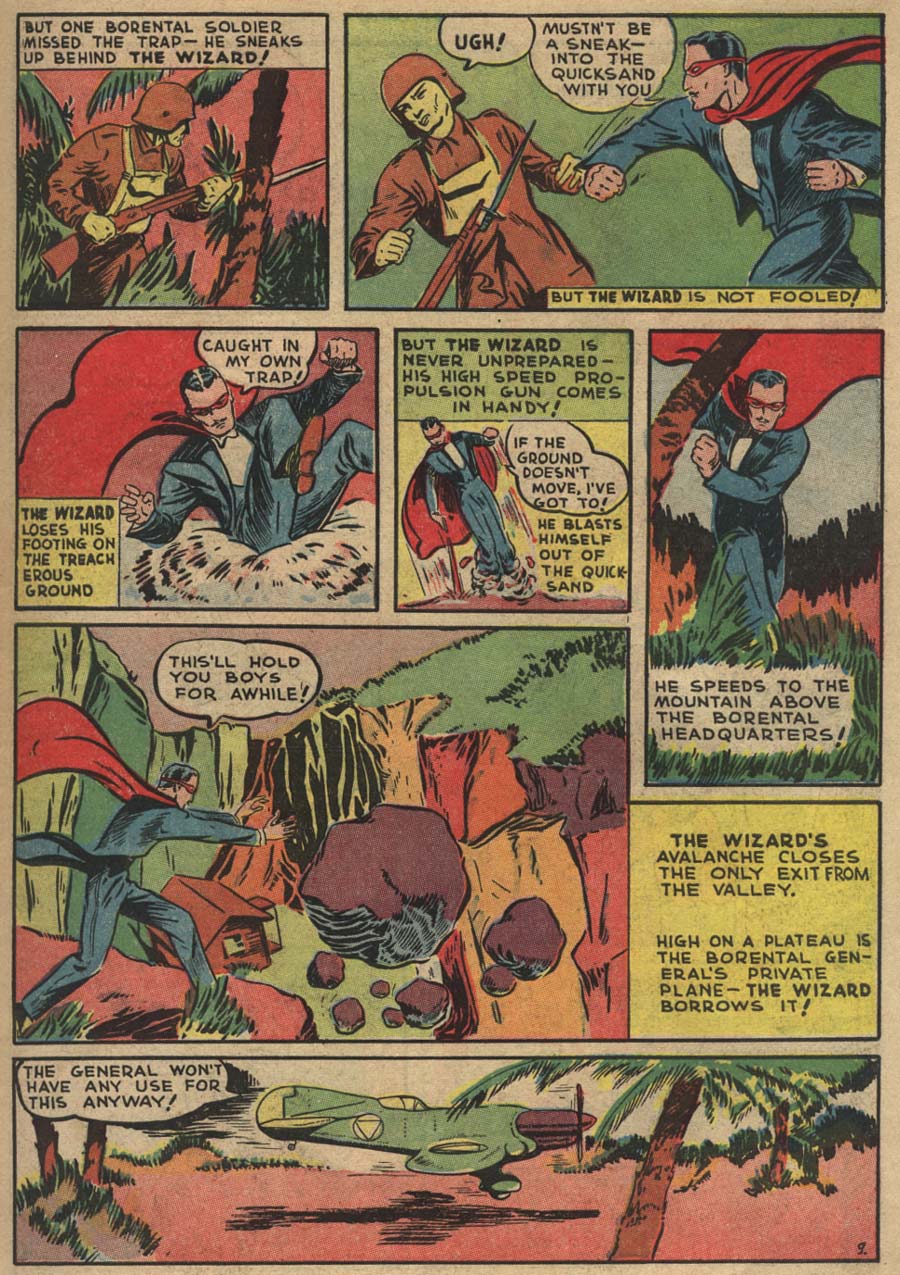
Returning to MLJ after a long time away, we find the Wizard (currently guest-starring in my home campaign!) on a new adventure.

We learn that his supercharged speedster can go 200 MPH and stop on a dime.

It's unclear how the Wizard stores Secret Formula F22X on his person; it's clearly not in a metal container.
It is winter when this story takes place, so the blizzard kind of makes sense.

Sparks from the exhaust setting the plane on fire is another complication to add to a random table.

An H2-Vx-O Ray that makes rain is a pretty specific trophy item. The funny/not-funny thing about this is that a nerve gas called VX will be developed over 10 years later.
Here's another really specific trophy item -- the dynamagnosaw ray projector can be used for wrecking things at range -- but only wires.

The Wizard's photographic mind works like a Danger Sense, which needs to become a superhero power that keeps you from being surprised for the duration.
Balloon capes are a minor trophy item that allow someone a chance to fall safely, as if with the Feather Landing power, but also with a chance of the cape tearing and becoming useless.

That leap looks like the Leap I power, since the plane comes down so low. Of course, planes will always have to fly down low when Heroes are ground-based.


Ethyl Formula 2X-Y-BZ would be a consumable trophy only consumable by vehicles, and would allow them to act as if Hasted (by the spell) for a limited duration.

Now this tactic is ...let's say unusually described here. It seems clear to me that the Wizard is using Sean Connery's tactic from Indiana Jones and the Last Crusade where he gets the birds flying in order to blind the pilot with dead birds. It's a gruesome tactic, and one the editor seems to have shied away from, explaining in the narration that the pilots are so stupid that they can mistake geese for planes.

Considering how violent some other MLJ titles will be in the near future, it seems odd that they shied away from violence here.
I don't have a lot to say about this page, except that I seemed to be particularly slow on the uptake with this story; it was not until this page that I realized "Borental" means Japanese. The artist even cleverly substituted the red circles on their wings for yellow triangles.
That the Wizard is unharmed by the explosion -- not only unharmed, but his cape isn't even torn! -- leads me to think he is defensively buffed with one of the higher level powers, like Imperviousness, here.

I do not recommend to my players that they try sitting on the broken off tail end of planes and trying to bring them in for safe landings by tugging on cords attached to the tail rudders; I'm pretty sure I'm going to be inflicting some falling damage regardless, unless he's using the Feather Landing power here.

Look at that, a Hero using quicksand to his advantage!  
Oops, the quicksand was dangerous to both sides! I guess there was a chance (2 in 6, or better?) of walking into quicksand anywhere in that area.

The high speed propulsion gun allows him to levitate, or is flavor text for the Levitate power.

The avalanche is caused by rocking things. Ha, honest typo -- I meant wrecking things!
That was it for the Wizard. Now I'm going to leave you with just a taste of Dick Storm, the Hero with the worst or the best name for a comic book character, depending on how seriously you take these things.

Dick here uses tactics, trying to turn his enemies against each other. H&H module RT1 Palace of the Vamp Queen is set up for that, with two warring factions of brigands controlling opposing sides of the building -- but I never did get players interested in pitting one side against the other.

(Scans courtesy of Digital Comic Museum.)

Sunday, May 20, 2018

Top-Notch Comics #2 - pt. 2

The second feature in this issue is Dick Storm.  Yeah.  Despite the awful name, this is one of the earliest features drawn by golden age great Mort Meskin.

It also illustrates the value of level titles. When the officers go down, Dick is able to take command because his level title in the fighter class is equivalent to an officer (sergeants are 3rd level fighters and captains are 5th level fighters).

Note to self: still need a tripping mechanic. I've talked about it before here on the blog. I thought it was something I could skip in the basic rulebook, but here it is again already.


I'm normally skeptical of allowing attacks that hit multiple targets, but I would allow someone with a held grappling victim to use that victim as a thrown club.

More doubtful is how Storm is able to throw a heavy keg of explosives as far as he does, unless that hallway is a lot shorter than perspective makes it look. Although a thrown weapon can be hurled 30', for extra-heavy weights I would probably shave some distance off of that.

You'll have to read this page and the next page together before understanding my discussion of them. Indeed, the first page threw me at first because it says The Mystic is "unseen," but the woman next to him is not surprised to hear him speak. It turns out, on the next page, that the two of them came together and she is his supporting cast.

Although the Invisibility spell, as written, ends only when the Magic-User attacks, there must be a way to willingly "switch it off" and become visible again. The spell section in Hideouts & Hoodlums is unclear about if spells can be willed to end by the caster or if he needs to wait for the duration to end, and that is because I wanted to leave that up to the discretion of the individual Editors.


It is unclear how a movie projector could be projecting onto thin air. This reminds me of the 4th level power I came up with for Supplement I: National, called Simpler Explanation. Maybe these tricksters (see the Trickster class from The Trophy Case v. 1 #4) were actually using magic, but the Simpler Explanation power allowed the player to change the scenario.

Of course, a Magic-User would not be using Superhero powers, but we've seen scant evidence of The Mystic being a Mystic so far. He does not, for example, use any real magic to escape at the end of this page, but uses a flash bomb to cover ducking out (flash bombs have been trophy items since Book II: Mobsters & Trophies).  A Superhero cannot turn invisible unless we introduce a new power, or if The Mystic was a psionic superhero (psionics are from Supplement III: Better Quality).

The wording in panel 3 is curious; The Mystic is "surprised" by the thugs (thugs has been a mobster type since Book II), but seems to still get in the first attack. They either all missed in their surprise attacks, or they only "surprised" him by being in his home, and he still won initiative in combat.

The Mystic's disappearing trick resembles the 2nd edition spell (from the basic book) Poof! Diving into the box first could have concealed the smoke cloud that comes with the spell. Or, this could be a magical effect from the box, and the box is itself a magic item (Box of Poofing?).

It's hard to know what's going on here -- is The Mystic using real magic or stage magic? Nadir was a hero like this. If it is real magic, could the mirror and the dummy be flavor text for a Mirror Images spell?  If it isn't real magic, is The Mystic a Mysteryman, throwing his voice at mirrors and dummies and making the thugs save vs. plot or they attack the wrong target?

Objects thrown into a melee, that miss, may hit another random target, so that vase checks out.

I've talked before on here about the ol' pull-the-rug-out trick, which can be a simple save vs. science to resist. But to get tripped so that you fall into your own trap chair? That makes it seem like we should have fumbles for saves in H&H, except that we learn on the new page that he meant to do that so he could overhear them talking after he was "captured".

One has to wonder about The Mystic's house. Maybe it makes sense for a stage magician to build a trapdoor in his own home (for practice?), but did the thugs not notice and wonder about the giant slide hooked up to the outside of the house?

I like the idea of the trick telephone that only calls police headquarters.


This is Stacey Knight M.D., and this is a good example of when level titles don't work.  Because a police chief, by level titles, is the equivalent of a 6th level fighter, it is absurd that this doctor can talk him out of doing his job, unless Knight is also at least 6th level. Or maybe he rolled a max score on his encounter reaction check and the Editor decided to go really generous.

1940 is probably the closest to modern day you can get in a story where a doctor can say "there's not much money in this business" and not be obviously lying.

(Scans courtesy of Digital Comic Museum.)