I haven't tackled a five-parter in a long time, but I had a lot to say about this issue.
We're going to pick up not long after where I left off with K the Unknown and we will, as usual, discuss it in terms of RPG game mechanics. As anyone who's ever read a previous post knows, I wrote the RPG Hideouts & Hoodlums and feel it does a spectacular job of emulating the early history of comic books -- which I prove post after post on this blog.
And yet...K, getting stunned on the first hit by a thrown paperweight just doesn't match up with the hit point model of incremental defeat that H&H uses. It seems more like every hit has a random chance of delivering a stun. And, as I think about it, I see this all the time against bad guys and animals; only Heroes are usually incrementally defeated. And it does give me pause.
This page also highlights the importance of checking every mobster you defeat for disguises.
I'll give K this, the finale is worthy of a James Bond movie, with the hero and villain struggling upright on a speeding bobsled -- in fact, it predates the bobsled chase in On Her Majesty's Secret Service by 23 years!
I would think that two men grappling on a moving bobsled would wind up getting thrown off almost immediately, but in-game would be fine with giving each a save vs. science each turn to stay put, with a penalty to their save on the hairpin curve.
If Buck Brady of the F.B.I. seems science fictional, it's because of the absence of 1,000-dollar bills out there today. The U.S. government stopped making the bills by 1946, and finally recalled them all in 1969, so I've never seen one in my life.
I decided to share this page to talk about players choosing the direction of the scenario, because I read this I couldn't help but think, if this was a game I was playing, I would have had Buck follow the car rather than search her room. Now, if I was the Editor instead, I could leave a clue in the room telling the player where the old lady was going, and hopefully the player will get the hint that it's important to go to that location...
In this case, the Editor seems to have decided to move the planned encounter back to the hotel room. On one hand, it makes the villain seem smarter, guessing Buck was coming, but on the other hand it makes the Editor seem like he's unfairly using his knowledge of the player's actions against them. A way around that might be to let the player attempt to save vs. plot to find the hotel room abandoned.
Here is the oddly-already-a-cliche of the man dressed as an old woman, but with the switcheroo that the Hero then uses the same disguise.
I'm impressed by the daring involved in piloting your boat into a police boat just to get their attention. A mean Editor could well give you a chance of sinking the police boat, and then where will you be?
The final story we're going to look at is Storm Curtis of the U.S. Coast Guard. I'm showing you this page for two reasons: one, it's more fun playing a character with interests other than crime-fighting 24/7. Give your Hero a hobby, either one you already know about, or one you're willing to research.
And two, check out that grappling hook gun! This is much closer to what a real grapple gun looks like than what Batman has carried since the 1980s, though I'm not convinced grapple guns were that small and handheld in 1940; there could still be some artistic license at play here.
Paper and pencils are good things to find on a defeated mobster, as are cigarettes.
Note the use of "espy" in panel 2, a word I don't think was even in common usage then!
Those are really convenient clues to find in someone's pocket!
Personally, I find the chief spy encounter anticlimactic, but it's certainly surprising and good to pull on your players once.
I think it's amusing how Curtis sort of bumbled into this whole spy ring, like a player getting a lot of railroading help from his Editor.
Comics.org doesn't say who the artist is here, but I suspect Dick Briefer. What do you think?
(Scans courtesy of Digital Comic Museum.)
An exploration of the Golden Age of Comics, through the lens of Hideouts & Hoodlums, the comic book roleplaying game.
Tuesday, October 8, 2019
Prize Comics #1 - pt. 5
Labels:
back stories,
Buck Brady,
clues,
damage,
disguise,
history lesson,
K the Unknown,
language,
minor trophy items,
player knowledge,
precedents,
saving throws,
scenarios,
Storm Curtis,
stunning,
tactics
Friday, October 4, 2019
Prize Comics #1 - pt. 4
We're back with Jaxon of the Jungle, just in time to see Jaxon go up against wild pigs! These boars look small enough to be juvenile boars, which makes it even more unseemly when he starts gutting one. There's got to be better ways to earn experience points, Jaxon!
Note how Tarpe doesn't, to her credit, draw blacks as caricatures, though we see plenty of stereotypical behavior, like being superstitious, cowardly, and on a later page, prone to alcoholism.
The constrictor snake is obviously a random encounter. But is the village? Editors who are not working from detailed maps sometimes randomly generate details as significant as village placement, or even just make it all up as they go. However, since this particular village figures into the plot, it seems more likely to have been premeditated.
This page, combined with the last, suggests that fatigue can be relieved by a short nap, or rest.
That poor native guard only wanted to come in and discuss the poems of Lewis Carroll with them, and look how they treat him!
I'm generally opposed to guns in both comic books and RPGs, even though I had to include them in Hideouts & Hoodlums to emulate their consistent usage, and the fact that my players love using them. Something I am okay with guns being used for in-game is holding your enemies at bay, by creating a line of fire that is dangerous for them to cross.
Any attack on a plane can cause a complication, even if it's a flaming spear.
"Scattering" isn't a game mechanic that guns can do, directly. Rather, they failed a morale save because they were being shot at by someone they could not attack back (not a situation covered in the rules, but a common sense reason to give a morale save).
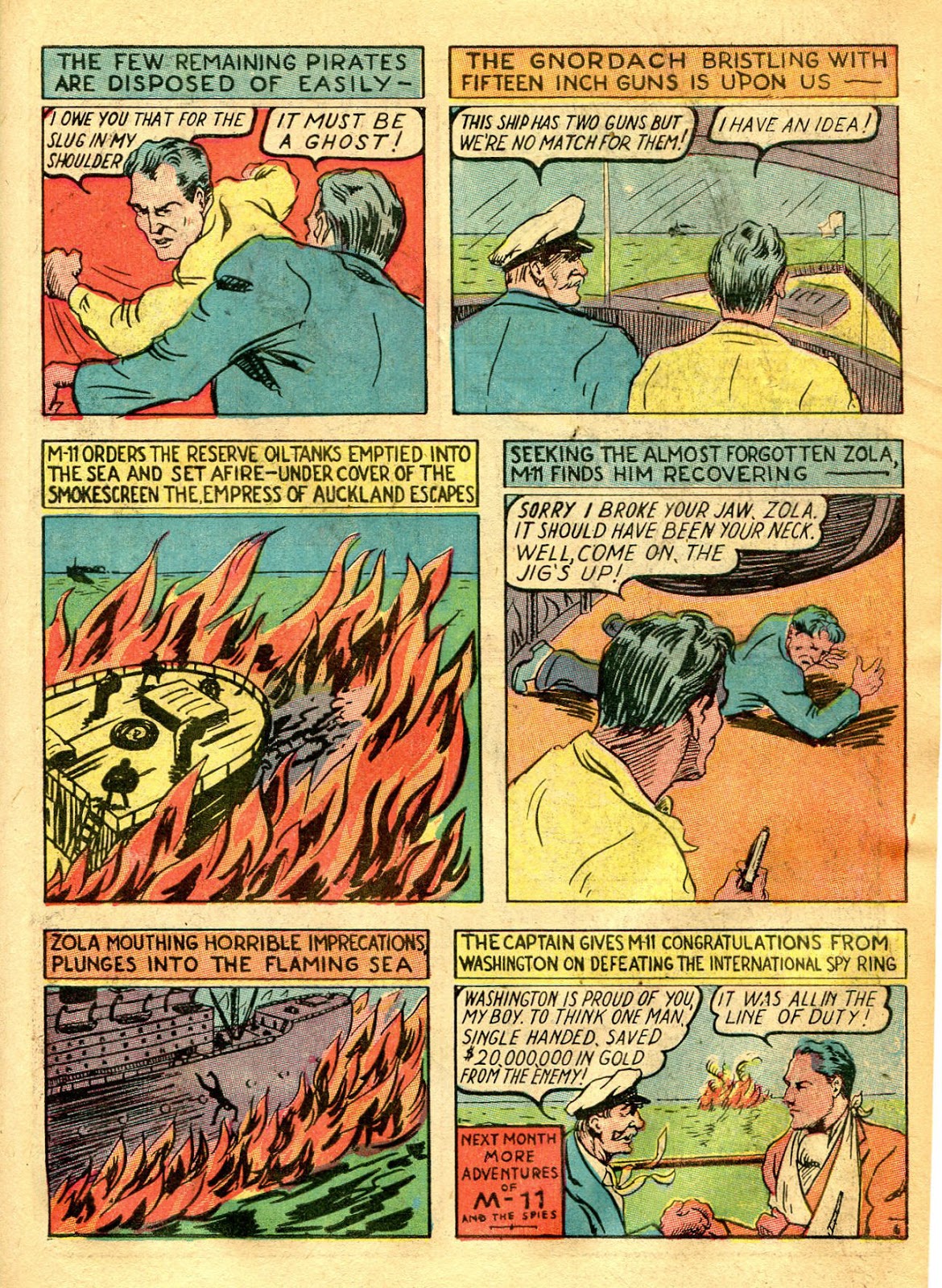
Moving on, we'll join the debut of M-11. This page interests me for several reasons. One, "Empress of Auckland" feels like such a realistic name, I wondered if there really was a ship called this. Not that I found, but I did find a plane called The Empress of Auckland, a Douglas DC-6B, that would later fly, starting in 1961!
And that $200 million in gold is not that unrealistic either, as over 140 tons of gold were transported to the U.S. in the early days of WWII. The unlikely part is it all coming on just one ship.
A villain with no fingernails on one hand is a creepy detail to use in your games!
How do you pull off someone's glove, using game mechanics? I think it would be sleight of hand, practiced as a skill. If you're just forcefully yanking it off without any attempt to go unnoticed, I might call that a basic skill check with a -1 bonus modifier, but if you were trying to pull the glove off so that the wearer doesn't notice, that would be an expert skill check.
I've talked about extenuating circumstances to add saving throws for additional penalties in addition to taking damage (like if you're leaning over a railing), as well as rolling to hit to grab something, before, and won't go into detail about them again this time.
The H&H rules do talk about using fire to create boundaries that are damaging to cross, but this is a different scenario where the fire is being used to create a boundary a vehicle won't cross. And it does make sense, if crossing the line of fire triggers a complication check, which is the way I'm still leaning towards handling damage vs. vehicles.
And the last story we're going to look at today is K the Unknown, a mysteryman in uncommonly orange long underwear.
I share this page because a good tactic for the Editor is to have mobsters doing more than just attack the Heroes; it gives the players more to react to and make decisions about during encounters. Here, K has to stay and fight or head after Terry.
K uses a smart tactic to lure a mobster outside and question him alone, rather than beard them all in their lair and then try and get answers.
Judging by what's on the table on the last panel, we might be dealing with drunken hoodlums here.
(Scans courtesy of Digital Comic Museum.)
Note how Tarpe doesn't, to her credit, draw blacks as caricatures, though we see plenty of stereotypical behavior, like being superstitious, cowardly, and on a later page, prone to alcoholism.
The constrictor snake is obviously a random encounter. But is the village? Editors who are not working from detailed maps sometimes randomly generate details as significant as village placement, or even just make it all up as they go. However, since this particular village figures into the plot, it seems more likely to have been premeditated.
This page, combined with the last, suggests that fatigue can be relieved by a short nap, or rest.
That poor native guard only wanted to come in and discuss the poems of Lewis Carroll with them, and look how they treat him!
I'm generally opposed to guns in both comic books and RPGs, even though I had to include them in Hideouts & Hoodlums to emulate their consistent usage, and the fact that my players love using them. Something I am okay with guns being used for in-game is holding your enemies at bay, by creating a line of fire that is dangerous for them to cross.
Any attack on a plane can cause a complication, even if it's a flaming spear.
"Scattering" isn't a game mechanic that guns can do, directly. Rather, they failed a morale save because they were being shot at by someone they could not attack back (not a situation covered in the rules, but a common sense reason to give a morale save).
Moving on, we'll join the debut of M-11. This page interests me for several reasons. One, "Empress of Auckland" feels like such a realistic name, I wondered if there really was a ship called this. Not that I found, but I did find a plane called The Empress of Auckland, a Douglas DC-6B, that would later fly, starting in 1961!
And that $200 million in gold is not that unrealistic either, as over 140 tons of gold were transported to the U.S. in the early days of WWII. The unlikely part is it all coming on just one ship.
A villain with no fingernails on one hand is a creepy detail to use in your games!
How do you pull off someone's glove, using game mechanics? I think it would be sleight of hand, practiced as a skill. If you're just forcefully yanking it off without any attempt to go unnoticed, I might call that a basic skill check with a -1 bonus modifier, but if you were trying to pull the glove off so that the wearer doesn't notice, that would be an expert skill check.
I've talked about extenuating circumstances to add saving throws for additional penalties in addition to taking damage (like if you're leaning over a railing), as well as rolling to hit to grab something, before, and won't go into detail about them again this time.
The H&H rules do talk about using fire to create boundaries that are damaging to cross, but this is a different scenario where the fire is being used to create a boundary a vehicle won't cross. And it does make sense, if crossing the line of fire triggers a complication check, which is the way I'm still leaning towards handling damage vs. vehicles.
And the last story we're going to look at today is K the Unknown, a mysteryman in uncommonly orange long underwear.
I share this page because a good tactic for the Editor is to have mobsters doing more than just attack the Heroes; it gives the players more to react to and make decisions about during encounters. Here, K has to stay and fight or head after Terry.
K uses a smart tactic to lure a mobster outside and question him alone, rather than beard them all in their lair and then try and get answers.
Judging by what's on the table on the last panel, we might be dealing with drunken hoodlums here.
(Scans courtesy of Digital Comic Museum.)
Labels:
complications,
Editor's tips,
fatigue,
fire,
firearms,
history lesson,
Jaxon of the Jungle,
K the Unknown,
mobsters,
morale,
racism,
Secret Agent M-11,
skills,
tactics,
villains,
wandering encounters
Sunday, September 29, 2019
Prize Comics #1 - pt. 3
Today we start with the third feature, Jupiter the Master Magician. He's our second alien magic-user after Magician from Mars (in fact, the inspiration should be obvious).
Is Jupiter using magic words, or just talking in his native tongue?
Since Jupiter is "sent" to Earth, we don't have to speculate about what spell he used to cover 628,743,036 km. Perhaps it is some super-teleporter that his people have back at home.
That Jupiter is "in his visible form" means that people from Jupiter are naturally invisible. This does not conform to the alien race available to players...but then, we never see him invisible, so perhaps this is just flavor text.
It's hard to blame this passerby for being suspicious. For one thing, your name being the same as the planet you're from is just plain weird, like being an Earth magician called Earth. Weirder still are those antennae that look like tiny pencils on his forehead.
---
Jupiter appears to be using a Telekinesis spell to move about 400 tons of railroad cars -- which is way, way beyond what the Telekinesis spell can currently move in Hideouts & Hoodlums. We might need some new variations of Telekinesis, like:
Telekinesis I (1st-level spell): Can move 30 lbs.
Telekinesis II: (2nd-level spell): Can move 300 lbs.
Telekinesis III (3rd-level spell): Can move 1 ton.
Telekinesis IV: Can move 6 tons.
Telekinesis V: Can move 50 tons.
Telekinesis VI: Can move 400 tons.
This goes a long way towards balancing out spells to powers, with powers currently being much more powerful. However...I'm not comfortable enough with this yet to make it official.
Of course, this also means Jupiter has a whopping 11 brevet ranks.The super-fast flying that takes place between panels 3 and 4 could just be Teleport.
Jupiter either has a Crystal Ball as a magic item, or this is flavor text accompanying the use of a Clairvoyance spell.
As uncomfortable as I am with Telekinesis being as powerful as I made it above, I'm about equally uncomfortable with the caster not needing line-of-sight with what he's mentally moving.
*Sigh* Am I going to need a new spell called Crack Mountain? Actually, the 7th level spell Earthquake might account for this geological behavior, but that still puts Jupiter in Stardust territory for being ridiculously overpowered.
It amazes me that a mob boss can hear that Jupiter split a mountain in half, and then is ballsy enough to think siccing three hit men on Jupiter is going to be sufficient to deal with him. I'm not saying Golden Age mobsters are all dumb, but they are incredibly naive about the risks they are dealing with.
How to determine when torture is effective? Jim Johnson could get a save vs. science to resist the pain of the foot toasting, but if he's supporting cast and no Hero is present, I would probably just wing the results.
This time, Jupiter seems to be scrying through a real Crystal Ball, as the Clairvoyance spell would not let him find a person far away like that.
There's so much wrong with this -- is Jupiter sure he has the right address? Is he sure no innocents live -- lived -- in that building?
Mechanics-wise, he's either cast Earthquake again, or...perhaps like Stardust, Jupiter needs to be statted as a Magic-User/Superhero and has used wrecking things on the building.
So, when someone says invisible in this story, what they really mean is intangible. This makes me think we should stat Jupiter as a ghost instead of an alien.

Wall of Steel isn't a far cry from the 5th level spell we already have, Wall of Iron.
That is one strange-looking emergency chute -- is it lined with copper wire? Also, where was it? Behind a secret door?
Jupiter makes some cryptic comments about Jim being able to learn magic someday. The H&H rules deal with sharing XP with your Supporting Cast when they have a Hero class, but what if they don't? The rules don't deal with how long it takes to become a classed character, and this is entirely left to the discretion of the Editor. Unless future issues actually show Jim learning magic, we don't even have an example of this yet to emulate with the rules.

It's completely unclear what spell Jupiter casts that makes them lose control of their car. What is clear is that Jupiter can casts spells through the Crystal Ball, making that one very powerful Crystal Ball.
Let's discuss what a "portable wireless set" would be in 1940. It looks pretty clear from the picture that it is a wireless telegraph, and that tech has been around since 1830. Wireless radio has been around since 1900.
It's interesting reverse psychology to have a non-Hero character try to stop your Heroes from pursuing the scenario at gunpoint. It might make them all the more determined to finish the scenario -- or they might just beat up this first guy and think they're done!
(Scans courtesy of Digital Comic Museum.)
Labels:
brevet ranks,
Jaxon of the Jungle,
Jupiter the Master Magician,
magic items,
Magic-User,
new spells,
non-classed SCMs,
races,
scenarios,
spells,
technology,
torture,
transport trophies,
tricks
Friday, September 27, 2019
Prize Comics #1 - pt. 2
We rejoin Power Nelson in the "future" of 1982. Here he faces a rhino in the arena and defeats it in one blow -- because pacing is really tight in these early stories and nobody spent a lot of time on depicting combats. The Hideouts & Hoodlums do not emulate this, because playing out combats is too integral to the nature of a RPG -- even if it is not the sole focus of H&H as it is so many other games.
There are three ways we can explain this, in-game. One, we could say this rhino simply had low hit points, perhaps due to age or illness, or random rolling without any rationalizing. Two, we could reduce the Hit Dice of big animal mobstertypes, if we wanted to, to make combats against them go quicker like we see here. Three, Power might be using Super Punch, though that is a high level power, and means that Power is not a 1st-level superhero, but one with at least five brevet ranks.
To sum up the tiger fight, Nelson uses Raise Car to lift the rhino, combined with Extend Missile Range to turn the rhino into a missile weapon.
---
Platoons must be smaller in the future; this platoon appears to consist of just seven men.
---
It's bizarre that the Mongols were so sporting as to give Nelson a net so large that it could ensnare seven men at once, a net at least 30' x 30'. If explained by powers instead, Nelson has expended three Hold Person powers, which seems almost as unlikely.
Now we're in the middle of the second feature, Ted O'Neil the Barnstormer. There is some crazy aerial acrobatics in this feature, most of which I have trouble believing would be possible
One, there's holding on to the edge of a plane's wing by your knees. I would make the aviator burn a stunt for doing this at normal altitude, and then two more to hold on during the dive! I wouldn't even allow skill checks for something this crazy.
And that handkerchief snatch? I'd make Ted roll to hit AC 0, or maybe even lower, to hit the handkerchief wile passing at that speed, plus a save vs. science to avoid taking ramming damage if he connects with the ground.
Climbing a shaking rope to climb up to a plane might be an expert skill, or could be another stunt. Holding onto Ogden in mid-air is a grappling attack, so no stunts can be used on that.
---
Aviator's helmets and bags of silver are more clues to add to murder scenes, and the next time I put together a random table of clues (I did one in The Trophy Case years ago).
Who keeps bags of silver around their home?
A plane's cowling is the removable hood over its engine.
Ogden may be the first villain in comics so cheap that he has to hitchhike to get around.
---
Normally I say that stunts cannot be used in combat, but here the gripping the wing of the plane is mostly independent of the grappling attack, and I might begrudgingly allow it.
---
Mobs in 1940 are awfully trusting of confessions that are beaten out of someone. Doesn't it occur to them that Ogden might be lying now to make the beating stop?
(Scans courtesy of Digital Comic Museum.)
There are three ways we can explain this, in-game. One, we could say this rhino simply had low hit points, perhaps due to age or illness, or random rolling without any rationalizing. Two, we could reduce the Hit Dice of big animal mobstertypes, if we wanted to, to make combats against them go quicker like we see here. Three, Power might be using Super Punch, though that is a high level power, and means that Power is not a 1st-level superhero, but one with at least five brevet ranks.
To sum up the tiger fight, Nelson uses Raise Car to lift the rhino, combined with Extend Missile Range to turn the rhino into a missile weapon.
---
Platoons must be smaller in the future; this platoon appears to consist of just seven men.
---
It's bizarre that the Mongols were so sporting as to give Nelson a net so large that it could ensnare seven men at once, a net at least 30' x 30'. If explained by powers instead, Nelson has expended three Hold Person powers, which seems almost as unlikely.
Now we're in the middle of the second feature, Ted O'Neil the Barnstormer. There is some crazy aerial acrobatics in this feature, most of which I have trouble believing would be possible
One, there's holding on to the edge of a plane's wing by your knees. I would make the aviator burn a stunt for doing this at normal altitude, and then two more to hold on during the dive! I wouldn't even allow skill checks for something this crazy.
And that handkerchief snatch? I'd make Ted roll to hit AC 0, or maybe even lower, to hit the handkerchief wile passing at that speed, plus a save vs. science to avoid taking ramming damage if he connects with the ground.
Climbing a shaking rope to climb up to a plane might be an expert skill, or could be another stunt. Holding onto Ogden in mid-air is a grappling attack, so no stunts can be used on that.
---
Aviator's helmets and bags of silver are more clues to add to murder scenes, and the next time I put together a random table of clues (I did one in The Trophy Case years ago).
Who keeps bags of silver around their home?
A plane's cowling is the removable hood over its engine.
Ogden may be the first villain in comics so cheap that he has to hitchhike to get around.
---
Normally I say that stunts cannot be used in combat, but here the gripping the wing of the plane is mostly independent of the grappling attack, and I might begrudgingly allow it.
---
Mobs in 1940 are awfully trusting of confessions that are beaten out of someone. Doesn't it occur to them that Ogden might be lying now to make the beating stop?
(Scans courtesy of Digital Comic Museum.)
Wednesday, September 25, 2019
Prize Comics #1 - pt. 1
Today we're going to be looking at just the first feature from Prize Comics' flagship title.
Power Nelson is Superman transposed to Buck Rogers' setting -- the sort of mash-up one normally expects to see in fanfiction, but was quite common in the Golden Age of Comics, when creators routinely stole from each other.
So, according to this, we've already had WWIII by 1982. That doesn't seem so far-fetched, as far as the Cold War had escalated by 1980-1982. What's far-fetched is that the "Mongols" (long since subsumed into Chinese, so it would really be China invading us) were in any position to do this by 1982. Now, by 2020...
Remember when New York looked like this in 1982?
Did I saw Superman crossed with Buck Rogers? Well, this origin story also anticipates Captain America, though with Cap we were told why there would only be one man endowed with his abilities. Here, we're told "only one" can be given these powers, with no further explanation. Did they run out of ingredients for super-soldier serum...?
I love the last panel on this page. The Mongol Army is supposedly this all-powerful world-conquering force, but they make their soldiers pay for their own weapons. First chink in the armor revealed!
The author of this story remains unknown, but he is well-versed in pulp literature, including John Carter. From A Princess of Mars we learned the code of the futuristic soldier, always using the sword first before the rocket pistol.
---
We don't get to see the rocket pistol in action, but if it can really blast someone to atoms then that would be a "save or die" situation, most likely, rather than dealing points of damage.
Power uses the power Extend Missile Range here, to throw the soldier so high in the air.
Power is going to slowly go through the Superman catalog of powers, as all the initial superheroes in comic books did...though, while others will try to show Superman up, Power under-performs. Instead of Raise Car, he only hefts a motorcycle -- I mean, a rocket cycle over his head. Now, I can't tell how heavy these cycles are supposed to be, but I suspect they might fall within the generous encumbrance rules for Hideouts & Hoodlums, and not require an actual power expenditure.
---
I also like that first panel, and how it looks like a Shriner parade!
---
Let's start our discussion of this page with the number of attackers who can surround you in melee. There are eight positions for man-sized attackers around a target. If the target's back is to a wall, that number drops to five. So, sure, seven members of the famous Death's Head Division can stand around Nelson and try to block him from moving, but they can't all attack him at once.
So, how does "blocking him from moving" work, as a game mechanic? If five of them were pressed into melee range around him, they would all get free bonus attacks on him as he tried to move out of that position. However, since they are outside of melee, he can move towards a corner of their semi-circle where no more than four would be within sword reach.
Complicating matters is that some of the soldiers have guns instead of swords. Guns give them the advantage that they don't have to be within melee range to attack, but they lose the advantage of the free bonus attack if he tries to move past a missile weapon.
On the other hand, it gives them the advantage after moving past them that they can simply turn and shoot once he's outside of melee again without having to chase after him.
And before moving on to this next page, I want to talk about the cool rocket-roller tank. We don't know much about it, but I'm guessing that's a forward-mounted raygun, since the barrel is too narrow for any kind of significant missile. Since it's rocket-powered, it must move much faster than a real tank (maybe a 75 Move?) And that roller is probably a little more effective than normal treads for running people over (+1 to hit?), and clearly has an intimidation factor to it, but since most of the weight of the tank isn't resting directly above it, I would say damage might be as low as 4-24 points.
I'll keep it brief about this page: nobody in 1940 seemed to have a clue how powerful atomic weapons would be. Here it takes three to damage a city block.
In any campaign based on 1940-era science,atomic weapons will be just powerful explosives, maybe doing twice the damage of a grenade.
"What a man!" Some of these panels are just unintentionally hilarious.
Let's talk about why Power doesn't just bust out of those chains and attack the emperor on the spot. Can he? By H&H rules, when you recover from being stunned, your wrecking things ability returns to you at full-strength. Is that not the case here, or is Power simply biding his time? It might make sense to do so if he is out of defensive buffing powers (or simply had none prepared for the day) and down to 6 hp or less.
In a futuristic setting, it's fun to take familiar landmarks and turn them into something else; and Yankee Stadium as a gladiatorial arena is quite brilliant, I think.
(Scans courtesy of Digital Comic Museum.)
Power Nelson is Superman transposed to Buck Rogers' setting -- the sort of mash-up one normally expects to see in fanfiction, but was quite common in the Golden Age of Comics, when creators routinely stole from each other.
So, according to this, we've already had WWIII by 1982. That doesn't seem so far-fetched, as far as the Cold War had escalated by 1980-1982. What's far-fetched is that the "Mongols" (long since subsumed into Chinese, so it would really be China invading us) were in any position to do this by 1982. Now, by 2020...
Remember when New York looked like this in 1982?
Did I saw Superman crossed with Buck Rogers? Well, this origin story also anticipates Captain America, though with Cap we were told why there would only be one man endowed with his abilities. Here, we're told "only one" can be given these powers, with no further explanation. Did they run out of ingredients for super-soldier serum...?
I love the last panel on this page. The Mongol Army is supposedly this all-powerful world-conquering force, but they make their soldiers pay for their own weapons. First chink in the armor revealed!
The author of this story remains unknown, but he is well-versed in pulp literature, including John Carter. From A Princess of Mars we learned the code of the futuristic soldier, always using the sword first before the rocket pistol.
---
We don't get to see the rocket pistol in action, but if it can really blast someone to atoms then that would be a "save or die" situation, most likely, rather than dealing points of damage.
Power uses the power Extend Missile Range here, to throw the soldier so high in the air.
Power is going to slowly go through the Superman catalog of powers, as all the initial superheroes in comic books did...though, while others will try to show Superman up, Power under-performs. Instead of Raise Car, he only hefts a motorcycle -- I mean, a rocket cycle over his head. Now, I can't tell how heavy these cycles are supposed to be, but I suspect they might fall within the generous encumbrance rules for Hideouts & Hoodlums, and not require an actual power expenditure.
---
I also like that first panel, and how it looks like a Shriner parade!
---
Let's start our discussion of this page with the number of attackers who can surround you in melee. There are eight positions for man-sized attackers around a target. If the target's back is to a wall, that number drops to five. So, sure, seven members of the famous Death's Head Division can stand around Nelson and try to block him from moving, but they can't all attack him at once.
So, how does "blocking him from moving" work, as a game mechanic? If five of them were pressed into melee range around him, they would all get free bonus attacks on him as he tried to move out of that position. However, since they are outside of melee, he can move towards a corner of their semi-circle where no more than four would be within sword reach.
Complicating matters is that some of the soldiers have guns instead of swords. Guns give them the advantage that they don't have to be within melee range to attack, but they lose the advantage of the free bonus attack if he tries to move past a missile weapon.
On the other hand, it gives them the advantage after moving past them that they can simply turn and shoot once he's outside of melee again without having to chase after him.
And before moving on to this next page, I want to talk about the cool rocket-roller tank. We don't know much about it, but I'm guessing that's a forward-mounted raygun, since the barrel is too narrow for any kind of significant missile. Since it's rocket-powered, it must move much faster than a real tank (maybe a 75 Move?) And that roller is probably a little more effective than normal treads for running people over (+1 to hit?), and clearly has an intimidation factor to it, but since most of the weight of the tank isn't resting directly above it, I would say damage might be as low as 4-24 points.
I'll keep it brief about this page: nobody in 1940 seemed to have a clue how powerful atomic weapons would be. Here it takes three to damage a city block.
In any campaign based on 1940-era science,atomic weapons will be just powerful explosives, maybe doing twice the damage of a grenade.
"What a man!" Some of these panels are just unintentionally hilarious.
Let's talk about why Power doesn't just bust out of those chains and attack the emperor on the spot. Can he? By H&H rules, when you recover from being stunned, your wrecking things ability returns to you at full-strength. Is that not the case here, or is Power simply biding his time? It might make sense to do so if he is out of defensive buffing powers (or simply had none prepared for the day) and down to 6 hp or less.
In a futuristic setting, it's fun to take familiar landmarks and turn them into something else; and Yankee Stadium as a gladiatorial arena is quite brilliant, I think.
(Scans courtesy of Digital Comic Museum.)
Sunday, September 22, 2019
Keen Detective Funnies #18 - pt. 4
Only because I'm a Harry Campbell fan, I'm going to devote one more blog post to this issue, devoted entirely to Dean Denton...despite Dean not being my favorite of Campbell's characters, and this installment in particular being terribly racist.
At least Campbell, as usual, had done his homework. "Bomba" is Boma, capital city of the Belgian Congo, and is still an important city in the Democratic Republic of the Congo today.
The text makes it sound like Katanga is a city, but it is a province in the southeast corner of the Congo. The narrator's assertion that Katanga is 700 miles away is pretty accurate.
"Compagnie Belgique" is not a real thing, but seems very plausible, even though the correct way to say it would be "Compagnie de la Belgique," or Belgium Company.
---
Here we see a rare example of kit-bashing hi-tech trophy items during an adventure instead of during downtime. This is how a scientist class would use powers, which would here include a new power, Detect Radiation. It's a weird sort of power and not how, I think, Geiger counters actually work. It's functioning here more like a long-range Locate Object spell, or a Find the Path spell, rather than detecting something's presence in a certain radius.
---
Oh look, Dean is sexist now too. Sigh...
You're going to have to choke down some really terrible dialogue on this page, but one interesting piece of dialogue is the unusual phrase from Dean, "you're like money from home!" While certainly rare today, I wonder if this was a more common saying circa 1940.
---
And check out that sleight of hand! Has Absalom been carrying rabbits and canaries around in his pockets all this time, just hoping for an opportunity to do a magic act? Or is there more than even simple cantrips going on here? It almost seems more like an Animal Summoning spell!
This page is troubling to me, from a game mechanics perspective. We have an aerial dogfight and, the way I have the mechanics for this working out in my head, you make attack rolls each turn you are facing your opponent's plane and the more hits you get, the more a percentage chance of a random complication happens. I see this all the time in dogfight scenes -- but not this one, where the plane simply goes down without explanation, almost as if it had simply run out of hit points.
I guess I will need to watch for more examples.
(Scans courtesy of Comic Book Plus.)
At least Campbell, as usual, had done his homework. "Bomba" is Boma, capital city of the Belgian Congo, and is still an important city in the Democratic Republic of the Congo today.
The text makes it sound like Katanga is a city, but it is a province in the southeast corner of the Congo. The narrator's assertion that Katanga is 700 miles away is pretty accurate.
"Compagnie Belgique" is not a real thing, but seems very plausible, even though the correct way to say it would be "Compagnie de la Belgique," or Belgium Company.
---
Here we see a rare example of kit-bashing hi-tech trophy items during an adventure instead of during downtime. This is how a scientist class would use powers, which would here include a new power, Detect Radiation. It's a weird sort of power and not how, I think, Geiger counters actually work. It's functioning here more like a long-range Locate Object spell, or a Find the Path spell, rather than detecting something's presence in a certain radius.
---
Oh look, Dean is sexist now too. Sigh...
You're going to have to choke down some really terrible dialogue on this page, but one interesting piece of dialogue is the unusual phrase from Dean, "you're like money from home!" While certainly rare today, I wonder if this was a more common saying circa 1940.
---
And check out that sleight of hand! Has Absalom been carrying rabbits and canaries around in his pockets all this time, just hoping for an opportunity to do a magic act? Or is there more than even simple cantrips going on here? It almost seems more like an Animal Summoning spell!
This page is troubling to me, from a game mechanics perspective. We have an aerial dogfight and, the way I have the mechanics for this working out in my head, you make attack rolls each turn you are facing your opponent's plane and the more hits you get, the more a percentage chance of a random complication happens. I see this all the time in dogfight scenes -- but not this one, where the plane simply goes down without explanation, almost as if it had simply run out of hit points.
I guess I will need to watch for more examples.
(Scans courtesy of Comic Book Plus.)
Thursday, September 19, 2019
Keen Detective Funnies #18 - pt. 3
We're getting to the back of the book now and this month's semi-colored installment of Spy Hunters.
There is a village in Punjab, India called Abdal, but I don't know if that already existed in 1940, or would be a place an American author then would know about. There is an Abdal people in India, Urdu-speaking Muslims, that might be where the author learned the name from.
It's also worth reminding players that this was a time before portable radios, so communication by flashing light off of mirrors was a thing your Heroes might have to employ.
I'm including this page because it's important to note that not everyone everywhere had a radio by 1940. This whole village has no radio, and it's not just natives in the village.
You don't see "Unlimber your machine gun" every day, so I thought I'd include this page, and then look up what "unlimber" means. Apparently, it's a real word that means "detach (a gun) from its limber so that it can be used."
Okay...then I had to look up what a "limber" is. It's
"a two-wheeled cart designed to support the trail of an artillery piece, or the stock of a field carriage such as a caisson or traveling forge, allowing it to be towed." Huh, who knew?
I'm interested in this page for the map, and wondering how authentic it is. Again, series creator Lochlan Field (according to comics.org) has done his research; Chitral is a real place, both a state and a city that serves as the capital of that state. The Mahi River flows past Chitral at the same angle as that road in the drawing.
Chitral is significant for the British because of the
Chitral Expedition. It was, according to Wikipedia, "a military expedition in 1895 sent by the British authorities to relieve the fort at Chitral which was under siege after a local coup. After the death of the old ruler power changed hands several times. An intervening British force of about 400 men was besieged in the fort until it was relieved by two expeditions, a small one from Gilgit and a larger one from Peshawar." In other words, a major wargaming scenario.
And this page I'm sharing because it's a rare time when we see first aid being administered (rare, despite how common it is in all Hideouts & Hoodlums scenarios).
Moving on, we have another adventure of the inspiration for the floating eye mobstertype in H&H -- The Eye. We see here that there is a peculiar feature to its invisibility, as one of the workers is able to see it. Does everyone in line of sight need to save vs. spells to see through its special invisibility (the spell does not act this way)?
---
The other reason to share this page is to speculate as to which real country "Osthania" represents. Remember that, this early in 1940, Germany has hardly invaded any countries yet. Further, "bombarded on all sides" seems to only apply to Poland, uniquely caught between Russian and German advances.
---
The Eye can talk! Or is it telepathy, like I had floating eyes use? It's hard to tell because the "science" of word balloons is still in its infancy; there's not even a uniform balloon shape for thought balloons yet, let alone ones that denote telepathy.
Here the Eye demonstrates telekinesis, and not particularly strong telekinesis either, just like the spell. Though maybe he's just being very careful at not setting off the explosives.

"Alfonsky" even seems to confirm this is Poland. But there wouldn't be a Pole in charge of Poland past September 1939, meaning this story had to have taken place earlier than that. The President then was Ignacy Moscicki, which doesn't even rhyme with Alfonsky. Our ambassador to Poland at the time was Anthony J. Drexel Biddle Jr. -- and we know what date he left Poland, September 5, 1939, so we can date this story to the specific day thanks to this page. Anthony even had two daughters, though they were named Mary and Margaret, neither being Sandra.
Further, applying Polish history to this scene explains why the bombers are coming; this would be Day 5 of the German Invasion of Poland.
(Scans courtesy of Comic Book Plus.)
There is a village in Punjab, India called Abdal, but I don't know if that already existed in 1940, or would be a place an American author then would know about. There is an Abdal people in India, Urdu-speaking Muslims, that might be where the author learned the name from.
It's also worth reminding players that this was a time before portable radios, so communication by flashing light off of mirrors was a thing your Heroes might have to employ.
I'm including this page because it's important to note that not everyone everywhere had a radio by 1940. This whole village has no radio, and it's not just natives in the village.
You don't see "Unlimber your machine gun" every day, so I thought I'd include this page, and then look up what "unlimber" means. Apparently, it's a real word that means "detach (a gun) from its limber so that it can be used."
Okay...then I had to look up what a "limber" is. It's
"a two-wheeled cart designed to support the trail of an artillery piece, or the stock of a field carriage such as a caisson or traveling forge, allowing it to be towed." Huh, who knew?
I'm interested in this page for the map, and wondering how authentic it is. Again, series creator Lochlan Field (according to comics.org) has done his research; Chitral is a real place, both a state and a city that serves as the capital of that state. The Mahi River flows past Chitral at the same angle as that road in the drawing.
Chitral is significant for the British because of the
Chitral Expedition. It was, according to Wikipedia, "a military expedition in 1895 sent by the British authorities to relieve the fort at Chitral which was under siege after a local coup. After the death of the old ruler power changed hands several times. An intervening British force of about 400 men was besieged in the fort until it was relieved by two expeditions, a small one from Gilgit and a larger one from Peshawar." In other words, a major wargaming scenario.
And this page I'm sharing because it's a rare time when we see first aid being administered (rare, despite how common it is in all Hideouts & Hoodlums scenarios).
Moving on, we have another adventure of the inspiration for the floating eye mobstertype in H&H -- The Eye. We see here that there is a peculiar feature to its invisibility, as one of the workers is able to see it. Does everyone in line of sight need to save vs. spells to see through its special invisibility (the spell does not act this way)?
---
The other reason to share this page is to speculate as to which real country "Osthania" represents. Remember that, this early in 1940, Germany has hardly invaded any countries yet. Further, "bombarded on all sides" seems to only apply to Poland, uniquely caught between Russian and German advances.
---
The Eye can talk! Or is it telepathy, like I had floating eyes use? It's hard to tell because the "science" of word balloons is still in its infancy; there's not even a uniform balloon shape for thought balloons yet, let alone ones that denote telepathy.
Here the Eye demonstrates telekinesis, and not particularly strong telekinesis either, just like the spell. Though maybe he's just being very careful at not setting off the explosives.

"Alfonsky" even seems to confirm this is Poland. But there wouldn't be a Pole in charge of Poland past September 1939, meaning this story had to have taken place earlier than that. The President then was Ignacy Moscicki, which doesn't even rhyme with Alfonsky. Our ambassador to Poland at the time was Anthony J. Drexel Biddle Jr. -- and we know what date he left Poland, September 5, 1939, so we can date this story to the specific day thanks to this page. Anthony even had two daughters, though they were named Mary and Margaret, neither being Sandra.
Further, applying Polish history to this scene explains why the bombers are coming; this would be Day 5 of the German Invasion of Poland.
(Scans courtesy of Comic Book Plus.)
Subscribe to:
Posts (Atom)