Monday, October 21, 2019

Fantastic Comics #4- pt. 1

Alex Blum's first work in comics were these early Samson stories, and they are pretty good stuff. It is believed that Will Eisner, Alex's boss, wrote these stories, but I suspect he had a hand in the layout of this story as well, as ingenious as some of it is. Follow along and decide for yourself!

First of all, check out the amazing detail work on that smashed robot! This is, perhaps, our best glimpse ever at how an artist in 1940 imagined the mechanical insides of a robot would look like.

Samson never actually wielded a flail in combat -- but wouldn't that have been cool too?
That's right -- Samson doesn't just wear a furry loincloth into combat, he wears only that while casually strolling around town too. I have a theory, though, that Samson's look is only meant to be symbolic; that he doesn't really appear like this in public, but is shown to us this way because this is how we see him, as the Hero.

Note the imaginative panel layout at the bottom, with the island superimposed over the map showing where it is. That is genius, and has Eisner's handiwork written all over it.

---

Game mechanics-wise, Samson is buffed both with Raise Car and Different Physical Structure (to help him save vs. the deadly gas) on this page.
Narrators are usually prone to hyperbole, but this one was modest on page 1 when it said the robots were twice human size. On this page, the robot appears to be more like three times human size.  That makes them giant robots, and normally 15 Hit Dice. Even one is a tough encounter; bear that in mind as this story progresses.

---

It's really hard to pin down a nationality for Rigo based on just the name, but we'll see shortly who "Rigo" really is...


"No man made weapon can harm my creation" could well be hyperbole, but we do see the robot is nigh-invulnerable, which means at least an Armor Class as low as 3.

---

Dragor is who now? Oh wow, yeah, Dragor was the Hitler stand-in in Fantastic Comics #2! That's a cool little bit of continuity I almost missed!
I love this ingenious top panel!

Maximillian looks very Germanic to me, but Rigo is nearly a dead ringer for Stalin in that second panel. Since Samson has already bested Germany two issues ago, it makes sense he would tackle Russia this time around.
Don't miss the implications here -- Eisner and Blum just killed off Stalin.

We also see that giant robots can be voice-activated, and that they can be encountered in groups of up to -- 5,000??  5,000 15 HD robots? That's one messed up challenge level. I mean, maybe 3+ Heroes, all level 21+, could handle this, but I would never throw this against a single Hero of any level.
The first panel here needs to be seen as symbolic only; clearly that robot at the bottom is not so huge that it can literally reach over and crush a skyscraper in its hand as it walks past. The 2nd and 3rd panels, though, are probably meant to be literal, and are pretty grim and violent. These giant robots main attack forms are squeezing and stomping. I would not treat squeezing as a grappling attack, as there's clearly no way those women (or the natives we saw this happen to earlier) can reverse the hold and throw those robots on the ground.


If Rigo is Stalin and the robots come from Russia, then this gorge must be somewhere in the Ural Mountains? Samson is lucky to have found a place where he can strategically bottleneck the robots. I guess traffic was too heavy on the roads for the robot army?

Now, what is poison gas supposed to do to robots? Is Samson leaving this incredibly gullible old man in front of the robot army to get killed off, so he can't make any more deadly inventions?

Players should be rewarded for coming up with ways to use their wrecking things ability to do secondary damage. Here, it stops three robots. Only 4,997 more to go! The story doesn't tell us how Samson stops the rest, though I suspect they are programmed to try and go around rubble and simply keep falling off the cliff, one after the other.

(Scans courtesy of Digital Comic Museum.)


Wednesday, October 16, 2019

Amazing Mystery Funnies #18 - pt. 3

We're going to speed through the rest of this issue today, picking up where we left off with Larry Kane. This old castle is so like Old School dungeon design, with random layouts that don't make much real world sense -- like coming in through the main entrance and finding a long hallway lined with doors instead of, oh, maybe a foyer or something.

I didn't know this, but a garret is an attic that's been finished so it can be lived in.
Well, darn! Instead of some spooky ghosts, it's just some mobsters making all the noises. From the descriptions, if I was running this as a Hideouts & Hoodlums scenario (and don't think I wouldn't!), I would stat them as two robbers and a thug. Though I would personally shake things up in this story by having mobsters and undead in the house -- much like my Palace of the Vamp Queen module.
Spoilers: Larry wins. So let's jump ahead to the next feature, Spy A-5 (we're also told his name is Storm King, but that feels an awful lot like an alias as well).

The story is pretty run-of-the-mill, with this being like the eighth or ninth story I've read about an inventor with a stratoplane since I started reading these stories. The only thing worth considering here, then, is the game mechanic issue of the splashing-liquid-in-their-faces-to-distract-them trick. If I was a fan of the new edition of D&D and its mechanic of advantage and disadvantage, I might say the distraction gives them a disadvantage on their next attacks. While the mechanic is clearly popular with today's players, it's a big game-changer in that it alters the dice rolls far more than a small modifier does. I would have to say it goes against the flavor of H&H.


Speaking of flavor...the other use for this trick is simply flavor text to explain how Storm wins initiative on that turn. In H&H, the dice rolls determine the result, and then the result is described; you don't normally pick the result you want and then the mechanics help you get that result (although there are situational modifiers that will give you a 5-20% bonus).

Anyway, on to this next page. First, I wanted to point out that the mobsters are able to use escape artistry as a skill; normally we only see that working for Heroes.

We see corners being used for hard cover. We also see a Hero taking a rare hit and needing first aid afterwards.
For game balance, sometimes it's good to introduce trophy items with a built-in drawback, and this stratosphere has a doozy. Unless the pilot can keep the fuel mixing just right (skill check? Per take-off?), the plane explodes for, I'm guessing, a lot of dice of damage.
And now we get to Fantom of the Fair, and a really nice location for a hideout. I can imagine some cool, water-based traps in that place.


Is Dr. Loy babbling, or does he have voice-activated machinery?

So how tough are these things? We're not talking about golem-level tough if Loy can mass produce a thousand of them. Probably not even gargoyle-level tough, to make them immune to normal weapons. Rather, I'd say they have good Armor Class and that's why the bullet doesn't harm him.

But what to call them? Loy calls them his masterpieces, but that's a terrible name for a mobstertype.  "Weird hideous creature" is too long. I would shorten that, then, to The Weird.


Although the weird are undoubtedly tough, their chief advantage against The Fantom seems to be only numbers. I would give them maybe 2, no more than 3, Hit Dice.

The Fantom has gone from a mysterious figure with a fascinating backstory to just some redheaded guy in long underwear and cape. Or is the Fantom in disguise, as he definitely seemed to have black hair in his earliest appearances...?
I had to look up "water bubbler" and learned that it's a slang term for a water fountain, used in New England.

That the weird melt into puddles when hit with water makes them pretty useless, but also easy for low-level Heroes to face.

Fantom's chemical analysis seems like a longshot, depending on a) the weird's creator to not be from some foreign country, or smuggle the chemicals into the country, and b) that they were all made in the last six months.

And what is up with that ugly cowl the Fantom is wearing? It's like he has a red condom pulled down over his head...

(Scans courtesy of Comic Book Plus.)

Monday, October 14, 2019

Amazing Mystery Funnies #18 - pt. 2

We're still looking at Jon Linton's adventures in the future; a future where men wear robes and women wear short skirts.

It seems like a huge design flaw that Satan Rex's atomic power plant is controlled by two exposed electrodes. I was going to say the place should also have some fail-safes in place, but I suppose the power shutdown is a fail-safe, preventing something worse like a meltdown.

I don't think any 1940 writers knew about meltdowns yet...and yet, Harry Campbell did seem to have more knowledge of science than your average comic book writer of the time, so...?
I just complimented Campbell for his smarts, but there seems to be a glaring mistake here; two pages back, Jon learned the systems would need 30 minutes to reboot, and here the "wall of force" is rebooting well before then. Of course, maybe Satan was smart enough to have a back-up system kick in for the force wall.

It's interesting that Campbell calls it a wall of force and not the more common term, force field (in use in science fiction going back to 1920!). Wall of Force is, of course, a magic-user spell as well.

The second to last panel spells out that the Scientist class normally takes a week of downtime to invent something, but has a chance to kit-bash something in just a day.
The Mount Wilson Observatory telescope would be the largest in the world until 1949. I'm not sure where the "6,000 billion million miles" came from, but researchers could see nebulae over 5 trillion miles away.

The "reveal houses on the moon, if there are any" is as optimistic as telepathic television-phones.
Bill and Davey is an odd duck, a comic strip coming from a minor league syndicate that was picked up by both Dell and Centaur (though neither for long). It's hard to see what they saw in it -- unless they just picked it up cheap.

There were headhunters, and cannibals as well, on the Solomon Islands, so while the depiction of Ajax might seem racist, the description isn't. 
This is Tippy Taylor on Fantasy Isle, a non-subtle rip-off of Swift's Lilliput. This scenario should be a cakewalk for even a class-less half-pint; since I'm still working on the assumption that 1 hit point represents roughly 30 lbs. of mass, and a 6" tall person would weigh less than an ounce, then Lilliputians...or Fantasy Islanders don't even come close to having a full hit point, or being able to do any damage themselves.

The tank poses more of a threat, even scaled to tiny size. Since it's the size of a gun, I would allow it to do a full 1-6 points of damage if it shot Tippy in the leg.

That must be a 3' high jump by Tippy. Impressive! 
This is John Degen, Private Detective, from a one-shot called "The Fiend of Halwith Hall." Shadowing someone, by car, on a country road, should be a basic skill check.

John is smart to head straight to the cellar, as most of the good stuff in a hideout is underground.

John has a skeleton key, a minor trophy item that gives him a bonus to skill checks when opening locked doors.
Here we have a mad scientist with the emphasis on mad. Like many mad scientists, he wants to do a brain transplant. Now, he might be just a raving loon, or maybe he has the science to do it; we never do find out.

Two wolves are unusual pets for a mad scientist.

The pit trap in the driveway is very unusual. It also doesn't make a lot of sense, since the car was parked when John goes inside, and is in the pit trap after he gets out. Maybe it took a long time for the weight of the car to activate the trap?
That's a lot of blood loss, to make the gunpowder too wet to burn. The Hideouts & Hoodlums rules don't account for blood loss and there's no way to make yourself bleed faster to foil traps.

Wow, that is one dark ending. It's rare for Heroes in comics to fail, but John not only failed to save this poor guy, but we find out just what horrible fate befell him.
Lastly, we're going to look at a verbose page of Larry Kane, investigating "The Ghost of Kirkwood." There's a pretty good set-up for a haunted house scenario here, with lots of rumors being supplied on this page.

My curiosity has been aroused too, but it's late and I'll read the rest next time!

(Scans courtesy of Comic Book Plus.)

Friday, October 11, 2019

Amazing Mystery Funnies #18 - pt. 1

Speed Centaur? Really? You're going to make me read Speed Centaur, first thing? Sigh..

Now, to be fair, this scenario seems as preposterous on the face of it as a centaur superhero. What would the Axis Forces possibly want with U.S. horses circa 1940? It turns out there actually is a real story like this.

"Hop on my back and ride me, trusty sidekick!" How did  Fredric Wertham miss this?
What the waaah? Since when can centaurs fly? I guess I'm modifying the centaur record in the Mobster Manual again!
I've never heard of such a killer horse -- but killer horse seems almost like a worthy mobstertype for Hideouts & Hoodlums! It also appears here that killer horses can attack with both 1 bite and 1 kick in the same turn. Speed beats the killer horse with grappling.
I'm interested in this page for the first panel. Reel is able to gamely perform a move worthy of a movie stuntman; but keep in mind Reel's training is as a cameraman. So when did he become such a capable acrobat and marksman?

On an earlier post, I speculated about Supporting Cast and at what point they can become classed and I may have missed the obvious; as soon as they become Supporting Cast to a Hero, they become important enough to gain a class, even if they only had a mundane profession before. 


Killer horses will chase after you if you run!

...It's been as hard as ever taking Speed Centaur seriously, but perhaps this could illustrate, instead, that Supporting Cast animals can be given very specific and out-of-their-character tasks, like running down and trampling someone.
Phew! Moving on to The Inner Circle now. There's not a lot of game-relevant material here, although I'm curious to see if any of those newspapers really exist...

Long before The New York Bulletin became a fake newspaper in the Marvel Netflix Universe, it was a real New York newspaper, running from 1840 to 1850! There was a London daily called The Courier, but I can't find that there was a London Daily Courier. The Montreal Post-Telegram is completely bogus.

Next, I'm noticing how widely different the value of the gold stolen is between countries. How close are those exchange rates?


No, there was $4 to the pound, so the London Daily Courier should be reporting 200,000, not 250,000 pounds. The Canadian numbers are even worse; the Canadian dollar was only worth 10% more than a U.S. dollar in 1940, so the Montreal Post Telegram should say 55,000, not what looks an awful lot like 500,000!

I tried to also do a little research on why damage to the conning tower, specifically, would keep a sub from being able to submerge. I don't think it's because the hit was on the tower, per se, but any hole in the sub is going to take on water.

Leaving those Circle Boys behind on their boats, let's jump ahead to Jon Linton, the thinking man's Buck Rogers (well, sorta...).

I suppose there's something comforting in knowing that notes handwritten in cursive are still going to be a thing in the future.

Jon's trick here seems a bit too obvious to me, but I suppose when you're dealing with a narcissist like Trump -- er, I mean Satan -- it's easy to play on his vanity and get him to think you're on his side.

In game play, this can be difficult, particularly if the player and Editor don't see the character's motivations the same way.

If the Editor felt, Jon's player is misinterpreting what I'm going for, he could prompt his player with a skill check or Wisdom check (we've talked about unofficially using ability score checks in H&H before) and correct him if he succeeds - or, simply change the way the villain's character to match player expectations, if that makes things easier.

I love how Harry Campbell, even if he doesn't always get the science right, certainly makes a game try of it. Here he fairly accurately predicts safe atomic energy plants, with 2 million volts being possible if the plant has up to six transformers. He also accurately understands reboot time.

(Scans courtesy of Comic Book Plus.)

Tuesday, October 8, 2019

Prize Comics #1 - pt. 5

I haven't tackled a five-parter in a long time, but I had a lot to say about this issue.

We're going to pick up not long after where I left off with K the Unknown and we will, as usual, discuss it in terms of RPG game mechanics. As anyone who's ever read a previous post knows, I wrote the RPG Hideouts & Hoodlums and feel it does a spectacular job of  emulating the early history of comic books -- which I prove post after post on this blog.

And yet...K, getting stunned on the first hit by a thrown paperweight just doesn't match up with the hit point model of incremental defeat that H&H uses. It seems more like every hit has a random chance of delivering a stun. And, as I think about it, I see this all the time against bad guys and animals; only Heroes are usually incrementally defeated. And it does give me pause.

This page also highlights the importance of checking every mobster you defeat for disguises.
I'll give K this, the finale is worthy of a James Bond movie, with the hero and villain struggling upright on a speeding bobsled -- in fact, it predates the bobsled chase in On Her Majesty's Secret Service by 23 years!

I would think that two men grappling on a moving bobsled would wind up getting thrown off almost immediately, but in-game would be fine with giving each a save vs. science each turn to stay put, with a penalty to their save on the hairpin curve.
If Buck Brady of the F.B.I. seems science fictional, it's because of the absence of 1,000-dollar bills out there today. The U.S. government stopped making the bills by 1946, and finally recalled them all in 1969, so I've never seen one in my life.
I decided to share this page to talk about players choosing the direction of the scenario, because I read this I couldn't help but think, if this was a game I was playing, I would have had Buck follow the car rather than search her room. Now, if I was the Editor instead, I could leave a clue in the room telling the player where the old lady was going, and hopefully the player will get the hint that it's important to go to that location...
In this case, the Editor seems to have decided to move the planned encounter back to the hotel room. On one hand, it makes the villain seem smarter, guessing Buck was coming, but on the other hand it makes the Editor seem like he's unfairly using his knowledge of the player's actions against them. A way around that might be to let the player attempt to save vs. plot to find the hotel room abandoned.

Here is the oddly-already-a-cliche of the man dressed as an old woman, but with the switcheroo that the Hero then uses the same disguise.
I'm impressed by the daring involved in piloting your boat into a police boat just to get their attention. A mean Editor could well give you a chance of sinking the police boat, and then where will you be?

The final story we're going to look at is Storm Curtis of the U.S. Coast Guard. I'm showing you this page for two reasons: one, it's more fun playing a character with interests other than crime-fighting 24/7. Give your Hero a hobby, either one you already know about, or one you're willing to research.

And two, check out that grappling hook gun! This is much closer to what a real grapple gun looks like than what Batman has carried since the 1980s, though I'm not convinced grapple guns were that small and handheld in 1940; there could still be some artistic license at play here.
Paper and pencils are good things to find on a defeated mobster, as are cigarettes.

Note the use of "espy" in panel 2, a word I don't think was even in common usage then!
Those are really convenient clues to find in someone's pocket!

Personally, I find the chief spy encounter anticlimactic, but it's certainly surprising and good to pull on your players once.

I think it's amusing how Curtis sort of bumbled into this whole spy ring, like a player getting a lot of railroading help from his Editor.

Comics.org doesn't say who the artist is here, but I suspect Dick Briefer. What do you think?

(Scans courtesy of Digital Comic Museum.)

Friday, October 4, 2019

Prize Comics #1 - pt. 4

We're back with Jaxon of the Jungle, just in time to see Jaxon go up against wild pigs! These boars look small enough to be juvenile boars, which makes it even more unseemly when he starts gutting one. There's got to be better ways to earn experience points, Jaxon!

Note how Tarpe doesn't, to her credit, draw blacks as caricatures, though we see plenty of stereotypical behavior, like being superstitious, cowardly, and on a later page, prone to alcoholism.
The constrictor snake is obviously a random encounter. But is the village? Editors who are not working from detailed maps sometimes randomly generate details as significant as village placement, or even just make it all up as they go. However, since this particular village figures into the plot, it seems more likely to have been premeditated.
This page, combined with the last, suggests that fatigue can be relieved by a short nap, or rest.

That poor native guard only wanted to come in and discuss the poems of Lewis Carroll with them, and look how they treat him!
I'm generally opposed to guns in both comic books and RPGs, even though I had to include them in Hideouts & Hoodlums to emulate their consistent usage, and the fact that my players love using them. Something I am okay with guns being used for in-game is holding your enemies at bay, by creating a line of fire that is dangerous for them to cross.

Any attack on a plane can cause a complication, even if it's a flaming spear.

"Scattering" isn't a game mechanic that guns can do, directly. Rather, they failed a morale save because they were being shot at by someone they could not attack back (not a situation covered in the rules, but a common sense reason to give a morale save).
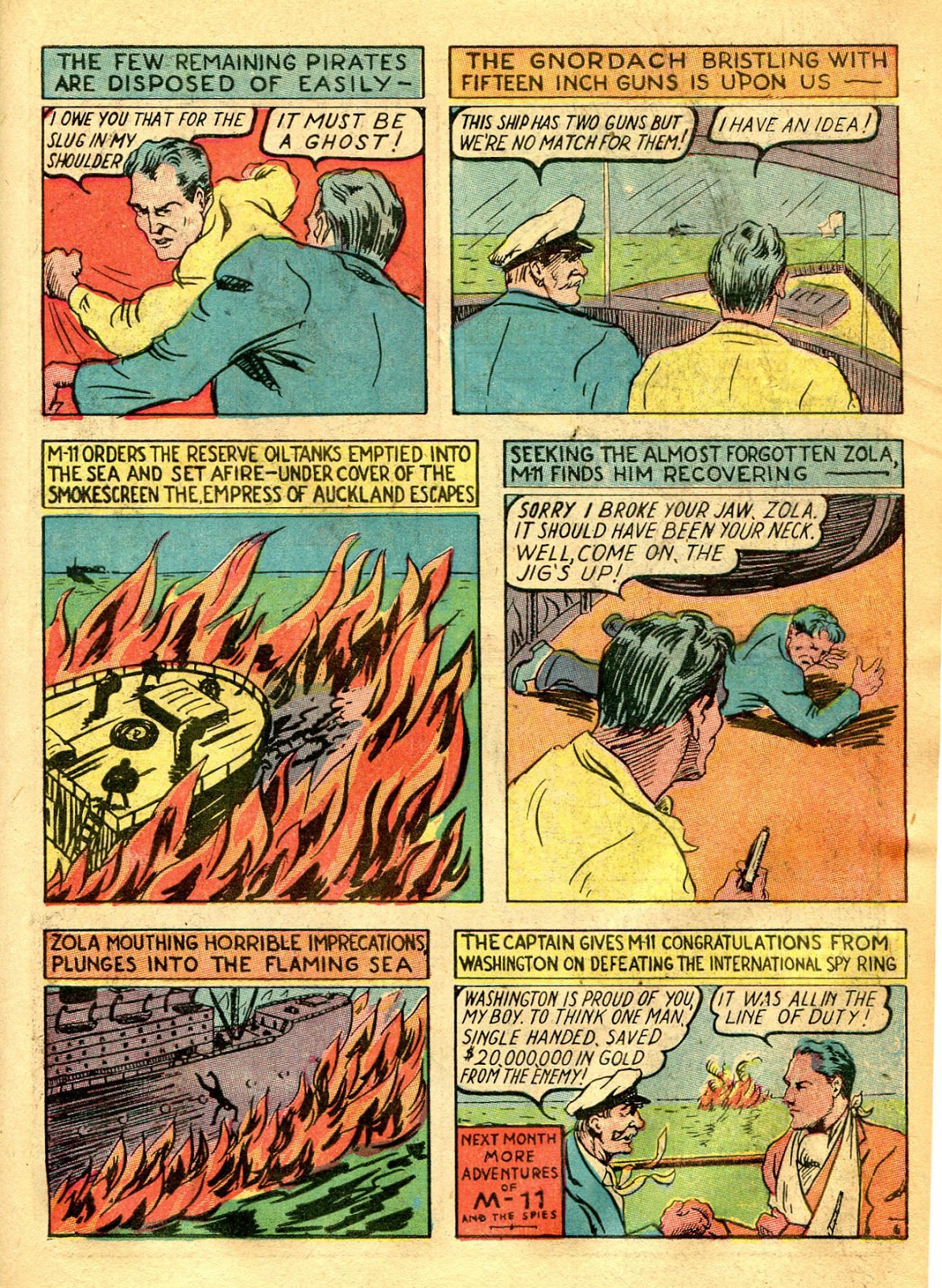
Moving on, we'll join the debut of M-11. This page interests me for several reasons. One, "Empress of Auckland" feels like such a realistic name, I wondered if there really was a ship called this. Not that I found, but I did find a plane called The Empress of Auckland, a Douglas DC-6B, that would later fly, starting in 1961!

And that $200 million in gold is not that unrealistic either, as over 140 tons of gold were transported to the U.S. in the early days of WWII. The unlikely part is it all coming on just one ship.

A villain with no fingernails on one hand is a creepy detail to use in your games!
How do you pull off someone's glove, using game mechanics? I think it would be sleight of hand, practiced as a skill. If you're just forcefully yanking it off without any attempt to go unnoticed, I might call that a basic skill check with a -1 bonus modifier, but if you were trying to pull the glove off so that the wearer doesn't notice, that would be an expert skill check.

I've talked about extenuating circumstances to add saving throws for additional penalties in addition to taking damage (like if you're leaning over a railing), as well as rolling to hit to grab something, before, and won't go into detail about them again this time.
The H&H rules do talk about using fire to create boundaries that are damaging to cross, but this is a different scenario where the fire is being used to create a boundary a vehicle won't cross. And it does make sense, if crossing the line of fire triggers a complication check, which is the way I'm still leaning towards handling damage vs. vehicles.
And the last story we're going to look at today is K the Unknown, a mysteryman in uncommonly orange long underwear.

I share this page because a good tactic for the Editor is to have mobsters doing more than just attack the Heroes; it gives the players more to react to and make decisions about during encounters. Here, K has to stay and fight or head after Terry.
K uses a smart tactic to lure a mobster outside and question him alone, rather than beard them all in their lair and then try and get answers.

Judging by what's on the table on the last panel, we might be dealing with drunken hoodlums here.

(Scans courtesy of Digital Comic Museum.)