We're still looking at Jon Linton's adventures in the future; a future where men wear robes and women wear short skirts.
It seems like a huge design flaw that Satan Rex's atomic power plant is controlled by two exposed electrodes. I was going to say the place should also have some fail-safes in place, but I suppose the power shutdown is a fail-safe, preventing something worse like a meltdown.
I don't think any 1940 writers knew about meltdowns yet...and yet, Harry Campbell did seem to have more knowledge of science than your average comic book writer of the time, so...?
I just complimented Campbell for his smarts, but there seems to be a glaring mistake here; two pages back, Jon learned the systems would need 30 minutes to reboot, and here the "wall of force" is rebooting well before then. Of course, maybe Satan was smart enough to have a back-up system kick in for the force wall.
It's interesting that Campbell calls it a wall of force and not the more common term, force field (in use in science fiction going back to 1920!). Wall of Force is, of course, a magic-user spell as well.
The second to last panel spells out that the Scientist class normally takes a week of downtime to invent something, but has a chance to kit-bash something in just a day.
The Mount Wilson Observatory telescope would be the largest in the world until 1949. I'm not sure where the "6,000 billion million miles" came from, but researchers could see nebulae over 5 trillion miles away.
The "reveal houses on the moon, if there are any" is as optimistic as telepathic television-phones.
Bill and Davey is an odd duck, a comic strip coming from a minor league syndicate that was picked up by both Dell and Centaur (though neither for long). It's hard to see what they saw in it -- unless they just picked it up cheap.
There were headhunters, and cannibals as well, on the Solomon Islands, so while the depiction of Ajax might seem racist, the description isn't.
This is Tippy Taylor on Fantasy Isle, a non-subtle rip-off of Swift's Lilliput. This scenario should be a cakewalk for even a class-less half-pint; since I'm still working on the assumption that 1 hit point represents roughly 30 lbs. of mass, and a 6" tall person would weigh less than an ounce, then Lilliputians...or Fantasy Islanders don't even come close to having a full hit point, or being able to do any damage themselves.
The tank poses more of a threat, even scaled to tiny size. Since it's the size of a gun, I would allow it to do a full 1-6 points of damage if it shot Tippy in the leg.
That must be a 3' high jump by Tippy. Impressive!
This is John Degen, Private Detective, from a one-shot called "The Fiend of Halwith Hall." Shadowing someone, by car, on a country road, should be a basic skill check.
John is smart to head straight to the cellar, as most of the good stuff in a hideout is underground.
John has a skeleton key, a minor trophy item that gives him a bonus to skill checks when opening locked doors.
Here we have a mad scientist with the emphasis on mad. Like many mad scientists, he wants to do a brain transplant. Now, he might be just a raving loon, or maybe he has the science to do it; we never do find out.
Two wolves are unusual pets for a mad scientist.
The pit trap in the driveway is very unusual. It also doesn't make a lot of sense, since the car was parked when John goes inside, and is in the pit trap after he gets out. Maybe it took a long time for the weight of the car to activate the trap?
That's a lot of blood loss, to make the gunpowder too wet to burn. The Hideouts & Hoodlums rules don't account for blood loss and there's no way to make yourself bleed faster to foil traps.
Wow, that is one dark ending. It's rare for Heroes in comics to fail, but John not only failed to save this poor guy, but we find out just what horrible fate befell him.
Lastly, we're going to look at a verbose page of Larry Kane, investigating "The Ghost of Kirkwood." There's a pretty good set-up for a haunted house scenario here, with lots of rumors being supplied on this page.
My curiosity has been aroused too, but it's late and I'll read the rest next time!
(Scans courtesy of Comic Book Plus.)
An exploration of the Golden Age of Comics, through the lens of Hideouts & Hoodlums, the comic book roleplaying game.
Showing posts with label scale. Show all posts
Monday, October 14, 2019
Amazing Mystery Funnies #18 - pt. 2
Labels:
Bill and Davey,
educational filler,
future,
hideouts,
history,
inventing,
John Degen,
Jon Linton,
Larry Kane,
minor trophies,
mobsters,
rumors,
scale,
science fiction,
Scientist,
skills,
Tippy Taylor,
traps
Thursday, May 23, 2019
Science Comics #1 - pt. 1
This is an exciting day for me; in the past, I have been reading comic books where I was familiar with at least one character from every issue, but now we finally reach Fox's Science Comics, I title I have never sampled before, with forgotten heroes I've never read and, in some cases, never even seen pictures of before!
But, I think I will ultimately wind up feeling disappointed instead of feeling like I've found hidden gems. Because we're starting with the Eagle, a character whose artificial wings make him look more like a hummingbird than an eagle.
===
Game mechanics: The Eagle's player will not need to keep a running tally of how much anti-gravitation fluid he has left, as I suspect this is just flavor text explaining how his flight powers work.
As I showed an example of a Supporting Cast Member being used well yesterday (emergency evacuation from a hideout), today we have another good use of one, as a plot hook collector/dispenser.
Here is a clear example of a wandering encounter; something uncommon in normally tightly plotted eight-page adventures. I can't even say that's an example of a drunken hoodlum in the car; the situation as a whole, more so than the occupant, is what the Hero can choose to deal with.
Here the Eagle makes an unusual choice. He could have tried just following the car from the air -- unless his flight power is so slow that he cannot keep up with a car in city traffic. Instead, he decides to target just one mobster and force information out of him. Now, perhaps he chooses this method just to get a feel for the opposition first. If the hoodlum blows his morale save immediately, chances are the Eagle is going to be facing some very low Hit Die mobsters. This could be especially important in a "sandbox" campaign setting where the hideouts of various challenge levels are all preset and the players won't know which are which.
I included this page, not to ridicule it (though it may be deserving), but to discuss old school maps and the scale of hideouts. Bear in mind that, to keep the aesthetic of old school D&D maps, many rooms in the hideout are going to be 20' x 20' at the smallest, and many 30' x 30' or even 40' x 40'. These larger rooms give you a lot more leeway to stage encounters in -- as you see here -- even though the room dimensions are not realistic.
===
And now we move on already to the second feature, Electro! This superhero is tied with Timely Comics' robot Electro, who also debuts this same month, and waayy before the Spider-Man villain.
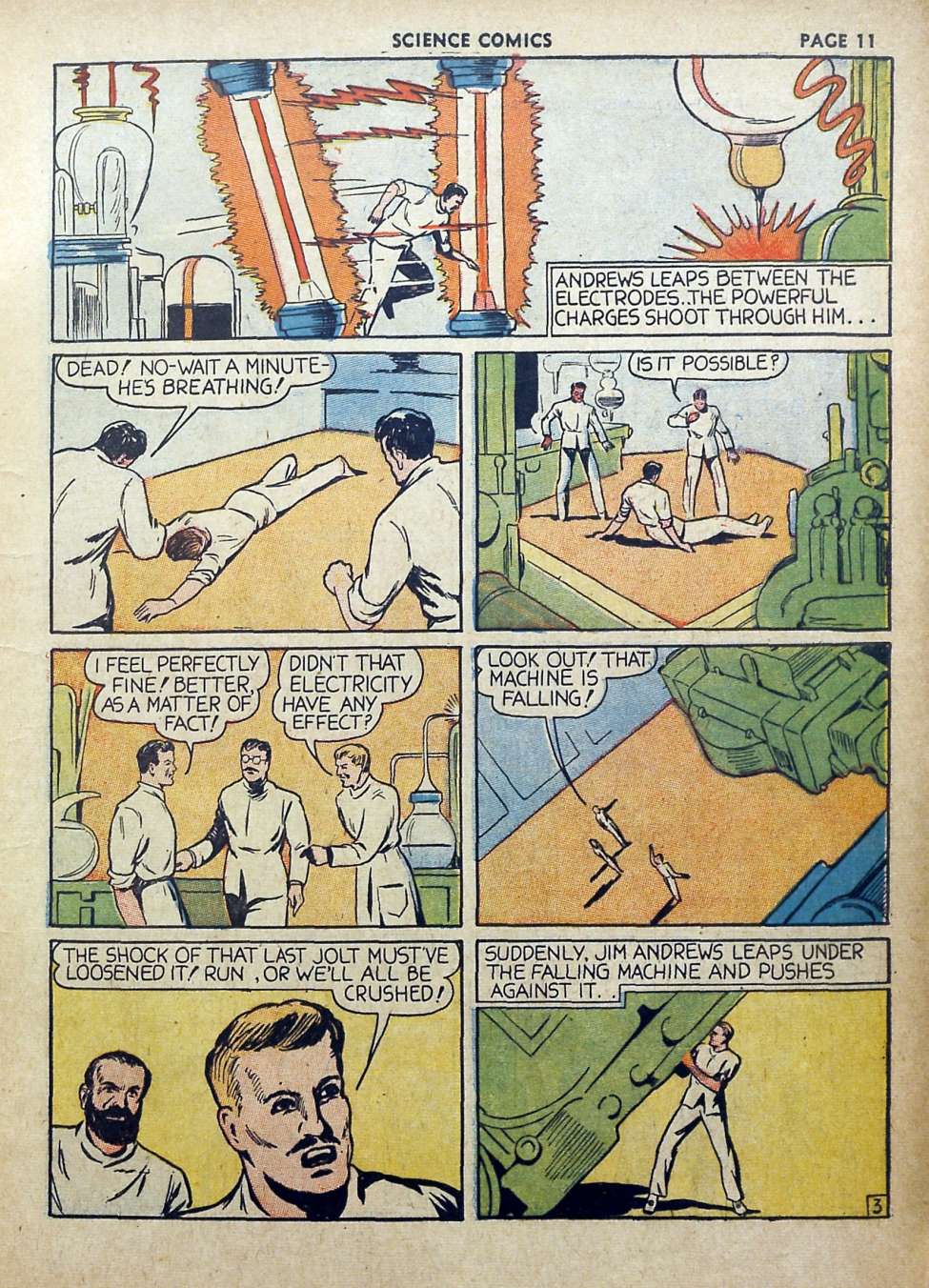
Here we quickly get his origin story -- Jim Andrews is electrocuted, but instead of killing him he gets superpowers. Right off the bat, he's lifting heavy machinery that looks heavier than a car -- Raise Elephant power?
And he can do the Light spell too, unless we make a power for that.
===
Here we find an interesting rationale for why superheroes wear distinctive uniforms -- because they can't live as normal humans anymore, they don't want to dress like them. Doesn't explain why so many maintain secret identities, though.

Of all the fake names for Germany I've seen, Moronia is still my favorite, but Gerlandia might be my second favorite.
Although you don't often hear about FDR's children, Franklin Roosevelt did have a then-33-year-old daughter, Anna. He also had four sons, so it's more than a bit sexist to ignore them and go after the one daughter.
===
Here Electro is shown how he flies by riding on electric beams -- not that it makes any sense, but hey, you can explain your powers anyway you want as long as you filled one of your power slots with it.
(Scans courtesy of Comic Book Plus.)
But, I think I will ultimately wind up feeling disappointed instead of feeling like I've found hidden gems. Because we're starting with the Eagle, a character whose artificial wings make him look more like a hummingbird than an eagle.
===
Game mechanics: The Eagle's player will not need to keep a running tally of how much anti-gravitation fluid he has left, as I suspect this is just flavor text explaining how his flight powers work.
As I showed an example of a Supporting Cast Member being used well yesterday (emergency evacuation from a hideout), today we have another good use of one, as a plot hook collector/dispenser.
Here is a clear example of a wandering encounter; something uncommon in normally tightly plotted eight-page adventures. I can't even say that's an example of a drunken hoodlum in the car; the situation as a whole, more so than the occupant, is what the Hero can choose to deal with.
Here the Eagle makes an unusual choice. He could have tried just following the car from the air -- unless his flight power is so slow that he cannot keep up with a car in city traffic. Instead, he decides to target just one mobster and force information out of him. Now, perhaps he chooses this method just to get a feel for the opposition first. If the hoodlum blows his morale save immediately, chances are the Eagle is going to be facing some very low Hit Die mobsters. This could be especially important in a "sandbox" campaign setting where the hideouts of various challenge levels are all preset and the players won't know which are which.
I included this page, not to ridicule it (though it may be deserving), but to discuss old school maps and the scale of hideouts. Bear in mind that, to keep the aesthetic of old school D&D maps, many rooms in the hideout are going to be 20' x 20' at the smallest, and many 30' x 30' or even 40' x 40'. These larger rooms give you a lot more leeway to stage encounters in -- as you see here -- even though the room dimensions are not realistic.
===
And now we move on already to the second feature, Electro! This superhero is tied with Timely Comics' robot Electro, who also debuts this same month, and waayy before the Spider-Man villain.
Here we quickly get his origin story -- Jim Andrews is electrocuted, but instead of killing him he gets superpowers. Right off the bat, he's lifting heavy machinery that looks heavier than a car -- Raise Elephant power?
And he can do the Light spell too, unless we make a power for that.
===
Here we find an interesting rationale for why superheroes wear distinctive uniforms -- because they can't live as normal humans anymore, they don't want to dress like them. Doesn't explain why so many maintain secret identities, though.

Of all the fake names for Germany I've seen, Moronia is still my favorite, but Gerlandia might be my second favorite.
Although you don't often hear about FDR's children, Franklin Roosevelt did have a then-33-year-old daughter, Anna. He also had four sons, so it's more than a bit sexist to ignore them and go after the one daughter.
===
Here Electro is shown how he flies by riding on electric beams -- not that it makes any sense, but hey, you can explain your powers anyway you want as long as you filled one of your power slots with it.
(Scans courtesy of Comic Book Plus.)
Subscribe to:
Posts (Atom)