Monday, January 25, 2016

The Funnies #25

Okay...I'm a little skeptical about Captain Easy being able to throw a lit torch over a castle wall, but besides that, it's a brilliant plan to get into a castle. And this is just a Fighter -- no powers or spells, no wrecking things. This is the kind of plan that makes you proud when your players come up with it, and you're only too glad to let them succeed.


I'm not a Ben Webster fan, so I hesitate to even share these pages...but the idea of installing an invisibility ray in your foyer, so no one can see who's entering your house, seems like just the sort of over-the-top thing a mad scientist might do. This could be a great deterrent for burglars working in teams, or groups of Heroes looking to raid his house.  "You see your teammate walk in first and -- completely vanish, as if disintegrated!" Of course, you risk your players getting their hands on an invisibility ray...

I don't know what to make of this page. Should "missing link" be a mobster type? Should it really be an intelligent, well-spoken monkey man? I'm open to the possibility, but really want a different model for it than this...


"Delirious from his wounds" sounds like an interesting complication from injuries. Again, I'm skeptical about inflicting complications on Heroes, even though I was at one time planning to have a table of these in 2nd edition. Maybe I still will, but for non-Heroes to suffer...?


Bob Baker's got a bold, but good plan to draw the killer out of hiding. Interestingly, I used this same strategy myself once, when playing the classic D&D module, The Assassin's Knot.


Now, this -- roping two people with the same lasso? This makes me think that maybe I do need to keep the game mechanic of stunts as-is. Mass Roping is not something that should be normally possible in combat, but as a once-a-day occurrence, I could allow this.

(Scans courtesy of Digital Comic Museum)


Wednesday, January 20, 2016

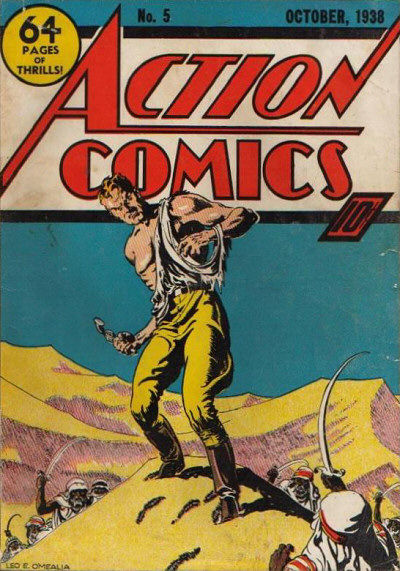
Action Comics #5 - part 2

In Tex Thompson's new adventure, he takes a chance on sneaking into the villain's hideout and challenging him directly to a duel, rather than fight his way through the villain's henchmen. Should the villain accept? If it makes the story work better, he should accept. If the Editor doesn't have a good deathtrap planed for the villain to place the Hero in, he should accept. Otherwise, the Editor can use an encounter reaction roll, with a positive result meaning that he takes the challenge.

Scoop Scanlon, Five Star Reporter, has an unusual dilemma -- he's after a robber who is hiding out in the hill country, but he's been so generous to the poor locals that they all work together to hide him. This could be a good scenario for Heroes, forcing them to deal with innocent locals on the wrong side of the law without (hopefully) shooting them or beating them up.

Zatara, Master Magician, likes throwing around a lot of spells in his adventures, and we can almost always count on some new ones. Here, he casts a new spell, Invisibility 5' Radius, so that anyone standing right next to him becomes invisible too.  He uses Detect Thoughts on an unconscious person -- the spell description says nothing about if this would work or not, so it seems like a call left to the Editor's discretion (I like leaving things up to one's own discretion).  He also casts Passwall, Dancing Lights, Knock, Phantasmal Force, and Fly on himself. He casts a "suspended animation" spell on Tong, but this might just be Hold Person. The new wrinkle is that, apparently, if you have Hold Person cast on you, you don't need to breath.

He casts the new spell Spirit Projection -- which seems to be his favorite spell! -- and we find out something new, that high-level Magic-Users have a chance of detecting the invisible spirit form (or maybe it's an incremental chance that goes up by level?).  He casts the new spell we've seen him before that Polymorphs an object, temporarily, into another object or animal (a mirror into a snake -- or is this an illusion?).  Zatara casts another new spell that seems like Mass Fly -- everyone in a 30' x 30' area grows wings that let them move at twice normal speed? The narrator makes it seem like the spell is even more potent than that, but I'd hesitate to let it go even faster. Even now, I'd probably make this a 5th level spell.

Polymorph spells is going to be a tricky issue. Polymorph magic is currently just high-level stuff in H&H, even just to turn into an animal. But what about a spell that can turn someone else into a flower? I think we can bring that down to 5th-level magic, if it's temporary -- maybe lower if it was really temporary.  He also Mass Polymorphs five men into birds.

In Egypt, Zatara explores the inside of a pyramid that can only be entered by touching, and then merging, with the hieroglyphs on the statue outside the pyramid. Inside, he and Tong encounter at least six "ferocious guardians" that look like little green men, some with just one eye; they sort of resemble goblins to me.  Zatara casts a spell on them that "makes them disappear in a puff of smoke".  Maybe it's a spell that transports them all a short distance away -- or maybe he just cast Sleep on them, and they fell to the floor really quick and are out of sight.

In the next room, metal sticks move on their own accord and constrict Zatara and Tong. Magic items...or Hold Person with a lot of flavor text?  Zatara casts another new spell that Conjures Flame, enough to fill at least a 5' Radius (1-8 points of damage to anyone inside it?). This could be a 1st-level spell.

Behind a curtain and down some steps is a large seated statue of Isis that transforms anyone gazing on it (and a missed saving throw vs. spells) to stone.  Zatara either casts three Stone to Flesh spells, or perhaps they are under a curse or magic spell he can remove with Remove Curse or Dispel Magic instead.

When Zatara leaves and comes back to the pyramid, a Wall of Force blocks him from re-entering (though his Spirit Projection works through it).  Zatara's spirit form is attacked with Gust of Wind and Magic Missile (5 arrows, so he's up against a 9th level caster!) spells, though I don't really see how those would affect him in spirit form. Finally, the statue of Isis animates and attacks him (maybe it's a golem and can affect his spirit form because it can be hit by spells or enchanted creatures), but Zatara casts a Melting spell that works an awful lot like wrecking things.

The evil sorcerer carries a new magic item, a Staff of Smoke that releases a smoke screen (Fog Cloud?) out of the eyes of the cat face on the head of the staff.

Lastly, the evil sorcerer plans to cast Disintegrate on Tong, but Zatara reflect it back with a Spell Turning spell that can be cast on anyone, not just the caster.

(You can read this issue at Comic Book Archives)

Tuesday, January 19, 2016

Action Comics #5 - part 1

That the early adventures of Superman took place in Siegel & Shuster's home town of Cleveland, Ohio is no secret, so it's strange that the dam Superman saves here is the "Valleyho" Dam when what's clearly meant is an Ohio Valley dam.

This installment features the first of many times Lois tries to trick Clark. It appears that she succeeds; Clark goes to the hospital fully expecting to find the news story there Lois told him about. And why not? He has no reason to suspect his own supporting cast has ulterior motives. Aren't they just around for offering him plot hooks? Typical of a novice player. And it's not like Hideouts & Hoodlums players go around, using mechanics like sense motive skill checks on everyone they meet.

The narrator says Superman reaches the dam at "the speed of light", but that is very clearly hyperbole. Superman appears to only be using the 1st-level power Outrun Train here -- or perhaps the 3rd-level power Race the Bullet, since the train had so much of a head start on him.

Displaying a 3rd-level power would not be the only time this story that Superman displays abilities that seem like they should be beyond his level with so few experience points to his name. He uses the high-level power Raise Bridge to save a train, and Divert River to save a town. He still has his limits, though, as he seems to have no power at his disposal that can buff him enough to stop the dam from bursting.

His power level also seems to go back down after this story. Perhaps his Editor kindly let him have some extra levels temporarily just to handle this scenario (they are called "Big Bang Levels" in Supplement V: Big Bang).

Superman wrecks a car to rescue Lois, a clear example of his wrecking things power.

The gag filler Coyote Canyon Bill shows Bill suffering damage from what appears to be the desert heat. I would not consider even the hottest desert capable of causing heat damage, though; more likely, the damage being inflicted on him is more likely from dehydration -- maybe 1d3 points of damage per 4 hour "rest" turn?

When "Chuck" Dawson ambushes his pursuers from behind a "clump of rocks", he has an advantage of at least a +2 bonus to hit -- +1 for being from behind and +1 for having a height advantage.  If he took a 1-minute turn to aim, he is at +3.

I've talked before about making it easier to survive falling damage into water, but this installment of "Chuck" Dawson specifies how far he can fall and take little or no damage -- 40'.

Pep Morgan's sports-themed installment, this time, is about sailboat racing. I'm not expecting this to come up often in H&H, but if it does, I've got some useful tips here, like there's a danger of capsizing if you try to start off too fast. There's also some actions that could be applied to any race, like "trying to squeeze through on the inside", or crashing other vessels, or lightening the load. I wonder, though, if I need separate game mechanics for each of these?

Phil the Floater is a short comic piece by "Alger" with his squat funny people. Phil is a thief -- not of the Mysteryman type, but just a common thief. His trick is diversion, swipe, and run -- a trick just about anyone could try and have a chance to succeed at. I would treat it the same as picking pockets, with...maybe a 2 in 6 chance of success?

The Adventures of Marco Polo picks up where it left off, with Marco and family being attacked by a large snake. This is a smart snake, too -- in addition to trying to bite and constrict, this one also can try to trip with its coils! I am not opposed to giving such extra attacks to exceptional encounters, but normally the trip attack would take the place of the bite or constriction attack.

One of the people attacked by the snake has a sprained leg that's still bothering him the next day. Non-Hero characters can suffer all kinds of complications from injuries, that can linger as long as the Editor needs them to -- even after magical healing!  Heroes should be exempt from lingering complications, unless the Hero and Editor agree it is useful to the story.


(This issue can be read at Comic Book Archives)


Saturday, January 16, 2016

Jumbo Comics #2

I wonder if anyone will ever run a funny animals campaign using Hideouts & Hoodlums?  In Peter Pupp, which we looked at with issue #1, all the elements of an action adventure scenario are here -- they can just be greatly exaggerated and make no sense. I would normally discourage an Editor from treating a weather control mad science device (as found in Book II: Mobsters & Trophies) from being able to affect the entire planet from space -- but in this sort of campaign it could.

Supplement III: Better Quality talked about various environments an Editor could use in a campaign and one environment that was cut and put in The Trophy Case v. 1 no. 6 was the "aerial wilderness".  I wrote "While no Golden Age comics of my acquaintance ever picked up on this notion" -- but I was unaware of Peter Pupp at that time. Clearly, the idea of exploring solid clouds has precedence here, as does hillbilly cloud giants...


I don't normally have my players stumble across mysterious Magic-Users handing out magic rings, but if I did decide, in mid-scenario, that some upcoming encounters were going to be too tough for them, I could see this as being a possible solution. A Ring of Djinni Calling is very apropos for H&H. I used a similar item recently in one of my campaigns (but it was a bottle instead of a ring), and like Peter Pupp's ring it only had a limited number of uses/charges.

The Hawk, always a class act, is here the very definition of Lawful Alignment as he consuls his men on "no wanton looting or unnecessary shooting".


I've said before that rappelling by rope should be easy for Heroes, except on challenging surfaces like a wet wall -- but here we have ten supporting cast all easily climbing a wall, while soaking wet from head to toe. Does climbing need to be automatic for everybody?


I'm not sure yet how I'd wind up statting this guy. This is the first appearance of a character called Mr. Eternity, who seems to be able to control his own shadow -- making it grow, move, etc. He also claims to be Death itself, but this bears further investigation.

This is from the continuing origin story of Sheena, Queen of the Jungle. The witch doctor tells of casting a Curse spell (Remove Curse reversed?). It's unclear if he wields actual magic or if Sheena's father died coincidentally, but if is magic, then a Bestow Curse spell can be lethal.


Somehow, ZX-5 is able to look at the car behind him, see the enemy agents discussed as policemen, and tell that they are agents in disguise on sight.  This has got to be a special ability for spies.

(Scans courtesy of Comic Book Plus)


Thursday, January 14, 2016

Feature Funnies #13

Oh, Joe Palooka, must you descend into hurtful stereotypes after so many installments of charming situation comedy? The next page really takes redneck stereotyping to an extreme, so I'm unsure what to make of this page's issue of child brides. Was older men marrying 11 year old girls really something that went on in the South in the 1930s, or is this just more stereotyping?


Now, this doesn't disappoint.  This is the first page of Will Eisner's feature Espionage, starring the suave secret agent Black X.  I personally consider this his strongest creation, before The Spirit.

Note the unusual addition of a date -- Sunday, December 23rd. Consulting a perpetual calendar, I see that the only year this story could have taken place was 1934, making Black X the oldest original character to be looked at on this blog!

Also note that, just because Black X is connected to the U.S. Espionage Division doesn't mean he has unlimited resources. Like Mission Impossible (over 20 years later), Black X can expect no aid if he gets caught.  Every Hideouts & Hoodlums Editor will have to think hard about how far he's willing to go to keep pulling the Heroes' out of trouble when they get themselves into it, or let them face the consequences.

 This one made me laugh...


From Archie O'Toole...is this the first use of spring-loaded shoes in comic books? This is a minor trophy item that should allow a Hero to double his leaping ability (normal leaping, not alien or Superhero enhanced leaping).

This also looks a lot like a slick hoodlum and a thug working against the king here.


The Clock keeps a detailed file on important people, with newspaper clippings going back 28 years. In-game, it could often be helpful if Heroes were willing to do research like this in their downtime, as it will keep them from having to spend too much during a scenario doing vital research.

Player-wise, it's just a good idea to take notes about every name you hear during the campaign.


The Clock drives a convertible! I can't think of a single advantage to a Hero to driving a convertible, can you?

I may have spoken about this before, but for shadowing/trailing someone, I would roll for surprise to determine if you can trail someone without being noticed. Then there's always a chance of you being the one surprised and the trailee becomes the trailer!

Looking through keyholes is a smart move for Heroes. It can suck for the Editor, having his surprises ruined.

It's the Editor's job to stock his campaign with mobsters for the Heroes to confront, but not his job to tell the players how to deal with those mobsters. Players may see an ethical dilemma where the Editor never intended one and act accordingly -- or go in with guns blazing and asking no questions. The Editor can have consequences for those actions, like if the Clock breaks the law by letting a thief keep some of the money he stole, but he should never say, no, you can't do that.

(Scans courtesy of Digital Comic Museum)


Tuesday, January 12, 2016

Popular Comics #33

We move into October 1938 now and start with this offering from Dell.  I don't actually have a lot to say about it, but I'm going to share some of it anyway.

Among the gag filler is this panel -- I'm really surprised it took this long to see the cliche of the "Indian rope trick".  Still...Hideouts & Hoodlums is going to need a Rope Trick spell.


I like this Shark Egan; it's got dynamic art and a fast-paced story.  We also learn why it's not always a good idea to keep a crate full of grenades in your plane -- because someone else might find their way into your plane.

We also see that it's awful hard to hit even a target the size of a boat with a grenade, when thrown from a fast moving plane. This matches up with the penalties to hit at high speeds given in the vehicular combat rules of Book III: Underworld and Metropolis Adventures.


And I'm sharing this page only because I think it's funny. I would not expect any Editor to ever let this work in H&H, no matter how light the mood of the campaign was. Now, in a game like Toon, then this could work...

(Scans courtesy of Comic Book Plus)

Monday, January 11, 2016

New Adventure Comics #30

We rejoin Don in Anchors Aweigh as he's lowering himself into the dark hold of a ship and praying "he wouldn't land on anything sharp cornered."  It's true that, while the base damage for falling is 1-6 points per 10' fallen, the Editor is free to lower this for falling on soft terrain, or raise it for falling on sharp, or otherwise more dangerous, terrain.

In the hold of the ship, Don takes a quick look around and manages to appraise the value of the cartridges being smuggled in the hold at a quarter of a million dollars. The first edition Hideouts & Hoodlums rules say nothing about appraisal (the implication being that everyone could do it automatically), but the second edition will treat it as a basic skill everyone has a chance to perform.

The first sailor who comes down into the hold is said to have "the agility of a monkey" and "runs down the rope ladder".  I'm tempted to add sailor as a mobster type, with the ability to climb up and down ropes and ladders faster than an ordinary person (or just give that ability to pirates).

In Tom Brent's adventure, Tom practices that most important of player tips -- when you have important papers to deliver, meet your contact first without the papers on you, in case something goes wrong.

When Tom tries to escape from the clutches of the fake consul, a guard has his rifle trained on Tom. Tom is somehow able to pick up the other guard and throw him at the rifleman before he can fire a shot. Now, it's possible that Tom won surprise, got a free action (the grapple), and then won initiative on the first regular turn of combat. Or, Tom picked up the first guard during his first turn, but the rifleman refused to fire because firing into a melee has a chance of hitting your ally if you miss.

Tom is captured again and tortured for information -- specifically, he is hung from his thumbs and whipped while shirtless. I would not expect an Editor to have to go into that much detail; torture can be glossed over and summarized by a save vs. science to resist. I would, ironically, require this save once per 4-hour "rest" turn.

In the adventure of Steve Carson of Federal Men, our story opens on the trial of three men accused of treason, with the judge saying "I regret that the sentence for treason carries only a twenty year penalty!"  Actually, according to the U.S. Constitution, treason can be punished with death. It is, however, appropriate for the courts to be more lenient in a comic book universe, as this allows a lot more repeat appearances by the same villains (something that will become more of an issue starting with the Silver Age).

A wanted poster shown to Steve shows a $500 reward for a wanted criminal.

When Steve is about to lose a fight, he is saved by a boy who throws a baseball and beans the mobster in the back of the head. I would normally allow a full grown man to do 1-3 points of damage with an improvised missile like a baseball; for a half-pint, I would probably restrict damage to 1 point of damage. Of course, the mobster could be on his last hit point from the unarmed combat with Steve before the baseball hits him.

Later, another half-pint Junior Federal Man thwarts an attempt on his own life by having rigged an alarm system for his bedroom -- anyone climbing the drain pipe outside his window pulls a string that causes a ball to drop and land on the boy's sleeping head to wake him -- after which the boy can bash the intruder with a baseball bat while the intruder is prone and hanging from the window ledge. If this comic strip -- and the movie Home Alone -- has taught us anything, it's that half-pints should be good at setting traps and alarms.

Nadir, Master of Magic, deals with river pirates in his adventure. They are well-equipped pirates, piloting speedboats and armed with sub-machine guns; they might be better statted as robbers than as pirates, since robbers tend to be more hi-tech. Nadir defeats them with a Charm Person spell on their leader, who Nadir gets to sound a retreat.

Later, Nadir is ambushed by peculiar attackers using a noose. I would say that a noose could do normal 1-6 points of damage on a hit, but only if the hit occurs during a surprise attack. If the victim is somehow unable to free himself, he will continue to take damage each combat turn.

Cal n' Alec is a joke strip about two old prospectors, but they remind me of played characters in this installment. Frustrated that their mine was buried in a dynamite explosion, they briefly decide to swear off prospecting. This can happen to players too, who can feel disgruntled by too much failure in a game scenario. In the end, though, Cal and Alec bite on their next plot hook when a stranger runs up and hands them a map -- and stalwart players will often bite on that next plot hook too.

Incidentally, I'm not keen on preparing any game mechanics to determine the extent of a cave-in when a mine is hit by dynamite. There just needs to be things for the Editor to wing as he goes along.

Another example is The Adventures of Desmo and Gabby.  Gabby loses his wallet during a fight. There does not need to be a game mechanic to check for seeing if you lose something from your pockets during fights. Sometimes, players just need to accept that their Editor has a story-based reason to make something happen.

Tod Hunter, Jungle Master, finds rubies worth $5,000 each, which is 10 times what I guessed rubies were valued at in Book III: Underworld and Metropolis Adventures (in the gem table previously found in Book II: Mobsters and Trophies).  Guess I may have to revisit that!

(This issue can be read at Comic Book Archives)