Showing posts with label melee combat. Show all posts

Friday, August 23, 2019

Famous Funnies #67 - pt. 1

We rejoin Roy Powers, Eagle Scout today after a long time separated. Here, we see how easy traps are in the modern age of Hideouts & Hoodlums. A simple oil flask hanging from a string in D&D would be of little threat to anyone, but substitute it with nitroglycerine and suddenly you've got a trap that can be deadly for even mid-level Heroes.

We also see some nice tactics from Roy, using role-playing to his advantage against the mad scientist.
Just a couple pages later, Roy is already jumping into his next scenario.

Editors may be tempted to roll randomly for mobsters to see which target they choose; I've done this many times, and it does present an element of fairness that keeps players from feeling picked on. And yet, if there are common sense reasons to attack one target over another, the Editor should follow his common sense.
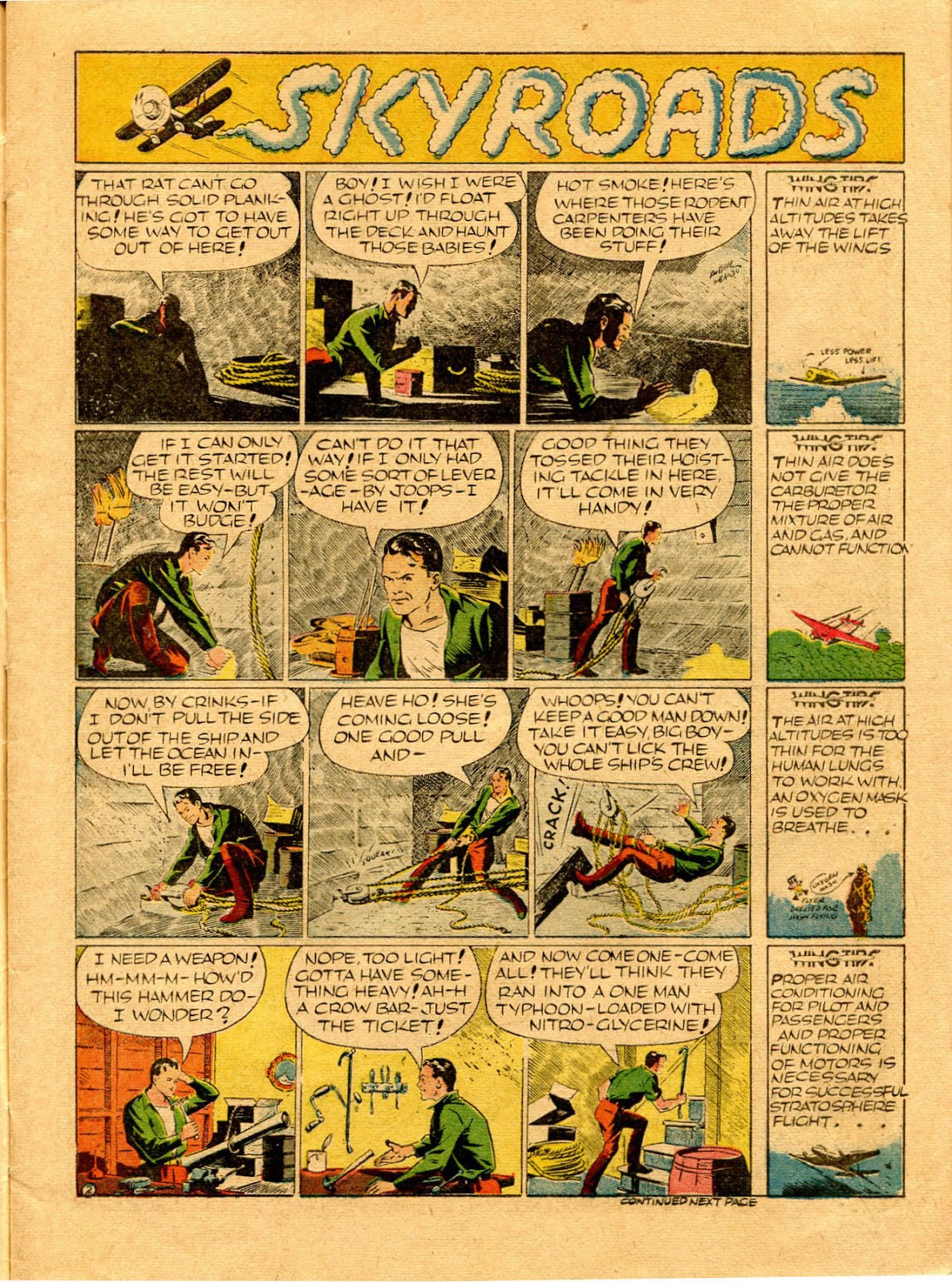
I'll be honest; Skyroads is such a generic aviator feature that I have no idea who this guy is!

Whoever he is, he comes up with a good rationale for getting a +1 modifier to his wrecking things roll. He probably asked if there was a hoisting tackle lying around and the Editor, unprepared for that tactic, had him make a save vs. plot to determine if there was or not.
Hairbreadth Harry leaps back and forth between being a credible source for H&H inspiration and outlandishness too zany to emulate with any seriousness game mechanics. Here, Harry swings towards the latter, as he claims to have used the pushing mechanic to push his melee combat with Rudolph 3,000 miles, or the equivalent of 15,840,000 points of damage, by H&H's current rules.

When I see panels of villains trying to bribe heroes, and I remember that taking money is a huge motivation in H&H, I wonder if we need to have different mechanics, even if only optional. Or would a saving throw vs. plot cover this? Yes, I think it might, at least for Lawful Heroes to take a bribe. But would that just deter players from playing Lawful Heroes...?
Sergeant Stoney Craig, even without his U.S. Marines, really (ahem) mops up with an improvised weapon in this combat. The spears are uncommonly short, and are maybe harpoons instead of spears. A harpoon would not count as an improvised weapon.

The knife is thrown by an assassin. There's a considerable amount of racism here, with the half-Asian man being called a "breed," but this actually plays well in the story, with the locals' racism explaining how quickly they accept this scapegoating.


Near Island is a real place, in Alaska. It seems strange that anyone in Alaska would hear "They had Jeremy Blade at near" and not think of Near Island...but this would make sense at a game session; players never get clues.
Dickie Dare is relegated to cheerleader in this month's installment, as these pages focus on the gorilla-lion battle. I'll have to add a note to the lion entry that, even when grappling, lions still get raking attacks.
I'm not even sure what's going on here, so it's even harder to figure out how this might apply to game mechanics. I guess...hearing Miss Karson's voice reminds Tiny that someone loves him, and gives him the will to keep fighting, even as his body tells him to quit...?

Yeah, that's really hard to quantify into crunchy rules. I suppose you could include a rule that supporting cast can rally you once per day to give you a +1 bonus to something -- and that would give players more impetus to bring supporting cast along besides the meager XP award.

Or, this is all flavor text and Miss Karson's rallying cries didn't influence Tiny's dice rolls at all.


(Scans courtesy of Digital Comic Museum.)


Thursday, July 18, 2019

Fight Comics #2 - pt. 3

If you've been worried about poor Kinks Mason and how he's going to get out of this pickle since my last post, you can see that he still has his hands full. The seaweed men turn out to be quite the challenge, with fist attacks seemingly having little effect on them. Now, it's also possible that Kink's punch just "missed" and did no damage, but to make the seaweed men more challenging, I'd like to make blunt attacks do half-damage to them.
The Navy would be shocked to learn that submarines can be run with one-man crews. Who knew? Now, I'm not sure what the minimum number of crew members required to pilot a submarine actually is, but I'm pretty sure it's higher. High enough that even an expert skill check shouldn't make this possible...

Also, we see Kinks loading a vacuum cleaner into a firing tube. Oops -- I guess that's actually supposed to be a torpedo?


Only here at the very end do we get the cool name of binding weed for this environmental threat.

Chlorophyll is super-effective on binding weed and seaweed men; more of it makes the former grow super-fast and lack of it kills the latter almost instantly.
This is Fletcher Hanks' Big Red McLane, King of the Northwoods. I include it because fighting fires sometimes comes up in scenarios and it's good to know how wide you need to dig your trenches to keep a forest fire from spreading.
Red is quite the high-kicker! I'm not sure, though, if using his feet should really give him any advantage at disarming opponents.

Heavyweights might qualify for a mobster entry, but I already have one for boxers in the Mobster Manual (it's coming -- someday!). Perhaps a note about heavyweights in their entry would suffice, rather than their own entry. Heavyweights might have +1 hit point and do +1 damage punching.

The term "palooka" predates the character Joe Palooka by at least a decade.
This is Oran of the Jungle. Oran is still a bizarre character, combining the urban prize fighter with the jungle hero. What concerns me here is whether Oran should be able to drag two people at once. I've previously talked about how a drag attack would work, mechanically, like a push attack, but in reverse. It's also in the rules that, if your opponents are also unarmed, you can make two unarmed attacks per turn. So yes, it is feasible to drag two opponents at once...


However, given the distance involved here, and that Oran needs to drag them over obstacles (the ropes), I might rule that Oran has to also succeed at grappling checks first, to make sure he can hold them long enough to drag them that far.
This is Terry O'Brien, Gang Smasher, though you wouldn't know he was a gang smasher since he seems to be a fairly ordinary boxer here.

There's something interesting in here, about how the Killer gains the upper hand by "craftily clinching" with Terry. For the Hideouts & Hoodlums rules to reflect this, there would need to be a space rule, where weapons need a minimum amount of space to be effective, allowing opponents to close into that space. It does require more preciseness to combat than H&H normally requires (even facing is rarely considered, except for back attacks). If you close so tight that your opponent can't get in a cross, can you only jab (a punch with a shorter space, but does lower damage?).

If we did institute this rule, we'd have to consider how to counter it. Does your opponent have to use the rest of his turn taking a 5' step back? 
This is "Strut" Warren of the U.S. Marines. Klaus Nordling is the artist and I enjoy his cartoony style here.

Here he battles a sumo wrestler, who I may need to stat as a mobster type. It hurts to punch a sumo wrestler (1 point of damage to self?), but other forms of unarmed combat, like kicking, work fine. In fact, sumos might be extra vulnerable to kicking (+1 damage?).

(Scans courtesy of Digital Comic Museum.)

Sunday, February 3, 2019

Mystery Men Comics #7 - pt. 3

We're back with Chen Chang and here Richard Kendall teaches us what a replacer is. Or at least he would be if my father wasn't an expert on trains. One look and he explained to me those are called derailers. But, yes...other than the name mistake, those are real things.
This is Lt. Drake of the Naval Intelligence, with examples of the dangers of shooting into a melee (uh-oh, shot your friend in the back!) and surprise rolls coming up in the Hero's favor (vs. guards, a mobstertype that is easily caught off-guard or easily overpowered in almost all instances).
Keeping someone submerged, as Drake does to the poor guard, is handled as a grappling roll; whoever has advantage forces the other one under. Three turns under in a row and it's save vs. science or drown each turn.

This is likely the first and last instance of a dead fish being used as a throwing weapon in a comic book.
This is Denny Scott of the Bengal Lancers. Torture never works on Heroes because they don't have to save vs. plot to resist giving out information like non-Hero characters would have to.

Putting your slaves to work along a river doesn't seem to be a good idea, especially in a comic book universe where water always acts as hard cover.
Moving on quickly, this page is from D-13, Secret Agent. Being dizzy and weak seem like complications from being low in hit points, but when it comes time to aim a gun steady enough to shoot through the heart, these "complications" don't seem to have any game mechanic effect on him and turn out to be merely flavor test.
This is from Captain Savage, Sea Rover and is an extremely rare example of a Hero succeeding by simply giving up and doing exactly what the bad guys tell him to do.


Nope, I'm calling you wrong on this one, comics.org. I know the art is credited to George Tuska, but there's no way that was inked by Tuska. A better artist, likely Bob Powell, inked over him on this one.

Anyway, Conjure Sand Storm seems like a pretty narrowly useful spell -- unless you plan on running a desert-based campaign. More likely this is Control Weather on display. You really do get a sense for how deadly Control Weather would be in the desert, though, as you can suffocate almost an entire caravan with it.

Melosh's next spell is Insatiable Thirst, a spell that wouldn't find its way into D&D until the 2nd edition book, Tome of Magic.
Melosh also has Polymorph Other and Protection from Normal Missiles in his spell arsenal. Pretty powerful for a guy who doesn't even own pants!

How Zanzibar casts Dispel Magic in his leopard form is unclear. Or the water has magical properties?

Having burnt through his higher level spells, Melosh is left with only Charm Person.

Zanzibar claims to have just won a "duel of wits", but it seems like what he did was cast Insatiable Thirst back on Melosh, then maybe used an Phantasmal Image spell to conceal the water hole. Then Z uses Dispel Magic on Audrey.

And in the end he gets to claim Melosh's Flying Carpet as a trophy! (Say...was Melosh wearing the carpet as a robe the whole time??)

(Scans courtesy of Comic Book Plus.)


Saturday, August 11, 2018

Champion Comics #3 - pt. 1

We return to the adventures of The Champ. A wrinkle on the cliche of "The Adventure of the Mazarin Stone" is that the walking stick with the treasure hidden inside is missing (it turns up later in a secret compartment; a second compartment inside a secret compartment).

Here we see a shadow figure, which was a mobstertype introduced in Supplement V: Big Bang and will be returning in 2nd edition.


The Champ laid a trap for the missing assistant by pretending to already have the formula.

Pointing a gun and delaying still means that you have to roll for initiative to see who goes first, at least if your opponent is withing charging distance.

Chloroforming your opponent should be an automatic action if you already have an ally pinning him down. The Champ still gets a save vs. poison for each turn he is pinned, though. Looks like he rolled poorly on the first try.


This may be the first time a length of chain is used as a whip in comics.

I have serious reservations about this supporting post and how easily the champ broke it. Now, if it was not a supporting post, and just ornamental, then maybe I could see The Champ wrecking it as a door (or as a machine, as a penalty for being tied to it and lacking leverage). This has to be at least wrecked as a generator, which a fighter has no chance to do (even in 2nd edition) until at least 3rd level.

 
The Champ takes 1 point of damage from the fire, but it burns his bonds alright.

Again showing wrecking abilities, the Champ makes mincemeat out of that door, but that is something a 1st level fighter can do. By the end of this adventure, the Champ will likely be 2nd level.

He shows he is Lawful by going back in to save the bad guys.

At last, we have a clue that several of these orientals are thugs. In the past, I would have statted them as yellow peril hoodlums, but I'm thinking it's time to lose that mobstertype. I wanted them, initially, as a way to build something like the monk class into Hideouts & Hoodlums, but orientals in the Golden Age are rarely martial artists. Instead, they are usually wimpy hoodlums or bloodthirsty hoodlums.

You would think Katsu would have learned by now not to try firing a missile weapon while in melee range.

Katsu, incidentally, is an actual word, a word shouted out in Zen Buddhism. It's not an authentic Asian name, but it's closer to being one than the usual fare, like Fang Gow.

It's an interesting tactic to have reinforcements riding in the car behind you, in this case a "horde" of five "yellow men."

The Champ has been in a lot of fights so far in quick succession in this story, suggesting that he has an awful lot of hit points. At 1st level, he could have a maximum of 9.

In Neptina, we learn that the fish men have the ability to surgically remove human lungs and install gills. They must have high Intelligence (and be of Evil Alignment).


The fish men have a fog-making machine that they can use on the surface (it would, understandably, be pretty useless underwater).


It's not clear, but it seems to be implied that all fish men are male, and the mermaids are all the females, of the same species. Or did the fish men just capture human women and convert them into mermaids?

Fish men (and their merwomen) are telepathic, but they have the technology to block telepathy. Not only to block it, but apparently to make people forget they can read minds -- since Neptina doesn't seem the least but suspicious when she cannot read Brad's mind.

This is Penny Wright, Feature Writer. Penny wanted to find stories in South America to write about, but winds up getting kidnapped by an unnamed country's rebel leader. Santos is, curious, not a fighter but a robber -- a strange position for leadership.

Penny tries for a surprise attack but fails. She loses initiative and Santos delivers a grappling attack. Now Penny can't attack with her knife; she can only defend herself from the grappling attack and try to escape it or reverse it.

(Scans courtesy of Comic Book Plus.)


Sunday, February 7, 2016

Action Comics #6

Though the covers still don't indicate it, this is the sixth comic book to feature Superman. It's also a special Superman story because it's the first story to look at the effects a real superhero would have on the world around him.  Specifically, in this case, how famous a superhero would be.

I had just this week talked about how there is no fame/popularity mechanic in Hideouts & Hoodlums, but that doesn't mean I haven't thought about it. The simplest such mechanic would be a 10% cumulative chance per level of the Hero being recognized. That would work for Heroes who travel broadly, but what about Heroes who choose to stay local -- how to modify that result for geographical distance outside the Heroes' campaign base? And how to modify it for Heroes trying to keep a low profile, versus those who were actively trying to court the press?  No, it makes more sense just to have the Editor wing this, based on the circumstances.

Back to the story...it amazingly anticipates the wealth of Superman merchandising that happened in the real world in the years following the character's debut. In the story, there's Superman Gasoline, the Superman Streamline Special (a car), Superman bathing suits -- all licensed products. If players want to pursue licensing deals for their Heroes in your game, you should probably use a simple encounter reaction roll to determine it. You could modify for level if you wanted to (+1 for levels 2-3, +2 for levels 4-6, +3 for levels 7+), or just leave it to the Hero's Charisma to modify.

Superman makes his saving throw vs. poison when Lois tries to drug him.

Superman snatching Lois out of mid-air is a simple attack roll.

Superman uses wrecking things to tear open the elevator doors, then uses the power Raise Car to raise the elevator (a quite pun-ish use of the power too, I might add).

"Chuck" Dawson loses his hat, or "sky-piece" as he calls it (the first time I've ever heard a hat called that). Even stranger is the line Chuck says next: "I'm sure glad those crooks didn't get a hold of this to use in their schemes".  Now, taken in the context of the fact that one bad guy had just stolen his horse, maybe Chuck is kidding, but taken literally, the idea has distinct possibilities. What if a bad cowboy can make himself appear to be a good cowboy by wearing a good cowboy's hat?

Pep Morgan goes on a hunting trip in this adventure and bags the biggest wildcat his guide has ever seen. Now, maybe the guide is prone to a little exaggeration, because the wildcat doesn't look proportionately larger than a cougar to my untrained eyes. Perhaps it's only slightly larger than normal because it has max or near-max hit points.

He also shoots a black bear, that goes down after two shots. I'm not keen on the idea of lowering bears to only 2 Hit Dice, so either this bear had unusually low hp, or this episode is a case for the optional expanded weapon damage for firearms (from Supplement I: National).

The Adventures of Marco Polo installment is remarkable for teaching me the word "caravansary", which is apparently an inn with a courtyard large enough to accommodate an entire caravan. How did I go so long without knowing this word for D&D?

In the scimitar duel Marco observes, parrying is clearly a combat option. Parrying has always been a feature (albeit a little-used one) in H&H's combat mechanics. But in Marco's follow-up sword fight, it seems dodging is a combat option as well. If players aren't using parry, will they be more inclined to use dodge?

The "Tex" Thompson adventure takes place in Europe. I've long disliked the use of fictional place names in comics and don't see much use in them, so it's a little frustrating when a place name comes along that I can't place to a real world analogy. In this case, Tex is flying over the "Trysolian" Mountains, and I cannot figure out what that's supposed to mean.

A big fighter plane forces Tex to land his biplane. I'm not sure if Force to Land should be an aviator stunt, or if it would just be a normal reaction to being shot at in the sky.

Last month, Black X ran into a villain who looked just like him in Feature Funnies and, this month, Tex runs into Captain Diablo who looks just like him. I might need a doppelganger mobster type for this, since the trope reoccurs so frequently.

In their aerial dogfight, Tex and Diablo keep circling each other, as if they both use the Find Blind Spot stunt, and cancel each other out.

My coverage of Zatara the Master Magician begins with a bit of a poser -- how does Zatara cast a spell with no verbal, somatic, or material components, while his hands are tied? He casts a spell on the Tigress that makes her look old and ugly. I'm not even sure what spell this would be -- Polymorph Other? Bestow Curse? A new spell called Uglify? Not for the first time, I wonder if H&H Magic-Users should have access to a combination of traditional spells and psionic disciplines...

Zatara uses a new spell that lets him, and Tong, assume gaseous form. His next spell is really tricky, though, when he transforms two dervishes (from Book II: Mobsters & Trophies) into mounds of sand, but mounds of sand that can still talk. So what's that? Clearly not a polymorph spell, since sand can't talk. Maybe an illusion, fooling them into thinking they are mounds of sand?

Zatara travels in his spirit form again in this issue, but the narrator calls it his "shadow" instead. He summons two pegasus-unicorns, which should be beyond all but the most powerful Mobster Summoning spells. Then he casts a spell he calls The Swords of Fire of Allah, which looks an awful lot like a Blade Barrier spell, except that it's really just another illusion; a dervish leader is able to disbelieve it.  He also casts a spell that buries the leader up this neck in sand and leaves two followers floating helplessly in the air (another variation of Hold Person?).

There isn't much elaboration on the contents of the pyramid of Cheops, but we know that Cheops is still there as an undead mummy, and guards a chest full of treasure but is really only interested in guarding one large emerald. If you win a friendly encounter reaction from Cheops (like Cheops did), he will loan you the Dead Armies of Cheops -- who are strangely dressed in medieval scale armor and riding horses, even though Egyptian troops did not have saddles. There are apparently thousands of soldiers, enough to sack a city defended with superior weaponry.

Lastly, Zatara seals the pyramid with a "curse", but he probably means a Wizard Lock spell.

(This issue can be read at Comic Book Archives)


Saturday, July 18, 2015

Star Ranger #6

I've written about both bandits and robbers before on this blog. In Hideouts & Hoodlums, they are two distinctly separate mobster types, but what makes them distinctly separate in the comic books is not always so evident.

Previously, I thought I had plenty of evidence that bandits are robbers of an ethnic/racial stereotype, most often Hispanics. But in this issue of Star Ranger, we see the same ethnic stereotype villains being referred to as robbers!

Regardless of how this one gets resolved, it seems robbers should maybe be extra good at finding concealed money on people's persons -- maybe a 3 in 6 chance?


H&H specifies melee combat as being when you're within 10' of your opponent, but what it doesn't spell out is that there are conditions in which that doesn't apply. Common sense has to be applied to figure out when the environment precludes melee combat, but one example would be when locked behind a door and trying to attack through a barred window. In these cases, you obviously have to lure your opponent right up to the bars before you can attack.


I have yet to meet a player who would pick a hot air balloon over an airplane, but they are in the rules (Book II: Mobsters & Trophies).


H&H is very generous when it comes to lifting weights. Essentially, anyone can lift up to 1,000 lbs. without needing a superpower. Non-Superheroes can even wreck things (the mechanics for that are in Book II in the ebook version, but moving to Book III: Underworld & Metropolitan Adventures in the POD version).


(Scans courtesy of Digital Comic Museum)