Tuesday, October 6, 2020

Popular Comics #49 - pt. 3

UGHH...the new Blogger is so terrible, I hate to even work with it. We'll see if I can plow through and at least finish this issue.

Captain Tornado finally earns some points -- despite how Jane is dressed, he keeps his eyes facing nice and high -- and then promptly tosses them away with senseless violence. "Giant eyes! I can't even see what it is, if it's dangerous or not, or what it's intentions are -- but I'm a'gonna shoot it anyway!"  
That's a pretty dynamic first panel for a strip this otherwise...well, I still don't know what to make of this strip. Let's try to work it out together, shall we? 

Pro: Moon Mountain Manor sounds like a great name for an adventure module.

Pro: Although the Village of Rose Hollow seems to be fictional, there is a Rose Hollow Valley in Baxter County, Arkansas that is near the Ozarks.

Con: A minor quibble, but newspapers don't print their headlines in color.

Pro? Con?: The story turns conventions on their head by having the unattractive scientist in the lonely laboratory overlooking the village be the hero instead of the villain.

Con: The laughably named Mancho Phyroe. Mancho makes me think our hero is Spanish, but what to make of Phyroe...?

Using field glasses to read cablegrams at a distance is a sound tactic.

"Yugrarvia" surely refers to the then-Kingdom of Yugoslavia.
This page brings up a good point about the importance of thinking about where your hideouts are getting their electricity. If from the local power grid, it is too easy for the Heroes to turn that power off, but if the hideout has its own dynamo, you must place it somewhere. 
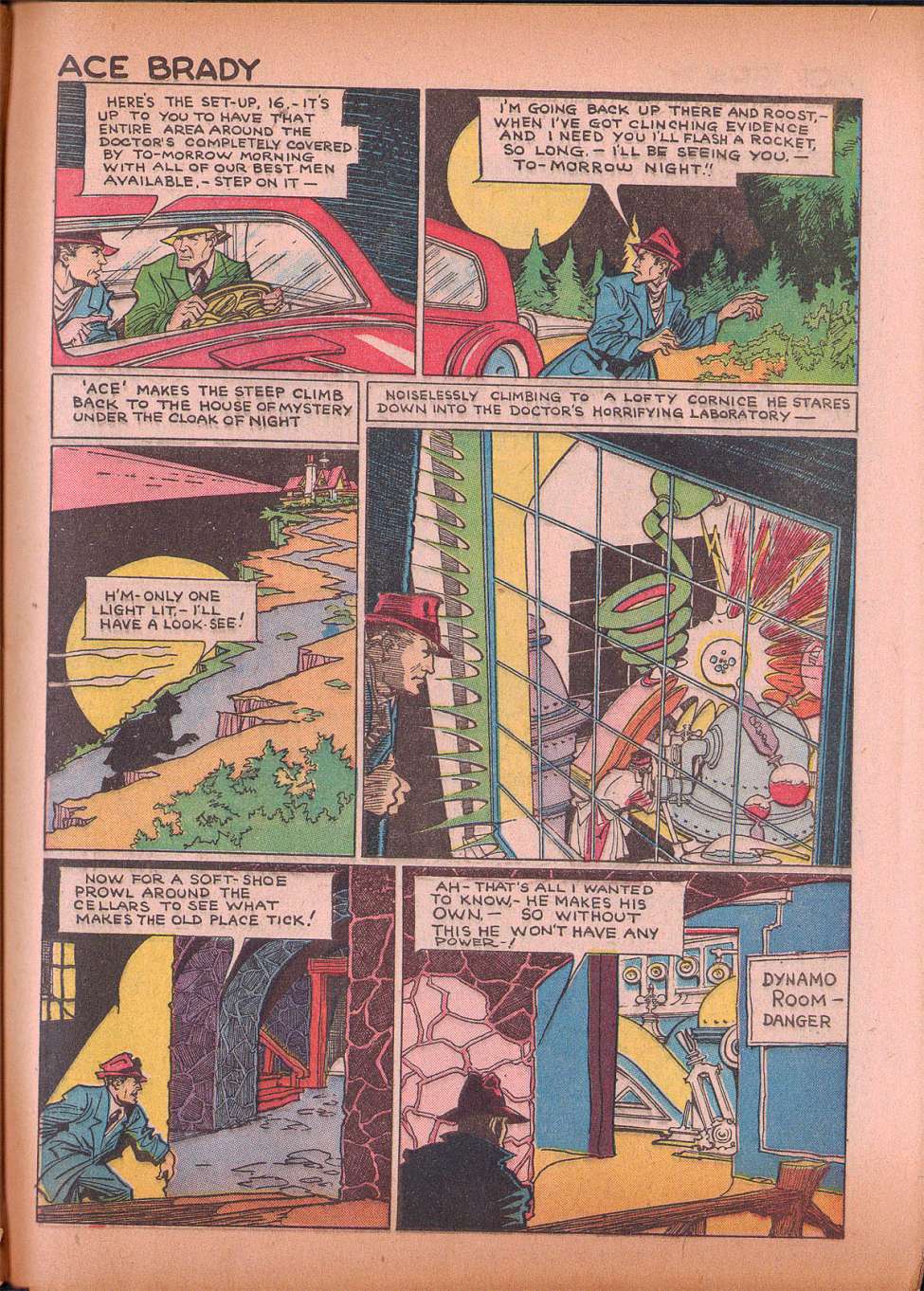
I am wondering what is supposed to be so "horrifying" about that laboratory. It looks more "intriguing" than anything.

"Soft-shoe prowl" is a cool term.
This is a rare occurrence of a Hero using a chimney to navigate vertically through a hideout, but it is a good idea to be prepared for this in-game.

I'm amused by, not only how the death ray says "death ray" on it, but that he's advertising it took nine tries to perfect it. 

There are no unexplored frequency bands in the vicinity of the X-ray; those are ultraviolet rays and gamma rays.

1,000 miles is a crazy long range for trophy weapons, but not that unusual in the comics. Consider carefully its effect on game balance, since players can get their hands on these. 
Wing-walking was a stunt for Aviators in 1st edition Hideouts & Hoodlums.

Gas tanks exploding is a fairly critical complication for aerial combat.
Shark is smart to rescue his opponents, as it does give him people to question for information.

In 1940, the "medical magic of the hypodermic" likely refers to morphine.

Here is a rare occasion of Asians speaking an actual foreign language instead of broken English.
The Syndicate sounds like a criminal organization, but here seems to be refer to a national alliance (the Axis, perhaps?). It does not seem to be a coincidence that the bad guys here seem to be Japanese.

Being able to throw destroyers against the Heroes does make it a seriously high-level challenge.
 
(Scans courtesy of Comic Book Plus.)

Thursday, September 10, 2020

Popular Comics #49 - pt. 2

I believe I had given the Power Dive stunt a bonus to hit when I made the Aviator class, but I've since learned in playing Dawn Patrol that power dives are for gaining speed, as done here. I don't presently have a rule to cover this, other than how a piloting skill check allows you to go a little faster than normal.
Once again, we're given a teasing clue that the Masked Pilot is either someone very famous or very influential, or both. Or he's carrying Doctor Who's psychic papers.
Penguin Pete, which is really a better adventure strip than it has any business being, reminds us that a "miss" in combat doesn't necessarily mean you missed your target, it's just that you caused no damage. Although I could have arrows do less damage to alligators...?
Don't forget that mobsters can wreck things, just like any non-superhero Heroes, with just two dice instead of three. That should be enough to smash a rowboat...though I could give them a +1 bonus when wrecking with their tails, or just mention that alligators can wreck things behind them with their tails.
We're going to spend the rest of this blog post spending more time looking at Captain Tornado than it probably deserves, but maybe we'll learn something about creating fictional civilizations.

Rule #1: Dress the natives exotically. Don't be afraid to make your Heroes confront a male guide wearing a thong-backed banana hammock.

Rule #2:  Rather than try to imagine new technologies, you can recreate modern conveniences through different means and still make a society look advanced. Here is a mechanical elevator. Also note the locals live in a place that resembles the courtyard of a fancy hotel.
Phosphorescence is a real thing, of course, but some unknown process must amplify it so it operates as sunlight. Of course, it's also possible that all the grass in this cave is astroturf, and the trees are fake sculptures, just to give them the feel of being aboveground. 
That the door "mysteriously opens" feels somewhat laughable today when every store has automatic sliding doors, but while the concept of automatic sliding doors is very old, the way to make this work electronically was not invented until 1954 -- so this is actually "futuristic" tech in 1940!

Note the trope of how visitors always get to visit rulers directly, instead of being made to interact with some underling who reports back to the ruler (which seems like it would keep the ruler much safer).  
Holy cow, this page is pretty terrible. "I'm free, white, and 18 and he can't boss me"? Really Jane? 

And while that's pretty overtly racist, that's nothing to how terrible this alien caste system is, with its two slave castes who either get their tongues cut out or aren't allowed to ever see light. 
If I didn't already hate this evil alien race enough, now we find out that they rip the wings off of giant butterflies and wear them. I guess we also find out from this that these aliens are hollow-boned, allowing them to fly.

The concept of species degenerating to the point where they no longer understand their ancestors' technology can be traced at least as far back as H.G. Well's Morlocks.

And we learn from this page that water pressure, instead of electricity, is how they work their technology. I wonder if water pressure could run a plane...?

(Scans courtesy of Comic Book Plus.)

Sunday, September 6, 2020

Popular Comics #49 - pt. 1

The radio drama allegedly always used true cold cases from the FBI files, and the Gang Busters comic strip at least started out the same, but how true is that by 1940? I can't find any evidence of an actual FBI agent John Winston, though Winston being the middle name of John Lennon is, admittedly, clogging my search results, and there's no reason why the name couldn't have been changed to protect a still-active agent's identity.

Richmond, Virginia is of course a real place. I can't find a Calvert Bank in Richmond, but there is a Calvert Drive in Richmond, and perhaps there was once a bank there? 

The Tri-State Gang was real. According to the Sword and Scale website, their crime spree ran "through Pennsylvania, Maryland, and Virginia during the early to mid-1930’s."

By this page, the scene has shifted to Baltimore, Maryland. The names of the streets seem to have been changed to ...protect the innocent streets. Although there is a Harvey Street in Baltimore, it is commercial instead of residential, and doesn't intersect with an Elm Street. 

The map hardly seems necessary, since the maneuver of blocking the intersection with cars is really not elaborate. 

The story of the Tri-State Gang is actually pretty interesting, but you wouldn't know it by this rushed retelling. Indeed, the Gang Busters comic strip often has a bland sameness to its stories.


So we'll skip ahead into Martan the Marvel Man. I'm pleased with what this installment is trying to do, showing us Martan and Vana getting to know Earth, but I'm skeptical that they would immediately understand our comedy as quickly as they do here. Even more interesting is that this is an alien invasion story, but with the twist that Martan and Vana are on the ground with regular people and get to see how they react and deal with it.

The locations are worth mentioning here. It's unusual that the aliens land somewhere in New Jersey and San Francisco and not more obvious targets, like Chicago, New York City, or Washington, D.C. Likewise in Germany, the aliens skip Berlin and are landing in less important areas of northern Germany.  

On a page I'm not bothering to share we also learn that the invaders are Martians, but the story ends with us still not even having seen the invaders yet. Maybe next time!


I am leery of this page because of the gruesomeness of that final panel, but two points here: one -- and we've seen this elsewhere before (and done better) -- is the idea of mistaking dinosaurs for dragons, or having dinosaurs and dragons be one and the same thing. It's a fanciful idea today, but much less was known of dinosaurs in 1940, so it would be easier to equate them with fantasy creatures. 

Second, and going along with how less was known about dinosaurs, pterodactyls are here displayed acting like carrion-eating vultures, when they were actually fish eaters, more like seagulls and albatrosses.  

Again, pretty gruesome, but I appreciate that the author knew the poisonous fumes are at least as dangerous as coming into contact with the lava (oops, Jurassic World 2 seemed to have forgotten that!). I would say anyone within 10' would need to save vs. poison or take ...let's say 2-8 points of damage from it, per combat turn within that distance.


Rekra is a weird name, but it actually is a name! I'm not entirely sure from where, but Google searching seems to be pointing to it being Slovakian. So this Slovakian spy has a gas gun and gas mask. Well-outfitted! This is a variant gas gun too, one that sprays paralyzing gas instead of sleep gas (both are chemically fanciful so, why not?). 

Oil line to motor broken is a good random complication in aerial combat (though this time it's being faked by plane thieves!). 


Out of the Sun was an aviator stunt in 1st edition Hideouts & Hoodlums, and here is used to give the Masked Pilot a surprise bonus while tailing the hijackers. 

This could be the earliest mention of Nicaragua in comic books. It's interesting that Nicaragua, being a neutral county in this story, gets to keep its name, but the villainous country is called "Vulcania." It's pretty easy to figure out which country that is, as El Salvador is known as the Land of Volcanoes. Although ruled by a dictator, Nicaragua was at least officially on the side of the allies during WWII. Although Nicaragua's dictator, Somoza, was corrupt, he wasn't as bad as El Salvador's dictator at this time, Matanza, who had more than 30,000 of his people killed.

(Scans courtesy of Comic Book Plus.)


Monday, August 31, 2020

Feature Comics #30 - pt. 2

We're looking at the second half of this issue of Feature Comics today, and are still in this month's Dollman feature. If you can't guess, Dollman has snuck aboard a German submarine since we last saw him. If you ignore the dynamic layouts and just concentrate on what Dollman is doing on this page, you'll realize there's nothing here he couldn't have done at full-size, backing my contention that a shrinking power is nothing but flavor text.

Now, he did, on the previous page, conceal himself in a crate too small for a normal-sized person to hide in...but the Editor could easily have changed the scale of the crates to fit the Hero.
I know where this is! the highest suspension bridge in the world was the Royal Gorge Bridge in Colorado from 1929 until 2001.

I am really impressed by the wrinkle in this story, that Rance leaves the time bomb intact to give the story a time limit. It's not really clear why. What would make this work so much better is if the time bomb wasn't safe to defuse, so the only way to do so is to find the man who left the bomb in the time they have available and trick him into defusing i for them. Which is almost exactly how this story goes, except for the necessity factor.
This is more of what I like from this story - not only finding out who the villain was, but finding out his backstory, looking for things to exploit so they can trick him instead of beating him up. It's all so ingenuously done that I would probably wind up giving Cameron a penalty to his save vs. plot to see through the disguise (the distance and bad lighting probably help too, so, -3?).
Here's an example of expert level sleight of hand from a non-adventure character. But I was more interested in sharing this page for the unusual word "bohunks." I don't know if you all knew this already, but bohunks is actually a racial slur, referring to an immigrant from central or southeastern Europe, especially a laborer.
We haven't looked at educational filler in a while. Things like this are very useful because, when I'm deciding how high or how far a Hero should be able to leap without some kind of buffing (either by skill or power or spell), I will look to world records, but of course world records keep going up over time. It's hard to believe that the pole vault record was "only" 14' back in 1940; now it stands at 20'!
We're jumping from there into Charlie Chan, where the artist does a great job of getting Warner Oland's likeness with all the shading. Here, Charlie lands on the nature of the bad guys' scheme from two clues. I've spoken about this before on the blog, how difficult it can be sometimes to distinguish the Editor misspeaking from deliberately leaving a clue in dialogue. The better clue, for a RPG, is having Chan realize the binoculars are expensive. I'm not even sure if one should need a skill check to determine that; I would think it would be obvious if a pair of binoculars was fancy enough to be expensive.
This page tells me pigeon blood rubies are worth twice what diamonds are worth. I wish it also told me what diamonds were worth in 1940, as that would be a good cipher for figuring out what all other gemstones were worth. Interestingly, I can find this information online, but only going back to 1960.

You don't hear about "pigeon blood" rubies often, probably because it is as violent as it sounds. Pigeon Blood Ruby meaning is primarily associated with its color that matches exactly with the blood drawn from a freshly killed pigeon.
I'm currently running a campaign where one of the Heroes is working to become a professional boxer, so I found this installment of Slim and Tubby particularly interesting. At first glance it seems that Slim needs a license and bond to become a boxer, but that's not true; he needs a license and a surety bond to work as a boxing promoter, something that's still true today (Slim is looking to become a promoter to promote his own boxing career).

We also see robbers armed with sub-machine guns here (well, sort of -- they never leave the car, but we're told they are that well-armed).

(Scans courtesy of Digital Comic Museum.)

Wednesday, August 26, 2020

Feature Comics #30 - pt. 1

It's been a long time since we last checked in with Quality Comics' flagship title. Here, the Clock (sans mask) investigates how a car was tricked into careening off the road, and anticipates the movie Goldfinger by 24 years.

That the Clock wakes up after 30 minutes suggests that he was simply stunned and recovers 1-6 turns later, but the Editor has decided to make those 10-minute exploration turns (which the Editor can do, at his discretion).
Monogrammed cigarettes must have been a novelty item of decades past.

That's also quiet an expose in the newspaper, that the dead man was a FBI man with secret industrial mobilization plans on him. I bet the FBI was wanting to keep that a secret. Industrial mobilization was, of course, a real thing, and had been ongoing since Sept. 1939 in the U.S.
I've seen this in games before, paying kids to run messages for you. In a pre-modern age it can be more reliable than technology for communication, though it could put the kids in danger.

Panel 3 is a good example of how easy it is for Heroes to scale walls, even in dress shoes and tuxedos, while carrying canes in one hand.
This is Lena Pry and we haven't looked in on this comic strip in a dog's age. I include this bit because of the discussion of relief checks, which was another real thing. The Agricultural Adjustment Act (AAA) was a United States federal law of the New Deal era designed to boost agricultural prices by reducing surpluses. The government bought livestock for slaughter and paid farmers subsidies not to plant on part of their land.
The Great Bear Lake is a real lake. It is the largest lake entirely in Canada, the fourth-largest in North America, and the eighth-largest in the world. Moose Creek is also real, running through Ontario.

There really is a Nugget City in the Yukon, but it's a RV park and, I suspect, doesn't date back as far as 1940. It's possible that "Nugget City" is a euphemism for the Town of Dawson, which was at the center of the Klondike Gold Rush.
This is Spin Shaw and Spin is in an unusual gaming situation that I've only seen once before in a Star Wars session; Spin is "grounded" by a captain who doesn't want him involved in the scenario, so part of the scenario becomes finding a way to get into the rest of the scenario. Here, Spin's player wisely finds a use for his plane that nothing else can do, forcing the captain's hand to let him take off. No dice rolls should be needed to judge a situation like this, and the player should certainly be rewarded for ingenuity.
Unlike Reynolds of the Mounted, which was surprisingly easy to place in the real world, San Luray seems to be entirely fictional. There actually is an archipelago called the Barren Islands -- but it's in Alaska, and it's very unlikely that this adventure takes place there. "Barren Islands" was surely meant to sound evocative, but also generic enough that they could be anywhere.
The cliche of the hollow statue that can be made to appear to be talking to its worshipers is as old as racism in adventure fiction. I include this example, though, because of the added details, like the density of the foliage concealing the entrance (find as secret door?), the fact that the entrance is a "queer opening" because it's much smaller than a normal door, and the shots of the interior show that the body has just one hollow column leading up to a small floored room in the head.
Eisner makes a point of showing us that Dollman is a good fighter at full-size to explain how he is still so capable at tiny size. Why I share this particular page, though, is for the use of "tomahawk" to describe a sap/blackjack. This may be purely a joke, as I can find no evidence that tomahawk was ever a slang term for a sap or blackjack.

(Scans courtesy of Digital Comic Museum.)

Friday, August 21, 2020

Wonderworld Comics #11 - pt. 4

This will be our last visit with this particular issue, and we'll kick it off with about page of "Spark" Stevens.

Although this looks like a tough fight, the gobs should be approaching 4th level by now, these spies are likely 1 or 2 HD, and the guy with the gun has as good a chance of hitting his allies as the gobs by firing into a melee.

And what does "gob" mean here? According to the Old Farmer's Almanac, "There are two theories on this one. This term first showed up in regard to sailors around 1909 and may have come from the word gobble. Reportedly, some people thought that sailors gobbled their food. The term also may come from the word gob, which means to spit, something sailors also reportedly do often."

As for "photostat files," The Photostat machine, or Photostat, was an early projection photocopier invented in 1907.
I was really expecting a better trap when that spy reaches out for the secret pedal than -- a bed coming down and smacking them in the head. Now, while I can't imagine this doing more than 1-6 points of damage (in fact, I would probably treat it as an improvised weapon that does 1-3 damage), it's possible that our gobs were just so low on hp after that fistfight that this was enough to knock them both out. Or, as a surprise attack, maybe this is considered a head blow, which comes with a chance of knockout in 2nd edition Hideouts & Hoodlums.
This is the first death-by-normal-sized-spiders deathtrap I've ever seen in a comic book -- and I have to say, it looks plenty unsettling and would surely spook a lot of players! Of course, one ordinary spider isn't going to have enough venom to cause much harm to anyone, but this is a thousand of them, so I would treat a spider swarm as a mobster with a collective Hit Die total and a save or die situation if the swarm starts all biting you at once.
Fire is probably the surest way to get rid of them; I also would have allowed the players to throw rocks at them or even pee on them to drive them off.

As the Editor, never forget about how fire causes smoke, and be liberal with assigning smoke inhalation damage if an encounter seems to be going too easy.
You're in for an unusually educational installment of K-51: Spies at War. It is, in fact, a little prescient -- the Nazis didn't manage to sink their third ship with U-boats until May 28, 1940. The world was shocked that Germany had managed to make new U-boats in secret after WWI, but they didn't have very many, not until capturing the French and Norwegian naval fleets. Now, what else this news ticker fails to get right is the number killed. 22 is purely wishful thinking; the actual death toll from the first two sank ships was over 1,200 deaths (they didn't bother going after small boats!).

Q-boats were real. Q-ships, also known as Q-boats, decoy vessels, special service ships, or mystery ships, were heavily armed merchant ships with concealed weaponry, designed to lure submarines into making surface attacks. The British and the Germans used them in WWI, and then the U.S. started using them too in WWII.
Panic parties were a real thing, just as described here. I'm guessing depth bombs, or depth charges, really work like that too, though I've never actually seen a picture of one being launched before.

This is yet another example of a random complication from vehicular damage, this time the electrical systems shorting out.
The weirdest thing about this story is that K-51 does nothing at all the entire story, except swim away at the end so the captain doesn't get in serious trouble. Nice of him, yes, but he gets zero experience points for this "session."

(Scans courtesy of Comic Book Plus.)