Saturday, April 27, 2019

Tip Top Comics #17, 20, 22

Also known as vol. 2, no. 5, 8, and 10. Outside of Tarzan, the strip I can't see because of strict copyright laws, the race for second-best ongoing story line is a contest between Billy Make Believe and Peter Pat. Like The Adventures of Patsy, these were parts of a minor and unsuccessful movement to merge the kids' adventure and fantasy genres. Both Billy and Peter have exciting adventures and reveal themselves to be capable fighters despite being half-pints, though Billy's seem less dangerous, as it is not clear whether his adventures are actually taking place or are only imagined by him, as the title suggests. 

I include this page's How to Make It sub-feature because, of all the mini-craft projects I've seen described in filler material so far, that one about making paper tepees is the only one I've actually done.
 ===

Billy is still fighting toy people (and contributing to racism?). It looks like toy people can be encountered in groups up to 30, and do not have to be human-like in form.

Captain and the Kids gives us wild men, another name for cave men, and reminds us how strong they are. Maybe all cave men should have the Raise Car power?

The reference to state police in Hawkshaw the Detective suggests that, despite being based on Sherlock Holmes, this takes place in the U.S.
Here's an issue we've discussed here before: when do powers/spells/stunts need to be activated? Does the wild man need to have used the Raise Car power to lift that tree out of the ground, or is simply flavor text accompanying the attempt to wreck the rope? It may depend on what comes next. If the wild man simply escapes the tree and ignores it afterwards, the Editor can rule that the tree was lifted out as just flavor text, as it has no bearing on the story. If, however, the wild man tried to pick up the tree and use it as a giant club, then the Editor should rule that a power needed to be used, even if he has to retroactively make that ruling.
We're now on issue # "20"...

This really takes me back to the early days of the blog when I used to keep a running tally of how many goats appeared in the comics. It's true, before there were supervillains, goats seemed to be the supervillains of comic books.

Here we see how little provocation goats need before attacking.
Ella Cinders addresses the issue of language. It's been a Hideouts & Hoodlums rule since the beginning that languages aren't important and all characters speak the same one. Ella Cinders makes it clear (or even more clear, we just assumed so before) that the language we all speak is English.
In a more capable artist's hands that first panel of Fritzi Ritz could have been downright scandalous. But I include this strip not to titillate you, but to point out that fur wraps cost $150 and that, if you're going to haggle, maybe you should wait longer before suggesting furs depreciate in value.
Peter Pat's first big adventure has been wrapped up and he's returning the princess to claim his reward -- and is seemingly very well rewarded too. Peter should be at around 3,000 XP right now, which means his title should be an officer, but colonel seems really high...
 ...but then, it depends on the perks that come with it. Peter, after all, won't be commanding large armies or have access to heavy artillery -- it looks like he gets a fancy helmet and a pony, and the chance to perform in the rodeo.

This page also reminds us that, when developing alien cultures on the fly, all you really need to do is swap out one detail, like pigs for horses at the rodeo.
And we'll wrap up for today on this first share from issue # "22" and Hawkshaw the Detective. It's a rare, early occurrence of bad guys using passwords or phrases to get into their hideouts.

A question to ponder, that I'm not sure how to answer yet: when Heroes are on a stakeout, should they make a save vs. plot or science to determine if they sneeze...?

(Scans courtesy of Comic Book Plus.)

Friday, April 26, 2019

Tip Top Comics #12, 17

Racing hydroplanes are trophy items in Hideouts & Hoodlums, but this would have been a good illustration for one, had I seen it sooner.
This is the second time Bill's tactics involve fire. Are you a pyro, Bill? A ring of fire could force animals to make morale saves to go through it, which would still do damage to them.
Don't mess with Indian medicine men (shamen would be the more appropriate term). Control Weather is a 7th level spell, so that magic-user is at least 13th level! Unless it was just a coincidence, of course...
 Outdoor snow is treacherous terrain, full of (snow-)covered pit traps.
Now we're going to jump into issue #17 (Sept. 1937), and this is also the debut of Jim Hardy on this blog. Those hoodlums in the bottom right hand corner have two suggestions for good places to look for hidden treasure. The wall safe concealed behind the painting is so cliche, but buried in the shed is someplace to remember.
I continue to be surprised by how often cowboys climb, and it's what convinced me early on that cowboys should just be mysterymen.

Barrels of gunpowder can wreck an entire building; it looks like the truck category to me. And, yes, sometimes the Editor just has to wing which category to use for wrecking things, despite there being a fair amount of examples listed.
I included this strip because I wanted to highlight how, in a H&H campaign, treasure could be "buried" around you wherever you go. Not quite at Zelda-level, where you might get a gem for every blade of grass you cut, but still...it never hurts to search around.
I'm intrigued by these toy people as a sort of intelligent golem (or would living statues be closer?). Billy punches one out easily, so they can't be tough, right? Only, what level would Billy be as a magic-user? 2nd level? So maybe the toy people are 1+1 HD.
No strange monsters this time in Peter Pat, though we see our madman is so mad -- he has no clothes! We also see how treasure can be used as a lure to make Heroes move towards traps, and sometimes it pays to have a trigger -- even if it's a big obvious lever -- in the room so the trap can be activated manually. Often, it's best to let the players' curiosity get the better of them and have them activate the traps themselves!

(Scans courtesy of Comic Book Plus.)

Wednesday, April 24, 2019

Tip Top Comics #10, 12

Still reviewing Tip Top Comics #10, from Feb. 1937. It is packed with United Features' also-ran comic strips -- though, to be fair, it was headlined by L'il Abner and Hal Foster's gorgeous Tarzan, but I just don't have access to those pages.
Which is why we're concentrating on strips like Chris Crusty, a strip that not even the most resolute platinum age comic strip fans talk about, but we're talking about it here because I am fascinated by this tiny gum vending machine which, if it did exist, must have predated the gumball machine we know and love but never use today.

This Joe Jinks strip is so meta that we can't ignore it on a blog as meta as this one. While Joe complains that bad things never happen as often in the comics as they do in real life, it begs the question -- for us, looking at it from a RPG perspective -- how many bad things do we want to have happen in our game sessions, in order to simulate real life?
I don't have an answer to that, as it's something for each Editor and his players to decide on as a group. When I'm running a game, I prefer to emulate real life as much as possible, with comic book characters and tropes just inserted into it as if it all made sense. But even I see that if you heap too many challenges onto your players -- without equal rewards -- they are going to be discouraged.

In Broncho Bill, we get a tactical suggestion of setting a grass fire to serve as a distraction, and
perhaps Bill can be forgiven for taking such an extreme resort since a life is at stake. And yet, from our modern sensibilities, it may rankle to see him run the risk of starting a fire that could get out of control and cause wide environmental damage. And herein lies a difficult call for the Editor and the use of the save vs. plot mechanic to restrict non-Heroic activity -- do you restrict according to the standards of the day, or our modern standard of heroism?

Let's leave aside such heavy questions to look at
Billy Make-Believe for (ahem) a spell. We have seen tree-like creatures before in comic books, but this is the closest to Tolkien's ents I have yet seen. And this is for sure the first appearance of Jack Frost in any comic book. He certainly looks comical, with his icicle nose, and he has fairy wings despite being a taller than Billy.

Not only Billy Make-Believe, but Peter Pat is turning into a font for new mobster-types -- except, as much as I'd love to stat that pink thing, what should I call it? A turtlesaurus? 

Besides that, the tactic of tying the rope to


the turtlesaurus and having it pull the door open for them is pretty clever.

The only time I ever see gryphons in comic books seems to be from adaptations of Alice in Wonderland. Does this mean I need to stat mock turtles too? Should they be distant cousins of turtlesaurs?

Jumping into issue #12, this installment of Hawkshaw the Detective borrows more than usual from Sherlock Holmes, with the action being borrowed almost wholly from the story "The Adventure of the Empty House." And yet...this tiny strip also, in a way, anticipates Batman and how so many of his adversaries
have psychological hangups. One could imagine this foe being called The Pinner, if Batman faced him...

Another bizarre critter in this issue's Peter Pat! Maddeningly, these inventing animals are never given names. What do I call this? A Cheetah-Bull? It looks tough, but Peter backs it into a corner, drops a net on it, and it's completely out of the fight on the next page.  2 Hit Dice, maybe?

The madman is called a "monster," and I did stat madmen in Supplement V: Big Bang. I'll have to make sure they are featured in the Mobster Manual.
When looking for hideout dressing for scary rooms, perhaps I'll draw inspiration from this page of Fritzi Ritz.

(Scans courtesy of Comic Book Plus.)

Sunday, April 21, 2019

Tip Top Comics #7, 10

Moving through Tip Top Comics quickly...

Hawkshaw the Detective introduces us to the idea of non-classed characters/mobsters being able to "level up" certain skills.

The Captain and the Kids reminds us that stilts could be a good way for Heroes to enter hideouts on an upper level.
Chris Crusty gives us a good idea for a trap; the Hero touches something and a paralyzing electric current keeps him there (on a failed save vs. science, of course).
One does not normally run the risk of having to roll again to see if you hit a random target after missing in melee, but if the Editor wants to run a campaign with the feel of Phil Fumble, he can add that rule.
I think bison are way too cute to be shooting at, but a bison could be a fierce opponent for low-level Heroes, so I'll make sure they're statted in the Mobster Manual.
$2 is a sufficient bribe for a waiter at even the fanciest of restaurants, according to Looy Dot Dope.
If taken seriously, Billy Make Believe would definitely need to be statted as a magic-user -- but note the peculiar effect here, where shrinking Bub ends his invisibility. What that suggests is that spells cannot be stacked, but casting one ends the duration of the previous spell on that person. Luckily for magic-users, I don't intend on making magic work like that in Hideouts & Hoodlums -- unless I see a lot more evidence of this happening...
Peter Pat is going to require more watching, as this dinogator is rather interesting. The lights shining from its eyes reminds me of the blindheim, a monster in the old AD&D Fiend Folio. I'm thinking I would stat a dinogator as a ...6 HD mobster?
From issue #10...I thought this was good, subtle humor.
And, coming full circle back to Hawkshaw the Detective, we learn that laughing gas (nitrous oxide) can be mixed into milkshakes and retain its properties. Who knew? (Actually only works in comic books -- in real life nitrous oxide is a safe food additive and is even used as a propellant in whip cream cans!).

(Scans courtesy of Comic Book Plus.)

Saturday, April 20, 2019

Tip Top Comics #6

Today we're going to go way, way back to catch something we missed before -- that comicbookplus.com actually has a pretty good collection of Tip Top Comics, from United Features.  Now we're going to be taking a detour backwards for a while and catch up.

And we'll be starting all the way back to Oct. 1936 for this blast from the past (if some of this gives you deja vu, it's because most of these features were also published in Comics on Parade). And first, I'm just going to show you this page of gag filler because I think half of it (all the left half too) is really funny.

In the middle of this silly page is some interesting problem-solving when it comes to crossing a chasm, or preventing others from crossing a chasm behind you.
I thought I should include this because it's so hard for people today to wrap their minds around how difficult cross-country communication used to be. "Six bits" is 75 cents -- almost the cost of a meal back then -- to make one long distance phone call.
I think I've written before about using "punk" as another name for wimpy hoodlums, the mobstertype at the absolute bottom of that particular hierarchy.

But I'm interested in this notion behind wedding feasts. A spell that would allow you to control someone once you have access to their table scraps? What would you even call that? Charm through Leftovers? But it does bear more thought...
Hideouts & Hoodlums players who come from a D&D tradition often know to listen at doors, but how many of them also sniff at doors? The chances of detecting something would be the same (= basic skill check), but the question here is, should it apply to a smell check coming from two rooms away? Depending on the strength of the odor, I might upgrade it to an expert skill check, or make it ineligible for a check at all.
Price check: $10 dresses.
This is an interesting point. Normally, there is no restriction on movement in combat, but should that always be true while grappling? As a general rule, I like encouraging movement in combat; it keeps things interesting to not be standing in one place the whole battle. So I would say that your opponent has to have at least a partial hold on you to curtail your movement.
We see a surprisingly few giant squids in comic books; most artists seemed to prefer making giant octopi instead.

I really like that design of a diving bell with mechanical arms. Half-robot maybe?
The mushroom is a Consumable of Diminution.

This also makes me want to run the classic D&D module Dungeonland, but for H&H...

(Scans courtesy of Comic Book Plus.)

Thursday, April 18, 2019

Jungle Comics #2 - pt. 4

I don't think it's right to move on from Jungle Comics without addressing its last and weirdest feature, Fletcher Hanks' Fantomah. While Tabu had already passed into other hands, and the splash page of this story (not shared here) looks like it's by a different artist, Fletcher was still allowed to work his wonky magic on the rest of this story. It interestingly bookends the Tabu story of this same issue, by both being about elephant graveyards. Note the difference between R.L. Golden's technically more proficient drawing of an elephant's graveyard, but with much less ivory, and Hanks' drawing below where the graveyard is awash in a sea of ivory.

Here we also get a sense that Fantomah is some sort of angel for animals, delivering them peacefully to their afterlife. She takes no direct action against the evil humans, but observes the cosmic justice. Well, she might have helped goad them towards cosmic justice, by sealing them in the graveyard...
Perhaps the most bizarre part -- in a strip overflowing with bizarreness -- is the curious incident of the death cries of the dogs. The narration describes the dogs are running away from the arch, the direction that Fantomah wants them to go, so it seems unlikely that she did it. Is it just coincidence? Do they meet a jungle predator off-panel? Is the noise just illusory, made by Fantomah to spook the men?

===

Game notes: $1 million in ivory is going to create transportation issues, no matter how loosely the Editor enforces encumbrance rules (which are pretty lax in Hideouts & Hoodlums to start with!).

Fantomah's sudden appearance in panel 6 might stem from ending an Invisibility spell on herself. Her ability to transform

from flesh to skeleton and back is likely just a Phantasmal Image spell. Blocking off the arch is a much more impressive spell, though -- Wall of Stone (unless she used the lesser spell Stone Shape to make the walls swell and bulge inwardly?).

(Scans courtesy of Digital Comic Museum.)

Wednesday, April 17, 2019

Jungle Comics #2 - pt. 3

We're still looking at Captain Terry Thunder of the Congo Lancers ("Terry" has been added to the title since last issue). I like that fifth panel; in a RPG scenario, each man's secret could be shared with the player only and, although the published scenario here was all combat, in game everyone could have the secondary goal of trying to figure out everyone else's secret past through roleplaying.
This is Wambi, the Jungle Boy. Wambi has the ability, like most jungle explorers seem to do, of summoning animals. Here, we see nine monkeys encountered at once.

Wambi, forced to choose between the people who raised him and some white guys he just met last issue, chooses to betray his own people. Okay, sure, they turn out to be slavers -- but those slavers wiped your bottom when you are a baby, kid!
Speaking of number appearing, here we see at least 40 natives, and is probably meant to represent much more than that.
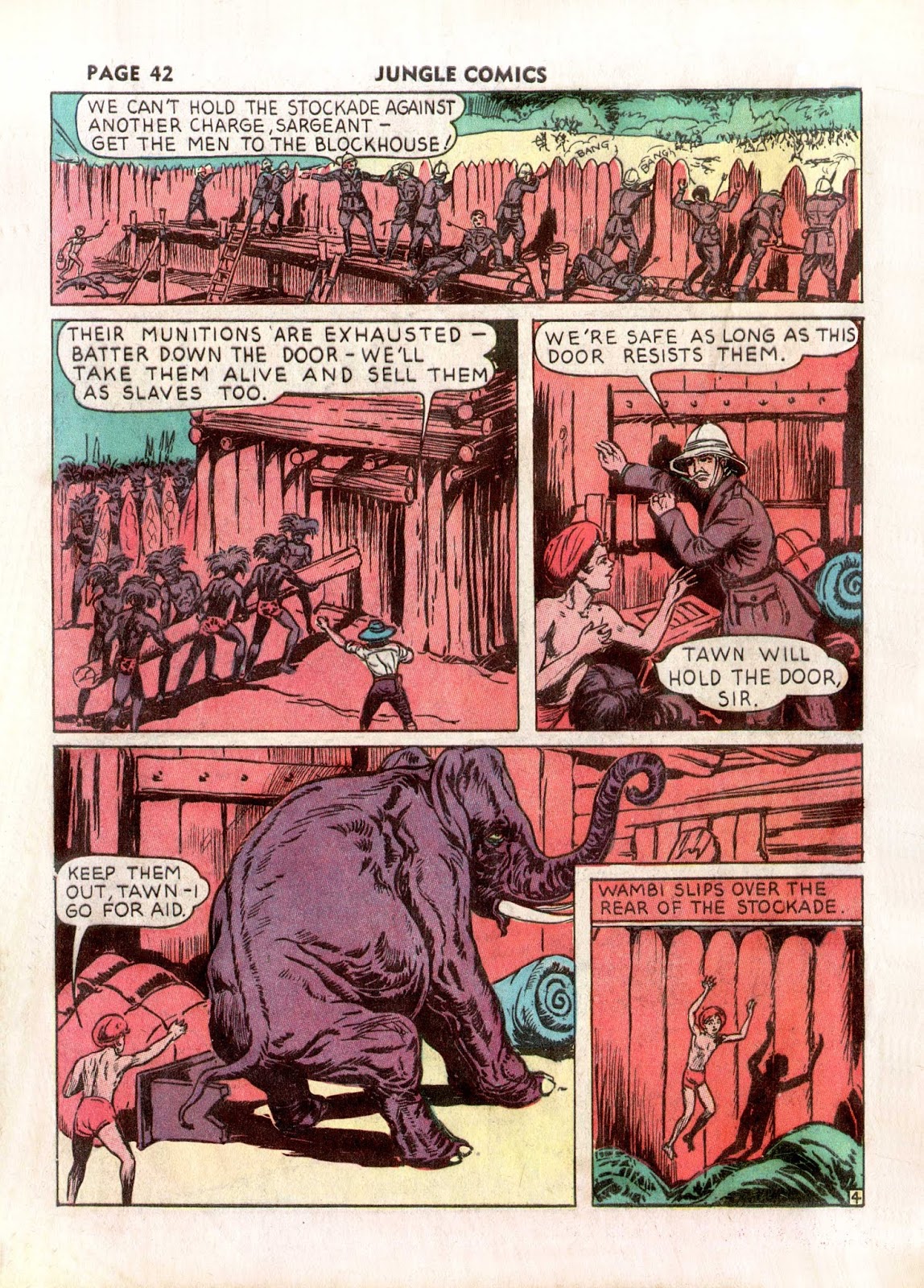
"What the devil? How did the elephant get in my blockhouse? And how is there room for him in here? Is he sitting on all my men?"

Of course, in the early days of D&D, you could put 20 orcs in a 10' x 10' room and no one batted an eye, but nowadays you should put a little more sense into spaces than that...
This is from Roy Lance, a feature best remembered for its good sense of geography and ethnography. The Riffians are indeed a real people, also known as Riyafa or Rwafa, and a Berber-speaking people of Northwestern Africa. Everyone has heard of Ethiopia today, but that might have been an obscure country in 1940. The Zulu are a Bantu ethnic group of Southern Africa and the largest ethnic group in South Africa. Not surprisingly, the author cannot name a real cannibal or pygmy people from Africa.
This page is all kinds of wrong -- Joan is being spanked, with a native gleefully watching, for being a free thinker and feeling like she shouldn't have to obey a man. 1940 was a tough time to be a woman.

The map is serviceable, though, with a mix of real locales, like the Congo River and Stanley Falls, with names that I can't verify are real. Twice, upon seeing Wakuna in this story, I thought "Wakanda...?" Probably not intentionally similar.
Now, seeing all the "primitives" running in fear from a film projection might seem racist to you, but bear in mind this trick also works on Scooby Doo. It just seems to be a given of the comic genre that visual and audio trickery is much more compellingly realistic than it would be in real life. So, as the Editor, keep an open mind when your players try nonsense like this.
This is from Simba, King of Beasts. It takes a lot of imagination to picture a water buffalo being the deadly nemesis of a lion, but now I'm just going to have to make sure to stat water buffalo -- and make them nasty!
I included this page because I realized there were actually few examples I had found so far in comics of outdoor tracking. This was the primary ability of the 1st edition explorer class, but maybe that can't be justified by direct emulation after all...

(Scans courtesy of Digital Comic Museum.)