Monday, April 15, 2019

Jungle Comics #2 - pt. 2

Tabu, not you too! Once-staunch defender of the wilderness, Tabu now slaughters animals willy-nilly to defend any man he sees. This has got to me my absolute least favorite part of the golden age -- this cheerful acceptance of animal death.

On the surface, Tabu drawn by R. L. Golden certainly looks better than by his creator, Fletcher Hanks, but it also looks more normal and mundane -- even when Tabu turns into a tree!

The elephant's graveyard is certainly supposed to be more impressive than it is, as it appears to only be the graveyard of three elephants.

One thing I do really like about this story is how Tabu discourages the youth from seeking revenge, but encourages him to let cosmic justice take its course (which happens, of course, because this is a comic book).

===

 Some game notes: Tabu uses ordinary grappling attacks on the lions, perhaps buffed by some powers, if Tabu is a magic-user/superhero, as I suspect. For the Advanced Hideouts & Hoodlums Heroes Handbook, I have been working on a mystic class that combines them both.

Evidence of gorillas being encountered in groups as large as five. It's odd that gorillas are actually social animals, but in comic books they are almost always encountered individually. This is also an example of pacing an encounter so the Heroes do not face all the mobsters at once.


There is, interestingly enough, a Tree spell in the original game that inspires H&H. I'll have to see if there's an open license version of that spell, or if I'll have to create something of my own.

======
This is a really curious story because it is actually a retconned retelling of the story in the previous issue -- something that almost never happens in comic books (except maybe in flashback). The white man's name is altered and the ending is altered so that Camilla lives. Someone may have thought after last issue went to press "Oops -- if we're going to name our feature after Camilla, it might be a good idea if Camilla survives."

I can find no evidence that a city named Kaza ever existed in Africa, but interestingly there is a KAZA now -- the Kavango–Zambezi Transfrontier Conservation Area.

That is one curious little rocket ship. Or, at least, it would have seemed strange in 1940 -- today we would call that a drone.
...As you can see here.
There's a very curious thing about these "natives." They look an awful lot like robots, yet they're never referred to as robots (or automatons, or anything but natives), and the narrator even tells us John kills several of them. Now, it's possible that the narrator is speaking from John's perspective, and how he thinks he's killing real people.


It's interesting that flexodium is a ray -- so it's a type of energy -- but it discussed as if it was a metal. Very likely this stems from a lack of understanding about how radiation works, which may have been commonplace in 1940.

Other than wanting to destroy western civilization, Camila doesn't sound so bad. Robbing ivory caravans is something I would be quite comfortable with letting Heroes of any Alignment do in my campaigns, though that is from my modern perspective, of course.
By "torpedo" she must mean rocket, and if her rockets can really reach space, her's beat German's V-2 rockets there by four years.

Once again, the very robot-like people are called nothing but guards.

=====

Game notes: 4 to 1 odds is overwhelming for John -- but if the Editor took a mulligan on their first gaming session, should John get to keep the XP from it?

We've seen so many paralysis rays already in comic books by now, but this time it's called an electric radio beam (which sounds like it would help your radio get good reception rather than paralyze someone).
I'm not crazy about Congo Lancer stories -- but I'm crazy about that map! If I was super-ambitious (I mean, more than I am now), I would try drawing a Editor's map of my campaign area that shows pictures of all the animals in that region and where they can most often be encountered.

That is one weird middle panel, with the crocodile just laying there, minding his business, while the radio waves talk over him.

(Scans courtesy of Digital Comic Museum.)

Thursday, April 11, 2019

Jungle Comics #2 - pt. 1

Jungle Comics is what happens when a publisher (Fiction House) has one successful title (Jumbo Comics, packaged by the famous Eisner-Iger studio) and decides to launch another, but on the cheap. When Fletcher Hanks is your best artist (and you'll be seeing his contribution in a day or two)...

I was recently in a Q&A with Don McGregor on Facebook and I asked him about pushing the envelope for violence in comics. His response was that he wasn't trying to push violence so much as show that violence has consequences. Which is relevant here because violence is on display on practically every page of Jungle Comics, but a strangely bloodless violence, even when characters are getting stabbed in the face. I found some of these images too unpleasant for sharing on my blog, so you'll just have to take my word on the face-stabbing incident.

Today we're just looking at the first two stories from this issue, Kaanga and Red Panther (called White Panther last issue).
Kaanga is drawn by Ken Jackson -- often free of the constraints of any backgrounds -- and so stiffly that he can sometimes be mistaken for Fletcher Hanks (in fact, I'm not entirely convinced that Jackson isn't just a pen name for Fletcher, with someone else inking over him).

Compared to Kaanga, Arthur Peddy's work on Red Panther is positively dynamic, though still gory. Later, Arthur will join DC Comics and get to work on the squeaky clean later appearances of the Justice Society of America.

Now, let's talk about the pages! In the first one above, we get possibly the first instance of a stick holding crocodile jaws open in comic books. At least he doesn't kill it!

Ape men often look -- or are blatantly -- racist in nature, but this story skirts that problem by depicting the ape-men as white as they can get. Dr. Wratt may be the first mad scientist in comics who won't wear pants. Or shoes. Or socks. I think we can safely assume he's naked under that long shirt. Dr. Wratt may be evil, but he's not too evil; he operates on Kaanga using an anesthetic gas.


=====

Game mechanic notes: Sticking a stick in a crocodile/aligator's mouth requires a successful attack roll, followed by a failed save vs. science for the animal. The ape man achieves a surprise attack and lands a head blow that stuns -- unless Kaanga was just low on hit points from the crocodile fight, in which case Kaanga has been rendered unconscious at zero hit points."Torn legs" do not require miraculous cures in Hideouts & Hoodlums, just normal rest.

Wratt needs to only establish eye contact with his victim to hypnotize him, but we've had plenty of evidence of how easy it is to hypnotize people in comic books. He does have one limitation, though, he can only hypnotize someone to make them do something they already want to do (like escape the island). To "dominate another's will" he needs that big, stationary machine.
It's unclear if the machine does all the work, or if it only makes his normal hypnotism more effective.

A choke hold is a result on the grappling table in 2nd edition H&H.

Here is a very rare example of tripping two opponents at the same time.

===

Wait a minute...if the shore was that far from his lab, how did they see the hypnotized guy get torn apart when he "neared" the shore?


The island is in the middle of a lake (I didn't share the page that established that); the long suspension bridge is the only way to the shore of the lake. But couldn't Kaanga swim the lake...?

We see ape men can be encountered in groups as large as eight.

Are the crocodiles in the lake, a lagoon, or both?

Meanwhile, Red Panther is trying to save missionaries from headhunters.

===

A stunt never seen before, or likely since, in comic books, is swinging from a vine held in one's teeth and scooping up two full-grown people, one in each arm. I have toyed with the notion of restoring the multiple levels to stunts that they had in 1st ed. But how to distinguish 2nd level stunts from 1st edition ones? A thought I've had here is that a stunt should only be able to accomplish one thing, but a 2nd level stunt can accomplish multiple things (2? 3?) at once.

A skill check can discover a hidden trap if the Hero is actively searching for them, though Red Panther seems to just happen to spot one here as if by accident. 
A long established practice in RPGs is to combine traps with something to fight, such as a tiger in a pit trap.

===

It seems odd that Red Panther chooses to jump into the pit and kill the tiger, rather than simply reach into the pit and pull the man out. He could have even helped the tiger out and sicced it on the headhunters.

====

Red Panther is able to use a stunt -- cutting his bonds against the sword -- even though combat has already started because he has not yet taken a combat action.

This is not the first time the term "giant" has been used to apply to a combatant who is actually just normal-sized. This is why I was thinking of creating a pseudo-giant mobstertype.

A push attack does not need to be away from you; here it shows a push attack being used to move an opponent behind you.

(Scans courtesy of Digital Comic Museum.)


Sunday, April 7, 2019

700th Post!

Hi. If I just kept chugging along to the next issue, my 700th post would be starting to cover Jungle Comics #2, but that just doesn't seem a fitting topic for such a milestone. But neither do I have something major to declare on this milestone, for I am close to finishing none of my big writing projects (like the Advanced Hideouts & Hoodlums Mobster Manual) any time soon.

So I thought I would take a little time to look back and reflect. Over almost 4 1/2 years, I have exhaustively studied and analyzed every American comic book story I could get my hands on (virtual hands or otherwise) that came out between 1935 and February 1940. For the most part, this has served a practical purpose, making Hideouts & Hoodlums -- quite possibly -- the most thoroughly researched role-playing game on the market. If not, it is clearly the most transparent, as all my notes are laid bare for all to see.

Where do I go from here? I'm going to keep doing this, as I'm still enjoying it. Oh sure, not every story is a gem, and some are just plain awful, but ranting about them is all part of the fun. And when I see something that just amazes me, I always let you know.

What can I do differently, from here on? I'm thinking of separating out the critiques from the game notes; put the game notes at the end for those who share my interest in that, but leave the analysis that might be of broader interest up front. We'll see how well I stick to that.

Tomorrow I start reading Jungle Comics #2. Can hardly wait now!


Saturday, April 6, 2019

Popular Comics #48 - pt. 3

The sports genre doesn't get a lot of attention on this blog, and Wally Williams gets even less (in fact, debuting here on the blog), but this story deserves special attention. Instead of the college kids fending for themselves, they unrealistically approach Wally's grandpa and ask him for help.

How old is Gramps? Gramps claims to have worked with Mark Twain, which may sound off, but Samuel Clemens died in 1910. Someone who was 18 in 1910 would be only 48 now in 1940. This bears in keeping in mind, when considering who your Heroes might have known in their backstories...
And Gramps actually has some good ideas. This underground newspaper is a sort of pre-Internet crowdsourcing for crime prevention.
I'm not sure if $10 is a reasonable rental price for a wagon and two horses in 1940, but it is for at least this old geezer.

This page raises other questions. Can a pea shooter/slingshot launch a dart? How great an effect would a small dose of carbolic acid have on an elephant?  If a person drank carbolic acid, it would cause acute gastroenteritis (inflammation of the stomach and intestines), leading to vomiting, collapse and death -- but only on a failed saving throw.

This is where game mechanics surrounding poison kind of break down in the game. The effects described always assume human mass; not only should increased Hit Dice allow mobsters to shake off the effects of poison, but should lessen the effect of poison when it does take effect. But how to adjudicate that?

I share this page so we could talk about movement rates. Can a charging elephant really overtake horses pulling a wagon? There are a lot of unknowns here, like how much weight the wagon is loaded down with, but generally speaking - an elephant runs up to 16-25 MPH. How this translates into movement rate is that an elephant would have a Move of 21, but with a skill check can manage a burst of speed that raises it to 24 (both for convenience and because of precedent, movement rates are rounded off to the nearest divisible of 3).

A horse can run up to 30 MPH; if we assume that the wagon halves their movement, that brings us down to 15. So, yes, even if the horses make their skill checks and the elephant fails its check, the elephant would still win. Of course, if the wagon was very light, this might not be the case.

(Scans courtesy of Digital Comic Museum.)


Friday, April 5, 2019

Popular Comics #48 - pt. 2

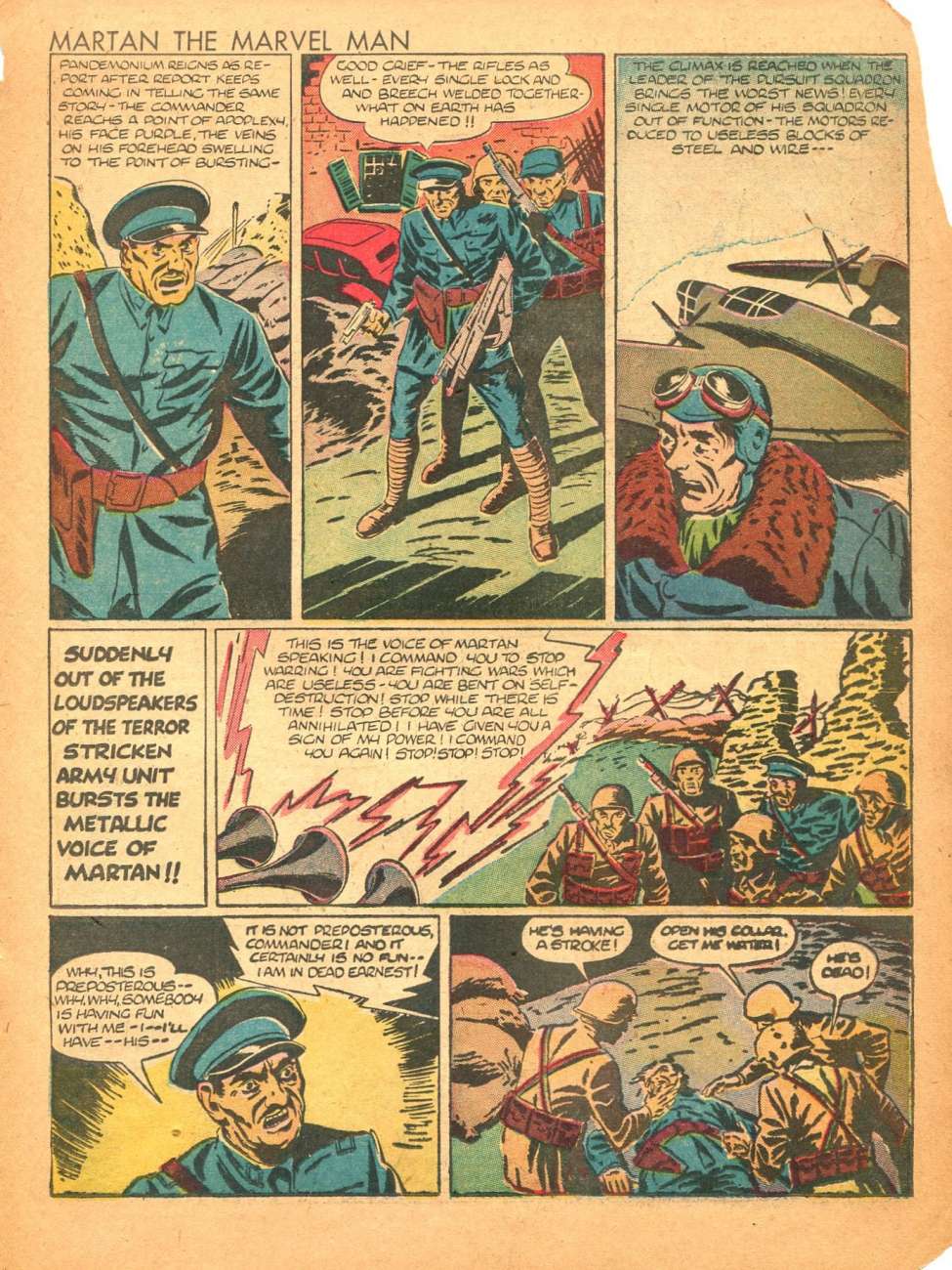
We're back with Martan today. He's flying around, judging Earth pilots as they shoot at him, and -- what? Isn't he flying a spaceship? How does he lean his arm out the window?? Did he actually roll down the window, like in a car?

I like the dialogue on that one pilot. I don't think he's using "smack" as a noun, but I can't wait to use that line in a game someday -- "I'm ready to pour 'six rounds of heavy caliber smack into him'!"
Interesting -- Martan is obviously attacking them with a raygun, but it's so rare for a ray to be invisible in comic books. The effect of the ray is specifically to lock up all mechanisms -- but this is effectively the same as temporarily wrecking things.
What we don't get a good idea of is what the area of effect is for this ray; we can tell it's wide, but it does have its limits (as Martan discusses shortly after this page).

Another feature of Martan's ship is that it can broadcast his voice through any electronic device, like these loudspeakers, with a range as great as the raygun.

The story takes as a dark turn, as the commander is so shocked that he has a stroke and dies on the spot. That is one failed morale save (on my chart, the worst result is fainting!)!
"Fata Morgana" is the Italian name for Megan le Fay. Martan's power seems to be the first instance of postcognition in comics (new super power!). Martan is able to create an image of what the building used to look like that both he and Vana can see (but not for long). It's unclear how long ago the church was ruined; perhaps postcognition can only reach back a few days in time.
Martan has no compulsion against killing humans (humans are still beneath him; an easy position for an alien to take).

Weird that the shadowy figures are armed with only swords and daggers. I actually did stat shadowy figures as a mobstertype back in Supplement V (and will likely include them in the Mobster Manual).
Radios being broken seems a not uncommon complication of airplane crash landings.

Being marooned on a deserted island is a great H&H scenario, as it tests the Heroes' ability to problem solve without the use of most of their special abilities.

The Masked Pilot should be very suspicious of the captain's lack of suspicion, particularly in regards to the Masked Pilot's mask.
Treasure placement can include weapon placement and always needs lots of thought, as two fully loaded automatics is not what I would expect to have found in a radio room.
It's interesting how the Masked Pilot is not worried until the sub-machine gun turns up. Now, that's interesting because, in H&H 2nd ed., a sub-machine gun isn't all that dangerous in the hands of a low HD mobster. Could it do more damage vs. a vehicle, though?

Things continue to escalate once the grenades come out! This kind of escalation of threat level happens all the time in game play, with the same risk of weapons falling into the Heroes' hands.
In Gang Busters, we see how a skill check for even driving can be critical in a scenario, as a failed check would send them over the cliff, or stopped before the parked car.

(Scans courtesy of Comic Book Plus.)

Thursday, April 4, 2019

Popular Comics #48 - pt. 1

We come back around to Dell as it celebrates the fourth anniversary of its very first title. With no sign of its original licensed comic strip features, like Moon Mullins, Dick Tracy, or Little Orphan Annie, we begin instead with the now-completely forgotten Captain Tornado. Although Tornado, Professor Bordani, and Jane are all stranded on an alien world, they might as well be just shrunken to insect size on Earth, because this whole feature is just an excuse to teach kids about bugs. Well, "teach" might be too strong a word for a feature that shows spiders as having only two eyes.
Normally people don't shoot into crowded melees in comic books, but Prof. Bordani does take time to aim first, which (at least in 1st ed. Hideouts & Hoodlums) always got you a +1 bonus to hit.
Everyone seems fine with the Professor's math, and not curious at all how the entire planet is not a barren desert, with three suns beating down on it, all at those sizes in the sky. In fact, I'm pretty sure they should be taking heat damage every turn.
Look out, Jane! In its belly, you will find a new definition of pain and suffering as you are slowly digested over a thousand years! Oh wait, it's only a giant ant lion. I might have to include giant ant lions in the Mobster Manual now (if I ever get it done!), probably as a 4-5 HD giant animal mobstertype. It is tough, taking a bullet or two from Tornado, and then still being able to chow down on a giant bug on the following page (not shown here).
Finally giving us something besides insects, our auteur here introduces an alien bug man. Professor hypothesizes that the man has a broken wing, failing to consider that his weight might just be too much for that type of wings to support (vestigial wings, perhaps?). As a nocturnal race, unaccustomed to daylight, they would likely be -2 to hit in broad daylight.
Here we get evidence that our "wingman" (for want of a better name) comes from a civilization with at least 20th century elevator technology.
I don't have much to say about Shark Egan this month, but this page seems like a great example of grappling working the way I imagined it in the 2nd ed. H&H rules, with the attack and counterattack taking place in the same turn.
Shark seems to have no idea what Buddhists believe in and is just wildly guessing. It's okay to say you don't know, Shark!
Finally, Martan the Marvel Man is still flying around Earth, talking smack about Earthlings, which I guess is only fair as we keep shooting at him and the ...invisible armor on his ship? I can't help but wonder what the point of making armor invisible is. Does Martan mean that the armor is blended seamlessly into the structure of the ship (he's now bragging about his aesthetic superiority?)? Does he mean that his ship is surrounded by an invisible forcefield? Regardless, I'm guessing his ship has a very low Armor Class and those bullets are just going to bounce off it on the next page...

(Scans courtesy of Comic Book Plus.)

Monday, April 1, 2019

Miracle Comics #1 - pt. 4

Sigh. I like to think of myself a moderately capable artist myself, good enough to recognize good art when I see it and be rankled by bad art. And this is really, really bad art. Like, had no business ever being published bad.

What is even going on in that first panel? The Masked Angel brags he never misses and then...misses? Or did he shoot the man in the wrist? That's how the guy is holding his wrist, but the gun wasn't pointed anywhere near it.

And that car in panel 4! The arms in panel 6! Ugh!
The dialogue isn't that bad, and this isn't the first story I've read recently to make this weird mistake, but if you are playing a mysteryman and baiting the police with notes -- don't handwrite them! Especially if the police captain knows you and has probably seen your handwriting already.
The last feature is Pinky Parker. It's a pretty slight story, but I'm including it because of this well-orchestrated and yet pretty implausible escape from a trap. One, that the bad guys would make the mistake of trapping Pinky and his copy friend in a closet with a gas jet in it. Two, that the peashooter can fit into the gas jet and still reach the transom (must be a bendy straw). Three, that the other room would fill with gas and not the closet, despite the transom being open the whole time. It's like the Editor listened to his players' idea to escape, shrugged his shoulders, and said "Sure, just save vs. plot and it all happens that way."
And maybe this bugs me most of all. With no other evidence on which to hold them, Pinky asks the conductor to search their pockets and then tells the conductor he put them there, as proof his story is true. He could have said that after anything was pulled out of the pockets.

(Scans courtesy of Comic Book Plus.)