Tuesday, September 10, 2019

Speed Comics #6 - pt. 4

One last visit to this issue, and we'll resume where we were with Lt. Jim Cannon of the British Navy. This page will give you a good sense for how hard it is for a low-Hit Die mobster/low-level villain to hit a target. Jim isn't far off when he mocks Devilfish for not being able to hit the broad side of a barn.

---

While this author was spot-on last time with the British using 15-inch guns, the Germans had already switched to metrics by then. These German "6-inch guns" were really 15 cm naval guns, and yes, the Germans were using those (the scale being to the ammunition, of course, not the gun itself!).

However, there seems to be significant artistic license going on here with the "torpedo cruiser." I've seen no pictures of torpedo cruisers that looked like small motorboats, nor have I seen any that launch from the bow of the boat yet.
Moving on, we're going to look at a super-creepy installment of Landor, Maker of Monsters. Voldemort's Dad here has created a new mobster-type, the cat man, in the most disturbing way possible. He's apparently shrunken a woman's body down to the size of a large cat, say 3' tall, traded her head for a real cat's head, and made it so that it would act in very un-cat-like ways, like listening to you when you tell it to do something.
So they just happened to be within sight of Landor's castle. Maybe not the safest place to take your niece for a picnic? And if they know this is Landor's castle, why do they leave it unguarded? Or why not buy it and raze it to the ground? Or convince the nearest municipality to annex the land and rezone it?

---

Cat-people are good for fighting half-pints and small dogs, but pretty useless against full-grown men. I would be generous giving this poor thing 1-1 Hit Dice.


The hammer toss is an unusual grappling maneuver, but I'm not sure if we need to add it, as this could be replicated with the throw result. In game play, I would say Torrence's player asked if he could throw Landor into the generator and make it explode. The Editor then said, let's break this down mechanically; you can roll to grapple Landor, then you can roll to hit the generator with Landor, then you can make a wrecking things roll vs. the generator. Torrence's player then got some pretty good dice rolls!

---
"If only we could be sure! If only...we could wait for the fire to die out and then check the ruins for his remains. Or watch the entrance and see if anyone comes out..."

---

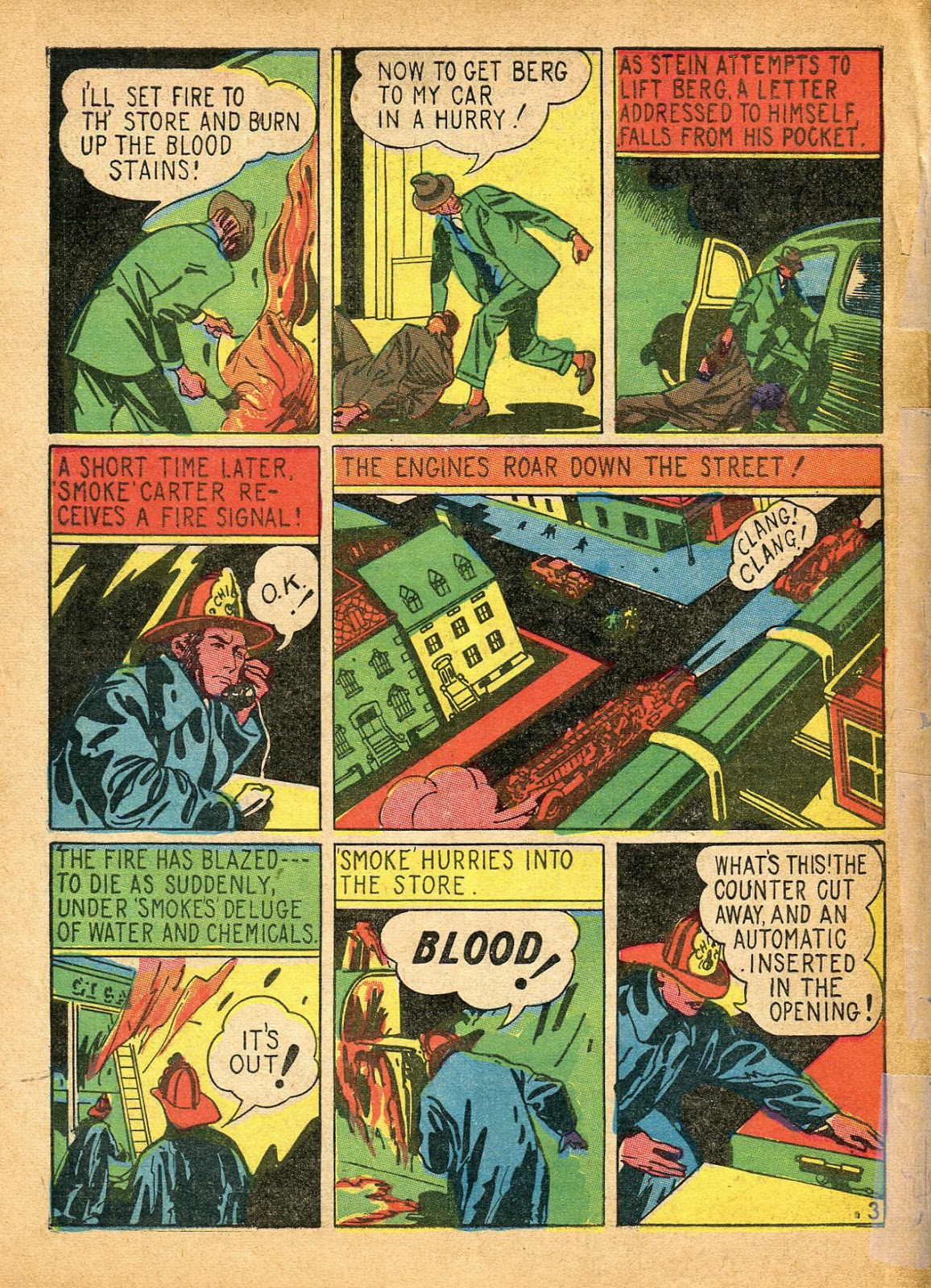
Moving on to Smoke Carter, we find some unusual clues to find at an arson scene, including blood, a counter cut away with an automatic inserted in the opening (like finding a trap), and a letter addressed to himself from the arsonist (not generally a good thing to be carrying when you're committing crimes, but it makes things really easy for your players!).
Guard dogs makes a lot of sense from a mobster's perspective, though it makes things tricky during game play -- do you discourage your players from beating up on dogs and make them outsmart them, or let the players play out the encounter anyway they want (spoiler: odds are 50/50 they will beat up the dogs)?

---

Hey...where did Smoke get those steaks from? Are you telling me he routinely carries steaks around in his car for emergencies just like this?
And lastly, we're just going to peek in on Spike Marlin, with a more whimsical than normal adventure courtesy of George Tuska (whose figure work is as stiff as ever here).

---

Spike pulls off a coupe most players of H&H would be envious of: a two-man press gang fails to capture him, so he beats them up, disguises them, and sells them back to their own boss -- netting him XP and $!

(Scans courtesy of Digital Comic Museum.)

Friday, September 6, 2019

Speed Comics #6 pt. 3

We're still looking at this month's Crash, Cork, and the Baron adventure and, as always, talking about comic book stories and how to emulate them using the game Hideouts & Hoodlums.  If you don't play H&H, you're still welcome to stick around and look at the pretty pictures.

Under most circumstances, and as we've talked about many times on this blog, H&H makes no distinction between subdual damage and lethal damage; the only time injuries kill is when the character is already unconscious or in a deathtrap. So the question here is, is Crash in a deathtrap?

No, the natives' intentions are to torture Crash, not kill him, so this cannot be a deathtrap. Indeed, rather than full damage, it appears that the natives are being careful to do less than full damage.


I hesitate to allow either side, players or Editor, to have such control over their damage that they can specify an exact number of points of damage they want to inflict, but misusing or under-utilizing a weapon should make it work like an improvised weapon, which do half weapon damage.

I really hate how this story ends. They threaten the chief, feed him a baloney story about how oil pipes leaking into their drinking water isn't bad for them, and then apparently get him addicted to cigarettes to force compliance. I just...ugh.
So let's move along and look at Ted Parrish, Man of 1,000 Faces.

Right off the bat, I'm wondering about that fall. Is Ted -- disguised here as Pedro -- really knocked unconscious by that, or just pretending? Ted is a 2nd level mysteryman by now, so it seems awfully humiliating to have a 10' fall knock him out. On one hand, maybe he's feigning unconsciousness, so no one can ask him any probing questions about where Pedro had got off to, but on the other hand, maybe the Editor wanted him unconscious so he couldn't do anything that would derail the story before the sub reaches Central America.

So, the next question I have is -- where is this? What Central American country was producing oil circa 1940? With some effort, I was able to find that Mexico started drilling for oil back in 1916, but I can't verify any other countries were drilling that early.

Even this page, which talks about a jungle, does not invalidate Mexico as a likely suspect. Though one normally thinks of Brazil both in terms of jungle and oil, Mexico has the smaller Lacandon Jungle within it.

And look, the ol' stick in the mouth trick!
Moving on, this is Dick Briefer doing Biff Bannon. For humor, the superhero-soldier turns out to have a fear of public speaking. But what does that mean, in terms of game mechanics? Is this evidence that Biff has a low Charisma score? Perhaps Biff's player really wants Miss Lee for his supporting cast, and is afraid of messing up the recruitment roll?
This first tier is rather remarkable. Firstly, it's a stirring mini-speech about the value of integrated public education to combat racism. I think that was Dick's genuine intention, as the second remarkable thing about this tier is panel 2, and the black boy who is drawn completely normal (or as normal as Briefer's highly stylized art allows). Remember, this is a time when even artists as progressive as Will Eisner were drawing black people in minstrel show style.
I'll spare you from the strange subplot that gets Biff put in a dress and wig. The important thing here is the sheer mass of improvised weapons half-pints can use, including things I never thought of, like B-B guns, firecrackers, blowguns, and inkwells. The inkwells come with a little something extra, the chance of producing a blinding attack, but I would say that's pretty unlikely; maybe if the inkwell hits on a natural 20.
This page is noteworthy because the mobster in panel 2 acknowledges that they live in the same world with Shock Gibson. So many characters lived in their own isolated universes before this, even in the same anthology title.


This is Lt. Jim Cannon of the British Navy. By "15-inch guns" it probably means the BL 15-inch Mk I naval gun. "It was the first British 15-inch (381 mm) gun design and the most widely used and longest lasting of any British designs, and arguably the most efficient heavy gun ever developed by the Royal Navy. It was deployed on capital ships from 1915 until 1959, and was a key Royal Navy gun in both World Wars," according to Wikipedia.

Leaving your big, protective ship, and putting yourself in harm's way in a shot-range plane or a torpedo launch seems like a terribly unsound tactic, and yet what else can a Hero do? Share XP with everyone on board the Hood? Not likely!

(Scans courtesy of Digital Comic Museum.)


Tuesday, September 3, 2019

Speed Comics #6 - pt. 2

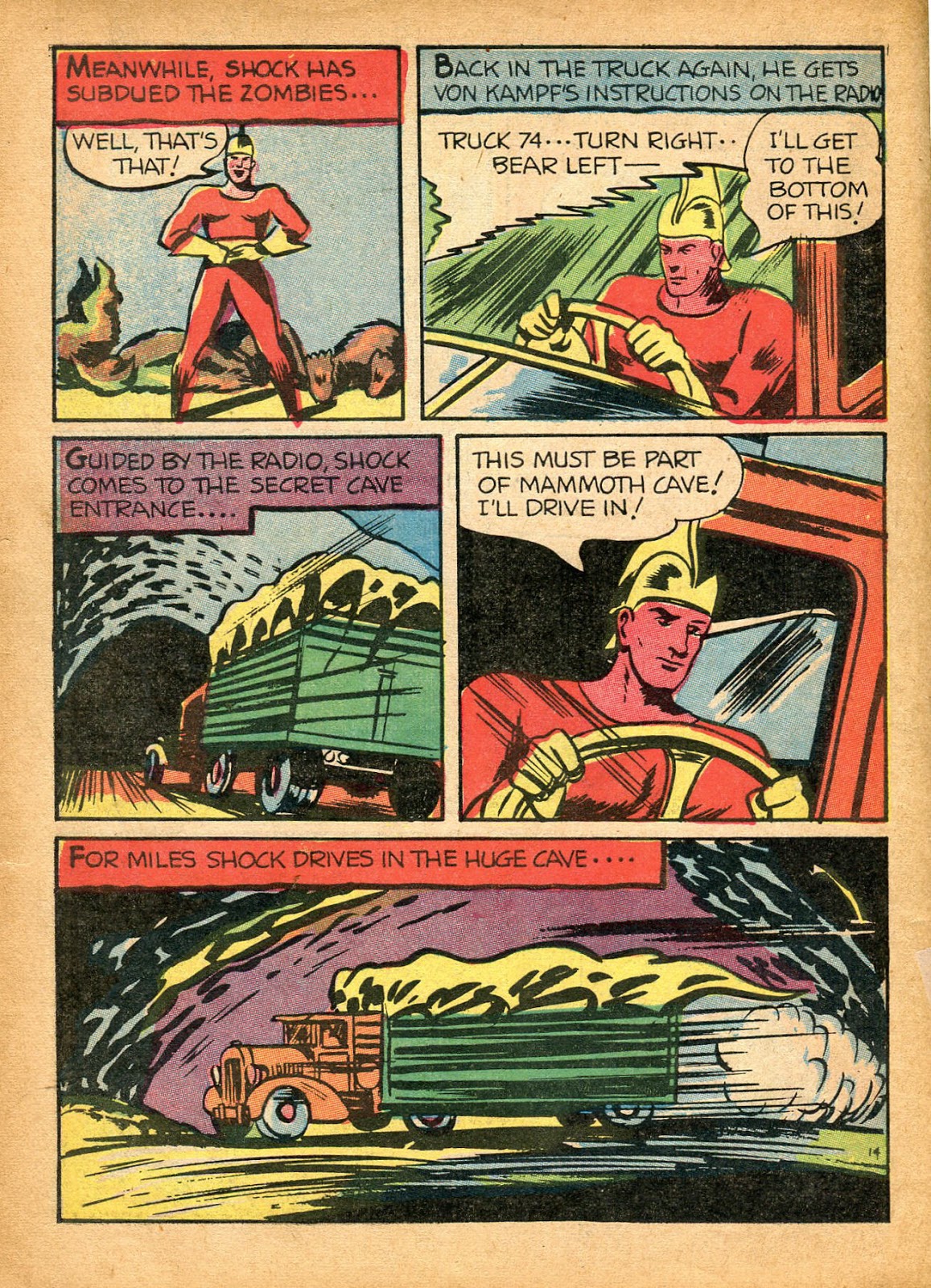
Continuing on with the latest Shock Gibson adventure, we find Baron Von Kampf is finally using the tactic I had predicted last time, of using the truck's radio to lure Shock into a trap.

It's very unclear to me how a cave mouth wide enough to drive a truck through is a secret entrance, particularly to a well-explored cave complex.

And man, someone really smoothed out those tunnels to allow a truck to drive for miles through them!
When we do see bats in comic books, they tend to be just hideout dressing and not an actual encounter.

An electrical field on the other side of a doorway marked "enter" is fiendishly clever.
A deathtrap worthy of Houdini!

This is the second time electricity has drained Shock's electricity powers. I still don't get how that works, but I appreciate that his player wanted him to have a weakness. By Hideouts & Hoodlums rules, he doesn't need one unless he's statted as an alien, android, or merman superhero.
Shock is using wrecking things to escape this deathtrap -- and it really is a good deathtrap, because if he missed one or two wrecking rolls, he might actually have suffocated inside the concrete. But what category is Shock wrecking? A brick wall is in the cars category, but this concrete hasn't had time to harden yet. On the other hand, Shock has to move with zero room for leverage, so that penalty might negate any advantage he has from the softness of the concrete, so I would stick with cars.

Every villain's hideout needs a lever that opens trapdoors. The question is, does the trapdoor need to be placed in advance and the Hero's movement through the cave accurately mapped, or simply make him save vs. plot to avoid passing over the trapdoor by chance? The former has a certain amount of built-in suspense, as you put a map in front of the player and ask him to show his route, but it requires some prep work from the Editor in advance.
Pit traps that fall into water filled with alligators are a dime a dozen; what sets this trap apart is the waterfall in between. What purpose does the waterfall serve? Not much that I can imagine; it would not disorient the Hero and give him a penalty on his surprise roll any more than falling into the water initially would. If anything, the waterfall gives the Hero a little more time to save himself before winding up in the lower pool with the alligators.
It's usually sharks that are shown attacking each other when one is hurt (the myth of the feeding frenzy), but it's a real stretch to say that having its tail in its mouth makes it so helpless that the other gators go into a feeding frenzy. Couldn't the gator just spit his tail out anyway?

The result is the same anyway; Shock basically chickens out from the fight and exits the pool, using this so-conveniently forgotten ladder left in the pool.
Wrecking a stone wall is in the trucks category, and I would put support pillars in the same category. Now, did Shock make some kind of geology skill check first to determine those were load-bearing columns, or did he just start wrecking columns at random and get lucky?

The Villain class has a percent chance, higher per level, of being "lucky to escape" just like this.


And now we'll skip the beginning and jump further into the next story. Crash, Cork, and the Baron (now also referred to as the Three Aces) are in South America navigating what appears to be the Amazon River. Their riverboat has hard cover in the form of protective screens, but it's not enough to keep some "arrows" from getting in. And I use "arrows" because, if they're 5' long, we should really be calling them javelins.

Of course, from a modern perspective, it's difficult to side with the Three Aces here. That pipeline is going to spill crude oil into the river and pollute the environment; they are really on the wrong side of this conflict.
...Not that the natives seem interested in solving this diplomatically. The native on the far right in panel 1 seems to be drawn more like a monster than a human, betraying the racism of this story.

Hurled stones are improvised weapons and do 1-3 points of damage.

(Scans courtesy of Digital Comic Museum.)

Sunday, September 1, 2019

Speed Comics #6 - pt. 1

We're back to Brookwood, predecessor of Harvey Comics, and home to Shock Gibson. Shock is, despite being human and having electrical-based powers, very Superman-like. This is great for Hideouts & Hoodlums, because these superheroes are all using the same powers and that makes them easy to catalog.

Here's Shock using the 1st-level power Feather Landing.
And here Shock is using the power Raise Elephant. Since he's not using the truck as a weapon, that is just flavor text assigned to the Raise Elephant power.

Shock would already be a 4th-level superhero at this point, but he still doesn't have enough of a reputation that ambulance drivers recognize him on sight.
Although he's outrunning a motorcycle and a truck, the power in use here is Race the Train.
There are Hold powers, like Hold Plane, that Shock could be using here against the truck, but since he doesn't seem likely concerned about whether the truck is damaged, it's more likely he is simply trying to wreck it.

It's also conceivable that little enough time has passed that the duration is still ongoing for his earlier application of Raise Elephant.
I love how Shock is interrogating the mobsters through the truck while he's holding it up.

Shock's forcefield is likely the power Imperviousness.
Unconcerned that the mobsters on the radio were listening in earlier, knew Shock had the truck, and were attempting to lure him off-track -- Shock just drives off to Kentucky because he was told to.  This is why it's a great idea for Editors to be flexible with their plans. If you weren't expecting them to go to Kentucky and your players go anyway, then it's time to relocate the adventure to Kentucky.

New York to Kentucky, incidentally, is about an 11-hour drive. I wonder if Shock drove straight through or stopped overnight. There's no indication in the story either way.
I love the idea of hiding hideouts in famous, real world cave complexes. I wonder if a map of Mammoth Caves is available online somewhere.

I've talked about Von Kampf zombies before and how they will be in the Mobster Manual (to be released eventually!). I really like how steady Von Kampf is; he's not a Lex Luthor who flits from world conquering plan to plan. Von Kampf is always focused on one plan, taking over with zombies!


I include this page because I very briefly wanted to mention that, in a modern setting, it is very easy to transport mobsters to wherever you need them for your scenario. Mobsters typically found in a different climate -- or even in a lost world setting -- can be flown or trucked into other areas to be encountered.
I'll have to add to the Von Kampf zombie entry that their creator can see what's going on through their eyes (I would assume, so long as he is within so-and-so range and has the appropriate equipment to do so).

(Scans courtesy of Digital Comic Museum.)

Wednesday, August 28, 2019

Rocket Comics #1 - pt. 2

We're still looking at the first comic book of March 1940, from Hillman!

Hurricane Hart, High Seas Hellion, is noteworthy because of this note, or more specifically the riddle on it. My players have always hated riddles, and they wouldn't like this one any better.  Indeed, I doubt many of them would have figured this one out.
Spoilers abound on this page for the riddle.

---
Also note that, in Hideouts & Hoodlums terms, the monetary value in that treasure chest probably just bumped Hart up a level.
More riddle spoilers. The tide was so strong, it pulled his pants off between panels 1 and 3!
Moving on to the next story, this is Red Robert, the Electro Man. This guy kind of resembles Spider-Man's future foe, Electro too, though Red completely foregoes any kind of costume, and the Marvel comics version was over-the-top gaudy (in a good way).

Red is more powerful than Marvel's future Electro too, as in addition to (in H&H terms) Get Tough and wrecking things, Red can turn into electricity and travel through power lines, via the high-level power Teleport through Focus (more like DC's future Atom). Electro Man must be buffed a lot of brevet ranks.


Although buffed to the gills with brevet rank-enabled powers, Red is still a starting-level Hero and has starting-level funds; hence, his needing to borrow a car from his sister. And why would someone who can effectively teleport through power lines need to borrow a car? Because his H&H player wants to conserve his high-but-still-limited number of powers he can use per day for the big fights ahead.

Panel 4 is very confusing, as if panels are missing Where did that paper come from and what does it have to do with being too afraid to fight?

The villains' hideout just happens to be stocked with a vacuum-bell-drops-from-the-ceiling trap. Very dangerous, as long as one of the Heroes happens to step in just the right 5' x 5' square and -- oops, hasn't already demonstrated the ability to wreck things.

I need an invisibility power for superheroes besides Invisibly Fast...

Jumping ahead, this is The Steel Shark, which is the name of the villain, while the Hero is Lt. Dick Jones. You know you're dealing with a villainous mysteryman when they have a signature move like leaving a submarine-shape cut where they hit you.

Comics.org lists "?" for artist on this story, but I'll be darned if this doesn't look like our old friend John Paterson, so prolific at Centaur back in '38.

Bear in mind this was a coded message that's already been decoded; the decoders bothered leaving the "stop" words used in telegrams, instead of just writing periods.

I wonder if we should have a mobstertype called a suicide jockey -- a mobster who's not particularly tough, but never needs to check morale and will kill himself in the most spectacular way possible at the first sign of trouble.

(Scans courtesy of Comic Book Plus.)

Monday, August 26, 2019

Rocket Comics #1 - pt. 1

We made it to March 1940! At the same time, we're going into the future with Rocket Riley. I think I'm gonna get whiplash!

There's not going to be much Hideouts & Hoodlums content here today, more just frolicking in pure goofiness.

"How naive, Dad! Don't you know that the secret of exploding the atom will be made into a terrible weapon, not a tool for peace?"

Ah, how blissfully ignorant the next five years will be.


"I'm going to build a spaceship -- and mount it on my roof! I'm sure that won't harm the building at all!"

It seems crazy how gold is going to destabilize a nuclear reactor, but ignoring real world science, there is perhaps some logic to this. We know that mass can't travel at light speed, only energy. Three pages from here, we'll hear Rocket claim they are approaching the speed of light. What if the nuclear reactor isn't just powering the engines, but is transmuting the ship and its interior into energy? And the one element it can't transmute into energy is gold.
There's actually good science concealed on this page. Even the void of space isn't completely empty, and one of the biggest dangers of interstellar travel would be collisions with objects.

...Although, if they were being transmuted into energy for the trip, they would probably just bounce off the object. Not immediately fatal, but being thrown randomly off-course could be deadly in the long run.
There's a lot of aviation talk here that's surprisingly accurate; let's break it down. An aileron is a hinged flight control surface usually forming part of the trailing edge of each wing of a fixed-wing aircraft. Elevators are flight control surfaces, usually at the rear of an aircraft, which control the aircraft's pitch, and therefore the angle of attack and the lift of the wing. A heliometer is a refracting telescope with a split objective lens, used for finding the angular distance between two stars. An inclinometer, or clinometer, is an instrument used for measuring angles of slope (or tilt), elevation, or depression of an object with respect to gravity's direction. Laterals -- on a plane -- would be flaps on the wing that control lateral movement; lateral control on a spaceship would be something very different, like maybe mini-jets on the port and starboard sides. Ceiling, here, does not refer to maximum altitude, but to ceiling functions in mathematical formulae. 
Here we see the importance of commas; note that Prof. Sterling is not saying, "I must start the vacuum, retards, or we will crash!"

This is also where Rocket says they are approaching light speed, as I mentioned earlier.
That there are four moons means, if they are still in this solar system, they must have entered orbit around Jupiter, Saturn, Uranus, Neptune, or Pluto. The surface clearly doesn't look like a gas giant -- though the dialog only says they entered orbit of a planet, not that they were landing on the planet; they could well be landing on a fifth moon.

Traveling to even Pluto at light speed would take less than five hours. They have clearly not left our solar system, because that would take over 4 years to reach the next closest star, Proxima Centauri, at that speed.
Now here's where things get really weird, as whatever world this is, is home to octopus men. They are encountered in groups of over 100 at a time.
Octopus men are fast on land, with a slightly faster move than normal humans (13-14?).

I'm not sure that's a sound tactic Rocket tried. By dodging, he makes two of the aliens crash into each. What is the other 100 doing, standing and watching behind them? I think Rocket really did fall, and the narrator is just covering for him.
Nope. Uh-uh. The wind resistance as they approach escape velocity would mean saving throws vs. science with a -11 penalty to keep from being blown off. Rocket should be taking 20d6 falling damage by the end of this page!

(Scans courtesy of Comic Book Plus.)