Wednesday, January 11, 2023

Amazing Man Comics #11 - pt. 3


We're still on Minimidget, so today we're going to talk about the trouble with shrinking and game mechanics. I have proposed before on this blog the radical idea of using no new game mechanics at all -- that shrinking is entirely flavor text. The benefit is that you are -4 to be hit, the same as if your opponent couldn't see you (in this case, because you're so small).  But that ignored one critical issue with being small, and that's getting from point A to point B when any common sense ruling at normal size would say you could not pass through that opening.  You could hand wave the common sense ruling, but that could be granting more power through handwaving then I am generally comfortable with, particularly in a scenario like this where escaping from a locked room is critical. 
Where that leaves us is that the shrinking Hero must be a Magic-User with the Poof! spell. The flavor text of the spell has been replaced with shrinking, but the spell effect - of getting from point A to point B over a short distance - is still there.

Ugh, Google isn't letting me wrap text around the images today. Thanks so much, Google!

I shared this second page for more evidence of the importance of random initiative rolls for each combat turn. Even as I've turned away from random initiative rolls when running D&D and back towards Old School common sense order, it's clear that common sense has nothing to do with who gets to attack first in a comic book panel. Here, the hoodlum has three guns trained on him, yet he's still able to rush up and punch Minimidget before anyone can make a move to stop him.

What you just looked at was Zardi the Eternal Man, a brand new character, and an interesting spin on the Mandrake clone. You'll notice in the following pages that Zardi sometimes appears to be using real magic, like when he makes himself young again, and other times his wand seems to be more like a scientific tool akin to the Doctor's sonic screwdriver. The last panel even seems to allude to this when it refers to what Zardi does as "tricks," instead of spells.

Now the question is, do I need a spell that de-ages someone? I would say probably not, since there are no game mechanics attached to age in H&H (except between minors and adults, and even then just for mobsters). More on this shortly.

"Conquering gravity" is a Levitate spell. 

And, of course, it's ridiculousy racist to make your ethnic manservant dress in period clothing and not let him even wear a shirt.

For a magic cane, it sure looks like it's just a trick cane with a retractable silk line reeled up inside it. The only magic I'm seeing here is that Zardi is strong enough to lift Jeffry aloft with one hand - but then, we can chalk this up to flavor text, since Zardi isn't using his other hand for anything important.


Here we can see that Zardi's age actually does figure into the scenario, as a disguise. Since that is the only purpose it is serving, this could simply be a Change Self spell. 

He also casts Invisibility on Jeffrey.


There is no explanation for how Silky faked that photo, but Silky is a great nickname for a Slick Hoodlum. 

Zardi is either casting Knock, or his cane has some electronic door-opening feature -- which it looks more like. 

The magic cane "works" because he's using it as a whip and actively whipping them. No magic here.


Chaldean illusions are the Phantasmal Image spell. 

I think it's refreshing that Zardi seems to be no more than a 5th level magic-user. 

I'm jumping into the Shark story in progress. 

There's not really a good in-game rational for how Shark just happens to find this going on with his "magic" television just in the nick of time...except....the Shark's TV probably has a certain chance of finding bad guys per turn, which were measured in rest turns, until the moment a combat happened, and then his turns became melee turns. This explanation is a little dodgy because the Shark is not in her combat until after he already benefits from being slowed down to her turn speed.

Another example of a gun being disarmed with a thrown knife.


I don't recall if any other Shark stories feature this weakness, but it's a good idea and makes the last two panels of the previous page all the more heroic. 

I don't get how Fritz is able to tell just by looking at him that he's helpless, or manages so quickly to tie it to the thrown knife. 

I'm also surprised that belt buckles can do that kind of damage. Were belt buckles made sharper in 1940? I would think they would each do 1-3 points of damage, at best. 

Pretty good art, though! 

(Scans courtesy of Comic Book Plus.)


Saturday, January 7, 2023

Amazing Man Comics #11 - pt. 2

Welcome back! Let's pick up where we left off last time with Chuck Hardy. Chuck has met a new species in his Hollow World setting and, no, it's not lobstermen, it's pygmy lobstermen. That implies that there are "normal"-sized lobstermen out there somewhere too. We don't learn anything about the pygmy lobstermen other than they use a monarchical system of government, are matriarchal, extremely friendly, and technologically primitive. We never once see them fight, so they could have 12 HD for all we know, but I think it's a safer bet that they have a 1/2 HD, or 1-1 HD at best.


I wish we had a sense of scale for that curious lizard, as it looks more fearsome than pygmy lobstermen and frogmen. 

I'm going to spare you the next page and the results of Chuck's trap. Here's a hint: had it been drawn realistically, there would be blood flying everywhere. So how do I stat this trap? A catapult-launched spear is going to be pretty powerful - I'd even be willing to say 3-18 points of damage worth - but it's also going to be an impractical, poorly-aimed weapon. Despite the number of spears, they would each have a chance to hit equal to just a 1 HD mobster. 

Incidentally, missing from this story is any explanation for how people with pincers for hands were able to make rope ladders.


If panel 3 makes you think of the Ewok Dance...then we think alike.

The only real reason I shared this page is the peculiar wording of "knock him kicking!" Google that phrase and the only thing that comes up is a sports article from a 1965 newspaper, and it's behind a paywall so I can't tell what the context is. I can only imagine that Chuck's dialogue is being written intentionally silly.


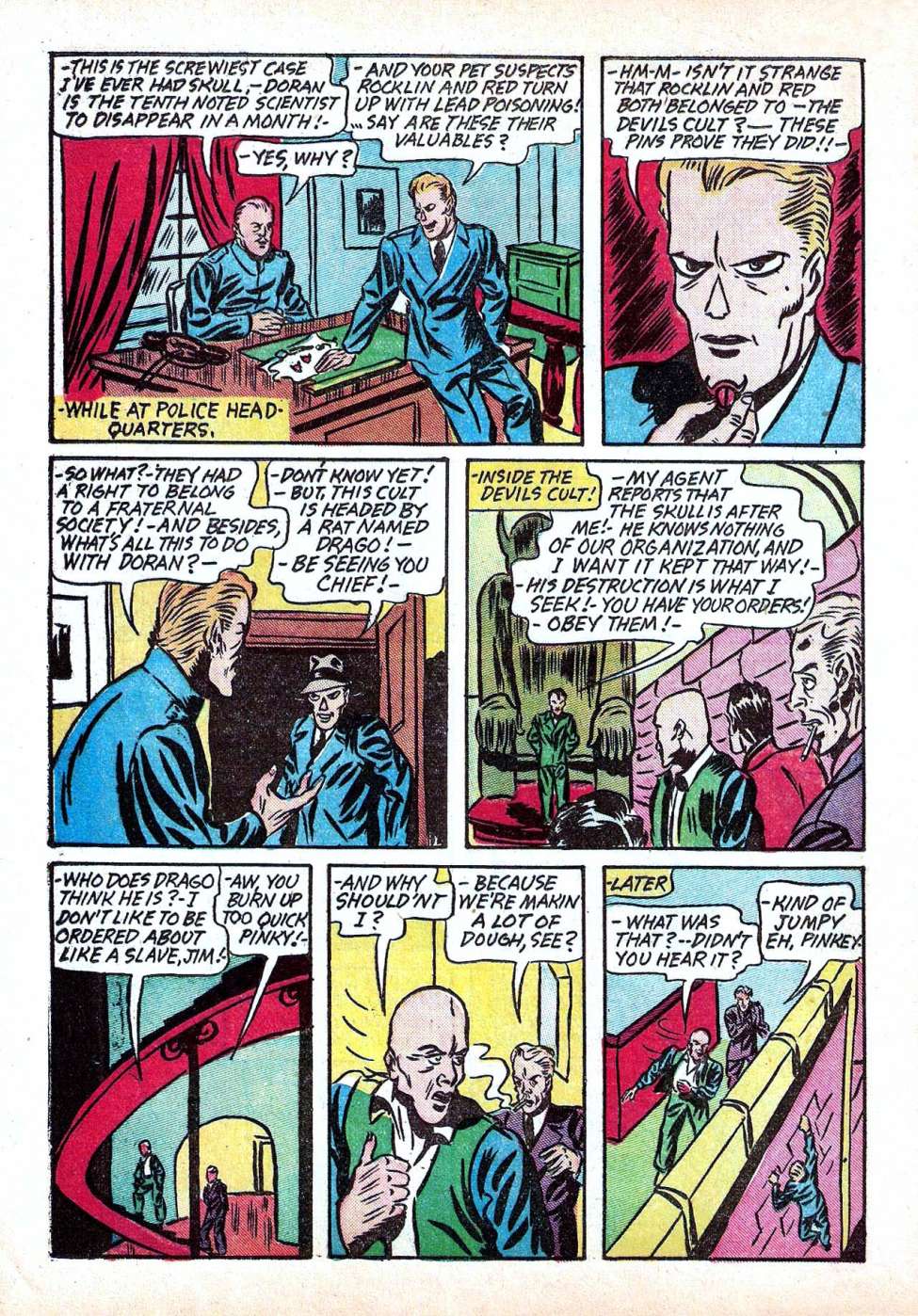
Moving on to Iron Skull...

I was confused at first by the term "pet suspects," never having heard it before. Apparently it's a real term meaning the same thing as "most likely" suspects, though my first thought was that the Chief had a pet that suspected them.

It's incredible that the Chief is unable to see the two dead men both belonging to the same cult as a clue. Or perhaps I should say it's suspicious... coincidentally, Drago hears that the Skull is after him right after the Skull leaves the police station. 

This episode of Pinky & Jim, Slave Cultists is interrupted by Iron Skull, climbing up the bricks instead of the easier drainpipe right next to him. To be fair, the Editor could rule that a drainpipe isn't strong enough to support an android's weight (there is no game mechanic behind that; it would just be a common sense ruling by the Editor). It's also possible that Iron Skull is so strong that he's pinching fingerholds into the bricks (which would be handled by a wrecking things roll). 

Here we have a new type of robot - grotesque robots. What's special about these is that Iron Skull's annod comptod machine doesn't work on them. Now, no one knows what "annod comptod" means, but we know from past issues that this machine is what Iron Skull uses to Wreck at Range (the power). It seems that grotesque robots are immune, or greatly resistant, to being wrecked. The Skull has to defeat them the old-fashioned way with punches. 


In the future (or maybe because this is a comic book?), you don't have to smother someone for 10 minutes with a chloroform-soaked rag to knock him unconscious, you just toss the rag on his face and if it lands he is knocked out. 

Both the art and the caption in panel 3 are confusing. The rod must run through the center of the sphere and spins it. The "pyramids" would more properly be called spikes. Being scraped against the spikes wile being rotated past them seems like it would do at least 4-24 points of damage to me. Good thing that the Skull is being held with nothing but rope - easily wrecked as if a door. 


Now this is interesting - Yagani is a Hindu name. In Iron Skull's future, he has to watch out for spies from India! (Unless Burgos just mistakenly assumes this is a Japanese name, since otherwise his WWIII is awfully similar to WWII). 

The bald guy is an assassin, as detailed in the Mobster Manual.  

I think this is the first time I've ever seen a comic book character actually swallow a key; this is usually a cartoon thing.


"Dragon has a time bomb hidden here!"

"We have no time to look for it! In a 10' x 10' cell with almost no furnishings!"

We can see it makes no difference whether Iron Skull wrecks with his head or his fists, so that's all flavor text.

I've never been impressed with Burgos' artwork, but that last panel is particularly rushed. That "BOOM!" going off a few feet away looks like it was set off by a firecracker instead of a bomb.

Note that we never did find out who Drago's informant was - my money is still on the Chief!

Before we go, let's peek in on just one page of Minimidget. All I have to say about this page is that Boma is a real city, in the Congo - and also that ordinary people seem to be really cool about tiny shrunken people in this strip.

(Scans courtesy of Comicbookplus.)


Wednesday, January 4, 2023

Amazing Man Comics #11 - part 1

Now that I'm finally publishing Amazing Man (see Funny Picture Stories #7 - on sale now!), covering this story might not only seem biased, but posting pages seems like it might hurt future sales - but oh well!

There are some big changes this issue, starting with how Aman seems to have dropped his first name, John. Gone also is the interesting struggle in John Aman between hero and antihero; the Council of Seven has decided these stories need to be a lot more straightforward from now on. 

Aman is "purified" by fire, but what this would mean game mechanically isn't clear. Is it simply a magical effect of Alignment correction? Is Aman taking damage from the fire? Given that his initial tests involved stabbing him with knives, I'm guessing he's taking damage. Aman is a really good sport about this, as I'm guessing they would not allow him to buff himself with the Resist Fire power. 
We begin to get some explanation here about why Aman is being dressed up like John Carter of Mars. Having an indestructible costume would normally be some comfort, but maybe Aman is secretly wishing it covered up enough of him to offer more protection? For that matter, how much should an indesctruble costume protect him?  In the 2nd edition rulebook, I have indestructible costumes being statted as Armor Class 2 (and remember, lower is better). My description wisely does not describe how much of the body needs to be covered by the costume, so maybe these straps and sternum hield are enough? Is what a costume looks like really no more than flavor text?

Has the purification ritual protected Aman from the Great Question's influence, or did Aman make his saving throw vs. charm?


It's just as well that Everett doesn't give us an exact number of days it takes to get from Tibet to Louisiana by plane. Even Google Maps can't tell me this today! What I can't figure out, which is probably more important, is where Aman was heading before he wound up near Louisiana. It certainly isn't on the way to Chicago or New York City from Tibet. Maybe he was planning on vacationing in Florida before fighting evil?

As far as I can tell, the "lost" in the "lost bayous of Louisiana" means that they have disappeared due to landscaping the terrain, as opposed to unmapped "lost world"-type areas. Still, this first interpretation is definitely more interesting and lends itself to adventure fiction.

This page attempts to explain away Amazing Man's John Carter rip-off togs as a "Tibetan uniform." Could this be the Great Question's final laugh at Aman, convincing him that this was the latest in Tibetan fashion?
I appreciate that Amazing Man has the subtlety, that you don't see often in superheroes, to climb a wall and oberve the bad guys unnoticed. Because he's climbing vines, I would probably still make the player roll a skill check, but at a large bonus. 

I like this hideout set-up, where the prison cells are behind a cell with three panthers in it (we'll see there are three of them on the next page). How Aman circumvents the panthers to get to the prisoner is great too, showcasing the versatility of this power. 

I've probably talked about this before, but I haven't posted in a long time and I can't remember. The issue is, how would Amazing Man have this power in H&H? Because Green Mist is not a 1st-level superhero power, or even a low-level one. It does bear some resemblance to the 1st-level magic-user spell, Poof! Could that be all it is - just an exception of allowing a Superhero to prepare a Magic-User spell as a power, and everything about it that isn't movement is flavor text?  
Three panthers is actually a pretty tough encounter in H&H, so it's disappointing that Aman takes them each out in one punch. It is more likely than them being knocked out that they have each failed their morale saves after taking damage and they choose to stop fighting. 

These bayou pirates have a lot of personality to them. We even get help with statting them. One is a brute (a variant of thug) and another is a slick hoodlum. Garlock, their leader, doesn't seem the master criminal type, but might be a mid-level fighter, since he can subdue panthers.

The brute gets upgraded on this page to pseudo-giant, a mobstertype that appears in the recently released Mobster Manual.  The throw is a very effective grappling move in the 2nd edition grappling rules - probably not enough on its own to take out a pseudo-giant, but Amazing Man may be buffed with one of the Get Tough powers to boost his damage. We also learn there are thugs present in the room (I see two of them, not counting Slick and Garlock).


Aman can be casual about what happens to the treasure because his Editor awards xp for treasure just for taking it out of the hideout. What happens to it after that doesn't matter if you don't have personal expenses!

But Aman is clearly gaming the system; there was no reason for him to kill those three alligators (he calls them crocodiles, but it makes sense that he did; he hasn't been in the U.S. more than six months). He obviously did it for the experience points!


What I like here is that Everett gives us almost a whole page of chemistry-building between Aman and Zona. Unlike Lois' attraction to Superman's animal magnetism, it looks like Zona is going to be attracted to how thoughtful Aman is (offering her his jacket for modesty) as much as for his rippling muscles. 

This next bit of research I had done back in November for the Public Domain Heroes Facebook group, but I'll reshare it here. 

I had long assumed that Amazing Man's companion, Zona Henderson, had a made-up first name, or it was a nickname (short for Arizona?). According to SSA.gov's baby names by years list - https://www.ssa.gov/cgi-bin/popularnames.cgi - Zona was a real name, though a rare one, ranking 712th-820th most common baby name in the span of years I think she was most likely born.

And, of course, we get the familiar trope of televisions being able to function like crystal balls. 

Chuck Hardy has moved up to second feature (which, I understand, was not generally considered the second best position in a comic book; it went first, last, and then alternated in towards the center). 

Frog men last appeared in Fantastic Comics #3. They turn up like bad pennies!

(Scans courtesy of Comic Book Plus.)

Monday, January 2, 2023

Thrilling Comics #3 - pt. 6

It's hard to believe there is so much we need to go over from this one issue, but here we are, squeezing out a few more pages for a 6th post!

We're still on the Rio Kid. I like this one story detail, where Keller has been trying to legally acquire that land all this time, but when he faces a last minute inconvenience his true nature is revealed and he tries to bully his way past it.

I can't be certain, as I've seen that trick shot stunt in a lot of cowboy stories, but this might be the first time I've seen a pen shot out of someone's hand. Considering that the Rio Kid is maybe five feet away from Keller, at most, and could simpy grab the pen away, makes me think Rio is just showing off. 

Panel 6 is confusing, as Rio appears to be gunning down Keller, but it is just someone else wearing the same shirt as Keller, because Keller shows up again in panel 7. It also looks like Rio is shooting the bad guys in the back as they're fleeing, but it's really just that one guy who has his gun in his hand. Rio "generously" allows the others to escape because they are unarmed. 

Panel 7 has several examples of hard cover. 

I had to look up "cayuse." According to Wikipedia, "Cayuse is an archaic term used in the American West, originally referring to a small landrace horse, often noted for unruly temperament. The name came from the horses of the Cayuse people of the Pacific Northwest."

If I was to do a cowboy-themed supplement someday -- which I've not ever fully ruled out -- I wonder if tough cowhands would need to be statted. They definitely are weaker than deputies.

Panel 6 confuses me. Does Kid Rio have some past with Keller we don't know about? Because it seems like Green has a score to settle with Keller, not Rio.


Bear with me on this -- this final feature is ridiculously racist -- but it is actually the first appearance of a pegasus in a comic book, not counting the pegasus-unicorns in Action Comics #6.

I like the quest - to bring back milk for undernourished children everywhere - and it seems very appropriate for a high fantasy scenario with half-pint protagonists. 

I'm also willing to forgive the racism on this page.  Assuming this is all in Marco's imagination, including Snowball, and Marco's only exposure to black people is from comic books, then it is entirely possible that he would imagine a black person looks like this.

I can't resist commenting on this page. For one thing, Ice Cream Mountains is wonderfully evocative and would be a good addition to a Candyland-themed campaign setting.  While the narrator calls them the Ice Cream Mountains, Snowball calls them the Tutti-Frutti Mountains. My first thought was that Snowball is using the term as a euphemism for an expletive (like "rassum-frassum"), but I see no evidence that tutti-fruitti was ever used as an adjective with negative connotations before the 1970s.  Tutti-frutti, as an ice cream flavor, has been around since the 1860s.

I also had to look up if there had been a particularly bad blizzard in 1899 or if that was a made-up detail. Sure enough, it was real!

I am tempted to stat snowmen as a mobstertype...

5,000 miles is just a fraction of the distance to the Moon. Not that the snowman is wrong; since we are already in the Milky Way Galaxy, you are there whether you go 5,000 miles or 1 mile.

The idea of an alien species that simply chooses not to age is an interesting one, more so than the Libertarian fantasy of a utopia the goat-riding baby alien espouses. Also more interesting is that the alien is riding a goat at all, which makes me think of Thor and his goat-drawn chariot.

Final feature! Now how the robbers think thousands of dollars is "the world's richest haul." This is entirely appropriate for a non-serious scenario.


$1,000 is a very generous reward for the theft of thousands of dollars and quite the xp boost for Buddy Braver. We also learn that a box of candy costs 50 cents. 

(Scans courtesy of Digital Comic Museum.)


Sunday, January 1, 2023

Thrilling Comics #3 - pt. 5

We're back, and so is The Lone Eagle! Here we see the Lone Eagle being overcome by four-to-one odds, which I find refreshing, even if it will not be the norm in this adventure from here. Perhaps he levels up quickly! 

Note that LE isn't placed in a deathtrap, but just left behind and they assume he's dead. Who has time to check for a pulse or watch for breathing? 

Now panel 6 is a big mystery, though you might not have realized that it was Where is this "no-man's-land"? You might assume, like I did, this is France - but this was published in February 1940 and Germany did not invade France until May! In February, the world knew Hitler had his eyes on Norway, but most of the fighting in Europe was taking place between Finland and Russia. This panel is like someone wasn't paying attention to current events and just, by coincidence, predicted the future!

I'm amused how Lone Eagle, clearly an Air Force guy, is able to commandeer a tank just by pointing at it. "This isn't Hertz, Lone Eagle!" that officer should be saying (fun fact: Hertz rent-a-car goes back to 1918!). 

I'm calling shenanigans on being inside an exploding tank and emerging unharmed, unless Lone Eagle is secretly a superhero buffed by the Invulnerability power. I think 8-80 points of damage, for being caught inside when a tank explodes, seems more than reasonable.

How did Lone Eagle catch up with Brent? If Brent was there some time ago, asking for the fastest route to German Intelligence, why is he still wandering around the battlefield? Or, if the soldiers didn't believe him and took him into custody - again, how is he now wandering around the battlefield? I feel like we missed at least three pages of Brent's daring escape from confinement.

Lastly, I'm again amused, this time by how Lone Eagle has a secret pocket in that jumpsuit. Come on, LE, the "secret" compartment is one of those huge, obvious cargo pants pockets above your knees, right?  

Great, thanks to this page we need to address the unpleasant subject of torture. Comic book heroes get tortured more often than I enjoy seeing. The goal is never to beat the hero unconscious, but to break his spirit and make him act unheroic. But how to handle that as a game mechanic? It might make sense to consider the whip damage subdual damage -- the hero can no longer resist if he reaches zero hp -- but LE just got over 100 lashes and I'm guessing he doesn't have over 100 hit points. I think how I would handle this is, every time the hero is reduced to zero hp, he has to make a save vs. plot or be broken by the torture. If the hero makes the save, hit points are effectively restored to full and the process can start again. 

But even if the hero is broken, what does that look like? Is the player forced to roleplay blubbering? A player could simply spare himself the headache of the game mechanics and chose this, as it's not really a consequence. But what if the hero lost something crucial - like experience points - if broken? There is precedent for energy draining in the game and, while it's purely supernatural, torture is a draining experience too...

One can't help but wonder what the warden was doing, taking a late night stroll without guards through the prison...but before that is the mystery of how LE got out of his cell. Did he use wrecking things to bust the door down?
Nope, nope, nope - unless that plane was planning to drop a person onto the roof of the train, there is no way LE should be able to leap up to the plane. I can no longer ignore that LE is clearly statted as a superhero, despite his lack of a proper costume and other genre tropes. 

That a superhero could have so much trouble with a single pilot is very much in keeping with how I pictured the superhero class balancing out in H&H; being a relatively weak fighter when not buffed with combat-related powers. 

But he's not just a superhero; it seems pretty clear that he's going to win this 6:1 dogfight (spoiler from next page: he defeats three and then escapes), which suggests to me that he's at least a 3rd level aviator, in addition to at least a 1st level superhero.

I do like the smart tactics of the Germans - trying to stop this unstoppable killing machine indirectly rather than continuing to approach the train with that field gun on it.

There were a lot of comic books published around this time that proved to be prophetic, not that it was hard - during WWII, if you imagined the worst scenario possible, that usually happened sooner or later. This comic predicts a German invasion of the Netherlands three months before it actually happened. Apparently the Dutch failed to believe Lone Eagle's warning. 

Again, this story predicts the bombing of London seven months before it happened. It predicts the bombing of Berlin by four months, though clearly the author is wrong that bombing Berlin first stops the bombing of London.

"Gee, good thing you told us not to miss, Lone Eagle! We were aiming low for a 50-50 success rate!"

A 50-50 success rate is, of course, the norm for 1st-level characters in H&H.

Yes, the British RAF did use some American planes, but most of them were British-made. The implications of this story are, of course, that the English can't save themselves withou the U.S.'s help (again, largely true), and that Americans would seem like superheroes on the battlefield with Europeans (this is just propaganda).

Moving on, we return to what I have long dubbed the Mythic West, a "demi-plane," if you will, that allows for "Wild West" action in the modern day. 

Nueces, Arizona, is not a real place, but is likely named after Nueces County, Texas. 

Panel 3 has some rather disturbing implications.

I had to look up the use of punchers here. From the Internet: "In those early days of cattle drives the cattle were not particularly eager to enter loading chutes or box cars, so the cowboys poked or punched the cattle with long poles to get them in to the cars. The term was first recorded in 1880 and soon became a synonym for all those who worked cattle."  I don't think "Fork-D punchers" has any special meaning, other than they work for the Fork-D ranch...

I had to look twice to verify this, but the guy in the fight at the bottom isn't the Rio Kid; he's just some guy who's about to become Supporting Cast, and is probably at least a 2nd-level cowboy, given how well he's doing in this fight.

Boy, this is one violent comic book! This page is a nice reminder, though, that not everyone in a given organization is going to be the same Alignment. Here we have a Lawful jailer having a disagreement with the Chaotic sheriff. Turn this around when you're stocking your hideouts - make sure there are the occasional Lawful hoodlums who may turn on their bosses and help the Heroes!

Shooting a rope, while riding on horseback, would normally require a natural 20 on an attack roll (at least while I'm running the game) - but this is why the cowboy class, when it resurfaces in 2nd edition someday, will still need to have stunts. 

Tombstone is, of course, a real place. It is likely a portal site that exists in both the real world and the Mythic West, so one could leave Tombstone heading into either.

(Scans courtesty of Digital Comic Museum.)


Thursday, September 1, 2022

Thrilling Comics #3 - pt. 4

We're back (after a LONG time away!), still with the Three Comrades, though you'll only see two of them on this page. 

Max should be statted as a guard, or maybe a beat cop. 

Note that our two Heroes intentionally surrender to Von Sneer, no doubt to learn what he's up to. If they'd wanted to, they could have rushed him, even from across the room, and still gone before him if they'd won initiative (which I see happen in comics a lot!).

It's worth noting that Heroes shouldn't have to worry about what languages they know, but you're encouraged to take this benefit away from non-Hero characters. This is a good way to give Heroes another advantage over normal people (and here, greatly assists the plot!).

This page brings up an interesting point, because a lot of the time Heroes are tied up for deathtraps, but are almost never gagged. And they almost never yell for help either. Now, we don't expect them to because it doesn't come off as very heroic, but it is certainly the most natural reaction to being tied up. 

I am skeptical about allowing a filing cabinet tipping over on someone to knock them out - though it will famously be super-effective against Iron Man years later - and would probably allow this to do no more than 1 point of damage. Of course, it's possible for mobsters to only have 1 hit point!

That's a really good guess as to what the oil drums are for. I probably would have guessed they were smugglers myself, but this makes for a better story with higher stakes.

It's weird how physics work in comic books to feed the narrative. A filing cabinet tipping over knocks out a guard, but Lucky bounces down a flight of stairs, caught halfway in a barrel, and seems virtually unharmed. Two thoughts: 1) this proves that damage ranges are a thing, and 2) it makes me wonder if objects should be able to soak damage. I have ruled before if you fall on a person, you can half your damage and transfer the other half to the person you're landing on. But if we applied that to inanimate objects...then armor has to work much differently game mechanics-wise. I think we'll skip this for now.


"Attaboy, Lucky, keep 'em busy killing you!" Seriously, how is Lucky not dead, as the mobsters shoot down at him at short range and he's only moving as fast as a motorboat attempting to match to their vessel? Luckily, in the hands of a 1 HD mobster, even sub-machine guns only get 1 attack per turn. 

I am as unconvinced by that wooden beam being able to do that as I was by the filing cabinet. This is a very generous Editor these boys' players have.

Using the oil seemed an ingenious move at first, but wouldn't starting a fire with it have been more effective?


We're done with those crazy kids and moving onto the next feature, The Woman in Red. The violence level is pretty extreme in this feature, with a man being shown (granted, in silhouette) hanging from the rope that you see on this page on the previous page, and on this page you get a knife thrown into someone's neck (again, granted, not the first time I've seen that in a golden age comic book; it even features into Amazing Man's origin story). 

I mainly include this page for two points. One, American mansions have a tendency to be castles or have many castle-like features in golden age comic books -- and that is a good thing, because you can freely borrow castle maps from That Other Game and use them here and they fit this game. And secondly, telling the handedness of someone from how they tied a knot sounds like a basic skill check to me.

Okay, one more observation - other than having very pronounced cheekbones, there doesn't seem to be anything too terrifying about The Terror.
 
Since The Woman in Red and The Terror are both unencumbered and, hence, moving at the same movement rate, it's only natural that WiR fails to catch up. 
 
Here, we learn that you can open a secret door and still get a surprise turn after. 
 
A 200' drop is a very tall castle, unless this also accounts for a dry moat at the base of the castle wall too? 
 
It's not clear where the mysteriously handy rope is hanging from. Depending on how far down she is when she passes it would help me determine how fast she's falling and, from that, the AC to reach out and "hit" the rope -- AC 9 in the first second, AC 7 in the second second, AC 4 in the third second - by then she's fallen more than halfway. I might also require a Strength or a Dexterity check (whichever is better on the 1st second; whichever is worse on the 3rd second) to determine if she can keep a hold on the rope after catching it, or if her downward momentum pulls her past it. 
 
I'm puzzled by what that shape is in front of the window, as I'm not aware of that being a castle feature. I mean, it makes sense, as it makes it harder for anyone to smash through the window and fit inside, but I just don't know what that pole would be called.  
 
I wish I had enough detail to map this castle, because we keep getting tantalizing glimpses of how elaborate it is. So far we have a rooftop access door from a tower, multiple staircases, rooms that are only accessible by secret doors and outside windows (or by digging your way into them), and a literal dungeon with cell doors (double-barred no less) on the same floor with a library.


More interesting points - the Woman in Red gives away her real name in order to gain someone's trust, a rare instance of a gun being used to disarm a knife, and in the Scooby Doo-esque climax we learn that the butler - that is, someone named Butler - did it.


Here's a quick look at the next feature, which gives us two novel twists - one, a new location to rescue a damsel in distress from, and two, a new "Macguffin" - a military code book (thank goodness it's not yet another new invention!).

(Scans courtesy of Digital Comic Museum.)