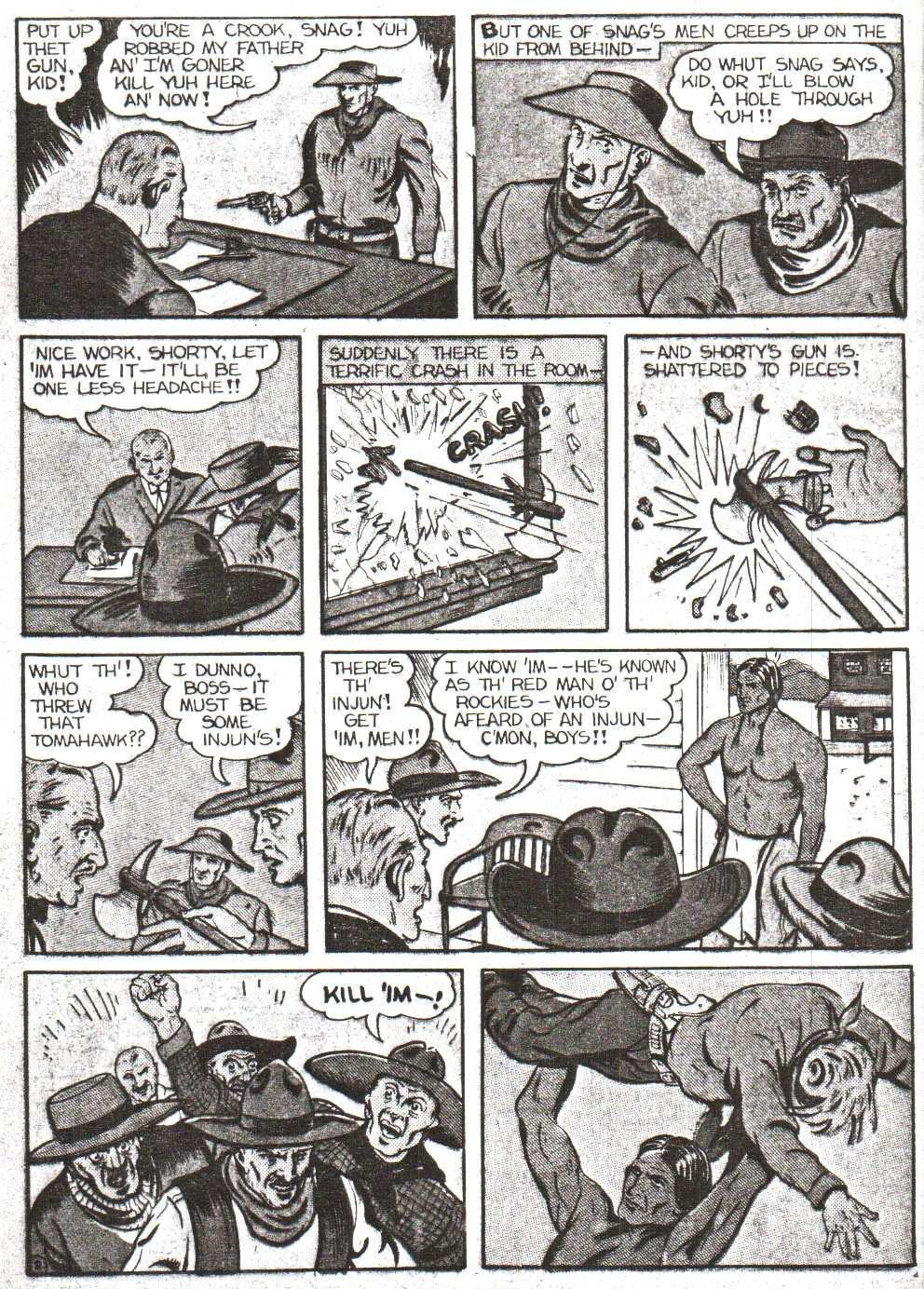
This is from Red Man of the Rockies. I'd wager this is the only time this character ever appeared anywhere, but he's a curious figure in comic book history. Like Big Chief Wahoo, this strip seems to be treating an Indian like a superhero just by virtue of him being an Indian -- but done in a serious adventure mood, more like Superman.
Actually, whether this particular Red Man is a fighter, mysteryman, or superhero, is the first subject of this post. Check out this first example, of Red Man being able to throw a tomahawk through a glass window and still hit its intended target. I would rule right away that a fighter couldn't do that, as a thrown tomahawk would lose too much energy in breaking the glass. Maybe Red Man could do that by burning a stunt, if he was a mysteryman. As a superhero, the Editor could ask him to wreck the glass as if it was a door in the same turn as the attack roll for the hatchet, needing both rolls to succeed for this to work.
We've looked at lots of panels like this first one before and asked the same question: is this a fighter's "combat machine" ability, or a superhero using the power Multi-Attack? If the former, then Red Man is at least a lieutenant (4th level fighter). If the latter, he's at least a great man (2nd level superhero -- or a good man, 1st level, in 2nd edition, as I'm going to let them get powers right away now).
I'm pretty sure I've already talked about taking a shot for someone else too. I'm still torn on how that mechanic should work -- if you're providing cover for the other target, or just automatically transferring the hit.
So what to make of this? Did Red Man heal him with a magic spell? Is the remedy some kind of trophy item (we never actually see how he did it)? Or did Red Man just let him get lots of rest, heal normally, and then try to take credit for it?
And what to make of that hearing hoofbeats the white man can't hear? One of them made his surprise roll and the other didn't? Red Man is using the Super-Senses power?
And how about this leaping? My first thought was, oh, this must be Leap I -- he's a superhero! But the gap also looks like it's maybe no more than 20', and that's doable for an athlete with a running start. I would require a fighter or mysteryman to make a skill check (used to be a save vs. science here) or misjudge the gap and miss, while a mysteryman could burn a stunt to automatically make the jump.
And that shooting through the rope and a man in the back with the same bullet? That's definitely an example of burning a stunt for the mysteryman class. So where does that leave us? Maybe he's a good man/charade man (1st level superhero/2nd level mysteryman -- and, yes, I do plan on using level titles more often in 2nd edition).
This is Lee Trent. I was impressed by the tactic of lassoing the chimney and then scaling up the wall by rope -- a tactic that you don't have to be a cowboy to use. The hole in the roof offers an unconventional means of entry into the hideout; Editors should always be prepared for unconventional entry. And, lastly, hiding out in the rafters should (and probably did) give Lee a good bonus to his surprise roll.
The Ermine is back. I believe I made a case, the last time, that The Ermine was an explorer (the optional class from The Trophy Case v. 1 no. 2), but here it's quite clear that The Ermine is supposed to be a superhero (though a low-level one, since doors are still giving him trouble).
The Ermine easily chases off two full-grown bears. While it might seem he did it too easily, bears and other animals don't necessarily have a reason to attack a human, unless some magic, hi-tech, or simply hunger was coercing them. So under normal circumstances, I might always give animals an encounter check and/or a morale save to see what they do.
This feature is Kid Centaur and, unlike Speed Centaur, everyone is a centaur in this strip -- which would make for a pretty weird H&H campaign.
No, I'm more interested in the trap here, where something metal on the ground that the Heroes would be tempted to pick up is secretly electrified.
(Scans courtesy of Digital Comic Museum)
An exploration of the Golden Age of Comics, through the lens of Hideouts & Hoodlums, the comic book roleplaying game.
Showing posts with label Lee Trent. Show all posts
Sunday, November 20, 2016
Friday, May 1, 2015
Star Ranger #1
A good playing tip: when searching a hideout, always count the toothbrushes in the bathroom. It will at least tell you how many mobsters inside have good hygiene.
Here's a serious thought -- should counterfeit money be considered trophy treasure, worth experience points? One could perhaps make an argument that Lawful Heroes could not benefit from counterfeit money, and that maybe only a Chaotic anti-Hero would actually knowingly use counterfeit money. A possible compromise position would be giving a Hero a good deed award (100 XP) for personally taking counterfeit money, of any amount, out of circulation.
I'm surprised it's taken this long for a comic book story to show cacti hurting people. I have trouble picturing a cactus as a mobster type, even though there are some dangerous plants (like creeper vines and man-eating trees) in Hideouts & Hoodlums. I think, like skunks, cacti should be treated as a trap component, like -- if the Heroes go over this fence, they find a row of catci growing on the other side and must save vs. plot or take 1d3 points of damage from landing on them.
It's also interesting that our cowpoke seems to be taking damage from bronco busting. That might actually make sense in a campaign with a light mood -- the cowboy takes 1d3 damage per turn of bronco busting until he gets a good reaction roll from the bronco.
I like the adventure of Lee Trent here quite a bit; it deviates from the normal cowboy story by upping the ante a little. As a blatantly modern day Western, the bad guys can use machine guns instead of rifles or pistols. Lee's "rocket pistol" is just a flare gun, but even that seems like a useful thing for a Hero to carry.
Although initiative in H&H can be left to a simple pair of dice rolls (with high roll going first), the rules encourage the Editor to consider other factors first, like who has a weapon already in hand. Only using a stunt like Quick Draw should Lee able to go first before a cowboy with a throwing knife already in hand, as he does here.
Now this is really interesting, from a H&H perspective. Could the game be used for an animal-only campaign? Lobo is a Fighter, gaining XP by taking on bears...
...and besides combat, there's the threat of hunters' traps, and protecting your pack from them. I do think there's the potential here for at least a short campaign. Any volunteers out there willing to try running one?
Here's an unusual premise -- the Hero is a Scientist with a gold-detecting machine. Now there's a plot-generating device!
Sorry -- spoilers! -- the Scientist turns out to be a Fighter pretending to be a Scientist, disguising his wireless radio as a gold-detector. The lesson here is that non-standard Heroes can still be built using class-based game mechanics, so long as the Hero just "dresses up" in the tropes of another class using flavor text.
(Scans courtesy of Digital Comic Museum)
Here's a serious thought -- should counterfeit money be considered trophy treasure, worth experience points? One could perhaps make an argument that Lawful Heroes could not benefit from counterfeit money, and that maybe only a Chaotic anti-Hero would actually knowingly use counterfeit money. A possible compromise position would be giving a Hero a good deed award (100 XP) for personally taking counterfeit money, of any amount, out of circulation.
I'm surprised it's taken this long for a comic book story to show cacti hurting people. I have trouble picturing a cactus as a mobster type, even though there are some dangerous plants (like creeper vines and man-eating trees) in Hideouts & Hoodlums. I think, like skunks, cacti should be treated as a trap component, like -- if the Heroes go over this fence, they find a row of catci growing on the other side and must save vs. plot or take 1d3 points of damage from landing on them.
It's also interesting that our cowpoke seems to be taking damage from bronco busting. That might actually make sense in a campaign with a light mood -- the cowboy takes 1d3 damage per turn of bronco busting until he gets a good reaction roll from the bronco.
I like the adventure of Lee Trent here quite a bit; it deviates from the normal cowboy story by upping the ante a little. As a blatantly modern day Western, the bad guys can use machine guns instead of rifles or pistols. Lee's "rocket pistol" is just a flare gun, but even that seems like a useful thing for a Hero to carry.
Although initiative in H&H can be left to a simple pair of dice rolls (with high roll going first), the rules encourage the Editor to consider other factors first, like who has a weapon already in hand. Only using a stunt like Quick Draw should Lee able to go first before a cowboy with a throwing knife already in hand, as he does here.
Now this is really interesting, from a H&H perspective. Could the game be used for an animal-only campaign? Lobo is a Fighter, gaining XP by taking on bears...
...and besides combat, there's the threat of hunters' traps, and protecting your pack from them. I do think there's the potential here for at least a short campaign. Any volunteers out there willing to try running one?
Here's an unusual premise -- the Hero is a Scientist with a gold-detecting machine. Now there's a plot-generating device!
Sorry -- spoilers! -- the Scientist turns out to be a Fighter pretending to be a Scientist, disguising his wireless radio as a gold-detector. The lesson here is that non-standard Heroes can still be built using class-based game mechanics, so long as the Hero just "dresses up" in the tropes of another class using flavor text.
(Scans courtesy of Digital Comic Museum)
Subscribe to:
Posts (Atom)


