Showing posts with label Editor's tips. Show all posts

Monday, February 7, 2022

Fantastic Comics #5 - pt. 2

We're back for round 2 of Samson vs. Eelo! Although he doesn't look like your "traditional" merman, I'd already decided last time I would stat Eelo as a merman. So panel 1 is either proof that mermen have great swimming movement rate, or this is the first clue that Eelo is actually a supervillain buffed with the Race the Train power.

I've seen some interesting rayguns in golden age comic books, but an underseas gun is a new one. A heat ray shoots heat. What is this one shooting out? Underseas? Is it just a water pistol?

That is some significant wrecking going on there. A submarine weighs a couple of thousand tons, so we're talking battleship category. 

But a hero shouldn't have to do everything; eventually moping up the enemies gets to be rote, or antic-climactic. It's good, then, to have the "cavalry" come in and mop up the remainder, or the remaining sub in this case.


I like most of this page. Samson, stoically guarding the two reunited lovers...Eelo, almost heroically, pulling himself up for one more contest with Samson (Eelo must be a supervillain with a few more powers at his disposal, to think he has a chance here)...

And then Samson just hits him and kills him. Ugh. Death-Dealing Blow needs to be its own power. It would be more powerful than Super Punch because Super Punch just does a bunch of damage to knock out virtually any foe, whereas Death-Dealing Blow must make you save vs. plot or die. So, a level 5 power? Maybe level 6? At this point, Samson only should have enough XP to reach 2nd level, so he's either been gifted more brevet ranks, or he's had more all this time and was actually holding back.

Like with ultra-powerful magic-users in the comics, one could ask me, Scott, if superheroes are this powerful, then don't you need more power inflation in even the early levels for Hideouts & Hoodlums? Good question, random stranger, but two explanations for this: 1) the superhero class is based on the first year of Superman stories, before all this power inflation happens, and 2) there are certainly elements I don't want to emulate about the early comic books because I just don't like them. These include done-in-one-blow fights and grossly overpowered heroes.

"Mercury is getting closer to the Sun every year. Eventually it will be destroyed by the - ah, I'm just kiddin'. Mercury is in a stable orbit and is gonna outlast both of us, baby." Apparently Flip just likes to periodically test how gullible Adele is.

Now I'm being flip, but this science is so bad it actually makes me mad that anyone would write it in a book children would be reading. What if they repeated this nonsense in class?


You know...you'd think someone brilliant enough to invent a fourth-dimensional projector would figure out a way to put two separate seats into it. I suspect Flip just uses this as an excuse to get all hands-on with Adele.

I don't even know what I'm looking at with those aliens. Are they giant pigeon angels with halos? Are those beanie copters?


Darn, I was just getting excited about statting Mercurian pigeon angels, but those are just thought-wave helmets. 

Whoa, I thought the misogyny in this issue was just going to be subtle, but this just got way over the top. Not cool, giant pigeon angle impersonators! But what do we think about Flip now? Is he off the hook for sparing her feelings, or should he be honest and tell her that the aliens are women-bashing in front of her? 

A thought about the architecture: at first these look like Earth skyscrapers, but if the natives are birds...what if these "buildings" are actually solid perches for the natives to roost on top of?

Nice...looks like I'm getting something cool for the Mobster Manual after all out of this issue. Heidites are D&D basilisk-like monsters, but instead of having a petrifying gaze attack, they exude green slime from their skin! From a D&D context, this potentially makes them even more dangerous than basilisks. 

Heck, I'm so excited, I just added it into the manuscript now! *sigh* Now to fix all the layout of the book after it...
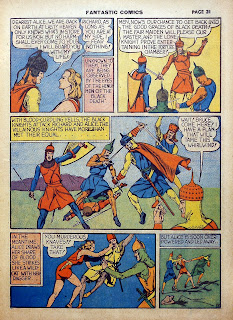


Jumping ahead to Golden Knight, we have a lot of people in chainmail here. Except the girl, of course, who is for some reason in a 20th century bathing suit instead of even a dress. The chainmail is AC 5, but it exists almost as flavor text -- if you hit the target, you can stab right through the chainmail as if isn't there.


I had commented recently on a Facebook post about monster tactics in D&D that the DM has to have some latitude for deciding how advantageous to make those tactics, that the Editor had to stop short of making them so advantageous that the players will switch to the same tactics.

Here, we see entangling with nets giving great advantage. The Golden Knight, despite having a sword in hand, can apparently not cut his way out, or stab through the nets. Now, if this is simply a failed saving throw, and the player knows it, maybe this won't become his next character's main tactic. But if nets work like this every time? Then he will, and he'll expect it to always work for him too, and should. 

Other than that, what bothers me most about this page? The spaghetti straps on The Golden Knight's tabard? The Gothic style of the castle in medieval times? The fact that the castle is brightly painted all over? Okay, it's actually all three.

(Scans courtesy of Digital Comic Museum.) 


Tuesday, July 28, 2020

Science Comics #2 - pt. 2

We're still on Dynamo's story and, if you remember where we left off, Dynamo had just palmed off the entire scenario onto the FBI -- and now they drop it back in his lap where it belonged. There are arguments in gaming circles from both sides on the fudging issue. Is it right for the referee/Dungeon Master/Editor to fudge dice rolls, even if it's just to nudge the story along? Normally I would urge an Editor to fudge rolls sparingly, but when you need people to fail search results just so your player will go back and try, I think the fudging is worth it.
Here's a peculiar power. It looks like Dynamo has cast the magic-user spell version of Hold Person, but in addition, the victim is moved across the room as if under a Telekinesis spell. On one hand, the placement of the victim seems unimportant enough, in this instance, that it could just be flavor text. On the other hand, I could see a more powerful version of Hold Person that let's you choose where the victim is held at could be even more useful, like if you positioned the victim to block a doorway.
Speaking of more powerful versions of Magic-User spells...it seems like Dynamo is using the spell Shocking Grasp here, only he can use it more than once per spell.

Hoodlums almost never feel confident enough to make fun of the heroes in Golden Age comics, but here we have an unusual instance of a hoodlum making up a clever nickname for the hero.
Wow, okay, way to rub their failure in the G-Men's faces, Dynamo! But...you do know that you likely just killed all those bad guys you're turning in, right? I mean, if being immersed in molten gold didn't burn them to death, they must have quickly suffocated...
Now we're on Cosmic Carson. Here we have a twist on the "ray that freezes your motor" -- the ray that literally freezes your whole ship -- and I think we've seen this twist only once before (always in sci-fi stories).

We don't know how much time passes between panels 5 and 6, but it seems like Carson has just arrived at the planet and immediately spots the lost rocket. Unless he's locked onto a transponder signal or some such, there's no way it should be possible to visually inspect a planet in less than weeks.

Also curious is that Carson's rocket gets much closer to the planet before being detected than the first ship. Are the aliens relying on visual detection too?
Thermo-rays look an awful lot like acetylene torches. In future settings, you can rename ordinary objects and make them seem futuristic.

It's interesting how they capture Carson, but just leave him trapped for hours, as if the aliens got too busy and didn't have time to take care of him.


Late in the story, we're finally told that the aliens are skull-men. They don't seem to be native to this world, since we only ever see four of them. They must be pretty good in a fight, since it only takes three of them to capture Carson. I'd say they have at least 1+1 Hit Dice.


This is likely the earliest reference to Popeye in a comic book not to feature him. Popeye has been getting stronger by eating spinach since mid-1931.
Clever strategy for convincing the bad guys to destroy their own weapons, but most Heroes simply capture the raygun and turn it against the enemy. Instead, Carson is content to fight with his fists, and the prisoners he rescued have to use clubs.

The reference to skull-men being weak doesn't jive with how they took down Carson earlier.

"No one will miss them, so it's okay that we killed them! Besides, they were weak!"

Hey, Carson, you're free now -- you can put a shirt back on!

(Scans courtesy of Digital Comic Museum.)

Saturday, July 25, 2020

Science Comics #2 - pt. 1

Now we come back around to Fox Comics and what was surely their weakest anthology, Science Comics. One look at the Eagle and his comical get-up that makes his antecedent, Black Condor, look positively conservative in comparison should tell you all you need to know about what I think about Science Comics. That said, we can always glean something useful from even the worst of comic stories.

Like on this page, we have a television able to view distant images without any camera in that location. It seems like a lot of heroes and villains have invented these, as impossible as they are (at least until we have Star Trek-level technology), and yet...what if there was a mysterious seller of these items, targeting specific recipients? A time traveler, perhaps? What starts out as just bad science could wind up being an intriguing plot hook!


Don't forget to roll for wandering encounter checks, even if just traveling between points A and B. No need to get them to B too quickly (unless you really don't want that scenario to run more than one session).
It shouldn't be hard to spot what the pilot does wrong here. Had he simply left his cockpit shut, the Eagle would have been powerless to do anything but stand on his wing. The pilot could have gone into a roll, to smack the Eagle with the wing. Or tried to slow down and turn so that the propellers come back and tear him apart.
Sometimes a player is just going to do something really stupid, like dive-bomb the bad guys in clear daylight from a great distance. Then, as Editor of the game, it's up to you to decide -- do you let his hero suffer the consequences and have the mobsters be armed? Or do you let him off easy and say not one of them has a weapon?
Nice bold font on that title!

The unnamed fort where the gold is kept is almost surely Fort Knox.
Now we go from a hero who doesn't wear enough clothing to one who wears too much.

This is also the most elaborate "flavor text" to go along with searching for secret doors I've ever seen. I like behind that giant block is just a little recessed space with an exposed lock.
That's a really long tunnel; I believe the closest stone quarry to Fort Knox is 41 miles away (where Quarry Road is). This is why authors like to use fictitious sites in their stories, so guys like me can't look this stuff up and fact check them.
Traveling on a beam of light is some funky science, but something that is fast becoming a trope in the superhero genre (Steel Sterling rides electromagnetism as well through the air). The important thing is that your flavor text for explaining how your powers work doesn't have to make a lot of sense.

There seems to be a plot inconsistency between pages; in the last page we learned that the gold was being broken into nuggets to conceal in with the quarried stone, but on this page the gold is still in ingot form.
This strikes me as really weird, that a Hero would find out where the villains' hideout is, but then send the authorities to handle the villains instead. I could see, if the player was meta-gaming, and thought the hideout was going to be too tough for him alone to handle, that he would recruit some federal men to come with him. But to then not come with them...?

(Scans courtesy of Digital Comic Museum.)

Monday, July 20, 2020

Champion Comics #5 - pt. 3

Before we quit this issue of Champion Comics and move on, let's visit one last feature. The Adventures of Bill Handy is yet another Terry and the Pirates clone, with the Asian sidekick replaced with a black sidekick.

I had to double check, but there is no country called Palay. It appears to be in the West Indies.

"Wanga," amazingly is a real thing (and I was sure that was the fake one!). It's a magical charm packet found in Haiti, so that explains which country "Palay" really is.
Putting a machine gun nest may have seemed like a really good idea while stocking the castle, and it's definitely a good defensive position that can attack the Heroes at various locations, so long as they're out in the open. The problem is what happens when the Heroes get their hands on that machine gun and that position, and can essentially take over the whole castle at that point. The lesson: don't leave trophy weapons sitting out where Heroes can find them unless you want them to have them.
It's a castle with dungeons! I wish we'd seen more of this place.

Smashing the radio room may seem an odd extra step. Bill must not be certain the dungeon will hold his prisoners.

I wish we got to see the other side of that map where the good stuff is! A map that shows the location of a new hideout is as good as a treasure map.


If you don't look closely at that last panel you'll miss their strategy. Bill pounds on the side of the tower. The Nazi climbs up the tower. At the top, Marco surprises the Nazi and takes him prisoner. I would expect this to work once, maybe twice, before the crew below gets wise and takes other actions. A wiser course of action would just be taking the sub down and making the good guys tread water. 
A wisecracking player might say, "Gee, what good is someone else's medal gonna do me?", but a smart player would know that medals are rewards and rewards are worth XP!

(Scans courtesy of Comic Book Plus.)

Monday, July 6, 2020

Crackajack Funnies #21 - pt. 3

I had a page of Boots I wanted to share, but for some reason I couldn't download it. Anyway, the joke at the end was that a cab fare was $25 and change, which was a surprisingly large amount to the character told that, but not out of the realm of the possible. I'll have to remember not to treat cab rides as freebies in my next campaign!

Here's a rare instance of Our Boarding House turning up here, and again it's to remind me of prices. $2 for moving men is reasonable, $5 seems a rip-off. Storage houses make house calls. You reading this, Public Storage? It's also worth remembering that, despite how cheap everything seems to us today in 1940 prices, they still expected quality from their merchandise.

 It should shock no one that the Iconi Indian tribe is made-up.

42' is really impressive for an anaconda, which usually top out at 30' long.

According to Wikipedia, "the large South American characins of the family Erythrinidae have also sometimes been called 'tigerfish'," but most tigerfish are found in Africa.

Poisonous reptiles has got to refer to snakes. There are pit vipers in the Amazon and...and...oh heck, there are plenty of sites you can look at yourself for this information, but I'm not looking at more pictures of real snakes to share them with you.

It's unclear if the crocodiles capsized the boat or simply took advantage of an accident.

One can't deny that swinging from vines, ropes, etc. into a battle is very cinematic. But is there any real advantage to it? He gains some momentum in the swing, but he also loses his ability to accurately target his kicks, while needing to maintain his balance and hold on the vine/rope/etc. at the same time.

If I had a precedent of using ability score checks in my campaign, I would ask for a STR and a DEX check, and only both are successful would I give a +1 to damage for the swing-kick.
From the outside of the fence, we can't tell if that is a professional hockey game, but 50 cents seems awful high for a non-professional game in 1940. The question then becomes, which hockey league is this? The Pro Hockey League was the earliest of its kind, started in Michigan in 1904. The National Hockey League, the one that's still around, began in Canada in 1917 but quickly spread to the United States. I suppose it depends on where Freckles takes place, but I don't think we've ever been given a clue. Heck, I don't even have a clue, after all these years, what that circle is in the middle of Freckle's face. A parrot beak?

But the real reason I shared this page is for the detector. I don't know if that's a real thing like the others, but it seems like it would be a really useful trophy item for mobsters to have, able to detect cars or planes approaching their hideout.
Dan Dunn gives us a detailed schematic of how to make your own buoy and use it to surreptitously drop off packages.
And here's a useful clue that you're dealing with a spy -- portable radios with inoperative tuning dials, so they can always pick up secret wave lengths.

(Scans courtesy of Digital Comic Museum.)

Thursday, July 2, 2020

Crackajack Funnies #21 - pt. 2

We're still looking at Wash Tubbs and, boy, there's an unsettling mix of realistic and cartoony violence in there -- which is actually pretty much my Editing style when running Hideouts & Hoodlums.

There are some interesting things going on here and on the previous page. From the previous page (I'll just summarize it for you), Frankie Slaughter beats up one of Wash's employees just to intimidate everyone present into not telling the police he was ever there.

Slaughter tries all the angles to get what he wants, as low as beating Wash half to death and threatening to do the same to his girlfriend. But he makes the mistake of trusting Wash is frightened enough to comply and doesn't send one of his boys with Wash to the bank.

Frankie Slaughter is a great villain name.

Wash, for his part, threatens Frankie with a gun (on the page I didn't share), but I was relieved to find out it wasn't loaded. Keeping the lease at the bank was very smart on his part.

Speaking of smart, Frankie again shows good tactics, trying to trick Wash into unloading the lease to a stranger, and then establishing an alibi (and having a secret exit from locations that aren't even his hideout!).
Red Ryder is knocked unconscious by the explosion. In D&D, when a PC wakes up, they can immediately get up and rejoin the battle with no ill effects (other than maybe still functioning at reduced hp). Here, Red is stunned for at least 1 turn after waking up; a more gradual transition to being fight-ready and something I'm considering adding as an optional rule now.
I'm normally far from a gun advocate, but if Red was looking to finish this fight most effectively, I think he would have gone with his gun rather than throwing sand in Carr's face. Apparently the sand gives him such an advantage that he easily wins the fight off-panel, so maybe I'm wrong? Let's review; how I would handle this is an attack roll, ignoring any armor but not DEX bonus or cover, then a saving throw vs science from the target. Failure means temporarily blinded and at a -4 to hit penalty for the next 1-4 turns. So, I guess that's a pretty good advantage, but not a sure win.
This has to be the most verbose feature I've reviewed yet for this blog, and I'm not even showing you the pages that are almost solid text. It's not really that complex a plot, but the author seems to think it is.

A monogrammed lace handkerchief and the smell of perfume are good clues, but the knife in the back is the best one of all and they don't even talk about it.
Noticing that someone else has the same initials is not a clue I would normally make someone roll for, expecting the players to catch it themselves. The smell of the perfume the players could not tell on their own, so for that I might allow an Intelligence check to recall it smelling the same; I don't see that being a skill, unless we treat perfume identification as a skill. There is generally a lower chance to make a skill check than an ability score check, so I guess it depends on how hard you think recognizing the perfume should be.


The Scarlet is an unusual name for a villain for two reasons: one, Scarlet isn't a noun, and two, you normally associate Scarlet with a female.

A fountain pen that shoots out stunning gas that can affect 1-2 people is a handy minor trophy item.

Smashing a window seems an unusual signal. What if The Scarlet had used bulletproof glass in his windows?

Complicating the story was the fact that Dorn's sister provided Ed with wrong information, and Dorn was purposely feeding people false stories to throw them off. Players need to be reminded sometimes that they can't trust all the information they receive in-character.

I'm not sure, but I suspect that "200 suspected cases of espionage a day" was just a guess and not a fact I could look
up and verify.

I never thought we'd be looking at Apple Mary again for adventure ideas, but a $5,000 reward to search for a missing item is a plot hook worthy of a fun treasure hunt.
From this page we learn that psychics charged $5, and a book can sell for as little as 50 cents (maybe from a used book store?).

(Scans courtesy of Digital Comic Museum.)

Tuesday, June 9, 2020

Action Comics #22 - pt. 2

Clip Carson is on a steamship heading from Algiers to South America (two issues earlier, Clip was a guard on an ivory caravan in Africa, so this makes sense). When he sees a man clubbed and shoved overboard, Clip selflessly dives into the water instead of waiting for the ship's crew to point some searchlights into the water first. Searching in the dark would have been at a large penalty, perhaps dropping Clip's chance of finding the sinking man to 1 in 8.

The man, Clip later finds out, was marked for death by having bought an ivory statue crudely depicting an elephant. A cult allegedly worships this as an idol and anyone who touches it is marked for death. Clip is told this marks him too, even though he only reaches for the idol, he never actually touches it. The idol story would make more sense if it was bought in India instead of Africa, then this would be a statuette of Ganesha. A cultist makes an attempt on Clip's life, throwing a dagger through a porthole. Not only would this be a tricky shot, but Clip remarkably makes no effort to go after the dagger-thrower, despite the fact the would-be assassin must have been dangling precariously over the side of the ship.

The first suspect is an anthropologist onboard. The anthropologist correctly points out to Clip that the owner's story doesn't hold up; that there is no elephant god in Africa, but Clip doesn't believe him because the man gets so huffy with him. Remember, when running Hideouts & Hoodlums, to be in-character when giving out information; players need to know that info is coming from a character who may or may not be correct, or honest, and not straight from the Editor.

Clip goes to the radio room and asks the attendant to "burn up the ether with this message." It's a curious phrase and one I was surprised to see still gets used today! The earliest use of it I can find is a 1927 book called The Story of Radio. Apparently, there was once a serious concern that the atmosphere might be able to hold only so many radio waves at a time, and the proliferation of radio was actually a danger -- that it would literally set the ether on fire. Even though Einstein's theory of special relativity made the theory of ether obsolete in 1905, the idea stuck around, particularly in its association with radio waves.

The person Clip sent the radio message to is one of his supporting cast we've never met before, a newspaper editor.

"Tex" Thomson's adventure starts with a lengthy prologue in the Indian Ocean. An explorer is warned not to go to an unnamed island because of the demons there. On the island, he meets an old man who claims to have stolen his soul and begins to slowly transform into the explorer, Cary James. The demon's transformation takes two days to accomplish, at the end of which time Cary will be dead. During that time, Cary remembers he had been given a locket to protect him from the demons. Incredibly, for no reason other than to further the plot, Cary puts the locket in a bottle with a note for a friend instead of using the locket.

Later, in NYC, we learn that Cary's friend is also friends with Tex. The demon, impersonating Cary, is there in NYC too. The demon is looking for the locket, because the locket and the letter both made it to Dr. Drummond in NYC, who just happens to be the friend Tex is staying with. The letter explains that touching the locket to the demon's forehead will destroy it. Tex isn't even the one who does it; it's Dr. Drummond, the true hero of this story.

Although called a demon in this story, this monster sounds more like a doppelganger. Perhaps this is a more powerful version that we can call a demon doppelganger. The touch of the locket makes it revert momentarily to its previous form before turning to ash.

Zatara is at the "El Storko Club," dining alone. This is clearly a stand-in for the Stork Club, the famous Manhattan nightclub, one of the most prestigious in the world at that time. Zatara spies The Tigress before she spies him, (he has surprise) so he turns himself invisible to watch her. The Tigress slips something into a banker's drink. Interestingly, Zatara doesn't cast something like Purify Food & Drink or Neutralize Poison, but a spell that "glues" the man's glass to the table. I have no spell like that in H&H. It seems to be a spell of such limited utility that I hesitate to make one, unless it can make objects much larger than a glass immobile. In that case, Immobilize Object might be a 1st or even 2nd level spell, depending on the weight limit affected and its duration.

As the banker and Zatara leave together, Zatara spots a safe about to land on the man beside him. Zatara makes the safe blow away -- probably with Telekinesis rather than Gust of Wind. Safes are heavy though, but Zatara has a lot of brevet ranks, so maybe he's high enough in level to move 800 lbs.? That would make him...oh. 40th level. There either needs to be a Greater Telekinesis power, or Telekinesis -- already a 5th level power -- needs a lot of tweaking.

Zatara has no spell for analyzing poison; he takes the drink from the Stork Club to a chemist for analysis (luckily it's not contact poison because it's surely been sloshing around and spilling on his hand by now). Zatara casts a spell that is very much like Word of Recall, but it doesn't have to be Zatara's home, it can take him to anyone else's home who travels with him. Zatara casts a Wall of Glass spell around the man's home. I'll make that a 4th-level spell; it's still pretty effective, since the glass is about 5' thick. Then he casts Passwall to go through the Wall without just flying over it. After all these powerful spells, it's remarkable to see Zatara cast a 1st-level Disguise spell to make himself look like the banker. Then he casts the 8th-level Polymorph Any Object spell to turn an ordinary paper check into a living snake.

Zatara turns down a $100,000 reward for saving the banker. With as many brevet ranks as he has, Zatara's player has apparently given up on ever leveling his was past them.

The man who hired the Tigress to kill the banker is a bad guy called the Mask. Like the Tigress, he has no powers; he just pays a plastic surgeon to make him look like people. Zatara must be famous enough that the surgeon knows exactly what he looks like (or the Mask had a lot of photos taken between panels). Having failed to kill the banker, the Mask impersonates Zatara and asks for that reward money -- which is a pretty good Plan B, I have to say.

If using Telekinesis on a safe was too much, Zatara next uses it on a car that must weigh a ton. Telekinesis definitely needs improving in the rules. Zatara uses Polymorph Other on the Mask to make his face ugly (even taking away one of his eyes to be extra mean). Zatara even goes after the plastic surgeon, putting a curse on him so he can never perform surgery again. Again he lets the Tigress go free, since he has the hots for her.

So, to summarize, we know Zatara has somewhere between 18 and 100 levels in Magic-User.

(Read at readcomiconline.to)


Friday, May 8, 2020

Smash Comics #8 - pt. 2

I don't care for any other features in Smash Comics as much as Espionage, but that doesn't mean we can't glean anything useful from them. Let's start with Abdul the Arab, our "hero"/traitor to his people, who helps the British steal his nation's oil...

We always pause to examine maps. Kuwait is not drawn by accident inside Iraq's borders; Kuwait had been annexed back into Iraq in 1938. Riyadh is the capital of Saudi Arabia.


This is an unusual scenario for a RPG, since it can't be solved by violence. Abdul has to prove Holden is stealing Rice's oil (in a Western setting, you could substitute cows for oil and run the same scenario) by getting a confession or finding the hidden pipeline, and by diving the work between himself and his sidekick, he gets both.


I can't verify that there is such a thing as a Cambridge Arsenal, let alone one holding 20,000 tons of high explosives. That seems like a really dangerous building to put that close to London.

Transatlantic flights did not fly every day in 1940, which can delay a scenario that takes place across the ocean. 


Here's an image of what appears to be a briefcase-sized short wave radio. 1940 Heroes can't easily carry these on them, but if they keep them in their cars they can split up and still communicate.


Heroes can often be notoriously hard to trap when they travel overly cautious, with all their gear and trophy items with them. The trick, then, is to get them to lower their guard and feel safe. Trap them while they don't yet know they've reached the hideout.


Yeah...that is one unconvincing ghost, what with his legs sticking out under the sheet. I know I've always said disguise needs to be really easy in comic books, but I might give the mobsters a +2 bonus to their saves vs. plot to see through this one.
We're going to skip ahead into the Hugh Hazard and His Iron Man adventure that follows. All the backstory you need to know here is that the Batzis are Nazis, Hugh knows they are responsible for sabotage here in the U.S., and he figured out they are keeping in touch via radio. He lucks onto their short wave -- I can't see that being a skill check; perhaps he just has a random 1 in 6 chance of catching one of their messages per rest turn, like a wandering encounter on the radio.

Now, I don't exactly get how this works, but if you connect a super-seper iconoscope to a teleradio, you can get a visual image of the person speaking, even if that person was only recorded with sound. Who knew?

"Krautville" sounds like a racist name for any town with a large German population in it...
Bozo has the Dig power, so that means he functions as at least a 6th-level superhero. And yet...we are treated to Bozo using the "Look behind you!" trick like a grade school prankster. I would say it's amazing that the old guy doesn't hear the propeller right over his head and know that Bozo is still there, only...well, then we also have to overlook that this tiny propeller can make a large robot fly.  I guess you could give the guy a save vs. plot to see if he falls for it or not, but I think a +4 bonus seems reasonable too.
This page kind of undersells this tactic, but a time-tested method of keeping the Hero from capturing the villain until later in the scenario is to have something happen that the Hero has to leave right now to stop. A Lawful or Neutral Hero should then have to save vs. plot to stay and defeat the villain early (maybe Chaotic too, depending on how much is at stake).

(Scans courtesy of Digital Comic Museum.)